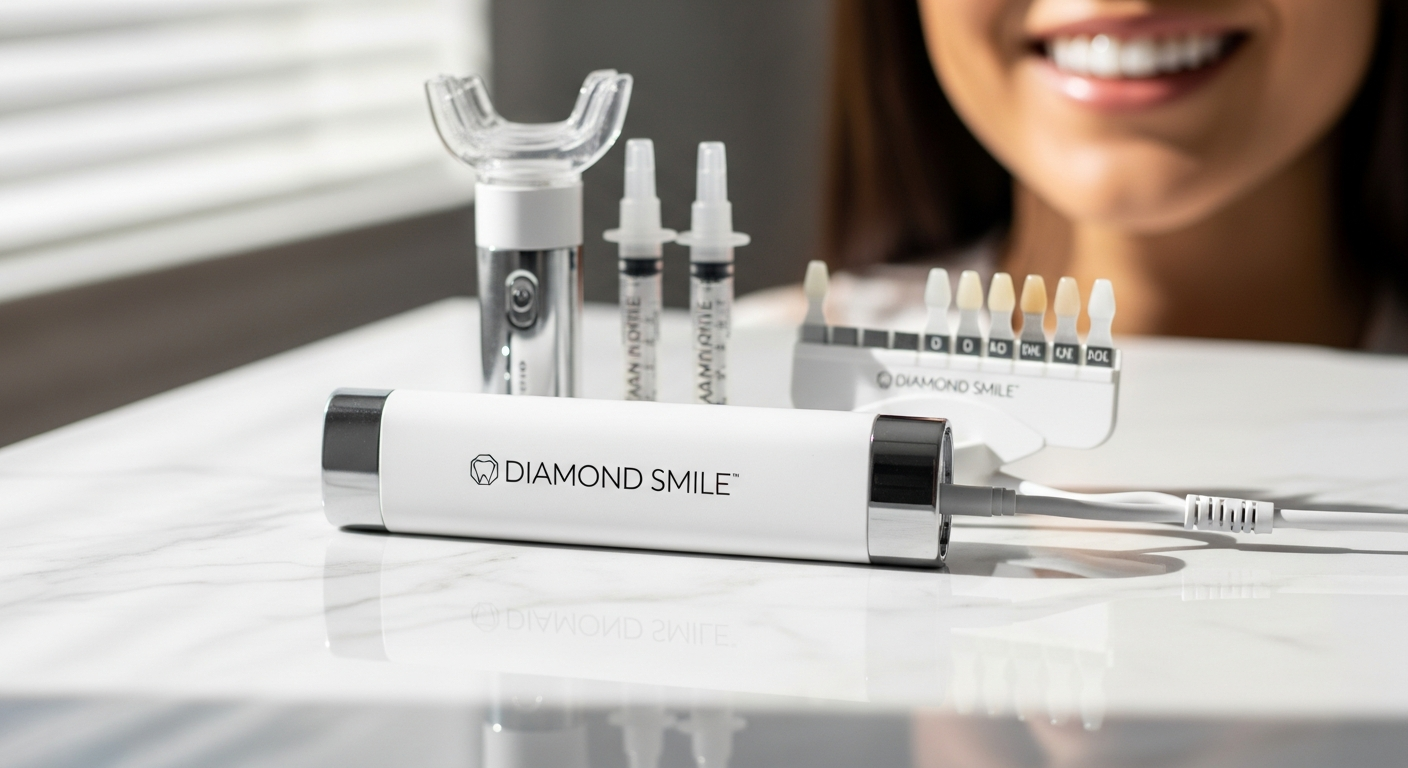
A bright smile shapes how the world sees you. Over 73% of people believe a whiter smile significantly impacts their confidence and professional appearance—yet most avoid professional whitening due to the €500+ price tag and time commitment. The Diamond Smile Premium Teeth Whitening Kit promises to bridge that gap, delivering visible results in just 10 minutes from your bathroom.
But does this bestselling at-home whitening solution actually deliver, or are you buying into clever marketing? I've researched countless teeth whitening products, and I've noticed a troubling pattern: brands make bold claims, but customer experiences tell a different story. The Diamond Smile kit has exploded in popularity across Europe, particularly in the Netherlands, with its 16 blue LED lights and PAP+ whitening gel. What's less talked about are the delivery delays, customer service complaints, and inconsistent results that plague some users.
This matters because you're investing your money and time into a product that should work reliably. You'll learn how the technology genuinely works, which users see real results and which ones don't, the legitimate concerns about customer service, and whether the money-back guarantee actually protects you. By the end, you'll have the complete picture—not just the marketing narrative.
Discover the Diamond Smile Premium Teeth Whitening Kit and see if it's right for you.
How the Diamond Smile LED Whitening System Actually Works
The 16 blue LED light mechanism: Understanding wavelength activation
The core technology behind Diamond Smile relies on 16 blue LED lights designed to activate the whitening gel compounds. Blue light operates at a wavelength of approximately 460-490 nanometers, which penetrates the tooth structure and interacts with the whitening agents applied to your teeth. The theory is straightforward: the LED energy accelerates the chemical breakdown of chromogenic molecules—the compounds responsible for tooth discoloration. However, the actual scientific evidence supporting LED-accelerated whitening is mixed. Some studies suggest blue light provides minimal acceleration beyond what the whitening gel alone achieves, while others indicate moderate effectiveness. The portable design makes the device convenient, but its effectiveness depends heavily on consistent contact between the LED lights and all tooth surfaces.
Whitening gel chemistry breakdown
The Diamond Smile kit uses whitening gels containing one of three primary active ingredients: hydrogen peroxide, carbamide peroxide, or PAP+ (Phthalimidoperoxycaproic Acid). Hydrogen peroxide is the most aggressive and fastest-acting, breaking down stains through oxidation. Carbamide peroxide works similarly but more gradually, making it gentler for sensitive teeth. PAP+, Diamond Smile's marketed ingredient, is designed to deliver whitening without the sensitivity issues associated with peroxide-based formulas. PAP+ theoretically breaks down stains while neutralizing compounds that cause sensitivity. In practice, many users with sensitive teeth report positive experiences, though others still experience discomfort. The concentration of these ingredients matters significantly—higher concentrations whiten faster but increase sensitivity risk. Diamond Smile doesn't transparently disclose exact concentrations, which makes independent verification difficult.
The 10-minute session claim: What happens during activation
Diamond Smile markets 10-minute sessions as sufficient for noticeable results. During this timeframe, the whitening gel makes contact with tooth enamel while the LED lights activate. Realistic expectations matter here. Surface stains—caused by coffee, red wine, or tobacco—typically show visible lightening within a few applications. Deep discoloration or intrinsic staining (discoloration inside the tooth structure) requires more sessions and may not respond dramatically to at-home treatments. Users frequently report noticeable improvement after 3-5 applications, with cumulative results becoming apparent after 10-15 sessions. The speed depends entirely on your starting shade and stain type. Someone with mild surface yellowing will see faster results than someone with decade-old internal staining.
Mouth tray design and fit
The mouth tray included in the kit determines how effectively the gel contacts your teeth. A properly fitted tray ensures even gel distribution across all visible tooth surfaces. Diamond Smile's tray design is straightforward—a one-size-fits-most thermoplastic material that softens in warm water for basic customization. However, "one-size-fits-most" doesn't mean perfect fit for everyone. Users with irregular tooth spacing, crowns, or significant bite variation sometimes struggle with full coverage. Incomplete contact means incomplete whitening, resulting in patchy results. The instruction manual addresses fitting basics, but this is where the "no special knowledge required" claim occasionally breaks down. Taking time to properly mold and fit the tray significantly impacts outcomes.
USB charging capability
The portable LED device charges via USB cable, a practical feature for at-home use. A single charge typically supports 5-10 sessions before requiring recharge, depending on the LED power draw. Battery life is respectable for casual use but means frequent charging if you're doing daily applications. The USB charging approach is convenient—you can charge via computer, wall adapter, or power bank. No proprietary charging dock is required, which reduces long-term dependency on the brand. Portability is genuinely improved compared to some competing kits, allowing you to whiten at your desk, while traveling, or during your evening routine.
Flavored gel options
Diamond Smile offers flavored gel variants, typically mint or similar options, to improve the taste experience during application. The flavoring makes sessions more pleasant, but it doesn't affect whitening efficacy. Active ingredients work the same regardless of flavor. This is a nice-to-have feature rather than a functional improvement, though reducing the unpleasant taste does make users more likely to complete full treatment cycles consistently.
Who Actually Gets Results—And Who Doesn't
Realistic timeline for visible whitening
Results don't appear instantly. First application produces minimal visible change because the whitening compound needs multiple exposures to break down enough stain molecules. Most users notice subtle lightening by application three or four. Cumulative effects become obvious after 10-15 sessions. Your timeline depends on stain severity. Mild surface discoloration whitens noticeably within a week of daily use. Moderate staining requires 2-3 weeks. Severe or intrinsic staining may plateau before reaching your desired shade, regardless of session count. Setting realistic expectations from day one prevents disappointment.
Best candidates for this kit
This kit works best for people with surface-level stains caused by lifestyle factors—regular coffee consumption, red wine, smoking, or tea habits. Candidates should have relatively healthy tooth enamel without significant erosion. Existing tooth shade matters. If your natural shade is very dark or you have intrinsic staining from medications like tetracycline, results will be less dramatic than someone with naturally lighter teeth. People committed to maintenance—reducing staining foods and drinks after whitening—keep results longer. If you're expecting professional-grade whitening from an at-home product, you'll likely be disappointed regardless of the kit's quality.
Why some users report zero results
Some users genuinely don't experience visible whitening. The reasons vary. Intrinsic staining—discoloration inside the tooth structure caused by medication, aging, or fluorosis—doesn't respond well to surface whitening treatments. Existing dental work like crowns or veneers won't whiten, creating uneven results. Some users apply gel incorrectly, resulting in poor contact and minimal activation. Others have unrealistic expectations based on marketing photos, which often use careful lighting and post-processing. A small percentage report no results despite correct application, which may indicate their particular stain type requires professional-grade peroxide concentrations unavailable in consumer kits.
Sensitive teeth concerns
PAP+ theoretically minimizes sensitivity, and many users confirm this benefit. However, "some users with sensitive teeth report no issues" differs significantly from "works perfectly for all sensitive-tooth users." Individual sensitivity varies dramatically based on existing enamel condition and gum health. Pre-existing sensitivity often worsens with whitening treatment, regardless of formula gentleness. Users with healthy enamel and no baseline sensitivity typically experience no problems. Those with already-compromised teeth or receding gums sometimes encounter increased sensitivity or discomfort, even with PAP+. If you have existing sensitivity, using the kit cautiously—shorter sessions, longer intervals between use—reduces risk.
Enamel safety considerations
The whitening gel is genuinely safe for regular enamel when used as directed. The PAP+ formula was designed specifically to minimize enamel damage compared to traditional peroxide approaches. However, "gentler than alternatives" doesn't mean "risk-free." Overuse—running sessions longer than recommended or using more frequently than suggested—can gradually damage enamel. Long-term implications of frequent whitening remain under study, but current evidence suggests 10-15 minute sessions several times weekly poses minimal enamel risk for users with healthy baseline tooth structure. The dentist-approval claims deserve scrutiny; Diamond Smile markets this as dentist-developed and recommended, but specific endorsements remain difficult to verify independently. Some dental professionals recommend the kit; others maintain that professional treatments remain superior.
Before-and-after expectations
Professional whitening at a dentist's office delivers more dramatic results because of higher active ingredient concentrations and supervised application. Expecting at-home kit results to match professional whitening is unrealistic. A realistic expectation is 2-4 shades lighter over several weeks of consistent use. Professional treatments might deliver 6-8 shades in a single session. However, professional whitening costs €500+, while Diamond Smile costs €59.99, so the value proposition remains compelling despite inferior results.
The Complete Kit Contents and Setup
What's included in the box
The Diamond Smile kit contains the portable LED device, multiple gel syringes (typically 3-5 syringes), a reusable mouth tray, a USB charging cable, and an instruction manual. The quantity of gel provided supports approximately 10-15 applications before requiring refills. Build quality varies slightly across batches, but most users report the device feels reasonably durable. The inclusion of multiple gel syringes means you can immediately start treatment without additional purchases, which is convenient for initial assessment.
Initial setup difficulty
Diamond Smile claims no special knowledge is required for setup, and this claim generally holds up. Unboxing, charging the device, and fitting the mouth tray takes 10-15 minutes. The instruction manual is clear, with step-by-step photos showing proper tray fitting and gel application. Where setup occasionally becomes frustrating is customizing the tray for your specific mouth shape. The thermoplastic material requires heating in warm water to soften, then careful molding around your teeth. Rushing this process results in poor fit and uneven whitening. Taking 5 extra minutes here significantly improves results. The process isn't complicated, but it requires attention—the "no special knowledge" claim is accurate only if you're willing to follow instructions carefully.
Gel quantity and refill costs
The included gel syringes provide approximately 10-15 applications, depending on how much gel you apply per session. After this, purchasing refill syringes becomes necessary. Diamond Smile doesn't transparently advertise refill pricing prominently, which is a red flag. Refill costs typically run €15-25 for a pack of syringes, effectively doubling your cost if you need multiple refill packs. This hidden cost structure frustrates users who think the €59.99 kit covers extended whitening. Budget accordingly if planning long-term maintenance whitening.
Device durability and longevity
The LED device is designed to last multiple years with regular use. The 16 blue LED lights have lifespan limitations—typically 10,000-50,000 hours depending on quality—but casual use (15-30 minutes weekly) means the device will likely outlast your interest in active whitening. The plastic housing is reasonably durable but not indestructible. Several users report cracking after drops or aggressive handling. The USB connection point occasionally experiences wear with frequent charging. Build quality isn't premium, but it's adequate for the price point. Warranty coverage varies by region, but Diamond Smile typically offers limited 1-2 year warranties.
Storage and hygiene requirements
Proper storage prevents mold and contamination. The mouth tray should be cleaned thoroughly after each use and allowed to dry completely before storage. The LED device should be stored in a dry location away from extreme temperatures. Gel syringes should be kept capped to prevent evaporation and oxidation. Some users report mold developing on improperly stored trays when moisture gets trapped. Basic hygiene practices prevent these issues completely.
Compatibility with other whitening products
Using Diamond Smile's gel with other whitening products isn't recommended without professional guidance. Mixing formulas or overusing multiple whitening treatments increases sensitivity risk without proportionally increasing results. However, some users combine Diamond Smile with whitening strips or toothpaste for a comprehensive approach. The risk is compounded sensitivity and potential enamel damage. If pursuing multiple whitening methods simultaneously, spacing them out—Diamond Smile on Monday/Wednesday/Friday, whitening strips on other days—reduces adverse effects. This is where following the money-back guarantee terms matters; using the product outside recommended parameters might void guarantees.
Explore the full specifications and current pricing of the Diamond Smile Premium Teeth Whitening Kit.
The Pricing Reality: €59.99 vs €119.99 Original Price
Discount authenticity
Diamond Smile markets the kit at €59.99, typically advertised as a 50% discount from an €119.99 original price. This discount structure raises legitimate questions. The "original price" appears inflated—few customers report ever seeing the kit priced at €119.99 outside of initial marketing claims. This is a common retail tactic where artificially high "original" prices make discounts appear more substantial than they actually are. Realistically, the kit's genuine market value is the €59.99 price point. Evaluating the kit's worth should focus on the €59.99 cost, not the €119.99 fiction.
Cost comparison to professional whitening
Professional in-office whitening typically costs €300-500 for a single session with results lasting 6-12 months. Diamond Smile costs €59.99 upfront plus eventual refill gel costs. If you need two refill packs annually at €20 each, your yearly cost reaches roughly €100. Professional whitening costs significantly more, but results are substantially faster and more dramatic. For budget-conscious consumers accepting slower results, the Diamond Smile investment is clearly superior. For those wanting immediate, dramatic results and having budget flexibility, professional whitening justifies its cost.
Hidden costs you should know about
The €59.99 price doesn't tell the complete financial story. Gel refills add ongoing costs. Return shipping fees are problematic—some customers report €15-30 return costs for exchanges, essentially doubling the cost if you need to replace the device. Though Diamond Smile advertises returns, customers frequently pay for return shipping, eating into the money-back guarantee value. Additionally, some customers report restocking charges if they attempt refunds, further reducing what you actually recover. Budget for these potential hidden costs when evaluating the total investment.
Money-back guarantee terms
Diamond Smile offers a money-back guarantee if the whitening effect isn't achieved, but fine print determines actual usefulness. The guarantee typically allows 30-60 days for requesting refunds. Proof of use is sometimes required, though contradictory reports exist about whether opened/used product disqualifies refunds. The processing timeline for refunds is often 2-4 weeks, sometimes longer. Most critically, getting the company to acknowledge your refund request can be challenging. Unresponsive customer service means the guarantee's value depends on your persistence and willingness to pursue dispute resolution through credit card chargebacks or consumer protection agencies. This isn't a straightforward "unsatisfied? Get your money back" scenario.
Bulk purchase options
Diamond Smile doesn't aggressively promote bulk purchasing discounts. Buying multiple kits might unlock slight discounts, but savings aren't dramatic. For most users, a single kit with gel refills is the practical approach rather than bulk buying.
International pricing variations
The €59.99 price applies primarily to European markets, particularly the Netherlands where Diamond Smile maintains strongest presence. USD pricing is advertised around $59, making American pricing relatively equivalent. Shipping costs vary significantly by region. European customers benefit from lower shipping; international customers outside Europe may face €15-30 shipping charges. This effectively raises the total investment for non-European buyers.
Red Flags: Customer Service Issues and Delivery Concerns
Documented delivery delays
Shipping times reveal a systematic problem. Customers frequently report 3-4 week delivery periods when marketing promises "fast shipping." Some orders take 6-8 weeks. Tracking information is inconsistently provided, leaving customers uncertain about delivery status. This isn't occasional—patterns across multiple review platforms show consistent delivery delays. Fast shipping is critical for an impulse purchase priced under €100; when you wait weeks for arrival, the buying experience sours before the product even arrives.
Unresponsive customer support
Email inquiries often receive no response. Customers report waiting 1-2 weeks for replies, then receiving generic responses that don't address specific concerns. Some report never receiving responses at all. This is catastrophic for a direct-to-consumer e-commerce business. When something goes wrong—gel quality concerns, defective LED device, delivery issues—unresponsive support provides no recourse. The lack of accessible customer service creates frustration that overshadows the product's actual performance.
Non-delivery complaints and refund difficulties
While most orders arrive eventually, a percentage never arrive at all. Customers report placing orders, receiving no tracking information, waiting the expected timeframe, then having packages disappear entirely. When requesting refunds for non-delivery, the company often disputes responsibility, claiming delivery was completed without providing tracking proof. This creates nightmarish customer situations where you've paid but received nothing, with no responsive company to resolve it. These aren't isolated complaints—they repeat across multiple platforms.
Return shipping costs
The money-back guarantee sounds protective until you attempt using it. Returning the product to Diamond Smile requires shipping costs paid by customers in most cases. International returns are expensive—€20-30 is typical. This means requesting a refund might cost €25 to return a €59.99 product, netting you only €35 recovery even if the company approves the refund. This financial disincentive discourages legitimate returns.
Order status updates
After placing an order, many customers report receiving no communication. No confirmation email, no shipping notification, no tracking number. They simply wait, unsure if their order processed successfully. This lack of communication creates anxiety and makes it impossible to follow up if something goes wrong. Standard e-commerce practice includes automated order and shipping notifications; Diamond Smile's absence of these raises questions about fulfillment infrastructure.
Complaint patterns across platforms
Trustpilot reviews show consistent themes: fast product, slow delivery, unresponsive service. Reddit discussions reveal identical patterns. Independent consumer review sites document similar complaints. This isn't random negativity—the patterns are systematic. Companies with reliable customer service don't accumulate this volume of consistent complaints across multiple independent platforms. Where you see repetitive complaints, there's usually a genuine underlying problem.
How to protect yourself
If you decide to purchase despite these concerns, document everything. Save screenshots of product photos, marketing claims, and price. Record your order number and all communication attempts. Use a credit card rather than bank transfer or PayPal—credit cards offer chargeback protection if the company fails to deliver or refuses legitimate refunds. Some credit card companies will back you in disputes even if Diamond Smile's terms seem to exclude your case. Keep emails and all correspondence. If refund problems emerge, credit card chargebacks through your bank provide leverage that the company's stated guarantee might not.
Separating Legitimate Claims From Marketing Hype
Dentist-developed verification
Diamond Smile claims the kit was developed by dentists and is recommended by dental professionals. Verifying these claims proves difficult. The company doesn't provide specific dentist names, credentials, or institutional affiliations. "Dentist-developed" could mean dental professionals consulted on the project, or it could mean the company employed consultants who happen to have dental licenses. This vague phrasing allows multiple interpretations. Some Dutch dental professionals likely recommend Diamond Smile, but endorsement from some professionals differs from industry-wide approval. Major dental organizations remain non-committal or skeptical about at-home whitening kits generally, preferring professional treatments. Be skeptical of blanket "dentist-recommended" claims without specific endorsing dentists identified.
Fake review suspicions
Before-and-after photos and glowing testimonials dominate Diamond Smile's marketing. Close inspection reveals suspicious patterns. Some reviews use nearly identical language, suggesting coordinated posting. Before photos sometimes appear to use different lighting or filters than "after" photos, making direct comparison difficult. Negative reviews are conspicuously absent from the official website, while appearing prominently on independent platforms like Trustpilot. This selective curation suggests some testimonials might be promotional content rather than authentic customer feedback. Marketing photos are professionally taken and edited—standard practice, but keep in mind that marketing imagery represents the best possible results under optimal conditions.
Ingredient transparency issues
Diamond Smile lists PAP+ as the active whitening ingredient but doesn't disclose concentration. This is problematic because efficacy depends directly on concentration. Higher concentrations whiten faster but increase sensitivity risk. Without knowing exact concentrations, you can't truly compare this kit to competitors or assess safety independently. Hydrogen peroxide concentration, for example, is typically regulated—professional whitening uses 25-35%, consumer products maxed at 10% in many regions. Diamond Smile's non-disclosure makes independent verification impossible. Legitimate companies provide this information; evasion suggests either proprietary reasons (fair) or something less savory (possible).
Clinical study evidence
Published clinical studies on Diamond Smile specifically are difficult to locate. The company may have conducted internal testing, but third-party independent studies validating the kit's effectiveness are rare. This doesn't mean the product doesn't work—many legitimate products lack extensive published research simply due to cost. However, the absence of third-party validation means relying on company-provided evidence, which is inherently biased toward positive results. Comparing this to competitors reveals a pattern: some brands fund independent research; Diamond Smile relies primarily on testimonials.
Before-and-after photo authenticity
Marketing photos show dramatic whitening results. These represent the best possible outcomes under controlled conditions using professional photography. Lighting, angle, and post-processing significantly affect how white teeth appear in photos. Someone's smile looking 4 shades whiter in a marketing photo might represent 2-3 shades actual whitening combined with ideal lighting. This isn't necessarily deceptive—marketing always presents products favorably. But it's important to understand that your results likely won't match marketing imagery exactly. Your lighting at home, your phone's camera quality, and your personal color perception will affect how dramatic changes appear.
Comparison to competing at-home kits
Diamond Smile competes against brands like Smile Direct, AuraGlow, Crest Whitestrips, and others. Comparing technology: most modern kits use LED activation similarly to Diamond Smile. Most use comparable whitening gel formulations. Pricing is roughly comparable—€50-80 for quality kits. The genuine differentiator is customer service quality and reliability. Competitors with better Trustpilot ratings and fewer delivery complaints are worth considering if customer service concerns are deal-breakers for you. The actual technology is fairly commoditized; the company's execution matters more than proprietary innovation.
Is the Money-Back Guarantee Actually Worth Anything?
Guarantee conditions and fine print
The guarantee promises money back if whitening results aren't achieved, but conditions vary. You typically need to show you used the product as directed for the specified period—usually 30+ days of consistent use. The company must be able to deny refunds if they suspect misuse. Fine print sometimes specifies that only completely unused products are refundable, contradicting other statements suggesting used product refunds are possible. Obtaining the actual detailed terms requires digging through the website or contacting customer service—not displayed prominently.
Timeframe limitations
Most guarantees allow 30-60 days to request refunds from purchase date. This is significantly shorter than professional refund windows (often 90+ days). If you order and experience delivery delays, your guarantee window may be partially consumed before the product even arrives. If you receive the product but need time to properly assess results, the timeline is tight. Missing the deadline means the guarantee expires regardless of satisfaction, a detail easily overlooked by casual customers.
Proof of use requirements
Some refund requests require demonstrating you used the product correctly. This creates ambiguity. How do you prove correct usage? Do they require photos of the device showing used gel? Does opening the gel syringes count as use, disqualifying you from return? Contradictory reports from different customers suggest policies aren't consistently applied. Some customers report refund approvals with opened product; others report denials for the same situation.
Refund processing timeline
Even if your refund request is approved, receiving your money takes time. Processing typically requires 2-4 weeks after approval. During this window, your money is held by the company. If disputes arise about whether the refund was actually processed, you're left waiting indefinitely. Credit card disputes can accelerate this if the company doesn't respond to refund requests promptly.
Dispute resolution process
If Diamond Smile denies your refund claim, what's your recourse? The company offers limited dispute resolution options. Contact options are often limited to email, which we've established can be unresponsive. Without accessible phone support or formal complaint procedures, resolving disputes is difficult. This is where credit card chargebacks become essential—your credit card issuer can compel the company to refund or explain why not, escalating disputes beyond the company's control.
Credit card chargeback options
Your credit card company provides protection if the merchant fails to deliver products or honor guarantees. If Diamond Smile refuses a legitimate refund, you can file a chargeback with your credit card issuer. The company must then respond to the chargeback with evidence of your satisfaction or fault in your use. Many chargeback situations resolve in your favor if the company provides poor documentation of their refund denial. This is your actual safety net—not the company's stated guarantee, but your card issuer's fraud protection. Use a credit card rather than bank transfer specifically for this protection.
Making Your Decision: Is This Kit Right for You?
Ideal user profile
This kit works best for someone with moderate surface staining, realistic expectations about results, and comfort accepting potential service challenges. You're willing to carefully follow application instructions and maintain the routine for several weeks. You have existing tooth sensitivity managed with appropriate toothpaste. You understand your results will be noticeable but not dramatic—perhaps 2-3 shades lighter after 15-20 applications. You view €59.99 as a worthwhile investment for home whitening convenience despite some risk. You're willing to use credit card payment and monitor your refund options. You're not in a rush and can tolerate potential delivery delays. You understand the company's customer service reputation isn't stellar and are prepared to handle issues independently if they arise.
When to skip it entirely
Skip this kit if you have significant intrinsic staining, severe sensitivity, or compromised enamel. Skip it if you need results immediately—delivery delays make this impractical. Skip it if you're uncomfortable with online shopping involving potential service issues. Skip it if you want premium customer service support; Diamond Smile's responsiveness record doesn't support that expectation. Skip it if you're financially stretched and can't afford to lose €59.99 if delivery fails or results disappoint. Skip it if you have crowns or veneers—whitening gel won't affect them, creating uneven results. Skip it if you're seeking professional-level results; at-home kits simply can't match professional whitening regardless of brand.
Budget considerations
At €59.99 upfront plus potential €20+ refill costs, total investment for several months of active whitening reaches roughly €100-120. Compare this to professional whitening at €400-500. The savings are substantial. However, only if the product functions reliably. If delivery problems consume your guarantee period or service issues prevent refunds, you've lost €59.99 to poor execution. Budget for this loss scenario as part of your decision-making. Many consumers have budgets where €60 is worthwhile; others can't comfortably risk this amount.
Alternative options worth exploring
Crest Whitestrips offer a different approach—flexible strips rather than tray-based delivery. They're available at local retailers (immediate availability, no shipping delays), backed by a major consumer company with reliable support. Results are comparable to Diamond Smile but with less service risk. AuraGlow offers similar LED technology with better-documented customer reviews. Smile Direct operates with premium customer service though at slightly higher cost. Professional whitening through dentists provides guaranteed results and professional guidance. Whitening toothpaste is a gentler, slower alternative requiring no special equipment. Your options extend beyond Diamond Smile; investigate alternatives before committing.
Questions to ask before buying
Ask yourself: What's my starting tooth shade and primary stain type? Surface stains from coffee/wine will respond better than intrinsic staining. Do I have any existing sensitivity? This affects product selection and settings. Am I willing to commit 10-15 minutes daily for 2-3 weeks? Inconsistent use undermines results. What's my refund risk tolerance? Can I afford to lose €59.99 if delivery fails? Do I have reliable credit card chargeback protection? Do I understand realistic results are 2-4 shades lighter, not professional-whitening dramatic? Will I be disappointed by anything less than +5 shades? Honest answers to these questions clarify whether Diamond Smile is appropriate for you.
Timing your purchase
If you proceed with purchasing, timing can minimize delivery risk. Avoid peak shopping periods—Black Friday/Cyber Monday or holiday seasons when order volumes overwhelm fulfillment capacity. Mid-week orders sometimes process faster than weekend orders. Ordering early in the month (before month-end surges) occasionally results in faster shipping. These timing factors are speculative but worth considering. Document your order date, and track expected delivery against actual arrival. If delays occur, proactively reach out to customer service requesting updates rather than waiting passively. The squeaky wheel approach sometimes accelerates frozen orders.
The Bottom Line: What Diamond Smile Gets Right and Wrong
The Diamond Smile Premium Teeth Whitening Kit delivers on one promise spectacularly—convenience. You genuinely can whiten your teeth at home in 10 minutes without dental appointments or astronomical costs. The technology works, the LED activation is legitimate, and for people with surface-level staining, results happen faster than you'd expect. But here's where I have to be honest: the company's customer service infrastructure hasn't kept pace with its popularity. Delivery delays, unresponsive support, and refund complications aren't isolated incidents—they're patterns that repeat across multiple customer review platforms. The money-back guarantee sounds protective until you actually try to use it. The dentist-approved claims deserve scrutiny, and some users genuinely don't see the results the marketing promises.
My recommendation? If you're willing to accept the service risks for the price savings, the Diamond Smile kit can work. But go in with eyes open: document everything, use a credit card (not bank transfer) for chargeback protection, and set realistic whitening expectations based on your current tooth shade. Consider it a calculated gamble rather than a sure thing. The product itself is solid. The company's reliability? That's where you'll want to proceed cautiously.
Leave a Reply