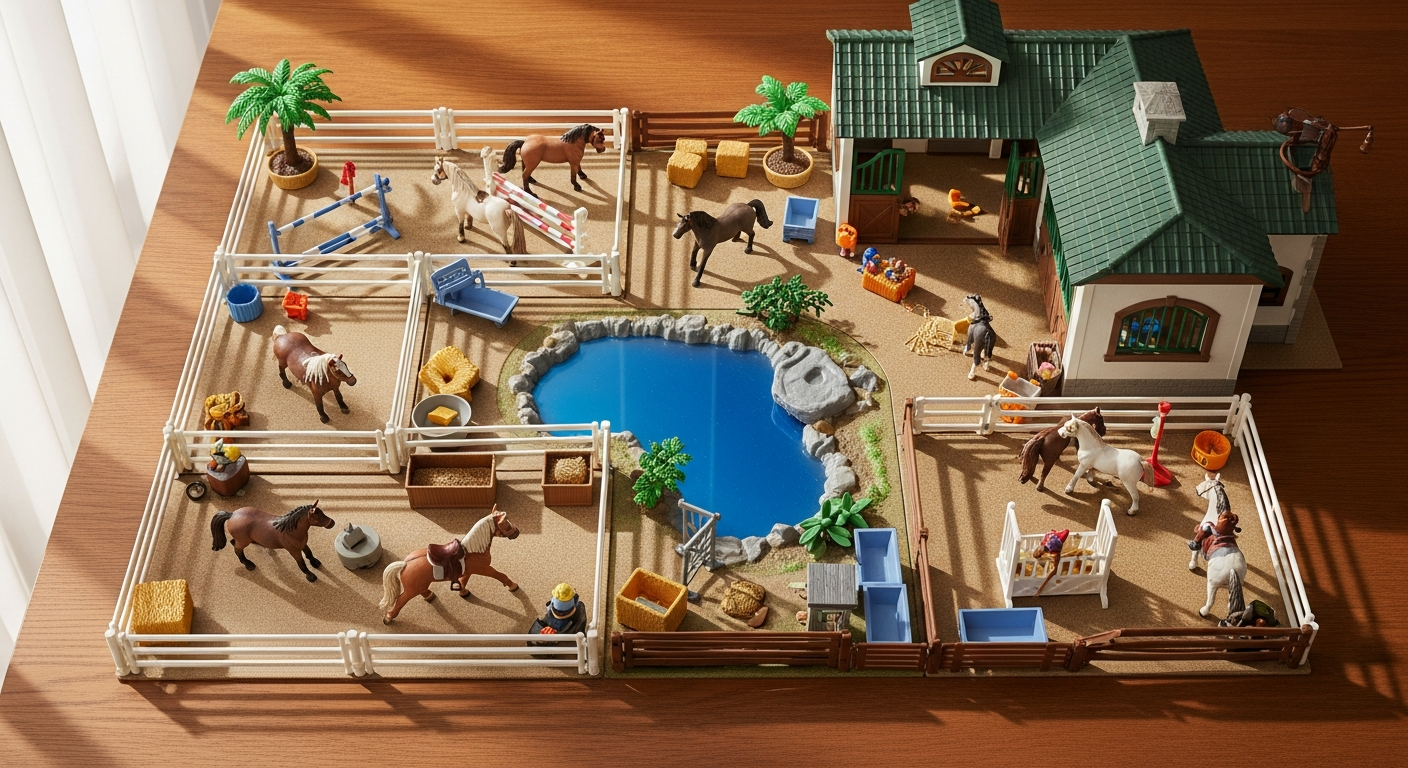
Children who engage in imaginative role-play develop stronger problem-solving skills and emotional intelligence. The Schleich Horse Club Lakeside Riding Center isn't just another toy—it's a gateway to hours of creative storytelling that keeps kids genuinely engaged. Parents everywhere are discovering that this playset delivers something rare: a toy that actually holds their child's attention without screens.
The Lakeside Riding Center stands apart in the Schleich collection because it functions as a complete ecosystem rather than a standalone toy. With over 50 to 115 pieces depending on the version, this modular playset gives children a fully realized world where they can create their own narratives. It's become a best-seller for good reason—the combination of hand-painted detail, realistic figures, and thoughtful design creates something genuinely special.
This guide walks you through everything that makes this playset exceptional. You'll discover the smart design features that prevent play from becoming repetitive, explore which accessories deliver the most value, and learn how to strategically expand your setup for even richer storytelling opportunities. Whether you're considering this as a gift or looking to maximize what you already own, you'll find practical insights here.
Understanding the Modular Design That Keeps Play Fresh
How the three horse stalls, wash station, and paddock elements can be rearranged for infinite configurations
The genius of the Lakeside Riding Center lies in how its pieces connect without rigid constraints. The three horse stalls, wash station, and paddock elements work independently yet cohesively, allowing children to reconfigure the entire setup based on their current story needs. A child might arrange everything in a compact line one day, then spread it across the floor the next to create separate areas for different adventures.
Why the modular approach prevents play from becoming stale and repetitive
Static toys lose appeal quickly, but modular designs combat boredom through natural variation. Each time your child rearranges the layout, they're essentially creating a new play environment. This behavioral shift—moving pieces around before engaging in new stories—resets their mental approach to familiar characters and settings, keeping the experience fresh even after months of play.
The two-story house structure and how it serves as a command center for storytelling
The two-story house anchors the entire playset, functioning as the central hub where all stories converge. The upstairs loft with sleeping bags becomes a retreat space for character development, while the downstairs areas handle active gameplay. This vertical structure gives children natural narrative anchors—upstairs scenes feel intimate and reflective, while ground-level scenes generate action and interaction.
Practical ways children naturally experiment with different layouts as their play evolves
Young children typically create simple linear arrangements: stalls in a row, house nearby, paddock in front. As they mature, their layouts become more sophisticated—separate grazing areas, training zones distinct from rest spaces, and multi-level play scenarios. This organic evolution mirrors cognitive development without requiring parental direction.
Connection between modular design and cognitive development through spatial reasoning
Arranging and rearranging pieces actively develops spatial reasoning, a critical component of mathematical thinking. Children unconsciously calculate dimensions, experiment with balance, and optimize flow—all cognitive skills that transfer to other learning domains. The modular design transforms playtime into subtle geometry and planning practice.
Real-world examples of how kids transform the space for different adventure scenarios
One scenario might feature a horse show, with paddock and house arranged to create a competition arena. Another might emphasize stable management, with stalls positioned for efficient daily care routines. A third scenario could focus on exploration, with the paddock extended into imaginary wilderness beyond the physical boundaries. Each configuration naturally generates different gameplay patterns and story arcs.
The Hand-Painted Figures and Realistic Details That Matter
Why Schleich's hand-painting process elevates this set beyond standard plastic toys
Mass-produced toys typically feature printed details that can fade and crack with use. Schleich employs hand-painting for each figurine, creating depth and authenticity that survives years of play. This commitment to craftsmanship means the figures maintain their charm and realism long after purchase, resisting the worn appearance that diminishes cheaper alternatives.
The three posable horse figures and how their realistic proportions encourage proper horsemanship learning
Each horse figure displays anatomically accurate proportions—realistic leg angles, proper spinal curves, and authentic movement capabilities. Children who handle these figures develop an intuitive understanding of equine anatomy and movement. When they eventually interact with real horses, this prior exposure through detailed models provides subtle foundational knowledge about proper handling and positioning.
Hannah and Lisa figurines: their articulation and how they enable dynamic storytelling
The two human figures feature articulated limbs and natural proportions, allowing them to assume riding positions, grooming poses, and resting postures. This physical flexibility directly enables narrative variety—Hannah and Lisa can be shown training, relaxing, caring for horses, or interacting with companions. The ability to position them realistically deepens immersion in the play experience.
Supporting animal characters (cat and mouse) and their role in expanding narrative possibilities
The included cat and mouse transform the playset from exclusively equestrian into a broader farm ecosystem. These companions introduce new storylines: caring for multiple species, creating conflicts or friendships between different animals, or simply adding living texture to the environment. Small details like these expand the narrative scope significantly.
The meticulous attention to detail in accessories like saddle blankets, grooming tools, and riding hats
Every accessory reflects the same hand-painted quality as the figures. Saddle blankets feature realistic patterns, grooming tools display functional detail, and riding hats match actual equestrian equipment styles. These minute details reward close observation and create micro-narratives—children notice the grooming tools and organically develop care-focused gameplay.
How realistic figures can serve as subtle educational tools for learning about horse care and anatomy
The combination of anatomically correct horse figures and functional accessories like grooming tools and feed creates an implicit educational framework. Children naturally learn about horse care practices through play—grooming patterns, feeding routines, and proper handling techniques emerge organically from the playset's design rather than feeling pedagogical.
Accessory Breakdown—Which Pieces Deliver Maximum Play Value
The wash station and its role in creating realistic daily-care routines
The wash station transforms abstract horse care into concrete, repeatable routines. Children can enact bathing sequences, water management, and equipment cleaning with genuine tools provided in the set. This functional playset element shifts play from purely imaginative to semi-realistic role-play, deepening engagement through procedural repetition.
Grooming tools and feed accessories that encourage nurturing play patterns
Nurturing gameplay develops empathy and responsibility concepts. Grooming tools and feed accessories make these caregiving actions tangible and visible. A child brushing a horse figure with a provided tool experiences genuine satisfaction from the care-based narrative, reinforcing positive behavioral patterns around responsibility.
The wooden horse for training and how it adds educational dimension
The training horse serves dual purposes: as a tool for teaching proper riding techniques through play-based learning, and as a narrative element for skill-development storylines. Children naturally create scenarios where their characters practice and improve—this meta-narrative about growth and competency adds psychological depth to the play experience.
Sleeping bags in the loft area and their significance for sleepovers and storytelling
Sleeping bags unlock sleepover narratives that extend play across time. Stories gain narrative complexity when characters stay overnight, creating multi-scene adventures that span imaginary days. The loft becomes a retreat space where characters bond, rest, and prepare for new adventures—a fundamental shift from single-scene play.
Riding hats and tack pieces that enable proper role-play scenarios
Proper equestrian equipment makes riding scenes feel authentic. When children can position riders with actual hats and saddles, their play more closely mirrors real horsemanship. This accuracy encourages children to learn actual riding practices, creating a bridge between imaginative play and genuine equestrian interest.
Which accessories see the most use and why they're worth the investment
Grooming tools, feed, and saddle equipment see constant use because they support the core caregiving narratives that naturally emerge in horse play. These pieces transform abstract horse-related play into functional routines that children repeat and vary, providing the structure that prevents play from becoming random. Their high utility directly justifies the playset's premium pricing.
Assembly, Durability, and Long-Term Play Value
Step-by-step assembly expectations and how straightforward the setup process is
Assembly is refreshingly uncomplicated—most structural elements connect with intuitive snap-fit joints that require no tools. The house sections assemble in minutes, stalls stack logically, and paddock fencing pieces connect without confusion. Parents appreciate that setup doesn't demand mechanical expertise or frustration-inducing instruction manuals.
High-quality plastic construction and why it withstands years of intensive play
The plastic construction uses durable polymers designed to resist cracking, warping, and color fading through repeated use. Unlike brittle plastics that fracture under stress, this material flexes slightly, absorbing impact from dropped pieces and rough handling. Five-year-olds and twelve-year-olds can both play intensively without degradation.
Safety certifications and materials standards that meet stringent requirements
Schleich maintains rigorous safety standards, with non-toxic paints, smooth edges, and pieces sized to prevent choking hazards. The materials meet international safety certifications, providing parents peace of mind regarding chemical exposure or injury risks. This commitment to safety doesn't compromise durability—quality and safety reinforce each other.
Real parent feedback on durability across different age groups and play styles
Parents consistently report that Schleich playsets survive years of intensive use. Figurines withstand drops, plastic elements resist cracking even with rough handling, and hand-painted details hold their appearance. Testimonials frequently mention passing sets down to younger siblings or friends, with pieces remaining fully functional and attractive after years of play.
How the sturdy build quality justifies the £85-£110 price point
The price reflects genuine construction quality rather than brand markup. Comparable playsets from lesser brands show degradation within months, requiring replacement. The Lakeside Riding Center's durability means families recoup costs through extended use and reduced replacement cycles, making the higher upfront price economically sensible.
Maintenance tips to keep the playset looking fresh and functioning smoothly
Occasional dusting maintains the hand-painted details' appearance, while gentle cleaning with damp cloths prevents dirt accumulation. Storing pieces in a dry location prevents moisture-related warping. Periodically checking snap-fit connections ensures they remain secure. These minimal maintenance requirements keep the playset functioning beautifully for years.
Expanding Your World—Strategic Add-Ons and Complementary Sets
How the Lakeside Riding Center serves as the foundation for a larger Horse Club ecosystem
The Lakeside Riding Center functions as the narrative and physical hub for the broader Schleich Horse Club universe. Additional sets integrate seamlessly, expanding capacity and story possibilities without requiring the base set to change fundamentally. Strategic expansion transforms a complete playset into a genuinely expansive world.
The Tack Shop playset and how it complements the main set
The Tack Shop introduces a commercial element to the Horse Club universe. Children can simulate shopping for equipment, create a business narrative around tack sales, or establish a supply chain for their riding center. This complementary set enriches the economic and social dimensions of their storytelling.
Additional horse boxes and why collectors add them for expanded capacity
Extra horse boxes unlock growth narratives—the riding center expands, accommodates more characters, and supports larger-scale competitions or events. Children naturally gravitate toward expansion when they encounter story scenarios their current setup can't accommodate, creating organic motivation for additional purchases.
Other Schleich sets that integrate seamlessly with the Lakeside Riding Center
Various Schleich horse sets, veterinary playsets, and accessory packs integrate smoothly. A veterinary clinic becomes adjacent to the riding center, introducing medical care narratives. Additional horse figures expand the cast of characters. Grooming accessory packs provide more tools for care-focused play. Each addition opens new story pathways.
Budget-friendly ways to expand without overwhelming storage constraints
Rather than purchasing complete playsets, families can add individual horses, single accessory packs, or smaller themed sets. This piecemeal approach prevents storage chaos while maintaining expansion options. Strategic purchases targeting specific narrative gaps deliver more value than random expansion.
How expansion sets unlock new play scenarios and prevent the original set from feeling complete
A set that feels complete paradoxically limits play because children perceive closure. Expansion creates productive incompleteness—the world feels like it has space for growth. New areas to develop and new story possibilities emerge, sustaining engagement beyond what a finalized playset achieves.
Age-Appropriateness and Play Styles Across the 5-12 Range
Why the recommended 5-12 age range reflects genuine developmental suitability
Five-year-olds possess the motor control and imagination to engage with the figures meaningfully but need simple scenarios and adult scaffolding. Twelve-year-olds can construct complex narratives independently. The range captures this developmental span while acknowledging that children outside these boundaries might still find value depending on individual interest and maturity.
How younger children (5-7) engage with the set differently than older kids (9-12)
Younger children engage in parallel play—characters perform actions alongside each other without necessarily connecting through complex plots. They focus on individual care routines and simple scenarios. Older children create intricate narratives with goals, conflicts, and resolutions spanning multiple play sessions. Both age groups find genuine value in the identical playset.
The balance between guided play for younger children and independent storytelling for older ones
Five-year-olds benefit from parental guidance establishing initial scenarios and suggesting care routines. Seven-year-olds begin developing independent stories but appreciate adult participation. By ten, most children create entirely self-directed narratives requiring minimal parental involvement. The playset accommodates all these developmental stages simultaneously.
Supervision considerations for the youngest users
Five-year-olds playing with the set should have supervision primarily to ensure figurines and small accessories don't migrate into mouths, though choking risks are minimal given piece sizes. Adult presence during early play sessions also allows for modeling storytelling and care routines, accelerating engagement. Most supervision needs diminish by age seven.
How the set grows with your child rather than becoming outgrown
Younger children find value in physical care routines and simple scenarios. Older children appreciate the detailed realism that supports sophisticated narratives. The same pieces serve fundamentally different narrative purposes at different ages, meaning children don't outgrow the set—their play simply matures alongside their cognitive abilities.
Real examples of how different age groups find unique value in the same playset
A six-year-old might spend thirty minutes acting out daily horse care routines repeatedly. A ten-year-old creates a competition narrative spanning multiple play sessions, tracking scores and developing character backstories. A twelve-year-old might develop elaborate storylines involving business management, relationship development between characters, and realistic consequences. The playset's depth supports all these approaches.
Explore the Schleich Horse Club Lakeside Riding Center and see why it's perfect for every age.
Price Comparison and Where to Find the Best Value
UK pricing (£85-£110) versus US pricing ($90-$120) and what drives regional differences
UK pricing reflects VAT inclusion, import duties, and regional distribution costs. US pricing varies based on individual retailer margins and regional economic factors. Currency fluctuations also influence relative costs, meaning periodic shopping across regions might reveal better values depending on exchange rates.
How retailer variations affect final cost and what to watch for
Major retailers apply different margin strategies—some discount heavily to drive traffic, while specialty toy shops maintain higher prices reflecting service and expertise. Online retailers often undercut traditional stores. Timing purchases around seasonal sales can yield 15-20% reductions from standard pricing.
Seasonal promotions and when to time your purchase for maximum savings
Black Friday and Cyber Monday typically feature the deepest discounts on premium playsets. Back-to-school promotions sometimes include toy sales. Christmas season sees both promotions and premium pricing depending on stock levels. Monitoring price trends across retailers reveals optimal purchase windows without requiring constant checking.
Comparing cost-per-piece value against other premium playsets
At £85-£110 for 50-115 pieces, the per-piece cost ranges roughly £0.75-£2.20. Comparable premium playsets often cost more per piece while providing less play value. When calculated against play hours and durability, the cost-per-hour metric becomes remarkably favorable—children playing intensively for years amortize the cost substantially.
Whether the investment aligns with play hours and longevity
A child playing actively with this set for four years across hundreds of hours inverts the cost calculation—premium pricing becomes irrelevant when measured against engagement quality. Many families report five-plus years of active use, making the per-hour cost negligible and the investment unquestionably sound.
Retailer-specific bundles that add value beyond the base set price
Select retailers offer bundled packages combining the Lakeside Riding Center with complementary sets or accessory packs at discounted combined prices. These bundles provide superior value to purchasing items separately, though they require larger upfront investment. Comparing bundle prices across retailers often reveals genuine savings opportunities.
Addressing Common Concerns and Minor Drawbacks
Packaging considerations and how to inspect for loose parts upon arrival
Some older reviews mention loose parts upon arrival, though this appears infrequent with current packaging. Upon delivery, immediately inspect for missing pieces and photograph any damage before disposal of packaging. Contact retailers promptly regarding missing components—most replacement policies accommodate this issue without difficulty.
The pink and blue color elements and whether they impact realism or play value
The playset features pink and blue design elements reflecting the Horse Club aesthetic. Some users prefer more neutral tones for perceived realism, though this stylistic preference doesn't diminish play value. Children typically embrace the color scheme without concern, responding more strongly to the functional playset design than aesthetic preferences their parents might hold.
Older versus newer figurine styles and personal preference considerations
Schleich has updated figurine styles over product generations, with some users preferring older versions. Purchasing from specialty retailers might offer access to earlier editions if particular styles appeal to you. However, newer figurines feature improved articulation and durability, making contemporary versions functionally superior despite stylistic preference variations.
Storage space requirements for a set of this size
The playset occupies substantial space when fully assembled—approximately 84 x 27 x 31 cm requires dedicated display or play area. Many families designate a dedicated shelf or storage table for the assembled set, while others store components and assemble for play sessions. Storage constraints should factor into purchasing decisions for space-limited homes.
How minor aesthetic preferences don't diminish overall play quality
Color preferences, figurine style variations, and modest packaging inconsistencies rarely affect actual play experiences. These minor considerations matter less than the genuine value children extract from hundreds of hours engaging with the set. Prioritizing play quality over aesthetic perfection leads to smarter purchasing decisions.
Troubleshooting tips for any assembly or missing piece issues
Refer to assembly instructions if pieces seem unclear. Contact retailers directly regarding missing components rather than attempting workarounds. Schleich customer service generally responds favorably to missing piece reports. Most issues resolve quickly, ensuring your playset functions optimally.
Why This Playset Becomes the Centerpiece of Horse Club Obsessions
The psychological appeal of having a complete world for characters to inhabit
Humans naturally respond to complete, self-contained worlds. The Lakeside Riding Center provides this completeness—a functioning farm with housing, care facilities, and outdoor spaces. Characters feel authentically situated rather than suspended in abstract space, deepening psychological investment and narrative authenticity.
How Hannah and Lisa's stories inspire children to create their own narratives
The included characters come with implied backstories and relationships. Children extend these narratives naturally, developing their own character arcs while maintaining connection to established personalities. This blend of canonical elements with original creation generates ownership and deep engagement that purely invented universes sometimes lack.
The role of realistic detail in deepening imaginative engagement
Realism paradoxically strengthens imagination rather than constraining it. When figures and accessories reflect actual equestrian practices, children don't expend cognitive energy questioning what's possible—they can invest that energy in story development. Detailed realism creates credibility that supports rather than limits creative thinking.
Why this set consistently ranks as a best-seller across multiple years
Consistent popularity reflects genuine quality and enduring appeal. Unlike trend-driven toys that fade within seasons, this playset sustains engagement across years and age groups. Word-of-mouth recommendations from satisfied families generate continuous demand, keeping the product in best-seller rankings despite premium pricing.
Parent testimonials about sustained engagement and reduced screen time
Parents frequently report that their children return repeatedly to this playset, often preferring it to electronic entertainment. The combination of tactile engagement, narrative possibility, and genuine play value creates authentic competition with screen-based activities—a rarity among physical toys. Testimonials emphasize sustained engagement measured in years rather than weeks.
The emotional connection children develop with their Horse Club universe
Children develop genuine emotional attachments to their Horse Club worlds. Characters become companions, settings become familiar and meaningful, and ongoing narratives create investment that transcends typical toy interaction. This emotional dimension transforms the playset from mere entertainment into a meaningful imaginative space.
Your Gateway to Endless Equestrian Adventures
The Schleich Horse Club Lakeside Riding Center delivers on its promise of being a central hub for imaginative play. What makes it truly special—beyond the impressive piece count and hand-painted detail—is how it adapts to your child's evolving interests. Whether your child is five and just discovering horses or twelve and building complex narratives, this playset grows with them.
The modular design prevents the dreaded "I'm bored" moment that derails so many toys. The realistic figures and thoughtful accessories transform casual play into genuine storytelling experiences. The price sits at a premium, but the durability, play value, and expansion potential make it a genuinely smart investment.
The best toys are the ones kids actually return to again and again. The Lakeside Riding Center earns that status through thoughtful design, quality construction, and genuine narrative depth. Start with the base set, observe how your child naturally gravitates toward different play styles, and then strategically expand when you spot gaps in their storytelling.
Building something far more valuable than a collection of plastic pieces means creating a world where imagination thrives. Your child will develop problem-solving skills, emotional intelligence, and genuine storytelling confidence through extended engagement with this exceptional playset.
Start your child's equestrian adventure with the Schleich Horse Club Lakeside Riding Center today.
Leave a Reply