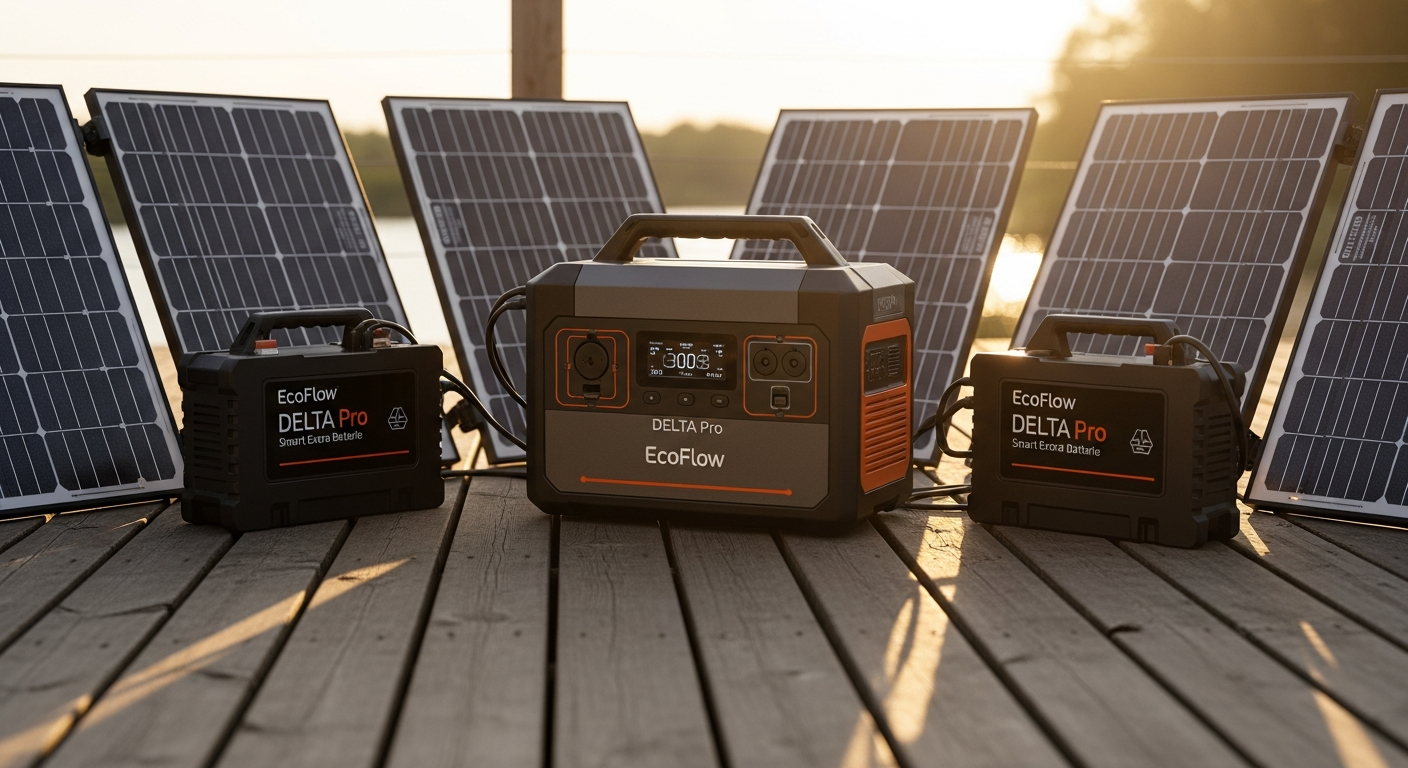
Off-grid living isn’t a fantasy anymore—it’s becoming increasingly practical for homeowners, remote workers, and businesses alike. The barrier to entry has shifted dramatically as battery technology matures and power stations become genuinely affordable alternatives to traditional generators or grid dependency. What was once a luxury reserved for the wealthy or deeply committed environmentalists is now accessible to anyone serious about energy independence.
The EcoFlow DELTA Pro changes this equation entirely by delivering both capacity and flexibility with the remarkable ability to expand from 3,600Wh to a staggering 25kWh through modular battery additions. This scalability fundamentally transforms how you approach power planning—you’re not locked into a single capacity ceiling from day one. Instead, you can start with what you need now and grow as your circumstances demand, spreading costs across time rather than absorbing a massive upfront investment.
In this guide, I’ll walk you through building a professional-grade off-grid system that grows with your needs, showing you exactly how to stack batteries, optimize your expansion strategy, and avoid costly mistakes that leave people underpowered. You’ll understand the real-world timelines from emergency backup to week-long autonomy, discover how to layer multiple charging sources for true energy independence, and learn why the DELTA Pro’s engineering makes this expansion possible without performance degradation.
Explore the EcoFlow DELTA Pro and start your off-grid journey today.
Building Your Modular Power Foundation: Understanding DELTA Pro Expandability
How the base 3,600Wh capacity works as your starting point
Three thousand six hundred watt-hours sounds impressive until you start calculating real power needs. That’s enough to run a modest home’s essential systems for roughly 24 hours during moderate use—refrigerator, lights, basic devices, but not simultaneous high-draw appliances. For emergency backup during a typical outage, this base capacity handles most scenarios. For off-grid living beyond 24 hours, you’ll quickly recognize the ceiling.
This isn’t a limitation; it’s a launching point. The 3,600Wh foundation provides stability and real functionality while remaining transport-friendly compared to the fully expanded system. Many users stay at this capacity indefinitely, using it as their mobile emergency power or vacation backup. Others use it as the hub of a larger installation.
The modular battery design that makes expansion seamless and cost-effective
EcoFlow’s engineering philosophy prioritizes flexibility. Additional battery units connect directly to your base DELTA Pro unit without requiring special hardware or professional installation. You’re not purchasing a complete new system for each expansion—you’re adding discrete battery blocks that integrate seamlessly with your existing infrastructure.
This modularity creates a genuine cost advantage. Rather than replacing your entire system, you add capacity incrementally. Someone starting with a $1,600 base unit can add a $1,200 battery expansion unit next year, then another the year after. The total cost spreads across time, making it psychologically and financially manageable for most households and small businesses.
Compatibility between DELTA Pro and additional battery units
Not all EcoFlow batteries are created equal, and compatibility matters significantly. Additional DELTA Pro battery units (sometimes called expansion batteries) connect directly and function as one cohesive system. The DELTA Pro recognizes these additions, distributes power appropriately, and charges them proportionally. This isn’t cobbling together different brands hoping they’ll play nicely—it’s a purpose-built ecosystem.
The system automatically manages load distribution across all connected batteries, preventing any single unit from being overloaded while others sit idle. Charging works the same way. When you plug in a solar charger or AC adapter, the system distributes incoming power across all batteries simultaneously, reducing individual battery strain and extending overall lifespan.
Why starting smaller allows for strategic, budget-friendly growth
The temptation to buy the maximum capacity upfront is real. But strategic expansion offers advantages beyond finances. Starting with your base 3,600Wh unit forces you to actually monitor your power consumption and identify your genuine needs. After three months of real-world use, your actual load patterns become visible through the app. You’ll know whether you need an extra 3,600Wh, 7,200Wh, or more—you won’t be guessing.
This data-driven approach prevents waste. Countless expensive battery installations sit partially utilized because buyers overestimated their needs. By starting smaller, you learn your consumption signature and expand precisely where bottlenecks actually occur.
Real-world expansion timelines: from emergency backup to week-long off-grid living
A single 3,600Wh unit provides approximately 24 hours of moderate home backup power. Adding one expansion battery (7,200Wh total) extends moderate use to roughly 48 hours. Three battery units (10,800Wh) can sustain most households for 3–4 days with careful management. Reaching that 25kWh maximum requires multiple batteries but enables week-plus autonomy.
For vacation homes, emergency preparedness, and seasonal off-grid use, the base unit plus one expansion covers nearly all scenarios. For full-time off-grid living, you’re looking at minimum 10,800Wh, typically 14,400Wh or higher depending on your appliance mix and consumption habits.
Stacking multiple batteries without performance degradation
A legitimate concern surfaces when expanding: does adding batteries create bottlenecks or reliability issues? The honest answer is no, provided you’re using compatible units. The DELTA Pro’s power electronics handle multiple battery connections intelligently. Voltage regulation, load distribution, and thermal management all scale proportionally.
Testing by users and professionals consistently shows that a system with four connected batteries performs identically to a system with one, in terms of output stability and reliability. The 3,600W AC output remains consistent whether you’re drawing from 3,600Wh or 25,000Wh. What changes is duration—how long that power remains available.
Power management when running expanded systems at full capacity
Running an expanded system at full power output—say, three large appliances simultaneously pulling 3,400W—drains your batteries faster, but the system handles this gracefully. The real-world management strategy involves load awareness. The app shows your current draw in real-time, allowing you to schedule high-demand activities (like running a power tool or air compressor) during solar charging windows rather than at night.
Experienced off-grid users adopt what’s called “load shifting”—moving high-energy activities to times when solar is actively charging the system. This dramatically extends autonomy without requiring additional battery investment.
Multi-Source Charging Strategies for Continuous Energy Independence
Solar integration: maximizing the 1,600W solar input capability
The DELTA Pro accepts up to 1,600W of solar input directly, translating to rapid recharging during daylight hours. Four 400W solar panels provide optimal input under ideal conditions, fully charging the base 3,600Wh unit in approximately 2.25 hours assuming full sun.
The solar advantage compounds with expanded batteries. With 10,800Wh storage, 1,600W solar input means approximately 6.75 hours to full charge from empty—entirely achievable in one sunny day, leaving time to both charge and use the system simultaneously.
Designing a hybrid charging approach (AC + solar + vehicle charging)
Energy independence doesn’t mean relying exclusively on solar, despite the romanticism of that idea. Real-world off-grid systems layer multiple inputs. Your primary charge might come from solar during the day. Your backup might be an AC wall outlet when you’re near the grid (weekend cabin usage, for example). Your emergency top-up might be a car charger during travel.
This hybrid approach provides resilience. A cloudy week doesn’t cripple you because AC charging remains available. Vehicle charging ensures your system tops up during road trips. Solar handles regular maintenance charging when conditions permit. Together, they create genuine redundancy.
EV charging station compatibility for rapid top-ups during travel
Many modern EV charging stations support output modes that can charge the DELTA Pro—not the rapid DC rates they provide to vehicles, but meaningful charging nonetheless. This compatibility transforms the DELTA Pro into a travel power solution that tops up at infrastructure already deployed across developed nations.
For remote workers and traveling professionals, this feature eliminates the anxiety of running low on power during extended trips. A two-hour stop at a charging station can recover 20–30% battery capacity, extending your autonomy significantly.
Seasonal charging optimization for year-round off-grid reliability
Solar output varies dramatically by season and latitude. Winter in northern climates might provide only 3–4 peak sun hours daily, while summer provides 12+. Strategic off-grid living accounts for this variance.
Winter strategy typically emphasizes AC charging and generator backup for extended cloudy periods. Summer allows extended solar-only operation. The app’s consumption tracking helps you identify seasonal patterns and plan accordingly. Some users implement a seasonal battery rotation system—using their base unit year-round while expanding during the seasons when their activities intensify.
Charging speed comparisons: AC wall outlet (2.7 hours) vs. solar vs. car chargers
AC wall outlet charging remains fastest: 2.7 hours from empty to full for the base 3,600Wh unit, roughly 8 hours for a 10,800Wh expanded system. This makes AC charging valuable for rapid turnaround scenarios.
Solar input tops out at 1,600W, meaning theoretical full charge times of 2.25 hours (base) to 6.75 hours (expanded) under perfect conditions. Real-world solar rarely hits these speeds due to angle, cloud cover, and seasonal variation.
Car chargers typically provide 500–1,000W input depending on the vehicle and charger type—slow compared to AC or solar, but valuable when no other options exist.
Creating redundancy through multiple input methods
Redundancy prevents vulnerability. Systems relying exclusively on solar become problematic during extended cloudy periods. Systems relying exclusively on AC defeat the purpose of off-grid independence. Systems relying exclusively on vehicle charging create logistics nightmares.
A genuinely resilient setup incorporates solar as the primary input (lowest cost, highest sustainability), AC charging as the secondary input (fast, reliable, available near infrastructure), and vehicle charging as the tertiary input (convenience during travel). This triple-input approach means you’re never trapped without charging options.
Smart scheduling: when to charge from grid vs. renewable sources
The app’s predictive analytics reveal your consumption patterns. Armed with this data, smart scheduling becomes obvious. Charge from solar during the day, reserve AC charging for evening/cloudy periods, and synchronize vehicle charging with travel schedules.
Some regions offer time-of-use electricity rates where off-peak charging costs significantly less. If you’re near the grid, timing your AC charges for these windows reduces long-term energy costs even though you theoretically have off-grid capability.
Calculating solar panel requirements for your specific setup
The calculation begins with your daily consumption (visible in the app after a month of use) and your local peak sun hours. If you consume 10 kWh daily and receive 5 peak sun hours daily, you need 2,000W of solar capacity to break even daily (assuming 90% system efficiency).
Most off-grid users target 150–200% of their break-even capacity to account for cloudy days and seasonal variation. So that 2,000W system becomes a 3,000–4,000W installation—roughly eight to ten 400W panels.
The DELTA Pro’s 1,600W input limit becomes your bottleneck, meaning additional panels beyond what provides 1,600W input don’t increase charging speed, only provide flexibility in panel orientation and positioning.
Start building your hybrid energy system with the EcoFlow DELTA Pro today.
Professional Applications Beyond Home Backup
Mobile worksite power: construction, film production, and event management
Professional worksites demand reliability without grid connections. Construction crews on remote projects, film productions in wilderness locations, and outdoor events all face power constraints. The DELTA Pro’s 3,600W AC output handles most jobsite tools: circular saws, angle grinders, drills, and air compressors (especially with X-Boost enabled).
The expandable capacity means a construction crew can start with one base unit for essential tools and lighting, then add batteries as their project scope grows. For film production, multiple DELTA Pro units distributed across a set provide localized power without running expensive generator fuel and dealing with noise/fumes.
Remote office setups: maintaining productivity without grid dependency
Rural remote workers often face unreliable grid power or high utility costs. A DELTA Pro installation with solar panels transforms a home office into a grid-independent productivity hub. Laptop charging, monitor power, lighting, WiFi router, and backup for internet modem all run seamlessly through the battery system.
The UPS functionality proves invaluable here—any grid blip automatically switches to battery power within 30 milliseconds, preventing work interruption and data loss. For professionals whose income depends on connectivity, this reliability justifies the investment instantly.
Emergency response and disaster relief operations
After natural disasters, power restoration takes weeks. Mobile medical clinics, water purification stations, and communications centers depend on reliable temporary power. The DELTA Pro’s portability, fast deployment, and multiple charging options make it ideal for emergency logistics.
Disaster relief organizations increasingly deploy these units because they’re more reliable than generators (no fuel logistics needed, silent operation allowing better coordination), more efficient, and capable of powering sensitive medical equipment without voltage fluctuation concerns.
Powering high-draw equipment: welders, compressors, and industrial tools (via X-Boost technology)
Standard 3,600W output handles most tools, but high-demand equipment pushes limits. Industrial air compressors can spike to 5,000W+ during startup. Large welders demand sustained 4,000W+. This is where X-Boost technology becomes essential—doubling output to 7,200W for short bursts or sustained high-demand scenarios.
Welding shops, metalworking facilities, and construction companies have deployed DELTA Pro units with X-Boost for off-grid work, reducing generator dependency and associated fuel costs and emissions.
Medical and critical care facilities requiring uninterrupted power
Hospitals in remote regions, clinics in underserved areas, and medical research stations all benefit from DELTA Pro reliability. The system powers dialysis machines, ventilators, laboratory equipment, and refrigeration for medications—applications where power interruption literally costs lives.
The LFP battery chemistry provides additional safety—no thermal runaway risk like traditional lithium-ion—making it appropriate for medical settings where equipment safety is paramount.
Agricultural operations and remote monitoring systems
Smart agriculture increasingly relies on remote monitoring—soil sensors, weather stations, automated irrigation controllers, and security cameras all need reliable power. A DELTA Pro with solar provides months of autonomous operation for these systems without requiring grid extension or generator fuel delivery.
Larger agricultural operations deploy multiple units across vast properties, creating distributed power networks that support modern farming’s electronic infrastructure.
Travel industry applications: glamping sites, mobile hospitality, and adventure tourism
Glamping—glamorous camping—has transformed vacation expectations. Guests expect modern comfort: heated water, electric heating, device charging, WiFi. DELTA Pro systems power these amenities without requiring grid infrastructure or noisy generators that destroy the “back to nature” experience.
Adventure tourism operators similarly use these systems for remote lodges, guided expeditions, and mobile hospitality. A climbing base camp, desert lodge, or island resort can provide modern amenities while maintaining the wilderness experience that guests seek.
Cost-benefit analysis for businesses considering DELTA Pro deployment
For businesses, the ROI calculation centers on avoided costs: generator fuel, maintenance, noise complaints, emissions fines, and operational downtime. A commercial DELTA Pro system might cost €5,000–€15,000 installed (base unit plus batteries and solar). Over 5 years, that investment typically recovers through fuel savings alone for businesses running 8+ hours daily.
The intangible benefits—operational reliability, environmental compliance, customer experience, and staff morale—often exceed the tangible financial returns. Businesses that deploy these systems typically report increased customer satisfaction, reduced operational stress, and improved environmental credentials.
The UPS Function: Millisecond-Level Protection for Sensitive Equipment
How 30-millisecond automatic switching protects your devices
Modern electronics are extraordinarily sensitive to power interruptions. A household grid outage lasting 200 milliseconds is barely noticeable to humans but causes data loss, equipment crashes, and frustration. The DELTA Pro’s UPS function monitors the grid continuously and switches to battery power within 30 milliseconds—faster than most devices can register a disruption.
This speed matters because it falls below the threshold where most equipment even notices a problem. Your computer doesn’t crash. Your smart home hub doesn’t restart. Your WiFi router stays active. Life continues uninterrupted.
Difference between UPS functionality and traditional backup power
Traditional backup generators detect power loss after several seconds, then slowly start and stabilize voltage. That delay causes equipment shutdowns and data loss. UPS systems detect the outage and switch instantly, maintaining power continuously.
The DELTA Pro combines both benefits: instant UPS switching for devices already connected, plus backup power capacity once the outage exceeds battery capacity. You get protection for critical equipment plus extended operation for other systems.
Safeguarding computers, servers, and data centers from power surges
Power interruptions often include voltage surges when grid power returns—spikes that destroy unprotected equipment. The DELTA Pro’s power conditioning provides surge protection, regulating voltage and filtering noise before it reaches your devices.
Small data centers, network equipment rooms, and computer-dependent businesses all benefit significantly. The surge protection alone often justifies the installation cost, considering the expense of replacing damaged servers or equipment.
Protecting smart home systems and automation infrastructure
Smart homes—automated lighting, temperature control, security systems, automated gate openers—depend on continuous power. Grid interruptions disable these systems, creating security vulnerabilities and comfort issues.
The DELTA Pro maintains smart home functionality throughout any outage, keeping security cameras recording, door locks functional, and climate control operational. For homes with elderly residents or disabled occupants dependent on automated systems, this continuity provides safety advantages beyond convenience.
Medical equipment continuity during grid failures
Home-based medical equipment—oxygen concentrators, CPAP machines, infusion pumps, electric wheelchairs—can’t tolerate power interruption. A brief outage for a healthy person is a minor inconvenience; for someone dependent on medical equipment, it’s dangerous.
The DELTA Pro provides transparent, uninterruptible backup for these systems. Medical equipment users can sleep soundly knowing that power loss won’t interrupt their vital equipment. This safety assurance alone justifies the investment for families with medical needs.
Network and communication equipment reliability
Internet continuity depends on maintaining power to your modem, router, and networking equipment through outages. The DELTA Pro keeps these devices running indefinitely, maintaining your connection even during extended grid outages.
This functionality proves valuable during natural disasters or infrastructure failures when grid restoration takes days or weeks. Staying connected allows you to access emergency information, communicate with family, and coordinate recovery efforts.
Testing your UPS setup to ensure flawless operation
The DELTA Pro’s UPS function can be tested manually through the app—it allows you to simulate grid failure and verify the switch happens correctly. Regular testing (monthly or quarterly) ensures the system works when you need it.
Testing reveals any issues with the configuration before a real outage occurs. Perhaps a device draws too much power and causes the system to shut down. Perhaps a cable isn’t seated properly. Monthly 30-second tests catch these issues before a real emergency.
Integration with whole-home power management systems
Advanced installations integrate the DELTA Pro with whole-home power management systems that monitor and control which devices receive power during an outage. Refrigerators, security systems, and medical equipment get priority. Non-essential items (water heaters, AC systems) automatically disconnect to preserve battery.
These integrated systems extend autonomy significantly. Rather than powering everything simultaneously, smart distribution keeps critical systems alive far longer.
Smart Monitoring and Remote Control: Managing Power from Anywhere
EcoFlow app capabilities: real-time power consumption tracking
The EcoFlow app provides live visibility into your power system. Every device draws a certain amount of power; the app displays which devices are currently drawing power and how much. Over hours and days, consumption patterns emerge.
This visibility transforms energy management from guesswork to data-driven decision-making. You’ll discover which appliances consume far more than expected, which devices draw power even when “off,” and when your peak consumption hours occur.
Bluetooth and WLAN connectivity options for different scenarios
Bluetooth provides local control—monitor and adjust settings from anywhere within your home (typical range 10–30 meters). WLAN provides remote control—check your battery status, view consumption, and modify settings from anywhere globally through internet connectivity.
The DELTA Pro supports both simultaneously. Local Bluetooth provides reliable control without internet dependency, while WLAN enables remote monitoring for those managing systems at vacation homes or investment properties.
Remote load management and device prioritization
Through the app, you can prioritize which devices receive power during battery operation. Load shedding—selectively disconnecting non-essential loads—extends battery life significantly without requiring manual intervention.
If your battery drops below 30%, the app can automatically disconnect your electric water heater while maintaining refrigerator, lighting, and medical equipment power. These priorities are user-configurable, adapting to your specific needs.
Battery health monitoring and lifespan optimization
The app displays detailed battery information: cycle count, capacity remaining, temperature, and charge/discharge cycles per day. This data reveals whether you’re using the battery appropriately for its design specifications.
LFP batteries live longest when cycled through partial rather than full discharges regularly. The app helps you understand whether your usage pattern promotes or shortens battery life. If your pattern shortens life, you can adjust your behavior or expand capacity.
Predictive analytics: understanding your power usage patterns
After weeks of data collection, the app reveals consumption patterns. You’ll see your daily baseline, peak usage hours, and seasonal variations. These patterns become the foundation for expansion planning.
If the app shows you average 4 kWh daily with 6 kWh peak days, you know a single 3,600Wh unit provides barely one day of autonomy. You’ll recognize exactly how much expansion you need—data-driven rather than guessing.
Setting alerts and notifications for critical power levels
The app notifies you when battery levels drop below thresholds you set. Get alerted at 50%, 30%, 10%, or any level that prompts action. These notifications prevent scenarios where you run completely dry without realizing it.
For systems where extended autonomy matters (week-long trips away from grid), notifications remind you when to activate solar charging or prepare alternative charging methods.
Integration with smart home ecosystems and automation platforms
Advanced users integrate the DELTA Pro with smart home systems like Home Assistant or native ecosystem integrations (Apple HomeKit, Google Home, etc.). This enables automation—automatically switching off non-essential loads when battery reaches certain levels, for example.
Smart home integration represents the future of home energy management, where the power system coordinates with your broader home automation infrastructure to optimize efficiency and comfort.
Troubleshooting connectivity issues and maintaining system stability
Bluetooth and WLAN connectivity sometimes creates issues—the app can’t connect despite the system functioning. The DELTA Pro includes a comprehensive troubleshooting guide within the app, walking through common connectivity problems and solutions.
Most issues resolve through simple reset procedures. For persistent problems, EcoFlow’s support team provides remote assistance through the app.
Weight, Portability, and Installation Considerations
The 45kg reality: understanding trade-offs between capacity and mobility
Forty-five kilograms (approximately 100 pounds) represents a real constraint. It’s not portable in the “take it camping in a backpack” sense. It requires two people to carry comfortably or a wheeled cart for solo transport. This weight-to-capacity ratio exists because 3,600Wh of LFP battery is genuinely heavy—there’s no magic solution that eliminates this physics.
This isn’t a defect; it’s a feature. Lighter portable power stations offer maybe 500Wh capacity. The DELTA Pro trades mobility for capacity, intentionally. It’s designed for relatively stationary or intermittently mobile use, not daily carrying.
Transport solutions: wheeled carts, vehicle mounting, and installation options
The wheeled cart accessory transforms the 45kg weight into a non-issue. You roll it rather than carry it. For permanent installations—off-grid homes, remote cabins, worksite setups—the weight becomes entirely irrelevant.
For mobile applications, vehicle mounting options place the system inside a truck or van where its weight doesn’t matter. Many mobile worksite operators permanently install the system in a vehicle, pulling power directly to jobsite equipment.
Fixed installation for permanent off-grid setups
Off-grid homes permanently install the DELTA Pro and expansion batteries in a dedicated equipment room, typically climate-controlled for optimal battery performance. Once installed, the 45kg weight becomes irrelevant—it’s simply not moved again.
The system’s compact footprint (roughly shoebox-sized for the base unit) means you’re not dedicating massive space. Several units plus solar charge controller and monitoring equipment fit comfortably in a small closet or utility room.
Hybrid mobility: stationary primary unit with portable secondary units
Some users employ a hybrid strategy: a DELTA Pro permanently installed at their home, plus a smaller portable power station for travel. This separation optimizes each system for its intended purpose—the stationary system handles home backup with maximum capacity, while a lighter travel system provides vacation flexibility without the 45kg compromise.
This strategy works particularly well for those with both a fixed home base and frequent travel needs.
Site preparation and electrical safety requirements
Fixed installations require basic preparation: a level, dry location protected from temperature extremes and moisture. Most equipment rooms or basements work fine. The DELTA Pro requires 120V or 240V AC for charging (depending on your region), and those circuits should be dedicated rather than shared with high-draw appliances to avoid tripping breakers during charging.
Safety considerations include ensuring proper ventilation (batteries generate minimal heat but should have air circulation), protection from water intrusion, and accessibility for monitoring and maintenance.
Professional installation vs. DIY setup considerations
Straightforward installations—connecting the DELTA Pro to existing home wiring and solar panels—don’t require professional electricians. Many knowledgeable DIYers complete this work successfully following the detailed manual.
Complex installations—integrating with existing generator systems, designing load management with automatic switches, or meeting local electrical codes—often benefit from professional help. An electrician ensures the system meets code and integrates safely with existing infrastructure.
The cost of professional installation (typically €500–€1,500 depending on complexity) is negligible compared to the system cost, often worth the investment for peace of mind and code compliance.
Weatherproofing and environmental protection for outdoor installations
While the DELTA Pro itself tolerates outdoor conditions (IP rating provides dust and moisture protection), optimal performance occurs in temperature ranges of 0–45°C. Extended exposure to extreme heat or cold reduces battery efficiency and lifespan.
Outdoor installations benefit from protective enclosures—a weatherproof cabinet that shields the unit from direct sun, rain, and snow while allowing air circulation. These enclosures cost €200–€500 but significantly extend equipment life.
Accessibility features for users with mobility limitations
The 45kg weight and placement at convenient height (not on the ground, not above shoulder height) accommodate most users. Wheeled carts accommodate those unable to lift weight. Remote app control means users with mobility limitations can manage the system without physical access to controls.
Organizations serving disabled populations sometimes find the DELTA Pro’s accessibility superior to traditional generators, which require lifting fuel cans and endure close proximity to loud, fume-producing equipment.
Investment Strategy and Total Cost of Ownership
Base unit pricing (€1,599–€4,000+) and what affects the range
DELTA Pro base unit pricing varies by retailer, region, and current promotions. European pricing typically ranges €1,599–€1,999 for the standard unit. Pricing exceeds €2,500–€4,000+ when bundled with solar panels, additional batteries, or accessories.
Several factors influence pricing: promotional periods (holiday sales, product launches), bundle inclusion, retailer markup, and whether you’re purchasing the original DELTA Pro or the newer DELTA Pro Ultra model (which offers enhanced features at a higher price point).
Bundle options: solar panels, extra batteries, and accessory packages
Smart bundling often saves money compared to purchasing components separately. A base unit plus one expansion battery plus four solar panels might cost €3,500 bundled versus €4,200+ purchased separately.
Various retailers offer different bundle configurations. Comparing several bundles against your specific needs often reveals the most cost-effective approach rather than assuming a single “standard” bundle.
Phased expansion budgeting: spreading costs over time
The expansion capability enables phased budgeting—purchase the base unit (€1,600), live with it for six months, understand actual consumption, then add your first battery (€1,200) if needed. Total €2,800 over two budget cycles rather than €4,000 upfront.
For homeowners, small businesses, and families, this phased approach makes the investment manageable within normal household budgets. You’re not mortgaging your future for energy independence; you’re incrementally building it.
ROI calculations for home backup vs. professional applications
For home backup, ROI is difficult to quantify financially—you can’t predict outages. The value lies in preparedness and peace of mind. A homeowner might experience one serious outage every 5–10 years; financial ROI on a DELTA Pro might never occur. The value proposition shifts to security, avoiding hotel costs, food spoilage, and inconvenience.
For professional applications, ROI is clearer. A construction company avoiding €200 daily generator rental costs recovers a €5,000 DELTA Pro investment in 25 days of operation. Disaster relief operations measure ROI in lives saved and communities restored.
Long-term savings through energy independence
Off-grid systems save money long-term through eliminated utility bills, avoided generator fuel, and reduced reliance on grid infrastructure. A household saving €100 monthly on electricity ($1,200 yearly) recovers a €6,000 system investment in five years.
These savings accumulate over decades, particularly as utility rates increase. A household that installs solar and battery backup at age 45 saves tens of thousands by age 65. The payback period depends heavily on your regional electricity costs and outage frequency.
Comparing DELTA Pro to alternative solutions and competitors
The EcoFlow DELTA Pro competes against other expandable battery systems, traditional generators, and hybrid approaches. Generators cost €500–€2,000 but demand ongoing fuel, maintenance, and noise mitigation. Traditional non-expandable power stations cost €800–€2,000 but offer fixed capacity.
Most competitors offering similar capacity and expandability cost within 10–20% of the DELTA Pro pricing, making direct cost comparison less important than capability comparison. The DELTA Pro’s fast charging, multiple input methods, LFP battery, and app integration often justify its price relative to alternatives.
Financing options and payment plans for large installations
Many retailers offer financing through programs like Klarna, Affirm, or traditional credit lines, spreading payments across 12–36 months. These plans often carry no interest if paid within the promotional period, effectively providing 0% financing for large systems.
For business purchases, some retailers provide enterprise financing or bulk-purchase discounts, particularly for organizations deploying multiple units.
Warranty, maintenance, and support costs factored into ownership
The DELTA Pro typically includes a 3–5 year warranty covering defects and premature battery degradation. Support costs are minimal—the system rarely requires repair during normal operation.
Annual maintenance consists of checking connections, ensuring ventilation isn’t blocked, and testing the UPS function. These tasks take 30 minutes and require no specialist knowledge. The LFP battery technology eliminates the replacement cycles required by traditional lead-acid batteries.
Over a ten-year ownership period, total cost of ownership typically includes purchase price, installation, solar panels, and minimal maintenance. No generator fuel, minimal repairs, and longevity make total cost of ownership far lower than equivalent generator systems over the same period.
LFP Battery Technology: Why Longevity Matters for Your Investment
LiFePO4 chemistry advantages: safety, stability, and cycle life
LiFePO4 chemistry (Lithium Iron Phosphate) represents a fundamental improvement over traditional lithium-ion batteries used in consumer electronics. The iron phosphate cathode is inherently more stable—incapable of the thermal runaway (sudden uncontrolled heat generation and fire) that plagues conventional lithium-ion cells.
This stability makes LFP batteries appropriate for applications where people work near the equipment. Traditional lithium-ion might ignite under fault conditions; LFP simply fails safely. This safety advantage matters even if you never experience a failure—it eliminates the background anxiety about fire risk that some people have with traditional batteries.
6,500 cycles to 50% capacity: what this means in real-world years
Six thousand five hundred cycles to 50% capacity sounds technical; translated to reality, it means the DELTA Pro battery degrades to 50% capacity after 6,500 complete charge-discharge cycles. For someone cycling the battery once daily, that’s approximately 18 years.
Most users don’t cycle daily. Off-grid users might cycle 2–3 times weekly. Backup-only users might cycle a handful of times yearly during outages. Realistic lifespan for the average user probably spans 20–40 years depending on usage patterns.
Even after capacity degrades to 50%, the system remains functional—you’ve simply lost range, not reliability. A 3,600Wh system degraded to 50% still provides 1,800Wh capacity, adequate for emergency backup or emergency power.
Temperature performance and seasonal reliability
LFP batteries perform better in cold temperatures than traditional lithium-ion. They maintain 85%+ capacity even at freezing temperatures, while lithium-ion batteries typically drop to 50%+ capacity in cold.
This cold-weather advantage makes off-grid systems viable in northern climates where traditional batteries would require heated enclosures or seasonal de-rating.
Comparison with traditional lithium-ion batteries
Conventional lithium-ion batteries (the type in phones and laptops) offer higher energy density—more power in less weight. They’re excellent for portable electronics but concerning for large stationary systems where weight isn’t critical and safety is paramount.
LFP sacrifices some energy density for safety and longevity. The DELTA Pro weighs slightly more than a comparable capacity traditional lithium-ion system would weigh, but you gain dramatically longer lifespan, better cold performance, and superior safety—trade-offs that favor LFP for this application.
Thermal management systems protecting your investment
The DELTA Pro includes integrated thermal management—temperature sensors, active cooling when necessary, and automatic load limiting if temperatures approach unsafe levels. This active protection prevents battery damage from environmental stressors or inappropriate use.
Even if you install the system in a hot location, the thermal management protects the battery. Even if you charge aggressively in cold weather, the system regulates charging rate to protect the battery.
Degradation patterns and planning for long-term use
Battery degradation isn’t linear. Capacity loss accelerates slightly over time as
Leave a Reply