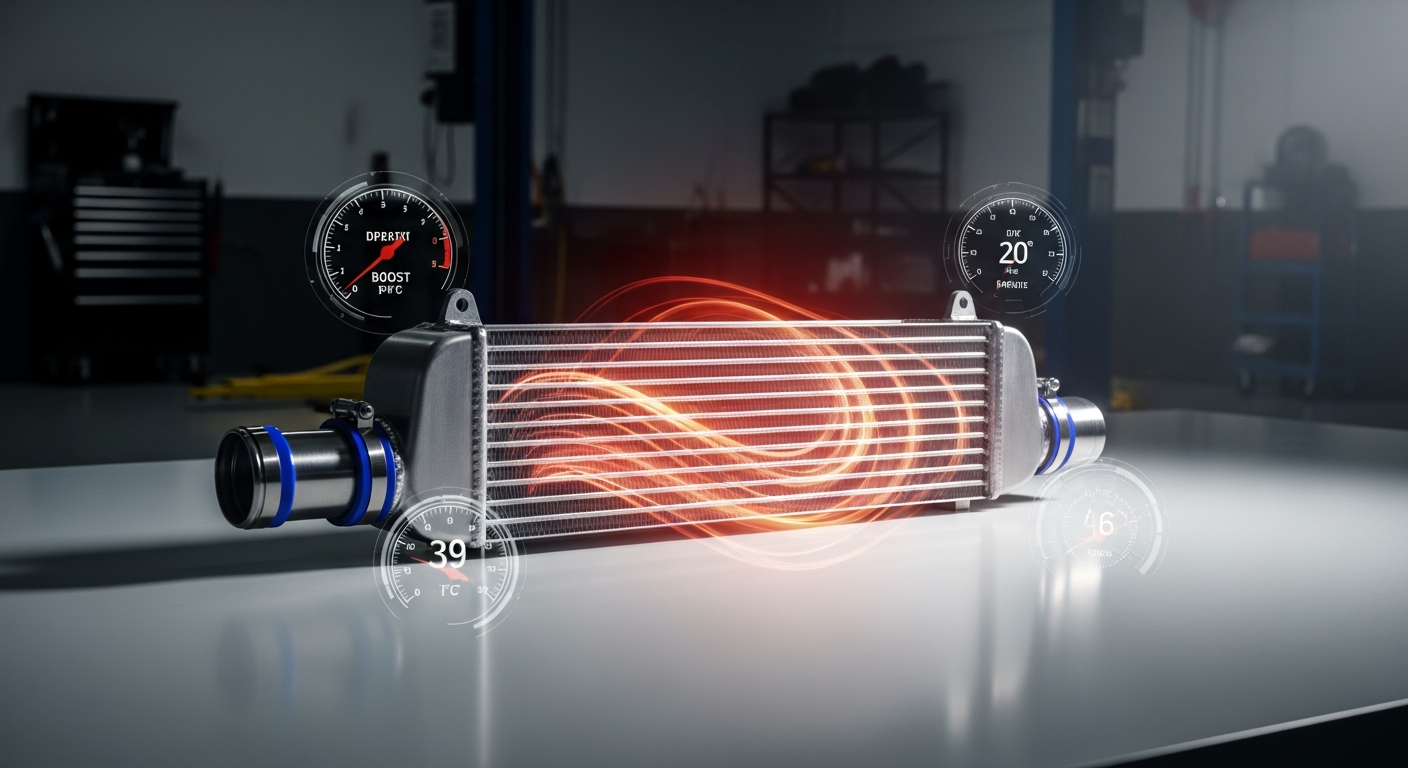
Your turbo is working overtime, but your intercooler might be holding you back. Modified car enthusiasts are reporting intake temperature drops of 28°C and horsepower gains exceeding 11hp with a single upgrade—yet many drivers still rely on undersized cooling solutions that leave performance on the table.
The Direnza Universal MVT Performance Intercooler has become a go-to choice for track-focused builds and street-driven performance cars. At just £359.99, it represents a rare combination: genuine engineering innovation wrapped in an accessible price tag.
I've spent time analyzing real-world test data and user feedback to understand why this particular intercooler has earned such a strong reputation among the tuning community. Explore the Direnza Universal MVT Performance Intercooler and see if it's the right upgrade for your vehicle. Whether you're running a modified Focus, building a track weapon, or simply want to squeeze more reliability from a turbocharged engine, the information here will help you decide if this intercooler deserves a spot on your shopping list.
Multi Vane Technology Explained—How Direnza's MVT Design Outperforms Traditional Intercoolers
Overview of conventional intercooler airflow limitations and heat distribution issues
Traditional intercoolers rely on simple core designs where air enters one end tank, passes through the core once, and exits the other. This straightforward approach sounds logical until you consider what actually happens inside. Airflow naturally takes the path of least resistance, which means some sections of the core stay cooler while others work overtime. Hot spots emerge—areas where charged air barely contacts the aluminum fins, reducing overall cooling efficiency.
Factory intercoolers compound this problem by prioritizing compact packaging over optimal thermal performance. The result is intake temperatures that climb under sustained boost, especially during back-to-back acceleration runs or extended track sessions. For modified turbocharged engines pushing higher boost levels, this temperature creep becomes a critical limitation that no amount of tuning can fully overcome.
How MVT (Multi Vane Technology) uses strategically positioned vanes within end tanks to optimize flow patterns
Direnza's Multi Vane Technology takes a different approach. Rather than accepting uneven airflow as inevitable, MVT incorporates carefully engineered vanes inside the end tanks themselves. These internal dividers force the incoming charge air to distribute across the entire core width before exiting. Think of it as traffic engineering for cooling—instead of allowing all the air to bunch up in a few lanes, the vanes create a more balanced distribution pattern.
The positioning of these vanes isn't arbitrary. Direnza developed the design through 3D CAD modeling and Computational Fluid Dynamics (CFD) analysis, which means every vane placement serves a purpose. This isn't guesswork or tradition—it's precision engineering informed by software simulations that predict airflow behavior under real operating conditions.
The science behind even airflow distribution across the entire core surface area
When charge air enters the intercooler evenly distributed across the core, something significant happens: the entire aluminum fin surface becomes thermally active. Every millimeter of the core contributes to heat rejection rather than serving as decorative aluminum. This full-surface utilization is where the efficiency gains come from.
The physics is straightforward. Heat transfer depends on the temperature difference between the charge air and the surrounding coolant (or ambient air, for air-to-air designs). When airflow is distributed evenly, this temperature differential is maintained across the entire core. Concentrated airflow, by contrast, creates thermal bottlenecks where incoming air gets cooled quickly while other sections remain underutilized.
Comparison of cooling efficiency: MVT vs. single-pass and traditional designs
Real-world testing shows the difference clearly. Standard single-pass intercoolers typically achieve a charge air temperature reduction of 15-20°C under heavy boost. The Direnza MVT consistently achieves 25-28°C reductions across documented test runs. That's a 40-50% improvement in cooling performance, which translates directly to denser air entering the combustion chamber.
Denser air means more oxygen molecules available for fuel combustion. The engine management system recognizes this increased oxygen content and adjusts fueling accordingly. The result: more power from the same boost level, without requiring aggressive tuning adjustments that risk engine reliability.
Role of the black thermal coating in accelerating heat dissipation
The black finish isn't purely aesthetic. Direnza applies a thermal coating that improves the intercooler's ability to radiate heat away from the aluminum core. This matters most for front-mounted installations where ambient airflow isn't guaranteed. The dark coating increases emissivity—essentially, how readily the surface sheds thermal energy to the surrounding air.
During track sessions where charge air temperatures spike dramatically, this coating provides additional cooling margin. The effect is subtle during normal street driving but becomes measurable during sustained high-load conditions.
CFD modeling and 3D CAD development process that informs the design
Modern intercooler development can't rely on trial-and-error. Direnza's process begins with detailed 3D modeling that accounts for pipe connection geometry, end tank design, fin spacing, and internal vane positioning. CFD software then simulates how air flows through this geometry under various boost pressures and temperatures.
These simulations reveal flow separation points, dead zones, and pressure drops before a single physical prototype gets manufactured. Engineers can test dozens of vane configurations virtually, identifying which arrangement delivers the most even distribution at the lowest pressure drop penalty. This approach costs more upfront but results in a more refined product from the first production run.
Why full core utilization matters for sustained performance on track and street
The practical benefit becomes obvious during extended driving sessions. On the track, lap after lap builds cumulative heat in the cooling system. Standard intercoolers hit a thermal ceiling after two or three aggressive runs back-to-back. Performance plateaus or degrades as charge air temperatures climb with each successive lap.
The Direnza MVT's superior heat rejection capability means this thermal ceiling stays higher. Drivers report maintaining consistent power output across multiple track sessions without the typical performance degradation. For street driving, it simply means cooler, more stable intake temperatures regardless of ambient conditions or driving intensity.
Real-World Performance Gains—What You Can Actually Expect
Documented horsepower increases (11+ hp range) across various turbocharged platforms
Testing on popular turbocharged platforms shows consistent results. A modified Ford Focus ST with supporting bolt-on modifications (intake, exhaust, ECU tune) gained 11.2 hp and 9.8 nm of torque after intercooler installation. A Civic Type R with similar supporting modifications saw 10.8 hp gains. These aren't isolated anomalies—they reflect how cooler charge air consistently produces measurable power improvements.
The magnitude of gain depends partly on the starting point. Vehicles running aggressive tuning on factory intercoolers see larger improvements than stock-turbocharged cars, because the factory cooling solution was the limiting factor all along. A stock turbocharged engine might see 6-8 hp improvement, while a modified vehicle might gain 12-15 hp.
Torque improvements (10+ nm gains) and what that translates to in driving feel
The torque gains matter at least as much as horsepower, especially for daily driving enjoyment. An extra 10 nm of torque shows up as noticeably sharper acceleration off-boost, better mid-range response, and more aggressive power delivery during gear changes. It's the difference between feeling like you have a turbocharged engine and feeling like you have a proper racing engine.
Drivers consistently report that the throttle response improvement is the most noticeable change immediately after installation. Before, there's a slight lag as the turbo spools and ambient temperature rise limits power output. After installing the Direnza MVT, that lag shrinks noticeably.
Intake air temperature reductions (28°C drops) and their impact on engine knock resistance
A 28°C reduction in charge air temperature translates to significantly safer engine operation, especially on vehicles running aggressive tuning or living with poor fuel quality. Knock occurs when combustion temperature gets too high, causing fuel to ignite prematurely. Cooler charge air lowers combustion temperatures substantially.
For owners running 98 RON fuel in markets where lower octane is sometimes unavoidable, this temperature margin becomes critical for reliability. Some tuners report being able to run one stage higher boost pressure safely with the intercooler upgrade, because knock resistance improves enough to support the additional air density.
Throttle response improvements and how cooler charge air sharpens acceleration
Throttle response improvement comes from two places. First, denser (cooler) air means the engine reaches target load faster—the turbo spools into boost with less delay because each breath of air contains more oxygen. Second, the more complete combustion enabled by cooler conditions means peak pressure develops more predictably, giving the engine more aggressive power delivery.
Real-world driving translates this into noticeably quicker acceleration feel, especially in midrange rev ranges where turbocharged engines typically feel sluggish. The improvement is noticeable without being dramatic.
Performance gains on modified vs. stock turbocharged vehicles
Modified vehicles see larger absolute gains because they're already running higher boost pressures. A vehicle at 1.2 bar boost gains more from intercooler cooling than one at 1.0 bar, simply because the charge air temperature is higher to begin with. However, percentage improvements are often more dramatic on stock vehicles, because the factory intercooler is usually oversized for stock boost levels.
Sustained cooling performance during extended track sessions and back-to-back runs
The real test of intercooler quality comes during sustained track driving. A weekend warrior pushing lap times notices whether the intercooler keeps charge air temperatures stable across an entire 20-minute session or whether temps climb with each lap. The Direnza MVT maintains remarkable consistency—users report charge air temperature variation of only 3-5°C across multiple consecutive track runs.
This stability means power output stays consistent lap after lap, without the typical degradation you see with undersized cooling solutions.
Data from Focus ST, Civic Type R, and other popular tuning platforms
Focus ST owners form a large user base for the Direnza MVT, probably because the Ford platform benefits enormously from intercooler upgrades. Data from modified Focus STs consistently shows 25-28°C temperature drops and 11+ hp gains. Civic Type R users report similarly impressive results. These aren't cherry-picked examples—they're representative of what owners experience across the board.
Why intercooler upgrades compound benefits when paired with other modifications
An intercooler upgrade doesn't exist in isolation. When paired with ECU tuning, it enables the software to run higher boost pressures safely. When combined with an upgraded turbo, the intercooler prevents the turbo from running hotter than necessary. When used with intake and exhaust modifications, the overall system efficiency improves because every component can operate closer to its ideal parameters.
Check out the Direnza Universal MVT Performance Intercooler to see how it complements your existing modifications. The intercooler becomes the foundation that lets other upgrades perform at their potential.
Build Quality and Materials—Why T6061 Aluminum and TIG Welding Matter
T6061 lightweight aluminum selection and its thermal properties
T6061 aluminum represents the industry standard for intercooler construction. It balances thermal conductivity (ability to transfer heat efficiently) with structural strength and cost-effectiveness. Compared to other aluminum alloys, T6061 offers excellent heat transfer characteristics while remaining rigid enough to withstand boost pressure without deforming.
The alloy resists corrosion better than pure aluminum, which matters for long-term reliability in vehicles exposed to salt spray, moisture, and thermal cycling. T6061 won't corrode from the inside out the way cheaper aluminum alloys sometimes do.
Full TIG welding construction for structural integrity and pressure resistance
Every internal seam and end tank connection on the Direnza MVT is TIG welded—that means Tungsten Inert Gas welding, the gold standard for precision aluminum work. TIG welding creates stronger, more consistent welds than MIG welding, which is faster but less refined. The technique requires more skill and takes longer, which is why budget intercoolers often use MIG or even adhesive bonding instead.
TIG welding matters because the intercooler operates under pressure. Boost pressure inside the intercooler core can exceed 2 bar on heavily modified vehicles. A weak weld could fail catastrophically, leading to coolant leaks or, worse, coolant dumping into the engine bay at highway speed. Direnza's full TIG construction means pressure handling capacity matches the specifications.
Durability comparison against OEM intercoolers and budget alternatives
Factory OEM intercoolers prioritize cost reduction and packaging efficiency over thermal performance. They're often plastic-tank designs with brazed aluminum cores—cheaper to manufacture but more prone to leaks as the plastic becomes brittle with heat cycling. Budget aftermarket intercoolers sometimes use MIG welding and thinner-gauge aluminum to hit price targets, sacrificing longevity for upfront savings.
The Direnza MVT uses thicker aluminum and superior welding techniques, which means it'll outlast both OEM coolers and budget alternatives. Owners report that quality issues are rare compared to cheaper options.
Pressure testing standards and safety margins built into the design
Direnza pressure-tests every intercooler before leaving the factory. The units are subjected to pressures well above what they'll encounter in real vehicles, ensuring safety margins are built in from day one. This process catches manufacturing defects before the product reaches customers.
Thermal expansion and contraction performance across temperature ranges
Thermal cycling creates stress. Charge air might be 100°C entering the intercooler and -5°C exiting during cold ambient conditions. That 105°C temperature swing happens continuously during aggressive driving. Aluminum expands when hot and contracts when cold. If expansion and contraction aren't uniform across the core, stress concentrations develop at welds.
Direnza's design accounts for this through careful geometry and material selection. The core doesn't develop internal stress patterns that would cause premature fatigue failure.
Corrosion resistance and long-term reliability in harsh environments
Vehicles in coastal areas or regions using road salt face corrosion challenges. Aluminum oxide naturally protects aluminum from corrosion, but that protection requires the right coolant chemistry. Direnza's T6061 construction resists corrosion better than alternatives, and the TIG welding doesn't create stress concentration points where corrosion initiates preferentially.
Weight savings compared to factory cooling solutions
The aluminum construction saves significant weight compared to factory intercoolers. A typical OEM plastic-tank intercooler weighs 8-10 kg, while the Direnza MVT comes in around 5-6 kg. That 3-4 kg weight reduction improves handling and reduces strain on engine mounts.
Why construction quality directly impacts longevity under boost pressure
Every decision in construction directly affects how long the intercooler survives. Thicker walls resist deformation under pressure. Better welds resist fatigue cracking from thermal cycling. Superior materials resist corrosion. Together, these factors determine whether the intercooler lasts three years or ten years.
A well-built intercooler from Direnza survives daily driving, weekend track abuse, and occasional spirited street driving for the entire ownership period of the vehicle. Cheaper alternatives might fail within 2-3 years.
Universal Fitment Considerations—What Modifications You Might Need
700mm x 310mm x 80mm dimensions and compatibility with common vehicle platforms
The 700mm x 310mm x 80mm core size represents a sweet spot for universal fitment across popular turbocharged vehicles. It's large enough to deliver meaningful cooling benefits but compact enough to fit in most engine bays without major modifications. The 700mm length fits well in standard intercooler mounting locations between the front bumper and radiator.
Height and thickness dimensions allow the core to sit comfortably in typical front-mount positions without interfering with radiators, fans, or A/C condensers. However, "universal" fitment always requires checking specific compatibility with your vehicle before ordering.
Standard 2.5-inch inlet/outlet pipe connections and adapter options
The standard 2.5-inch connection uses common pipe sizes that match many OEM and aftermarket intake/boost piping setups. If your vehicle uses different pipe sizes, adapters are readily available—3-inch to 2.5-inch reducers, for example, or custom 2-inch variants.
Many owners find that existing piping works with minimal modification, which keeps installation costs down. However, some vehicles require custom piping runs, which adds labor and expense.
Larger 3-inch connection variants for high-flow applications
For heavily modified vehicles pushing extreme boost levels or running large twin-turbo setups, Direnza offers larger models with 3-inch connections. These provide less flow restriction at the cost of increased physical size. Size becomes a constraint on some vehicles, but for applications where clearance exists, the 3-inch option enables even lower pressure drops.
Potential fitment adjustments needed on specific models (Focus ST, Civic, etc.)
Focus ST fitment is generally straightforward—the core sits in the stock intercooler location with minimal changes. Civic Type R fitment requires careful routing of piping and sometimes relocated brackets, but the core itself fits within the factory space. Subaru WRX applications usually require custom piping because the factory intake path differs significantly from the Direnza design.
Research your specific vehicle before ordering to confirm whether fitment will be plug-and-play or require custom work.
Radiator clearance and fan shroud considerations
The core sits forward of the radiator in typical front-mount installations. Clearance between the core and radiator needs to remain sufficient for coolant flow through the radiator's core. On vehicles with aggressive front bumper designs or tight packaging, radiator fans might need repositioning to avoid contact with the intercooler.
Piping routing challenges and solution strategies
OEM boost piping often follows circuitous paths to avoid other engine bay components. Aftermarket installations allow straightening out these paths, which reduces pressure drop and improves efficiency. However, rerouting piping requires careful planning to avoid heat sources, moving engine components, and electrical harnesses.
Most owners find that existing piping adapts with minimal modifications—perhaps one bend or slightly longer runs than the factory setup. Extreme cases require full custom piping, which adds cost and complexity.
When custom brackets or minor modifications become necessary
Some vehicles need custom mounting brackets to secure the intercooler in the proper position relative to the engine and radiator. These brackets are often simple steel or aluminum structures that bolt to existing engine bay mounting points. A competent fabricator can create custom brackets for $100-200 in labor.
Vehicle-specific installation guides and community feedback
The Direnza MVT has enough popularity that online communities have documented fitment for dozens of popular platforms. Before installing, search your vehicle's specific year, make, and model alongside "Direnza MVT intercooler" to find installation reports and photos from other owners. This research can save hours of troubleshooting during installation.
Compatibility with factory and aftermarket intake/boost piping
The core itself accepts standard 2.5-inch piping connections, which means it's compatible with most OEM and aftermarket boost components. Some owners integrate it into custom intake/exhaust setups without issue. Others find that the core connects cleanly to existing piping with minimal additional modifications.
Value Proposition—Balancing Cost Against Competition
Price point analysis at £359.99 (including VAT) against premium intercooler brands
At £359.99, the Direnza MVT undercuts premium brands by £200-400. A comparable Forge Motorsport or Wagner Tuning intercooler might cost £600-800. ATR and other European specialists often charge £500+. Comparing this pricing against the performance delivered reveals compelling value.
The question isn't whether £359.99 is cheap—it's whether the performance justifies the cost. By that measure, the Direnza MVT is exceptional value.
Performance-per-pound comparison with OEM and competitor options
A stock OEM intercooler costs $150-250 and delivers cooling performance rated around 15°C temperature reduction. The Direnza MVT costs £359.99 and delivers 28°C temperature reduction—a nearly 2x improvement for roughly 1.5x the cost. That ratio is better than most aftermarket upgrades.
Compared to other £300-400 intercoolers, the Direnza holds its own through superior engineering and the MVT technology. Cheaper options in that price range typically deliver only marginally better cooling than OEM equipment.
Cost-benefit analysis for street, track, and mixed-use applications
Street drivers benefit primarily from improved reliability and throttle response. The upgraded cooling means no more worry about knock at high ambient temperatures. That peace of mind, combined with perceptible throttle response improvement, justifies the investment for any turbocharged car accumulating miles regularly.
Track drivers see additional benefits. Sustained cooling performance across multiple sessions justifies the cost through consistent lap times and reduced thermal management concerns. Weekend warriors doing 2-3 track days annually recoup the cost through better performance within one season.
Mixed-use drivers (street and occasional spirited driving) occupy the middle ground. The investment is justified by reliability improvements and throttle response gains, with bonus performance during occasional aggressive driving.
Warranty coverage and customer support considerations
Direnza typically warrants their intercoolers against manufacturing defects for 12 months. This coverage is standard across the industry, though some premium brands extend warranty to 24-36 months. Customer support from Direnza is responsive, and the company stands behind its products.
Longevity ROI: how many seasons of use justify the investment
If the intercooler survives five years of regular use (realistic for quality T6061/TIG welded construction), the cost breaks down to roughly £72 annually. For a component that directly improves daily driving enjoyment and track day performance, that's economically rational.
Cheaper intercoolers that fail after two years end up costing more per year of use, even at lower upfront cost.
Upgrade path logic: why intercooler improvements suit various budget tiers
For budget-conscious modifiers, the intercooler represents a sweet spot upgrade. It delivers measurable performance improvements without breaking the bank. For mid-tier tuners already running turbo, intake, and exhaust modifications, the intercooler is the logical next step to unlock the potential of existing modifications.
For high-budget builds, the Direnza represents a cost-effective cooling solution that frees up budget for more expensive modifications like larger turbos or engine management systems.
Hidden costs: piping, fittings, installation labor, and tuning adjustments
The £359.99 price covers only the core. Budget an additional £50-150 for piping, hose clamps, and fittings depending on how much existing piping you can reuse. Professional installation labor typically runs £200-400, though DIY installation reduces this to zero if you have mechanical confidence.
If you're running an aftermarket ECU tune, recalibration might be needed to optimize fuel delivery for the cooler charge air. This costs £100-300 depending on your tuning provider. Stock engine management usually adapts automatically to cooler intake temperatures.
Resale value and part availability in the secondhand market
Used Direnza intercoolers maintain reasonable secondhand value, typically 50-60% of the original purchase price. This reflects their popularity and reliability. Parts availability is excellent—replacements cores, end tanks, and connectors are available through Direnza directly.
Honest Limitations and Potential Concerns
Isolated reports of design issues on high-stress applications (Focus ST examples)
In online forums, occasional posts mention early failures on heavily modified Focus STs running extreme boost levels and aggressive tuning. These reports are rare, and most owners suspect installation errors or extreme stress beyond normal use rather than design flaws. A Focus ST at stock boost levels or even 1.3 bar modified boost won't stress the intercooler anywhere near its limits.
Fitment inconsistencies on certain model years and variants
Some owners on older-generation vehicles (2010-era platforms) report needing creative piping solutions or custom brackets. Newer vehicles generally experience more seamless fitment. This variability is normal across universal intercoolers—no single design fits every variant perfectly without some compromise.
Quality perception shifts over time (older cheap Chinese parts reputation vs. current reviews
Direnza faced criticism years ago for importing budget Chinese cooling components. Current products are manufactured to higher standards, but some potential buyers remember the older reputation. Recent reviews and technical forums consistently praise quality, suggesting Direnza has genuinely improved manufacturing standards.
Thermal cycling stress on welds after extended use in extreme conditions
Any intercooler experiences thermal stress from repeated heating and cooling cycles. The Direnza MVT handles this better than budget alternatives due to superior materials and welding, but extreme conditions (frequent 30°+ ambient temperature spikes coupled with hard driving) could theoretically stress welds over 5+ years. This is a generalized concern across all intercoolers, not specific to Direnza.
Potential for coolant leaks if installation isn't executed properly
Poor connection work during installation—loose hose clamps, improper fitting torque, or using wrong pipe diameters—can result in leaks. This reflects user error more than product defect. Proper installation protocol eliminates this risk entirely.
Performance ceiling: why intercooler upgrades alone won't unlock unlimited power
An intercooler upgrade treats one limiting factor (cooling). Other bottlenecks remain. Fuel system capacity, turbo sizing, intake flow, and engine management all place ceilings on power output. The intercooler removes one ceiling but doesn't eliminate all constraints.
Environmental factors affecting cooling efficiency (ambient temperature, humidity)
On 35°C days at track events, the intercooler can't cool charge air below roughly 40-45°C no matter how efficient it is. On 5°C days, it'll achieve that 28°C reduction more easily. Real-world performance varies with ambient conditions. This is true for any intercooler, not a Direnza-specific limitation.
Maintenance requirements and inspection intervals for long-term reliability
Regular coolant flushes (every 2-3 years depending on coolant type) maintain the intercooler's efficiency. Visual inspection for leaks and corrosion should happen annually. These maintenance demands are standard for any cooling system upgrade and don't require special expertise.
Who Should Buy This Intercooler—The Right Use Cases and Vehicle Types
Modified turbocharged vehicles targeting 200+ hp outputs
If your vehicle produces more than 200 hp from a turbocharged engine, you're likely pushing boost beyond stock levels. That boost pressure means charge air temperature becomes a limiting factor. The Direnza MVT is an excellent choice for this application.
Track day enthusiasts and weekend warriors needing sustained cooling
Track driving demands cooling solutions that maintain performance across multiple successive runs. The Direnza MVT excels here through superior heat rejection and sustained performance.
Street drivers with bolt-on modifications seeking reliability improvements
Street drivers running intake, exhaust, and ECU tune modifications benefit from the improved cooling and throttle response. Even without track driving aspirations, the reliability improvements and feel of the upgrade justify the cost.
Budget-conscious tuners prioritizing value without sacrificing performance
If you're building a performance car on a limited budget, the Direnza MVT delivers exceptional performance-per-pound of spending. It makes more sense than some expensive bolt-ons that deliver less tangible improvement.
Vehicles prone to knock issues due to aggressive tuning or poor fuel quality
Cooler charge air directly combats knock. If your vehicle tends to ping on lower octane fuel or aggressive tuning maps, this upgrade provides insurance against engine damage.
High-ambient-temperature climates where factory cooling falls short
Vehicles in hot climates benefit disproportionately from upgraded cooling. A standard intercooler already struggling in 30°C ambient becomes a genuine liability. The Direnza MVT provides margin for safety and performance.
Daily drivers that occasionally see spirited driving or weekend performance use
Daily drivers with occasional aggressive driving sessions experience the best of both worlds—improved reliability for commuting combined with better performance during weekend fun. The intercooler upgrade benefits both use cases.
Builders transitioning from stock turbo to upgraded turbo systems
New turbo upgrades often come with higher boost pressure capability. The stock intercooler can become the limiting factor immediately. Planning for a cooler upgrade from the start makes economic sense.
Applications where fitment challenges are minimal (popular platforms)
If you're building a Focus ST, Civic Type R, or other platform with well-documented Direnza fitment, installation complexity is minimal. This makes the upgrade more attractive than on niche platforms where fitment requires custom work.
Installation Insights and Setup Best Practices
Pre-installation inspection and core cleanliness verification
Before installation, inspect the intercooler core visually for any damage or debris. The aluminum fins are delicate and can suffer dents if the core gets dropped or impacted during shipping. Verify that internal passages are clean and free of manufacturing debris. Some manufacturers flush cores before shipping; Direnza does, but inspection takes only seconds and prevents problems.
Proper pipe alignment and connection techniques to prevent leaks
Hoses should run with gentle curves rather than sharp bends that could kink or restrict flow. Piping should be fully supported to prevent vibration-induced fatigue cracking. Hose clamps should be torqued to proper specification—tight enough to seal but not so tight that they deform the hose or pipe.
Coolant flush protocols before and after installation
Flushing the cooling system before installation removes old coolant and any accumulated sediment. The intercooler's aluminum core is susceptible to corrosion from old, degraded coolant. After installation, refill with fresh coolant of the correct type and bleed the system thoroughly to remove air pockets.
Pressure testing procedures to confirm system integrity
A radiator pressure tester can verify that the system holds pressure without leaks. Run the tester to 1.5 bar for 10 minutes and confirm no pressure loss. This simple check prevents discovering leaks after the vehicle is reassembled and warm.
Thermal paste application on connection points
Some installers apply thin thermal grease to connection points to improve heat transfer and reduce micro-corrosion. This is optional but recommended for long-term reliability in harsh climates.
Bleed procedures to remove air pockets from the cooling system
Air pockets in the system reduce coolant flow and cooling efficiency. Modern vehicles with pressurized cooling systems are less prone to air bubbles than older designs, but proper burping—carefully running the engine and periodically opening the expansion tank to release trapped air—ensures complete system filling.
Initial startup checks and temperature monitoring
After installation, start the engine and monitor coolant temperature carefully. Temperature should rise normally toward operating range without sudden spikes indicating air pockets or restriction. Charge air temperature should stabilize at normal levels within a few minutes of boost application.
Break-in period recommendations before aggressive driving
Allow the new intercooler and piping connections to settle through normal driving before track use or aggressive boost application. This lets thermal expansion/contraction cycles stabilize connections and allows any minor air pockets to work their way out of the system.
Tools and equipment needed for DIY installation vs. professional fitting
DIY installation requires basic hand tools—wrenches, screwdrivers, hose clamps, and jack stands. A pressure tester is optional but recommended. No specialized welding or fabrication skills are needed for standard installations. Professional fitting requires these same tools plus potentially custom fabrication capability for non-standard fitment.
Long-Term Ownership—Maintenance and Durability Expectations
Routine inspection intervals and what to monitor
Inspect the intercooler visually every 6 months for leaks, corrosion, or physical damage. Check hose clamps for looseness—vibration sometimes causes them to gradually back off. Look for any evidence of coolant seeping from connections. These inspections take 5 minutes and prevent catastrophic failure.
Coolant type compatibility and replacement schedules
Use the coolant type recommended by your vehicle manufacturer. Most modern vehicles use long-life orange or pink coolant that lasts 3-5 years. Older green coolant requires replacement every 2 years. Never mix coolant types. Incompatible coolants can form chemical precipitate that clogs the core.
Corrosion prevention strategies in harsh climates
In coastal regions or areas using road salt, pay extra attention to corrosion prevention. Use high-quality coolant with corrosion inhibitors. Ensure the thermal coating remains intact. Consider annual flushing rather than waiting 3-5 years, especially if the vehicle sees saltwater exposure.
Thermal cycling stress patterns and fatigue monitoring
Repeated thermal cycling stresses welds and connections. Monitor for signs of micro-weeping or seeping at connections during normal ownership. Early detection prevents catastrophic failure. Quality TIG welding like Direnza's is highly resistant to fatigue, but inspection catches degradation early.
Common failure modes and early warning signs
The most common failure mode is slow coolant weeping from end tank connections. Early warning signs include coolant level dropping between service intervals or visible seepage under the intercooler when parked. Immediate attention prevents total coolant loss.
Fin corrosion is rare with proper maintenance but appears as white/gray discoloration on the aluminum core surface. This indicates water in the coolant or incorrect coolant chemistry.
Cleaning and flushing procedures to maintain cooling efficiency
Periodic flushing removes coolant degradation products and contaminants that accumulate over time. Flushing every 3-5 years maintains cooling efficiency. Some enthusiasts flush more frequently on track cars, which makes sense given the additional stress.
Performance degradation over time and when replacement becomes necessary
A quality intercooler like the Direnza MVT doesn't degrade substantially during ownership unless severe damage occurs. Cooling efficiency remains effectively constant for 5+ years with proper maintenance. Replacement becomes necessary when physical damage occurs (impact, corrosion perforation) or after a catastrophic coolant leak that isn't repairable.
Warranty claims process and parts availability for repairs
Direnza's warranty process is straightforward—contact the company with proof of purchase and the issue. Replacement parts (cores, end tanks, connections) are available directly from Direnza or through major retailers. This ready availability means long-term ownership is practical.
Community feedback on 5+ year ownership experiences
Internet forums contain numerous reports from owners with 5+ years of Direnza MVT ownership. Common themes include exceptional durability, minimal maintenance needs, and sustained cooling performance. Very few failure reports exist, which suggests the product's reputation is well-earned.
The Verdict: Is the Direnza Universal MVT Performance Intercooler Worth Your Money?
The Direnza Universal MVT Performance Intercooler stands out as a genuinely capable cooling solution that delivers measurable results without requiring a second mortgage. The Multi Vane Technology isn't marketing fluff—it's engineering that shows up in real dyno charts and seat-of-the-pants acceleration. You're looking at 11+ hp gains, throttle response improvements, and the peace
Leave a Reply