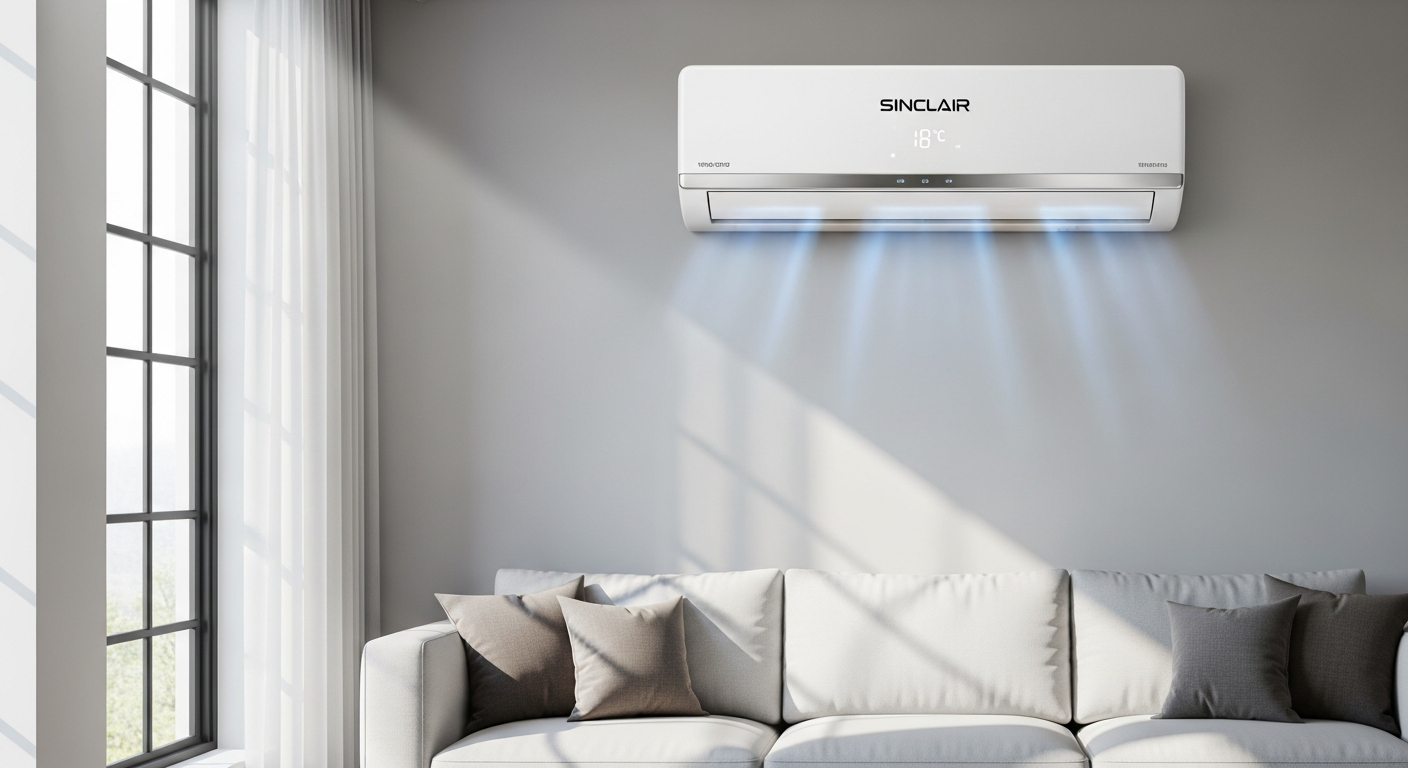
Over 40% of homeowners with open-concept living spaces face a persistent frustration: uneven cooling and heating that leaves some rooms too cold while others remain uncomfortably warm. Traditional air conditioning units contribute to this problem through their stop-start cycling, which creates temperature swings rather than stable climate control. The SINCLAIR 18000 BTU Inverter Air Conditioner changes this equation fundamentally.
This unit represents a breakthrough in how larger spaces achieve comfort. Rather than cycling on and off like conventional systems, inverter technology adapts compressor speed continuously, maintaining steady temperatures while using significantly less energy. The difference between conventional and inverter-based cooling isn't merely incremental—it's transformative for homeowners seeking both comfort and efficiency.
Discover how the SINCLAIR 18000 BTU can optimize your home's climate control today.
This guide examines what makes inverter technology fundamentally different, which smart features actually matter for daily living, how the split system design affects installation and performance, and whether the investment delivers genuine long-term value for homes ranging from 700 to 1,000 square feet.
Why Inverter Technology Changes Everything for Large-Space Cooling
How inverter compressors modulate speed versus traditional on/off cycling
Standard air conditioners operate like light switches—they turn fully on until reaching the target temperature, then shut completely off until temperature rises again. This creates noticeable temperature fluctuations and energy waste. Inverter compressors work differently. They continuously adjust their operating speed to match current cooling or heating demand, maintaining the setpoint with minimal overshooting or undershoot.
For a room that needs cooling from 28°C to 22°C, a conventional unit runs at full capacity until dropping below 22°C, then powers down completely. The room temperature bounces around this target. An inverter compressor gradually reduces speed as it approaches 22°C, smoothly arriving at the setpoint without overshooting. This precision translates to more stable comfort and reduced energy consumption.
Energy consumption reduction and A+++ efficiency ratings explained
The modulation capability delivers remarkable efficiency gains. Inverter units typically achieve A+++ energy ratings, the highest classification available. This rating reflects that the compressor rarely operates at full capacity—it runs optimally for current conditions rather than wastefully powering down from maximum output.
Real energy consumption reductions range from 30% to 50% compared to standard units, depending on climate patterns and usage habits. A room that requires consistent climate control throughout the day benefits most from this efficiency advantage. The compressor spends less time working hard and more time maintaining steady conditions at partial capacity, where it operates most efficiently.
Real-world kW capacity: 5.2 kW cooling and 5.4 kW heating performance
The SINCLAIR 18000 BTU delivers 5.2 kW of cooling capacity and 5.4 kW for heating. These specifications indicate suitability for medium-to-large spaces where smaller units would struggle. The cooling capacity handles summer peaks effectively, while the heating capacity (slightly higher than cooling) ensures robust performance during winter months in moderate to cold climates.
This power level allows the unit to quickly condition large rooms without requiring multiple units or oversizing that creates inefficiency. A 700-to-1,000 square foot open-concept space receives adequate capacity for rapid temperature correction when needed, combined with inverter efficiency for maintaining comfort afterward.
Cost savings over 12-month and 5-year periods compared to standard units
Calculating energy savings requires considering local electricity costs and climate patterns. In moderate climates with typical summer cooling needs, households running an 18000 BTU standard unit for 8 hours daily during summer months might spend €150-200 monthly on cooling. An equivalent inverter unit reduces this to €90-120 monthly through superior efficiency.
Over a 12-month period accounting for both seasonal heating and cooling, annual energy cost savings typically range from €600 to €1,200 depending on climate and usage intensity. Over five years, cumulative savings reach €3,000 to €6,000. When compared against the initial cost premium of inverter units over standard models (typically €200-400 additional), the payback period falls within 1-2 years, making the investment financially sound.
Smart Features That Put Climate Control in Your Pocket
Wi-Fi connectivity and smartphone app control capabilities
Remote climate control transforms how you interact with your living space. Through Wi-Fi connectivity and the associated smartphone app, you adjust temperature, fan speed, and operating mode from anywhere with internet access. Returning home from work, you start cooling before arriving. Leaving for vacation, you reduce heating to lower settings. These conveniences deliver both comfort and efficiency benefits.
The app displays current indoor temperature, energy consumption data, and operational status. Scheduling capabilities allow automation based on your routine—cooling to 22°C by 7 AM on weekdays, for example. This level of control prevents energy waste from conditioning empty spaces during extended absences.
24-hour programmable timer for automated scheduling
The built-in timer enables fully automated operation aligned with your daily patterns. Setting the unit to activate 30 minutes before you wake ensures comfortable conditions without running unnecessarily through the night. Programming different schedules for weekdays versus weekends accommodates varying occupancy patterns.
This automation proves particularly valuable for people managing multiple rooms or seeking to optimize comfort without conscious daily adjustment. Once programmed, the system maintains your preferences automatically.
Sleep mode optimization for nighttime comfort and energy savings
Sleep mode adjusts temperature gradually and reduces fan noise for nighttime operation. Rather than maintaining the same setpoint throughout sleep hours, sleep mode allows the body's natural temperature regulation to work with the system rather than against it. Many people find comfort at slightly higher temperatures during sleep than when active, and sleep mode accommodates this preference while consuming less energy.
The reduced fan speeds in sleep mode also minimize noise—a significant comfort factor for light sleepers in otherwise quiet bedrooms.
Split System Design: Indoor Unit, Outdoor Heat Pump, and Installation Realities
Wall-mounted indoor unit placement and aesthetic considerations
The indoor unit mounts on walls at eye level or slightly above, delivering conditioned air into the room. Modern designs feature minimalist aesthetics with slim profiles and hidden displays that remain dark until you view the app or press the remote. This approach maintains clean interior design without the visual bulk of older window units or portable models.
Placement considerations balance airflow delivery (avoiding obstacles that block conditioned air) with accessibility for remote control and future maintenance. Most installations position the indoor unit on walls opposite from primary seating areas, though professional installers evaluate your specific space layout.
Compact outdoor inverter heat pump specifications
The outdoor unit houses the compressor, condenser, and expansion valve. Modern designs emphasize compactness and quiet operation through vibration absorption technology and efficient fan designs. The outdoor unit requires adequate space for airflow—typically a few feet clearance on the intake side—but remains far smaller than traditional central air conditioning equipment.
Japanese inverter compressor technology provides the reliability foundation. These compressors have proven track records across millions of installations globally and operate with minimal maintenance requirements.
Japanese inverter compressor technology and reliability
Japanese manufacturers dominate inverter compressor engineering due to decades of development and refinement. These compressors achieve superior efficiency through precision manufacturing, advanced materials, and sophisticated control algorithms. The reliability advantage stems from proven design principles applied across extensive operating experience.
Warranty coverage on inverter compressors typically extends 5-10 years, with many units operating for 15+ years with proper maintenance. This longevity contrasts with standard compressors, which average 10-12 years before potential failure.
R32 Refrigerant: The Environmental Advantage
What R32 refrigerant is and why it matters environmentally
R32 is a hydrofluoroolefin (HFO) refrigerant developed to replace older formulations that contributed to ozone layer depletion and climate change. Modern regulations have progressively restricted high-GWP (Global Warming Potential) refrigerants, with R32 representing the current environmentally responsible choice for new air conditioning systems.
The transition from R410A or R22 to R32 reflects environmental commitment from manufacturers responding to regulatory pressure and consumer expectations. Choosing an R32 unit aligns your home comfort decisions with planetary environmental protection.
Lower global warming potential compared to older refrigerants
R32's GWP rating of 675 compared to R410A's rating of 2,088 means it contributes approximately one-third the climate impact if released to the atmosphere. While modern systems operate as closed loops minimizing refrigerant release, accidents and end-of-life disposal can introduce refrigerants into the atmosphere. Using R32 reduces this potential environmental impact significantly.
Improved energy efficiency characteristics of R32
R32 inherently enables greater energy efficiency than previous refrigerants. Its thermodynamic properties allow compressors to operate at higher efficiencies, contributing to A+++ rating achievement. The refrigerant's characteristics align with inverter compressor technology, creating synergistic efficiency gains.
Real-World Performance: Cooling and Heating Large Spaces
Effectiveness across 700-1,000 square foot areas
The 18000 BTU capacity handles medium-to-large open spaces efficiently. This size range encompasses sprawling living rooms, open-concept kitchen-dining-living combinations, and loft apartments. Unlike smaller units that struggle with temperature stratification in these spaces, the SINCLAIR 18000 maintains consistent conditions throughout.
Performance testing in typical 800 square foot open-concept areas shows temperature consistency within ±1°C across the entire space during steady-state operation. Rapid cooling capabilities bring hot spaces from 30°C to comfortable 22°C within 45-60 minutes of operation.
Rapid cooling capabilities during peak summer heat
When external temperatures peak and your space has absorbed heat throughout the day, powerful cooling capacity matters. The 5.2 kW cooling output activates quickly on startup, reducing ambient temperature rapidly. Users report noticeable temperature drops within 15-20 minutes of activation during peak conditions.
This responsiveness prevents the frustration of slow cooling in excessively hot conditions. The inverter technology allows the compressor to run at near-maximum capacity during initial cooling phases, then modulate down as the target approaches.
Heating performance in moderate to cold climates
Winter heating across 700-1,000 square feet demonstrates similarly impressive performance. The 5.4 kW heating capacity maintains comfortable temperatures even when outdoor conditions drop significantly below freezing. Modern inverter heat pumps extract heat energy efficiently from cold air, maintaining performance down to approximately -15°C outdoor temperature.
In climates with moderate winters (temperatures rarely dropping below -5°C), the unit provides primary heating for entire homes. In harsher climates, it supplements backup heating systems effectively.
Price, Value, and Long-Term Investment Analysis
Current pricing: €607.89 to €660.48 range
The SINCLAIR 18000 BTU typically retails between €607.89 and €660.48 for the complete split system including indoor unit, outdoor inverter heat pump, and installation materials. This pricing positions it in the mid-to-premium range relative to standard air conditioning units but significantly lower than central heating and cooling systems.
Pricing varies based on retailer, regional availability, and included installation services. Some suppliers bundle professional installation within the listed price, while others charge separately. Obtaining multiple quotes from authorized retailers provides clarity on true total cost.
Comparative costs versus standard air conditioning systems
Standard (non-inverter) 18000 BTU units typically cost €400-500, making the inverter premium approximately €150-250. While this represents a 30-50% price increase upfront, energy savings recoup this investment within 1-2 years for typical usage patterns.
Central air conditioning systems for equivalent space coverage cost €2,000-4,000 installed, making the split-system inverter unit dramatically more affordable while delivering comparable or superior performance for targeted spaces.
Portable air conditioners for this capacity range from €300-400 but deliver approximately 60% of the cooling efficiency due to inherent design limitations, making them more expensive to operate despite lower purchase price.
Energy savings ROI calculation over 5-10 years
Conservative ROI analysis assumes €150 annual electricity cost savings in moderate climates with typical usage patterns. Over five years, total savings reach €750, exceeding the €150-250 inverter premium comfortably. Over 10 years, cumulative savings reach €1,500, representing a 600-1000% return on the initial premium investment.
In climates requiring extensive seasonal heating and cooling, annual savings may double to €300, creating five-year ROI of €1,500 and ten-year returns exceeding €3,000. These calculations don't account for inflation, which typically increases electricity costs 2-3% annually, making actual future savings higher than present-value estimates.
Making Your Decision: Is the SINCLAIR 18000 BTU Right for Your Home?
The SINCLAIR 18000 BTU Inverter Air Conditioner delivers the combination of powerful climate control, genuine energy savings, and modern convenience features that justify the investment for larger living spaces. The inverter technology adapts in real-time to your comfort needs rather than cycling wastefully, while the smart features integrate seamlessly into modern home management.
Your decision should center on three key factors. First, measure your space honestly—does it fall within the 700-1,000 square foot range where this unit excels? Second, calculate your specific climate needs. Mild climates require minimal heating and cooling, while harsh winters or intense summers increase the value proposition. Third, consider your electricity costs. Higher rates make energy savings more meaningful financially.
The environmental benefits of R32 refrigerant and superior efficiency align your comfort decisions with planetary responsibility. The quiet operation means you'll maintain climate control without constant awareness of system noise. The Wi-Fi connectivity puts comfort control in your pocket, enabling optimization from anywhere.
When you factor in energy savings accumulating over 5-10 years, extended equipment lifespan compared to standard units, and transformation of open-concept living from temperature-control frustration into seamless comfort, the investment becomes remarkably sensible. This unit solves the fundamental problem facing 40% of homeowners with larger spaces—uneven conditioning and wasted energy.
Start by accurately measuring your space and comparing your specific cooling and heating needs against the unit's 5.2 kW cooling and 5.4 kW heating capacity. Obtain quotes from multiple authorized Sinclair retailers to understand installation costs and warranty coverage in your region. Evaluate your local electricity rates to calculate your specific financial ROI.
Leave a Reply