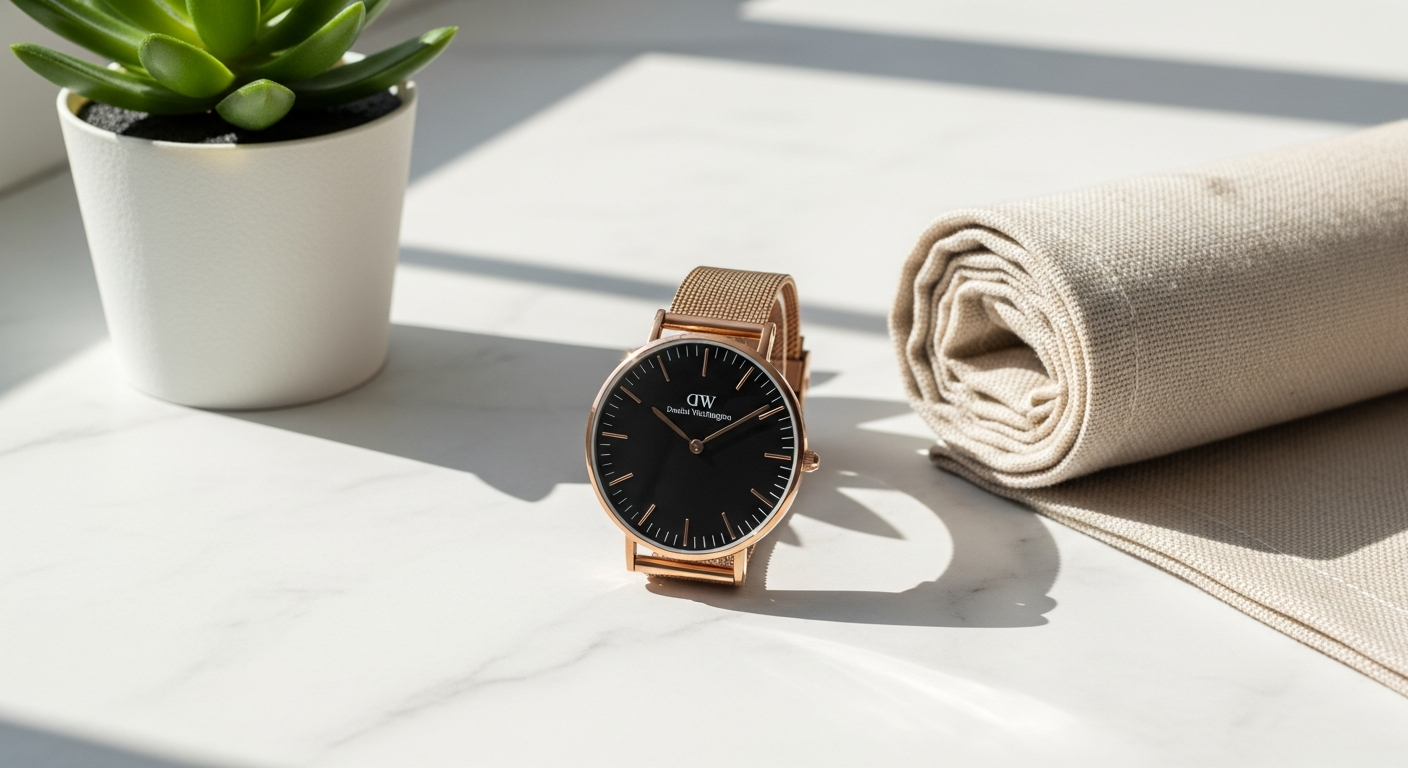
Over 2 million Daniel Wellington watches have sold worldwide, yet the Classic Petite remains the collection's crown jewel. This isn't just a watch—it's a cultural phenomenon that redefined what affordable luxury means for an entire generation. The Daniel Wellington Classic Petite emerged as the brand's answer to a growing demand for sophisticated, wearable accessories that didn't require a luxury price tag.
With its slim 28mm and 32mm cases, delicate mesh bands, and clean Scandi-chic aesthetic, this watch captured something the market was desperately seeking: timeless style without the pretension. The €130–€200 price point positioned it perfectly between fast-fashion accessories and haute horlogerie, making it accessible yet aspirational. Explore the Daniel Wellington Classic Petite and discover why it's become a must-have accessory for style-conscious consumers worldwide.
In this guide, I'll break down what makes the Classic Petite a best-seller, from its architectural design elements to the influencer-driven marketing that propelled it into every fashion-conscious consumer's wishlist. You'll understand the genuine appeal behind its popularity, explore honest critiques from watch enthusiasts, and discover whether this timepiece delivers real value or simply trades on brand prestige.
The Design Philosophy Behind Daniel Wellington's Classic Petite Collection
Scandi-chic minimalism: Nordic design principles at work
The Classic Petite embodies Scandinavian design philosophy—a movement centered on simplicity, functionality, and understated elegance. Nordic design rejects unnecessary ornamentation, instead favoring clean lines and purposeful proportions. Daniel Wellington's interpretation translates this ethos into a watch that whispers rather than shouts. Every element serves a purpose, from the uncluttered dial to the refined case proportions. This minimalist approach resonates with consumers tired of cluttered, ornate designs that compete for attention rather than complement the wearer's presence.
Case dimensions and proportions: Size matters
The 28mm and 32mm case sizes represent a deliberate departure from the oversized watch trend that dominated the 2010s. These dimensions suit diverse wrist types—the 28mm appeals to those with petite frames or anyone preferring a delicate aesthetic, while the 32mm offers a slightly more substantial presence without veering into bulkiness. The proportions create visual balance, allowing the watch to function as an accessory that enhances rather than dominates an outfit. This sizing strategy expanded the potential market considerably, making the Classic Petite genuinely inclusive rather than relegated to a niche audience.
Dial simplicity: Negative space as design
The dial's power lies in what's absent. The strategic use of negative space, paired with minimal indexing and elegant typography, creates visual impact through restraint. A simple hour marker, minimalist hands, and perhaps a subtle brand signature define the dial. This approach demands confidence in design—the belief that less is genuinely more. The result is a watch that remains visually interesting without demanding constant attention, making it equally suited to someone glancing at their wrist in a boardroom or at a weekend brunch.
Material finishes: Rose gold versus silver-toned cases
The choice between rose gold and silver-toned cases significantly influences styling versatility. Rose gold offers warmth and contemporary sophistication, complementing warmer skin tones and pairing beautifully with bronze, copper, and warm earth-toned fabrics. Silver-toned cases project cool elegance, functioning as a neutral that bridges cool and warm palettes effortlessly. Both finishes possess enough refinement to transition seamlessly across seasons and occasions, making the material choice primarily an extension of personal aesthetic preference.
Color options: Black and white dials
The black and white dial combinations represent the foundation of Classic Petite styling. Black dials project formality and mystery, commanding attention while maintaining sophistication. White dials radiate clarity and lightness, suited to minimalist wardrobes and spring/summer seasons. The contrast between dial color and case finish creates subtle but meaningful visual variation—a black dial on rose gold reads differently than black on silver, offering multiple personality expressions within a cohesive design language.
Slim profile advantage: Dainty without fragility
The watch's slim profile removes the weight—literally and psychologically—that many associate with timepieces. This dainty construction suits delicate-wristed individuals who found traditional watches uncomfortable, while simultaneously appealing to bold wearers seeking an understated complement to maximalist personal style. The thinness suggests refinement rather than weakness, positioning the wearer as someone confident enough to choose subtlety over statement-making.
Visual hierarchy: Intentional placement creates clarity
Every element on the Classic Petite dial occupies its position for a reason. The visual hierarchy guides the eye naturally from indices to hands to brand, creating readability without clutter. Typography choices reinforce this hierarchy, with the brand name proportioned to acknowledge its importance without overwhelming the dial space. This intentional arrangement demonstrates sophisticated design thinking—the ability to prioritize information while maintaining aesthetic coherence.
Technical Specifications and Movement Reliability
Quartz movement mechanics: Accuracy without complexity
The Classic Petite operates on quartz movement, the workhorse of modern watchmaking. Quartz movements offer exceptional accuracy, typically losing or gaining only a few seconds monthly. Unlike mechanical movements requiring regular maintenance and adjustment, quartz operates with minimal intervention. A battery powers the movement, eliminating the need for winding or periodic servicing. For everyday wearers uninterested in horological complexity, quartz provides reliable timekeeping that simply works without demanding attention.
Timekeeping precision: Real-world performance
User reviews consistently confirm that the Classic Petite maintains accurate timekeeping throughout its battery life. Most users report zero to minimal drift over months of regular wear. This reliability matters for professionals who depend on their watch for punctuality and those who value the assurance that their timepiece performs as intended without requiring adjustment or oversight.
Battery life expectations: Planning for replacement
The Classic Petite's quartz battery typically lasts between 24 and 36 months with normal use. When the battery depletes, replacement costs approximately €20–€40 at authorized retailers, a straightforward expense that falls within reasonable maintenance expectations. This battery cycle remains predictable and manageable, unlike mechanical watches requiring periodic service costing significantly more.
Water resistance ratings: Daily wear suitability
The Classic Petite generally features 3-5 ATM water resistance, rendering it suitable for splashes, hand washing, and brief immersion in water. This rating doesn't extend to swimming or water sports, though it handles everyday exposure without concern. For most wearers navigating urban environments and office settings, this water resistance proves entirely adequate.
Durability of components: Longevity under regular use
The case, dial, and hands demonstrate solid durability when treated with reasonable care. The sapphire crystal protecting the dial resists scratching better than mineral crystal found on some competitors. The mesh band, when maintained properly, shows impressive resistance to snagging and deformation. Many owners report their Classic Petite watches performing flawlessly after years of daily wear, though isolated cases of premature wear have surfaced in user forums.
Maintenance requirements: Minimal upkeep
The quartz movement requires no maintenance beyond periodic battery replacement. The mesh band benefits from occasional gentle cleaning with a soft cloth and lukewarm water. The case occasionally benefits from the same treatment. This minimal maintenance philosophy aligns perfectly with the watch's accessibility positioning—it doesn't demand the commitment or expertise that mechanical watches require.
Warranty coverage: Standard protection periods
Daniel Wellington typically provides a two-year warranty covering manufacturing defects, covering the movement, case, and band against failure due to faulty materials or craftsmanship. This warranty provides reasonable assurance without extending to damage caused by improper use, accidents, or normal wear. The coverage aligns with industry standards for watches in this price range.
The Mesh Band Revolution—Comfort Meets Customization
Self-adjusting mesh technology: Adaptation without tools
The mesh band represents one of the Classic Petite's most celebrated features. Unlike traditional metal link bands requiring professional resizing or leather straps needing hole punches, the mesh band adapts organically to different wrist sizes. The interwoven metal construction flexes to accommodate the wearer's wrist circumference while maintaining structural integrity. This self-adjusting quality eliminates sizing friction—a significant pain point that often deters watch purchases when uncertainty about fit exists.
Fit customization without tools: Magnetic clasp system
The magnetic clasp allows on-the-fly adjustments without requiring tools or professional assistance. The wearer simply adjusts the overlap of the mesh band to achieve their desired fit, accommodating variations throughout the day. This flexibility proves invaluable for those whose wrists change in circumference due to temperature, swelling, or activity level. The simplicity of this system demonstrates thoughtful design addressing real user needs.
Comfort during extended wear: Lightweight design benefits
The mesh band's lightweight construction makes extended wear comfortable in ways that heavier metal bracelets struggle to achieve. Many owners report wearing their Classic Petite throughout the day and night without the fatigue or irritation associated with substantial metal bands. The band distributes weight evenly across the wrist, eliminating pressure points that can develop from rigid bracelet segments.
Durability of mesh construction: Resistance to damage
The mesh band resists snagging and stretching better than critics might expect. The interwoven construction absorbs minor impacts without deformation, and the band's inherent flexibility reduces strain concentration at any single point. Users report minimal mesh degradation after years of daily wear, though regular inspection for any loose strands remains prudent.
Aesthetic versatility: Universal compatibility
The mesh band's refined appearance transitions seamlessly from casual to formal settings. It complements athletic wear without appearing overly sporty and elevates formal attire without seeming incongruous. This aesthetic neutrality means the wearer never needs to coordinate the band with their outfit—it simply works across contexts and seasons.
Comparison to traditional straps: Advantages of mesh
Leather straps require conditioning, risk water damage, and age visibly over time. Traditional metal link bands can pinch skin, require professional resizing, and feel heavy during extended wear. The mesh band eliminates these drawbacks while offering superior comfort and adaptability. Its durability exceeds leather while its weight profile surpasses traditional metal bracelets.
Cleaning and maintenance: Pristine appearance preservation
Keeping the mesh band pristine requires minimal effort—a soft cloth with lukewarm water removes most dirt and oils. For deeper cleaning, a soft toothbrush gently addresses any debris caught between mesh strands. This straightforward maintenance means owners can maintain their watch's appearance without specialized products or professional cleaning.
Pricing Strategy—Is the Classic Petite Worth the Investment?
Price range across retailers: €130–€200 variations
The Classic Petite's retail pricing typically spans €130 to €200, depending on the specific model, case finish, and retailer location. European retailers often price toward the higher end, while occasional sales and special editions occupy different points within this range. Understanding this natural variation helps shoppers identify genuine opportunities versus artificially inflated pricing.
Costco and outlet pricing: Deal opportunities
Specific models surface at Costco and outlet retailers at competitive pricing. The Petite St Mawes White Dial was previously available at Costco for $129.99, substantially below typical European retail. These opportunities occur sporadically, rewarding patient shoppers willing to monitor inventory across multiple channels. Check current availability and pricing on the Daniel Wellington Classic Petite to find the best deal on your preferred model.
Comparison to competitor offerings: Alternative minimalist designs
Brands like MVMT, Skagen, and Timex offer genuinely comparable minimalist watches at lower price points—often €80–€130. These alternatives deliver clean aesthetics, reliable quartz movements, and similar durability. The price differential between these competitors and Daniel Wellington reflects the brand premium rather than superior specifications or materials.
Brand premium analysis: Name value versus substance
A significant portion of the Classic Petite's price reflects Daniel Wellington's brand equity, built through effective influencer marketing and cultural positioning. The actual material cost—stainless steel case, mineral or sapphire crystal, mesh band, quartz movement—likely comprises 30–40% of the retail price. The remainder covers brand development, retail overhead, marketing, and profit margins. This reality doesn't diminish the watch's value to those seeking the brand experience, but it contextualizes the pricing within the broader market.
Value proposition for millennials: Affordable luxury appeal
The Classic Petite positioned itself perfectly within millennial purchasing psychology. It costs enough to feel like a real investment rather than impulse consumption, yet remains accessible without requiring significant financial sacrifice. The price point occupies the sweet spot between fast-fashion accessories and genuine luxury goods, appealing to consumers seeking status markers that feel earned rather than excessive.
Long-term cost of ownership: Battery replacements and resale
Beyond the initial purchase, ownership costs remain minimal. Battery replacements run €20–€40, occurring roughly every two years. The watch requires no professional servicing. Resale value depreciation is notable—the Classic Petite typically commands 40–60% of retail value on secondhand markets, reflecting both the brand premium and the watch's accessibility (which limits collectibility). This depreciation should factor into purchase decisions for those viewing the watch as an investment.
Seasonal sales and discounts: Timing for savings
Daniel Wellington periodically offers discounts during Black Friday, holiday seasons, and end-of-season sales. Subscription to brand newsletters and alerts on authorized retailer sites helps identify these windows. Patience in timing purchases can yield 15–25% savings versus full retail, though such discounts aren't guaranteed on all models.
The Influencer Effect—How Social Media Made the Classic Petite a Must-Have
Instagram and TikTok dominance: Visual platforms and aesthetic appeal
The Classic Petite's minimalist design translates exceptionally well to visual social media platforms where aesthetic coherence dominates. Instagram's emphasis on curated lifestyle imagery created the perfect environment for showcasing the watch alongside fashionable outfits, travel experiences, and aspirational lifestyles. The watch's subtle elegance photographs beautifully, appearing understated yet refined in carefully composed flatlay images and wrist shots.
Influencer partnerships: Micro and macro reach
Daniel Wellington's strategy leveraged both macro-influencers with hundreds of thousands of followers and micro-influencers with highly engaged niche audiences. This tiered approach meant the brand achieved broad reach while maintaining authenticity through smaller creators whose audiences trusted their recommendations. The partnerships often included gifted watches, creating organic-feeling content as influencers incorporated the timepiece into their existing aesthetic.
User-generated content trends: The #DanielWellington phenomenon
The hashtag #DanielWellington aggregated thousands of user posts, creating a community narrative around the brand. This organic content amplified paid marketing, as potential customers scrolled through real people's watches rather than polished brand imagery. The collective effect created the perception of ubiquity—if everyone on social media wore a Daniel Wellington, perhaps it truly was a must-have.
Celebrity endorsements: Notable figures amplifying desirability
Strategic placements with celebrities and style icons provided legitimacy and aspirational appeal. When recognizable figures wore the Classic Petite, it elevated the watch from trendy accessory to style staple. Celebrity endorsement operates differently than influencer partnerships—it leverages existing celebrity equity rather than building influence through the partnership.
Marketing strategy effectiveness: Calculated millennial targeting
Daniel Wellington's marketing deliberately targeted millennials' desires for accessible luxury, authentic self-expression, and community belonging. The brand understood that this generation valued experiences and identity markers more than previous cohorts, positioning the watch as facilitating both. The strategy proved remarkably effective, transforming an unknown brand into a global phenomenon within a decade.
Community building: Beyond watches into lifestyle
Daniel Wellington evolved from a watch brand into a lifestyle brand. The company cultivated community through social media engagement, user contests, and branded content extending beyond watches. This expansion created emotional investment in the brand itself, not merely its products, transforming customers into brand advocates.
Authenticity debates: Criticism of over-saturation
The ubiquity that marketing created simultaneously generated backlash. Watch enthusiasts criticized the brand's heavy reliance on influencer marketing, questioning whether widespread ownership indicated genuine quality or manufactured hype. The saturation meant that wearing a Daniel Wellington no longer signified unique taste—it signified following trends. This reality shift challenged the watch's desirability among those seeking exclusivity.
Styling the Classic Petite—From Office to Evening Occasions
Business casual integration: Professional wardrobes
The Classic Petite transitions seamlessly into professional environments. Paired with business casual staples—tailored blazers, crisp button-downs, structured trousers—the watch adds refined polish without appearing ostentatious. The minimal aesthetic aligns with professional environments favoring subtlety over statement-making, making it appropriate for conservative corporate settings while remaining interesting enough for creative industries.
Weekend wear versatility: Casual outfit combinations
Saturday morning coffee runs, weekend brunches, and casual errands reveal the watch's comfort in relaxed settings. Paired with jeans, simple sweaters, and casual footwear, the Classic Petite maintains elegance without overdressing. This versatility across contexts means owners needn't remove the watch when transitioning from work to leisure, simplifying their daily routine.
Formal event styling: Black-tie and cocktail attire
The Classic Petite surprises many with its appropriateness for formal occasions. The refined case finish, elegant dial, and delicate proportions complement evening wear as effectively as daytime casual. Paired with formal dresses, tuxedos, or cocktail attire, the watch maintains its understated elegance while contributing to the overall polished appearance. Its subtlety proves advantageous in formal contexts where flashiness seems inappropriate.
Seasonal adaptability: Transitioning across the year
The watch's neutral aesthetic adapts across seasonal wardrobes without requiring adjustment. The black dial works equally well with autumn's darker palettes and winter's cool tones, while the white dial complements spring's lightness and summer's brightness. The case finish choice influences seasonal harmony—rose gold leans warmer, naturally harmonizing with autumn and winter fabrics, while silver provides cool contrast to warm seasons.
Wrist stacking trends: Combining with bracelets and accessories
The Classic Petite's slim profile makes it ideal for wrist stacking—combining multiple bracelets, watches, or bangles for layered aesthetic appeal. The minimalist design doesn't compete with other accessories, allowing complementary pieces to coexist. Fashion-forward wearers appreciate this collaborative quality, using the watch as one element within curated wrist combinations.
Gender-neutral appeal: Beyond traditional categories
The Classic Petite transcends masculine/feminine watch categorization through its inherent neutrality. The 32mm size accommodates diverse wrist types, while the minimalist design rejects gendered aesthetic coding. This gender-neutral positioning appeals to non-binary wearers and those simply uninterested in gender-specific products, expanding the market beyond traditional watch industry segmentation.
Personal expression: Dial and case color choices
Selecting between rose gold or silver cases and black or white dials allows personal expression within the Classic Petite's design framework. These choices subtly signal aesthetic preferences and personal style, functioning as minor identity markers. The decision becomes meaningful despite limited options, allowing owners to feel they've selected something reflecting their individuality.
The Critical Perspective—Honest Drawbacks and Industry Pushback
Overpricing concerns: Cost-to-materials analysis
Watch enthusiasts frequently argue that the Classic Petite's €130–€200 price point exceeds the material value substantially. A stainless steel case, mineral or sapphire crystal, and quartz movement genuinely cost less than the retail price suggests. The criticism holds merit—a significant premium reflects brand positioning rather than superior materials or craftsmanship compared to competing products at lower price points.
Quartz movement limitations: Purist perspectives
Traditional watch collectors prioritize mechanical movements for their craftsmanship, longevity, and collectibility. Quartz movements, while reliable and accurate, lack the artisanal appeal and long-term value proposition of mechanical alternatives. Purists view quartz as a compromise—functional but uninspiring, lacking the narrative that mechanical watches provide. This perspective misses the target audience for the Classic Petite, which prioritizes utility and aesthetics over horological prestige.
Brand-driven value: Marketing's impact on pricing
The reality that Daniel Wellington's marketing prowess inflates the Classic Petite's price relative to unmarked competitors bothers those viewing watches primarily through a specifications lens. The brand premium, while commercially rational, means consumers pay for cultural positioning and Instagram presence rather than superior engineering. This transactional honesty doesn't invalidate the purchase for those valuing brand experience, but it contextualizes the financial decision.
Alternative options: Comparable minimalist watches at lower prices
MVMT, Skagen, and Timex all produce minimalist watches delivering comparable design, reliability, and functionality at 30–50% lower prices. MVMT's Chrono models, for instance, offer similar aesthetic appeal and accurate quartz movements at €60–€90. Skagen's watches feature Scandinavian-inspired design at comparable or lower price points. For price-sensitive shoppers prioritizing pure functionality, these alternatives merit serious consideration.
Durability questions: Long-term reliability reports
While most users report positive durability experiences, isolated incidents of premature failure have surfaced in user forums. Some mesh bands deteriorated faster than expected, and occasional movement failures occurred within warranty periods. These incidents remain minority cases, but they underscore that the Classic Petite isn't immune to manufacturing variance despite its positive reputation.
Resale value depreciation: Secondary market performance
The Classic Petite depreciates rapidly on secondhand markets, typically losing 40–60% of retail value within two years. This depreciation reflects the watch's accessibility—high production volume and widespread availability limit collectibility and long-term value retention. Those viewing the purchase as an investment should acknowledge that the watch functions purely as a utility item with limited financial upside.
Saturation in the market: Exclusivity erosion
The Classic Petite's ubiquity—particularly in fashion-forward social media circles—paradoxically diminishes its desirability among those seeking distinctive taste markers. When millions own the same watch, wearing one signals trend-following rather than style leadership. This saturation affects perception among status-conscious consumers and fashion enthusiasts valuing exclusivity.
Customer Reviews and Real-World Performance Data
Average rating trends: Aggregate scores across platforms
The Classic Petite maintains strong average ratings across major retailers, typically clustering between 4.0 and 4.5 out of 5 stars. These scores reflect generally satisfied customers acknowledging the watch's aesthetic appeal and reliable performance while noting the limited premium over functional alternatives. The consistency of positive ratings across platforms suggests systematic rather than anomalous satisfaction.
Positive feedback themes: Customer praise patterns
Owners consistently praise the watch's aesthetic appeal, comfortable fit enabled by the mesh band, and reliable timekeeping. The lightweight design receives frequent commendation from those tired of heavy watches. The versatility—suiting casual and formal occasions equally—appears repeatedly in positive reviews. The value for price represents another consistent compliment, with owners feeling they received good quality for their investment despite acknowledging the brand premium.
Common complaints: Recurring issues in negative reviews
Negative reviews cluster around a few themes. Some report the mesh band wearing faster than expected, with strands loosening prematurely. Others cite the quartz movement as uninspiring compared to mechanical alternatives, viewing it as a compromise rather than choice. The price premium compared to competitors appears repeatedly, with reviewers questioning whether the design difference justified the cost differential. Battery replacement costs occasionally surface as unexpected expenses.
Longevity reports: Multi-year performance tracking
Users reporting 2–3 years of ownership consistently describe reliable performance with minimal issues. The watch operates as expected, maintaining accuracy and durability through normal wear. Users reaching 5+ years of ownership become rarer in reviews, as the watch's accessibility means many owners upgrade or move toward different purchases. Those maintaining their Classic Petite long-term report continued reliable operation, suggesting durability exceeds the watch's price point.
Band durability feedback: Mesh construction experiences
Most users report the mesh band exceeding expectations for durability, with minimal snagging or deformation after extended wear. Some report occasional loose strands requiring attention, manageable through gentle manipulation or authorized service. The self-adjusting quality consistently receives praise, with users appreciating the lack of need for professional resizing. Cleaning proves straightforward, with warm water and cloth typically restoring the band's appearance.
Accuracy consistency: Real-world timekeeping versus claims
User reports of timekeeping accuracy align with quartz specifications. Most report the watch losing or gaining a few seconds monthly, well within acceptable parameters. The consistency of accuracy reports suggests manufacturing standards maintain quality control effectively. Occasional reports of problematic movements surface, but these remain statistical outliers rather than systematic issues.
Customer service experiences: Warranty claims and returns
Daniel Wellington's customer service receives mixed reviews. Most routine warranty claims process smoothly, with the company honoring coverage for manufacturing defects. Some users report slow processing times or communication delays, while others describe responsive, helpful interactions. International warranty claims occasionally encounter complications regarding regional coverage variations. Overall, customer service appears adequate though not exceptional compared to premium brands.
The Classic Petite in Your Collection—Finding Your Perfect Model
Size selection guide: 28mm versus 32mm determination
The 28mm case suits those with petite frames, small wrists, or a preference for delicate aesthetics. This size feels particularly appropriate for individuals choosing watches as subtle accessories rather than focal points. The 32mm provides slightly more presence and visual weight, suiting larger wrists and those preferring their watch to possess noticeable substance. Neither size feels wrong—the choice genuinely depends on personal wrist dimensions and aesthetic preferences.
Color combinations: Rose gold and silver cases with dial options
The four primary combinations—silver/black, silver/white, rose gold/black, rose gold/white—each carry distinct personalities. Silver/black projects professional formality, ideal for corporate environments. Silver/white radiates contemporary lightness, perfect for minimalist wardrobes. Rose gold/black offers warmth tempered by sophistication, suiting those with warmer complexions. Rose gold/white delivers feminine elegance without rigidity, appropriate for those seeking a traditionally romantic aesthetic. Personal coloring and style preferences should guide this selection.
Special editions and variations: Limited releases beyond standards
Daniel Wellington occasionally releases limited edition colorways and special collaborations extending beyond the standard offerings. These variations typically feature unique dial designs, special case finishes, or exclusive band combinations. Limited availability creates urgency and collectibility not present in standard models. Following the brand's announcements helps identify these releases before sellout.
Matching to your lifestyle: Model selection by daily activities
Those spending significant time in professional environments might prioritize the silver/black combination projecting business competency. Athletes or outdoor enthusiasts might favor the white dial for visibility and contemporary aesthetics. Frequent travelers appreciate the versatile designs suiting any destination context. Those with limited wardrobes benefit from the watch's adaptability to existing pieces rather than requiring wardrobe adjustments.
Budget considerations: Value optimization within the range
Shopping at authorized retailers ensures warranty coverage and authentic products. Costco and occasional outlet availability provide legitimate savings opportunities if patience exists. Avoiding counterfeit markets protects both legally and practically—fakes typically fail prematurely and lack warranty support. Setting a budget within the €130–€200 range and monitoring for sales strategically optimizes value without extending beyond reasonable limits.
Retailer selection: Authorized dealers and warranty implications
Purchasing from authorized Daniel Wellington retailers guarantees authentic products and full warranty coverage. Authorized dealers appear on the brand's official website. Third-party sellers and marketplace listings may offer lower prices but introduce authenticity risk and potential warranty complications. The minimal price savings rarely justify the increased risk.
Authentication tips: Identifying genuine watches
Genuine Classic Petite watches feature high-quality materials, flawless finishing, and precise dial alignment. The mesh band feels substantial and interlocks seamlessly without gaps. The packaging includes proper documentation and warranty cards. Counterfeit watches typically feature visible imperfections in finishing, misaligned elements, and lower-quality materials. Purchasing directly from recognized retailers eliminates authentication concerns entirely.
The Enduring Appeal of Minimalist Luxury
The Daniel Wellington Classic Petite has earned its best-seller status through a potent combination of genuine design excellence, strategic brand positioning, and authentic appeal to a generation seeking accessible luxury. Yes, watch purists will argue about the quartz movement and material value. Yes, similar designs exist at lower price points. Yet the Classic Petite persists because it delivers something intangible—a sense of refined taste, effortless elegance, and belonging to a global community of style-conscious individuals.
What makes this timepiece remarkable isn't that it's the most technically advanced watch on the market. It's that Daniel Wellington understood what modern consumers actually want: a beautiful, reliable accessory that works with their lifestyle, not against it. The mesh band adapts to your wrist. The minimalist dial complements any outfit. The price point feels achievable rather than aspirational.
If you're considering the Classic Petite, approach it with clear eyes. Understand that you're investing in design and brand heritage alongside horological function. For many—from busy professionals to fashion enthusiasts to gift-givers seeking something meaningful—the answer is a resounding yes. The Classic Petite isn't just a watch; it's a statement about how you move through the world. Invest in the Daniel Wellington Classic Petite today and join the global community of style-conscious watch owners.
Leave a Reply