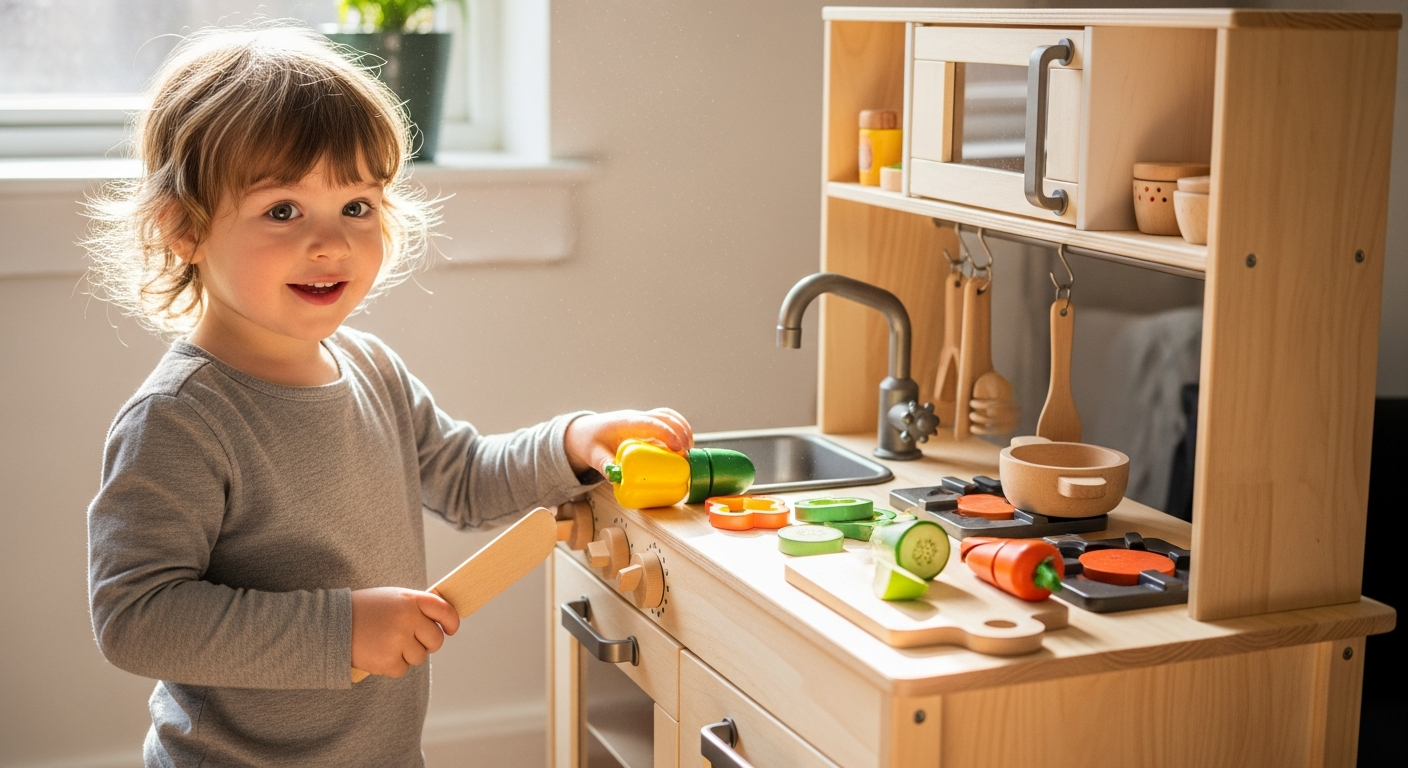
Children who engage in pretend play develop stronger problem-solving skills and emotional intelligence than those who rely primarily on screen-based entertainment. The Hape Gourmet Wooden Play Kitchen isn't just another toy—it's a powerful developmental tool disguised as fun. As a parent, watching kids transform ordinary afternoons into culinary adventures is remarkable.
Hape International Inc. has built a reputation for creating toys that balance beauty, durability, and genuine educational value. This wooden kitchen has become one of their most popular and best-selling products, consistently earning praise from families who understand the difference between toys that entertain and toys that genuinely support child development. The realistic setup with its clickable knobs, transparent oven window, and comprehensive appliance collection creates an engaging play space that keeps children coming back.
Discover why the Hape Gourmet Wooden Play Kitchen deserves a spot in your home today.
Why Pretend Play Kitchens Are Essential for Child Development
The Connection Between Imaginative Role-Play and Cognitive Development
Pretend play isn't frivolous—it's how children process the world around them. When a child stands at a play kitchen, they're not simply imitating adults; they're engaging in complex cognitive work. They're planning meals, deciding on cooking sequences, and thinking through the logical steps involved in meal preparation. This type of imaginative engagement builds neural pathways associated with planning, sequencing, and abstract thinking.
Research consistently shows that children who engage in regular pretend play demonstrate stronger cognitive flexibility—the ability to shift between different ideas and adapt to new situations. A wooden play kitchen becomes a laboratory where children experiment with different scenarios, test out social roles, and practice decision-making in a safe, consequence-free environment.
How Realistic Kitchen Play Encourages Problem-Solving and Decision-Making
The beauty of a fully equipped kitchen like the Hape Gourmet model lies in its realism. When children encounter a stove with multiple burners, a transparent oven window, and a sink with running water (in some models), they face genuine decision-making challenges: Which burner should I use? How long should this cook? What order should I prepare these items?
These aren't trivial questions—they're opportunities for children to exercise executive function skills. They learn to prioritize tasks, anticipate outcomes, and adjust their approach when something doesn't work as planned. A child might realize that certain "dishes" need to cook longer than others, or that some items should be prepared before others. These insights build practical problem-solving abilities that transfer far beyond the play kitchen.
The Science Behind Kinesthetic Learning and Hands-On Exploration
Children learn through their bodies and senses, not just through observation. When a child turns the clicking knobs on a Hape kitchen, feels the texture of the wooden surfaces, and manipulates the doors and drawers, they're engaging in kinesthetic learning. This tactile engagement activates multiple sensory pathways in the brain simultaneously.
Kinesthetic learners—and honestly, all young children benefit from hands-on exploration—develop stronger memory retention and understanding through physical interaction. The act of opening and closing a cabinet, adjusting a dial, or placing items in and out of storage creates muscle memory and spatial awareness that supports overall physical and cognitive development.
Building Confidence Through Mastery of Interactive Features
There's something powerful about a child successfully operating a toy that mimics real-world appliances. Each time a child turns a knob and hears the satisfying click, or opens an oven and sees inside with the transparent window, they experience a small moment of mastery. This repeated success builds confidence and a sense of competence.
The Hape Gourmet kitchen's interactive features—the turnable knobs, the working doors, the accessible storage—give children multiple opportunities to experience this mastery. Over time, these small victories accumulate into genuine confidence that extends beyond play.
What Makes the Hape Gourmet Kitchen Stand Out in Design and Features
Comprehensive Appliance Setup and Thoughtful Layout
The Hape Gourmet Wooden Play Kitchen comes equipped with a sink, stove, oven with transparent window, and cabinet storage. This comprehensive setup means children have everything they need for complete pretend cooking scenarios. The layout mirrors real kitchens, helping children understand how actual kitchen spaces are organized while providing enough variety to keep play fresh and engaging.
Some models, like the All-In-One Delicious Memories kitchen, expand this setup considerably. These premium versions include a controllable range hood lamp, an authentic microwave with a "ding" sound, a coffee maker, a dishwasher, and various cooking utensils. The addition of sound effects and more appliances deepens the immersive play experience and extends the age range of children who find it engaging.
Durable, Sustainable Materials Built to Last
Hape uses high-quality, sustainable materials including birch, maple, and engineered wood. This isn't particleboard or cheap plywood—it's solid construction designed to withstand years of vigorous play. Parents frequently report that their Hape kitchens show minimal wear even after years of use by multiple children.
The choice of sustainable materials reflects Hape's commitment to environmental responsibility. These aren't just durable toys; they're manufactured with consideration for the planet's future. For parents who care about both quality and sustainability, this alignment of values and product quality is significant.
Child-Safe Finishes and Thoughtful Safety Design
The kitchen is finished with child-safe, non-toxic, water-based paints. Every surface is smooth, with rounded edges designed to prevent injuries during active play. The manufacturing process includes rigorous safety testing to ensure compliance with toy safety regulations.
Hape's attention to safety extends beyond the obvious. The thoughtful design means fewer pinch points, splinter risks, or areas where small parts could become hazards. Parents can feel confident that their children are playing with a toy designed with their safety in mind.
Invest in a kitchen that prioritizes both your child's development and their safety.
Safety Standards and Material Quality You Can Trust
Hape's Commitment to Sustainable, Eco-Friendly Toy Manufacturing
Hape International Inc. has built its reputation on more than just fun toys—the company is committed to sustainable manufacturing practices. Each wooden kitchen is produced with environmental consciousness, using materials that are responsibly sourced and manufactured in ways that minimize environmental impact.
This commitment means that when you purchase a Hape kitchen, you're supporting a company that thinks about the world your child will inherit. The durability of the product also means less waste—a toy that lasts for decades across multiple children generates far less waste than cheaper alternatives that end up in landfills after a few years.
Non-Toxic Paint and Finish Specifications
All Hape toys use water-based, non-toxic paints that meet strict safety standards. Parents often worry about off-gassing or chemical exposure from new toys, but Hape's finish specifications eliminate these concerns. The paints are safe even for children who mouth or chew on the toy, though this is less of a concern with older toddlers and preschoolers.
Rounded Edges and Smooth Surfaces for Active Play
Every edge is rounded, every surface is smooth. This design choice isn't aesthetic alone—it's functional safety engineering. Active play involves bumps, collisions, and unexpected movements. A well-designed toy anticipates these realities and minimizes injury risk accordingly.
Third-Party Safety Testing and Regulatory Compliance
Hape's toys undergo third-party safety testing and comply with international toy safety regulations. This independent verification provides an additional layer of assurance that the product meets rigorous safety standards set by regulatory bodies that prioritize child protection.
Building Social and Emotional Skills Through Kitchen Play
Collaborative Cooking Scenarios That Teach Teamwork
A play kitchen naturally invites multiple children to participate simultaneously. One child might be the cook while another takes orders, or they might work together to prepare an imaginary meal. These collaborative scenarios teach children how to work together, negotiate roles, and communicate about shared goals.
Through these interactions, children learn to take turns, respect others' ideas, and work toward common objectives. The kitchen becomes a classroom in social skills, with lessons learned through play rather than instruction.
Role-Playing Different Family Dynamics and Social Situations
Children use play kitchens to process and understand the family dynamics they observe. They might recreate mealtime routines, experiment with different family roles, or act out scenarios they've witnessed in their own homes. This type of role-play helps children understand their family structure and their place within it.
Beyond family dynamics, children also explore broader social situations. They might pretend to run a restaurant, serve guests, or prepare special occasion meals. Each scenario provides insight into different social contexts and expectations.
Developing Empathy Through Nurturing and Caregiving Play
When children prepare food for stuffed animals, dolls, or imaginary family members, they're practicing nurturing and caregiving behaviors. This type of play develops empathy and helps children understand others' needs and feelings. The act of "feeding" someone—even a toy—builds an understanding of care and consideration.
Managing Emotions and Conflict Resolution During Group Play
When multiple children play with the kitchen, conflicts naturally arise. Who gets to use the stove? What should we cook? How should we divide tasks? These conflicts, while sometimes frustrating, are valuable learning opportunities. Children practice negotiation, compromise, and conflict resolution in a playful context where the stakes are low and adult support is available.
Investment Value and Pricing Across Models
Understanding the Price Range
Hape Gourmet kitchens range from approximately $62.99 to $199.99 depending on the model and features. Basic models offer essential kitchen components, while fully equipped All-In-One versions include advanced features like range hood lamps, microwave sounds, and comprehensive appliance collections. Mid-range options provide a balance between affordability and feature richness.
The price point reflects the quality of materials and construction. This isn't a budget toy—it's an investment in a product designed to last for years.
Long-Term Value and Multi-Child Durability
The true value becomes apparent over time. A Hape kitchen that costs $100-150 might be used by one child for 3-4 years, then passed to a sibling for another 3-4 years, and potentially gifted to a cousin or grandchild. When you calculate the cost per year of use across multiple children, the investment becomes remarkably economical.
The durability also means minimal replacement or repair costs. Unlike cheaper alternatives that might break or deteriorate, a well-maintained Hape kitchen requires no special upkeep and maintains its functionality and appearance through years of use.
Comparing Basic Models Versus Fully Equipped Options
Basic Hape models provide everything needed for engaging play—sink, stove, oven, and storage. These options are excellent for families seeking solid quality at a lower price point. The All-In-One models add features like working range hood lamps and microwave sounds that create a more immersive, realistic experience.
The choice depends on your budget and what you believe will most engage your children. Even basic models offer exceptional value and play potential. The premium versions simply extend that value with additional features that appeal to older children and support extended, more complex play scenarios.
Where to Find Authentic Hape Products
Purchase from verified retailers to ensure you're receiving an authentic Hape product with proper warranty and support. Authorized retailers maintain quality standards and provide assurance that you're getting genuine products manufactured to Hape's exacting specifications. Avoid suspicious deals from unknown sellers, as counterfeit toys occasionally circulate in the market.
Making the Right Choice for Your Family's Play Space
After exploring what makes the Hape Gourmet Wooden Play Kitchen such a standout investment, the picture becomes clear: this isn't just about having a beautiful piece of furniture in your home. It's about creating a foundation for meaningful, screen-free play that genuinely supports your child's development.
The combination of thoughtful design, sustainable materials, and realistic features creates an environment where children naturally gravitate toward imaginative play. Parents consistently report that their children return to this toy year after year, finding new ways to play and new skills to develop. The durability means your investment stretches across siblings, cousins, and even the next generation.
The social-emotional benefits—collaboration, empathy, communication, problem-solving—develop naturally through play rather than through forced lessons. The kinesthetic engagement supports physical development while the realistic features build confidence through mastery. All of this happens while children are simply having fun, which is exactly how childhood should work.
If you're ready to transform your child's play experience and invest in a toy that truly earns its place in your home, this kitchen deserves serious consideration. Your child's imagination—and your sanity—will thank you.
Choose the Hape Gourmet Wooden Play Kitchen and give your child a toy that grows with them.
Leave a Reply