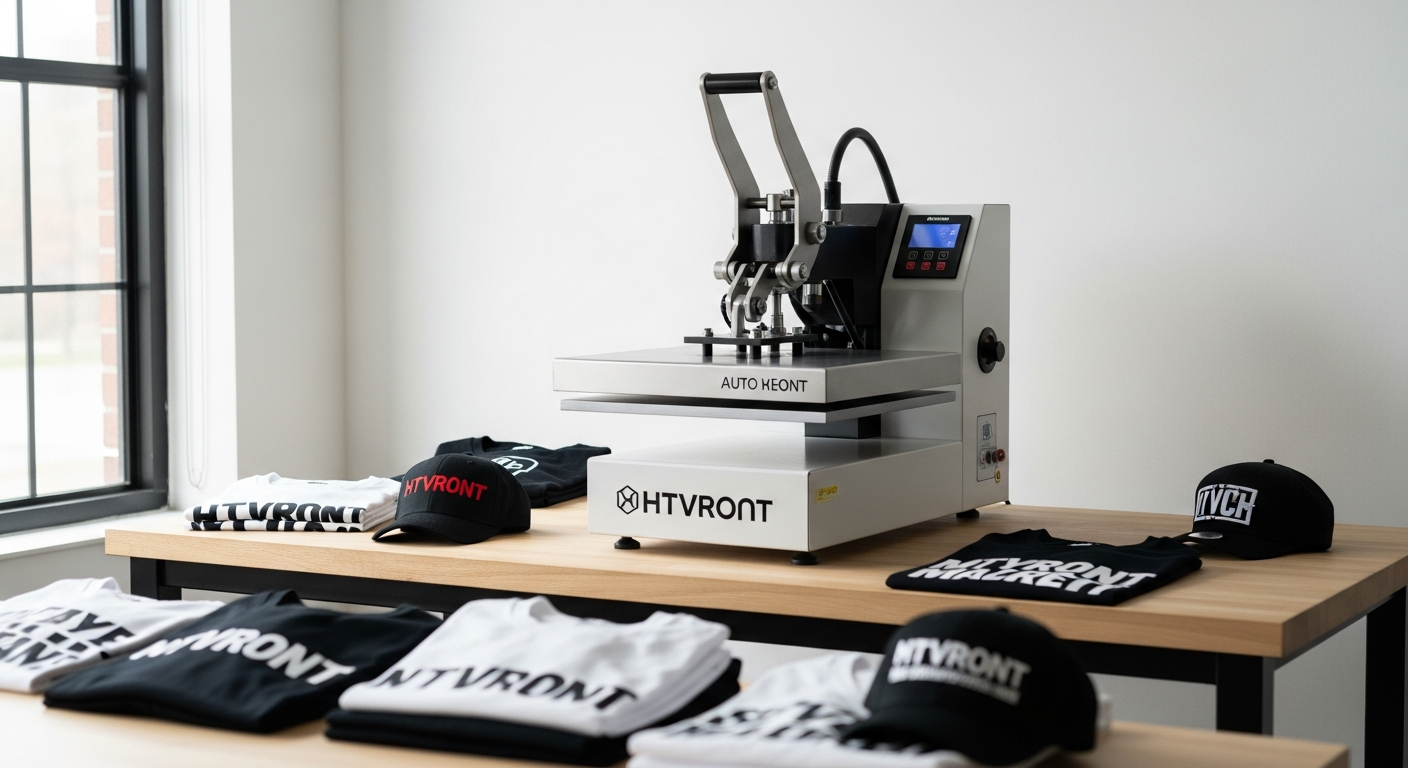
Small business owners producing custom apparel face a brutal reality: manual heat pressing is slow, inconsistent, and exhausting. Your hands cramp, your production crawls, and your customers wait longer than they should. The HTVRont Auto Heat Press Machine has quietly become the backbone of thousands of small-scale production operations, bringing professional-grade automation to entrepreneurs working with modest budgets.
In this guide, I'll walk you through how the HTVRont Auto Heat Press transforms small business operations—from production capacity and cost-per-unit economics to the specific features that make scaling sustainable. You'll discover which models work best for different business models, real-world productivity gains, and exactly how to maximize your return on investment.
Discover how the HTVRont Auto Heat Press can transform your production workflow today.
Why Small Business Owners Choose the HTVRont Auto Heat Press Over Manual Alternatives
Automatic Pressure Adjustment Eliminates the Learning Curve
Manual heat presses demand operator skill. You need to learn exactly how much force produces clean transfers, and different materials require different pressures. The HTVRont's automatic pressure adjustment removes this guesswork entirely. The machine applies consistent force across the platen every single time, regardless of who's operating it. This means your newest team member delivers the same quality as your most experienced operator on their first day.
Time Savings Per Unit Compound Across Your Business
Manual pressing requires you to apply pressure manually, monitor the timer, and release the pressure when time expires. The HTVRont's heat-up speed and auto-release functionality cut these steps dramatically. Where a manual press might take 45 seconds per garment, the HTVRont handles it in 25 seconds. Across an 8-hour shift, that compounds into dozens of additional units produced—directly feeding your bottom line.
Consistency Advantages Reduce Customer Complaints
Uneven pressure causes failed transfers, color fading, and design peeling after a few washes. These failures generate refund requests and negative reviews that cost you far more than the equipment investment. The HTVRont's even temperature distribution across its platen and automatic pressure adjustment virtually eliminate these problems. Your customers receive consistent, durable results that build loyalty and repeat orders.
Labor Efficiency Gains When One Operator Does More
With a manual press, one person can realistically handle 40-50 units per shift while maintaining quality. The HTVRont allows a single operator to manage 80-100+ units because the machine handles the precision work. That's 50% more output without hiring additional staff—a significant productivity gain for small operations.
Competitive Advantage in Markets Where Turnaround Time Matters
Custom apparel businesses live or die on turnaround time. Faster production means you can promise 2-day delivery instead of 5-day, positioning your business as premium in the eyes of customers. This speed premium justifies higher pricing and attracts time-sensitive orders from larger clients.
Scalability Without Proportional Labor Cost Increases
As your business grows, equipment limitations often force you to hire more staff. The HTVRont delays this inflection point. One operator can handle significantly more volume, meaning your labor costs grow slower than your revenue—a powerful driver of profitability as you scale.
Production Capacity and Throughput: What You Can Actually Achieve
Realistic Output Numbers for 15×15 Platen Models During an 8-Hour Shift
A well-optimized operation using a 15×15 HTVRont can consistently produce 90-120 units per 8-hour shift. This assumes standard t-shirts with simple one-color transfers, proper workflow design, and experienced operators. The calculation accounts for design loading time, cooling time, and quality checks—not theoretical maximum speed.
How the Auto Press 2's Pull-Out Drawer Design Accelerates Workflow
The Auto Press 2's pull-out drawer is deceptively important. Traditional heat presses require you to lift garments from directly above the heated platen, creating burn risk and awkward positioning. The pull-out drawer brings the loaded garment toward you, making loading and unloading faster and safer. This design change saves 3-5 seconds per unit, translating to 10-15 additional units per 8-hour shift.
Batch Processing Strategies for Different Garment Types
Different garments require different handling. T-shirts process fastest because they lay flat and require no special positioning. Hoodies demand more careful placement to avoid pressing seams. Tote bags need consistent pressure management because their material thickness varies. Grouping similar items into batches minimizes setup time and reduces operator context-switching, boosting throughput by 15-20%.
Temperature Preheating Efficiency and Its Impact on Total Production Time
The HTVRont reaches operating temperature quickly, but your first batch shouldn't start immediately. Allow 5-10 minutes for the platen to achieve full, even heat saturation. This preheating time is a one-time cost at the start of your shift. After that, every unit benefits from consistent, fully-stabilized temperatures—reducing failed transfers and rework.
Comparing Single-Machine vs. Multi-Machine Setups for Growing Businesses
A single 15×15 HTVRont typically maxes out around 120 units per day with one operator. Beyond that, you face a choice: hire a second operator for the same machine (creating bottlenecks and coordination challenges) or add a second machine with staggered operators. Two machines with two operators can realistically achieve 200-240 units daily, with smoother workflow and fewer bottlenecks.
Seasonal Production Planning and How the HTVRont Handles Peak Demand Periods
Custom apparel demand spikes seasonally—holidays, back-to-school, summer events. A single HTVRont can absorb modest increases, but serious peak demand (like 500+ units in a week) requires either hiring temporary staff or having a second machine ready. Many growing businesses add a second unit before peak season begins, then run both machines during busy periods.
Maximize your production capacity with the HTVRont Auto Heat Press Machine.
Cost-Per-Unit Economics: The Real ROI for Your Business
Breaking Down the Machine Cost Against Per-Unit Profit Margins
The HTVRont's entry price is $239 for the standard Automatic Heat Press or $349.99 for the Auto Press 2 with adjustable pressure. Your per-unit profit margin depends on what you're selling—anywhere from $3-8 on basic t-shirt transfers to $15-25 on specialty items. At a $5 per-unit average profit, the $349 Auto Press 2 pays for itself in roughly 70 units. Most businesses achieve this in 3-5 business days.
Energy Consumption and Electricity Costs Factored Into Pricing
The HTVRont draws approximately 1500W during operation. Running it for 8 hours daily costs roughly $1-1.50 in electricity, assuming average U.S. rates. This translates to a few cents per unit—negligible compared to your material and labor costs, but worth tracking when calculating true per-unit economics.
Material Waste Reduction Through Even Heat Distribution
Manual presses often produce uneven transfers because pressure distribution is inconsistent. This causes failed transfers, requiring reprinting and re-pressing—wasting vinyl, sublimation paper, or DTF film. The HTVRont's even pressure and heat distribution virtually eliminates waste from operator error. Over 1,000 units, this waste reduction alone can justify the equipment investment.
Labor Cost Savings When One Operator Manages More Units Per Hour
If you're currently paying yourself or an employee $15/hour, and the HTVRont increases throughput by 40 units per 8-hour shift, that's a direct labor savings of roughly $1.50 per additional unit produced. For a business doing 500 units monthly, this represents $750 in monthly labor savings—$9,000 annually.
Payback Period Calculations for Different Business Models
Print-on-demand businesses (producing to order, no inventory) see faster payback because every unit sells. With per-unit profits of $5-8, payback happens in 50-100 units, typically within the first week of operation. Inventory-based businesses (producing stock items) payback slower because cashflow depends on inventory turnover, but the equipment cost remains the same.
Long-Term Durability and Maintenance Costs Affecting Total Cost of Ownership
The HTVRont is built to last years with minimal maintenance. Regular care—keeping the platen clean, checking cord integrity, ensuring proper ventilation—costs almost nothing. Unlike some premium brands requiring expensive professional servicing, the HTVRont remains low-maintenance. A machine purchased for $349 can generate $10,000+ in revenue before any significant maintenance is needed, making long-term cost of ownership extremely favorable.
Mastering Different Heat Transfer Materials for Maximum Versatility
Heat Transfer Vinyl (HTV) Application Settings and Pressure Requirements
Heat transfer vinyl (HTV) is the foundation of custom apparel production. Typical settings for the HTVRont are 300-320°F for 8-12 seconds depending on vinyl type, with the Auto Press 2's pressure set around 70-80 pounds. Test each brand you work with because vinyl manufacturers use different adhesive formulations. Document your successful settings in a reference guide your team can access instantly.
Sublimation Printing Compatibility and Temperature Optimization
Sublimation transfers require higher temperatures—typically 380-400°F for 10-15 seconds on polyester items. The HTVRont reaches these temperatures reliably, making it a capable sublimation press. The key is ensuring your platen is clean (sublimation ink can build residue) and using appropriate release paper to prevent ink transfer to the platen surface.
Direct-to-Film (DTF) Transfers and the Auto Press 2's Adjustable Pressure Advantage
DTF printing is growing in popularity because it works on dark and light garments without white underlay. DTF transfers are thicker than traditional HTV, requiring careful pressure management. The Auto Press 2's adjustable pressure (50-170 lbs in 20-lb increments) is invaluable here—you can dial in precisely the right pressure without crushing the print or leaving it undercompressed. Standard fixed-pressure models can struggle with DTF consistency.
Specialty Materials: Puff HTV, Glitter Vinyl, and Flock Applications
Puff HTV creates a puffy, 3D effect but needs gentler pressure to expand properly. Glitter vinyl requires lower temperatures to prevent adhesive breakdown. Flock creates a velvety texture. The Auto Press 2's adjustable pressure shines with these specialty materials—you have fine-tuned control. Older fixed-pressure models sometimes struggle with puff HTV, as some users have reported, but the adjustable pressure feature addresses this limitation.
Material-Specific Troubleshooting When Transfers Don't Perform as Expected
Transfers can fail for specific reasons: peeling edges (insufficient pressure or temperature), faded colors (too-high temperature), or cracks in puff vinyl (over-pressing). Each material has its own troubleshooting pathway. When problems arise, adjust one variable at a time—temperature, time, or pressure—and test on scrap material before reprinting full orders.
Creating a Material Reference Guide for Your Team
Document optimal settings for every material and brand you use: temperature, time, pressure (for Auto Press 2), release paper type, and any special notes. Post this guide at your press station. This single document prevents operator guesswork and ensures consistency whether you're running one machine or five.
Safety Features That Protect Your Team and Your Bottom Line
Auto Shut-Off Functionality and Its Role in Preventing Workplace Injuries
The HTVRont's auto shut-off feature turns the machine off after a period of inactivity, preventing accidental burns from forgotten presses. This is more valuable than it sounds—production environments are chaotic, and distracted operators sometimes forget to close the press. The auto shut-off is a safety net that's saved countless small businesses from injury claims.
Heat-Resistant Safety Base and Why It Matters in Busy Production
The machine's base doesn't transfer heat to your workstation surface, preventing accidental burns when moving items near the press or working in close quarters. In a production environment where multiple people navigate tight spaces, this matters.
Pull-Out Drawer Design Reducing Hand Burns and Operator Fatigue
Traditional heat presses require reaching over the heated platen to retrieve finished garments—a continuous burn risk. The HTVRont's pull-out drawer brings finished items toward you, eliminating overhead reaching and associated burn exposure. Your operators also experience less repetitive strain because the ergonomics are superior.
Compliance with Small Business Safety Standards and Insurance Requirements
OSHA guidelines for heat press operations emphasize operator safety and ergonomics. The HTVRont's design aligns with these standards. Insurance companies may even offer slight premium reductions for using equipment with documented safety features, partially offsetting your investment.
Training New Team Members on Safe Operation Procedures
Safety training becomes simpler with the HTVRont's straightforward design. New team members learn faster because there are fewer variables to manage (automatic pressure means no guessing about force requirements). Document a simple training checklist: hand placement, clothing removal from the platen, material positioning, and the auto shut-off feature.
Liability Reduction Through Documented Safety Protocols
If an injury occurs, documented safety protocols and proper equipment use protect your business legally. The HTVRont's built-in safety features give you a strong foundation, but your written safety procedures are equally important. This combination significantly reduces liability exposure.
Comparing HTVRont Models: Which Version Fits Your Business Stage
Entry-Level 10×10 Models for Startups and Home-Based Businesses
The 10×10 platen is perfect if you're testing the custom apparel market or running a home-based side business. It handles t-shirts and small tote bags easily. The limitation is that oversized items (XXL+ t-shirts, large tote bags) don't fit comfortably, and production volume caps around 40-50 units daily with one operator. If you're primarily selling to family and friends or building a small test business, the 10×10 is an economical entry point.
Mid-Range 15×15 Automatic Heat Press for Growing Operations
The 15×15 model at $239 is the sweet spot for small businesses with serious ambitions. It handles standard t-shirts with room to spare, fits larger garments, and scales to 90-120 units per shift with one operator. This is where the value proposition becomes exceptional—you get professional-grade capabilities at an entry-level price.
Premium Auto Press 2 with Adjustable Pressure for Advanced Users
At $349.99, the Auto Press 2 adds adjustable pressure (50-170 lbs in 20-lb increments), allowing fine-tuning for different materials and thicknesses. This matters if you're working with DTF, puff HTV, or specialty materials regularly. The pull-out drawer also improves ergonomics and speed. For businesses managing multiple material types, the $110 upgrade over the standard 15×15 model pays dividends in flexibility and consistency.
Feature Comparison Table: Fixed vs. Adjustable Pressure, Platen Size, and Price Points
| Feature | 10×10 Model | 15×15 Standard | 15×15 Auto Press 2 |
|---|---|---|---|
| Platen Size | 10" x 10" | 15" x 15" | 15" x 15" |
| Pressure | Fixed | Fixed | Adjustable (50-170 lbs) |
| Heat-Up Speed | Fast | Fast | Fast |
| Temperature Range | Up to 400°F | Up to 400°F | Up to 400°F |
| Pull-Out Drawer | Standard | Standard | Enhanced |
| Price | ~$200 | $239 | $349.99 |
| Best For | Beginners, part-time | Growing small business | Advanced material work |
| Daily Capacity | 40-50 units | 90-120 units | 90-120 units |
Upgrade Path: When to Move From Smaller to Larger Models
If you're consistently producing more than 50 units daily on your 10×10, upgrade to a 15×15. Similarly, if your 15×15 is running at capacity (120+ units daily target) and you can't fit more equipment in your space, add a second 15×15 rather than upgrading—two machines provide flexibility and redundancy that a single larger machine can't match.
Resale Value and Equipment Lifecycle Planning
The HTVRont holds value reasonably well in the used equipment market. A 15×15 that cost $239 new might resell for $150-180 after a year of use, particularly if it's clean and well-maintained. This cushion is valuable if you decide to upgrade—the resale value partially funds your next purchase.
Real-World Integration: Fitting the HTVRont Into Your Production Workflow
Space Requirements and Workstation Setup for Optimal Ergonomics
The 15×15 model occupies roughly 2 feet by 2 feet of floor space. Your workstation should include space on both sides for loading and unloading garments, plus a small area for your material reference guide and temperature controls. The total operational space needed is about 4 feet by 3 feet for comfortable single-operator work. In a multi-person operation, allow 6 feet by 4 feet per machine to prevent crowding.
Integration With Design Software and Order Management Systems
The HTVRont is purely a heat transfer tool—it doesn't interface directly with design software or order systems. However, it's the final step in your production pipeline. Your workflow should be: order received → design created → design printed or cut → heat press transfer → quality check → packaging. Document this workflow so team members understand each step's dependencies.
Positioning Within a Multi-Step Production Line
For print-on-demand operations, position the HTVRont at the end of your workflow—after printing (sublimation, DTF, screen print) or cutting (vinyl). For DTF/sublimation operations, your layout might be: design station → printer → heat press → quality station → packaging. For vinyl cutters, it's: design station → cutter → heat press → quality → packaging. The HTVRont should be accessible without requiring garments to pass through other work areas.
Cord Placement Solutions for Different Workspace Configurations
Some older HTVRont models had less-convenient cord placement, though newer versions have addressed this. If cord length is an issue, use a heavy-duty extension cord rated for the machine's 1500W power draw, keeping it away from heat exposure. Better yet, position your press near an outlet or have an electrician add a dedicated circuit in your production space.
Ventilation Needs and Heat Management in Your Production Space
The HTVRont generates significant heat during operation. In small spaces without ventilation, ambient temperature can climb noticeably. Ensure your production area has adequate ventilation—open windows, fans, or ideally an HVAC system that cycles during heavy production hours. This protects operators from heat stress and extends the machine's lifespan.
Backup Equipment Planning for Business Continuity
If your business depends entirely on one HTVRont and it needs unexpected service, you're unable to fulfill orders. For serious operations, consider adding a second machine once you reach 100+ daily units. The second machine provides redundancy—if one goes down, you continue operating at 50% capacity rather than zero capacity.
Addressing Common Challenges and Limitations Honestly
Puff HTV Difficulties and Workaround Techniques That Actually Work
Some users have reported challenges with puff HTV on older fixed-pressure models—the puffing sometimes remained inconsistent. The solution is temperature and pressure fine-tuning: start at 320°F with medium pressure (around 60 lbs on the Auto Press 2), press for 8-10 seconds, then allow the vinyl to cool before handling. The Auto Press 2's adjustable pressure eliminates this problem by letting you dial in exact settings.
Pressure Inconsistency in Older Non-Adjustable Models and Why the Auto Press 2 Solves This
Fixed-pressure models apply the same force to every transfer, which works for standard HTV but struggles with variable-thickness materials. DTF transfers, puff HTV, and specialty materials benefit from pressure adjustability. The Auto Press 2's 50-170 lb range in 20-lb increments provides the flexibility premium manufacturers charge thousands more for.
Cord Placement Frustrations and DIY Solutions From Experienced Users
If your HTVRont's cord placement creates hazards or awkwardness, experienced users recommend using a cord management system (cable ties, hooks) to route the cord safely out of the work area. Alternatively, position your machine so the cord naturally extends away from your primary work zone.
Lack of Included Material Guides and How to Create Your Own Reference System
Earlier HTVRont versions didn't include comprehensive material guides. Create your own: a laminated sheet listing temperature, time, and pressure for every material and brand you use. Laminate it and post it at your press station. This takes 30 minutes to create and eliminates operator guesswork.
Temperature Calibration Over Time and Maintenance Schedules
Heat press platens can drift in calibration after extended use. Every 6 months, verify actual platen temperature using a temperature gun ($15-30) against the machine's display temperature. If drift exceeds 10°F, contact HTVRont support for calibration guidance. Most machines maintain accuracy for years with basic care.
When You Might Need to Supplement With Specialty Equipment
The HTVRont is a versatile workhorse, but specialty applications have limits. Screen printing, direct-to-garment (DTG) printing, and embroidery require different equipment entirely. The HTVRont handles heat transfers beautifully—HTV, sublimation, DTF—but recognize its boundaries. For a true multi-capability shop, you'll eventually add complementary equipment.
Scaling Beyond One Machine: Multi-Unit Production Strategy
Economics of Adding a Second or Third HTVRont Unit
A second HTVRont doubles your equipment cost (roughly $500 total for two 15×15 units) but can more than double output if workflow is optimized. With two machines and two operators, you move from 120 units daily to 200-240 units—an 80-100% increase in capacity. The per-unit equipment cost actually decreases, improving margins.
Staffing Considerations When You Move From Solo Operator to Team-Based Production
Running one machine solo is straightforward. Adding a second machine requires hiring a second operator or splitting your time between machines. Two operators on two machines can have different expertise—one specializes in vinyl work, another in sublimation. Document processes and material settings so either operator can run either machine when needed.
Quality Control Systems That Maintain Consistency Across Multiple Machines
With multiple machines, quality can drift if operators use different settings. Implement a simple QC checklist: inspect every 10th garment for transfer quality, document results daily, and immediately address any patterns (one machine running hot, one operator using wrong pressure). This consistency is what separates professional operations from amateur ones.
Workflow Optimization When Machines Run in Parallel
Ideally, your two machines run simultaneously with the same batch of garments. As soon as garment A finishes on machine 1, immediately load garment C (while garment B is on machine 2). This requires careful sequencing and organized staging areas. Many growing businesses use a simple batch management system: pile of 10 unloaded garments, 10 cooling/staging, 10 quality-checked and ready to package.
Supplier Relationships and Bulk Material Purchasing at Higher Volumes
Higher production volume justifies bulk vinyl, sublimation paper, and DTF film purchases. Vendors often offer 10-20% discounts for cases vs. individual rolls. Building strong supplier relationships also provides priority access during high-demand periods and occasionally sample materials for testing.
Equipment Redundancy and What Happens When a Machine Needs Service
A second machine isn't just about production increase—it's business insurance. If your primary machine needs unexpected service (rare, but possible), you continue operating at full capacity with your backup. For serious operations producing 150+ units daily, consider adding a third machine to handle peak demand and provide true redundancy.
Building Your Competitive Edge Through Equipment Investment
How Equipment Quality Directly Impacts Customer Satisfaction and Repeat Orders
Professional equipment produces professional results. Customers notice the difference between a transfer that flakes after five washes and one that lasts the garment's lifetime. Equipment investment directly translates to fewer complaints, higher satisfaction scores, and repeat orders—the lifeblood of small business profitability.
Positioning Your Brand Around Professional-Grade Production Capabilities
Quality equipment allows you to confidently market your business as professional-grade. Use this positioning in your website copy, social media, and customer communications. "All our transfers are made on professional auto heat presses with precise temperature control" signals that you're serious about quality, not a hobbyist.
Marketing Your Custom Apparel With Confidence in Quality and Turnaround Time
Equipment reliability enables accurate promise-keeping. When you guarantee 2-day turnaround with consistent quality, you deliver reliably. This reliability builds reputation—the most powerful marketing tool any small business has. Customers recommend you not because you're flashy, but because you deliver what you promise.
Premium Pricing Justification When You Can Deliver Superior Consistency
Businesses competing only on price lose to bigger competitors with lower costs. Competing on quality and consistency justifies premium pricing. "Our transfers last 100+ washes" or "2-day turnaround with zero quality issues" commands higher prices than "cheapest custom t-shirts in town."
Customer Testimonials and Case Studies Highlighting Your Production Capabilities
Ask satisfied customers for testimonials mentioning quality and turnaround. Document case studies: "Local sports team ordered 200 jerseys with 3-day turnaround—achieved with zero quality issues using professional heat press equipment." These stories position your business as capable and reliable, attracting larger orders.
Long-Term Business Sustainability Through Smart Equipment Choices
The HTVRont's exceptional value—professional results at affordable prices—creates a foundation for sustainable growth. You're not betting your business on trend-chasing or price wars. Instead, you're investing in consistent, reliable production that customers depend on. That's how small businesses survive and thrive beyond their first 3-5 years.
Your Path to Professional-Grade Production Starts Here
The HTVRont Auto Heat Press Machine isn't just another piece of equipment—it's a business accelerator disguised as a heat press. Whether you're running a one-person operation from your garage or managing a small team cranking out orders daily, there's an HTVRont model that fits your stage. The Auto Press 2's adjustable pressure gives you flexibility as your material mix evolves, the 15×15 platen handles everything from fitted t-shirts to oversized tote bags, and at $239-$349, you're looking at a payback period measured in weeks, not months.
The real question isn't whether you can afford a quality heat press—it's whether you can afford to keep losing money and time to inferior equipment. Your customers expect professional results, your team deserves tools that don't cause repetitive strain, and your business needs equipment that scales with your ambitions. The HTVRont Auto Heat Press delivers on all three fronts.
Ready to stop leaving money on the table? Start with an honest assessment of your current production bottlenecks, calculate your per-unit costs with manual pressing, then compare that to what the HTVRont could deliver. Your future self will thank you for making this move today.
Start your professional-grade production journey with the HTVRont Auto Heat Press Machine.
Leave a Reply