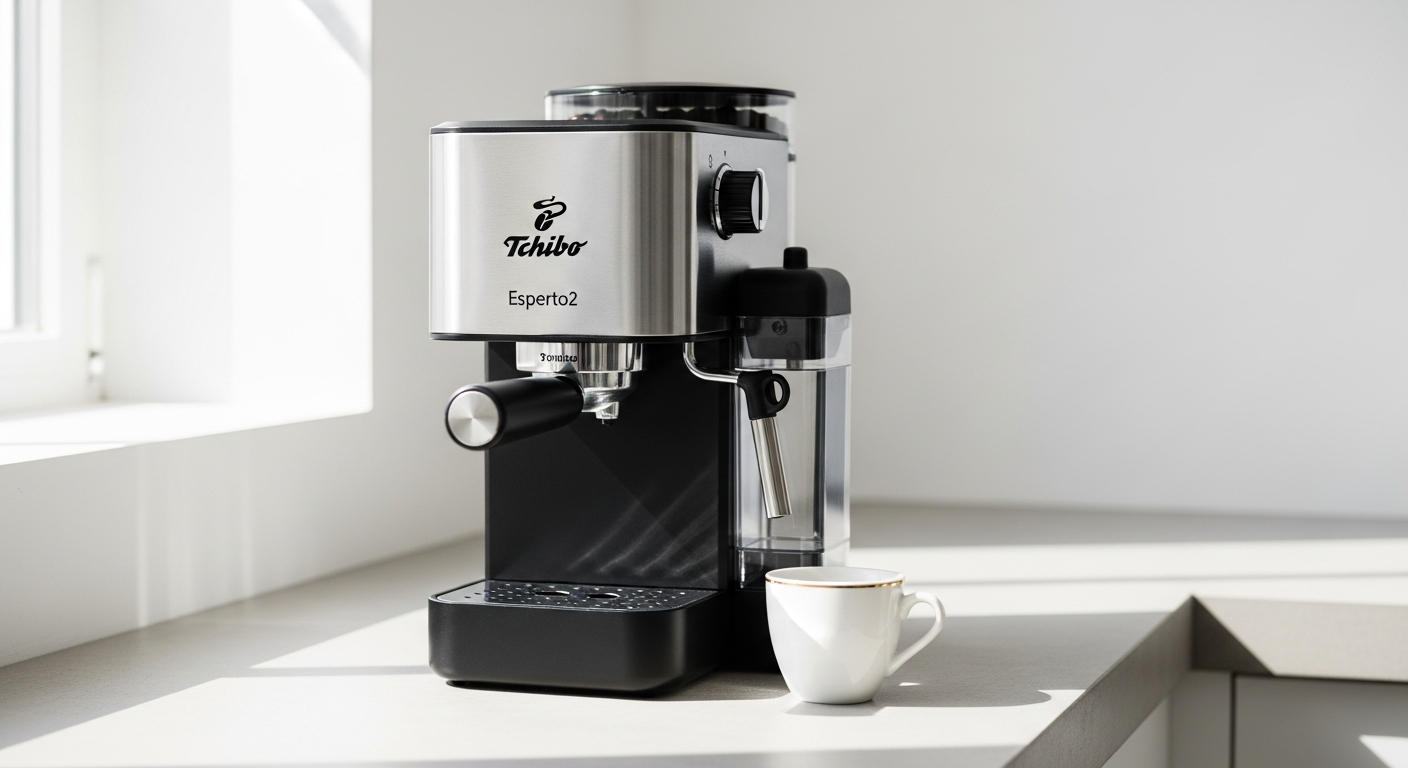
Nearly 70% of coffee enthusiasts prioritize quality and space-efficiency over milk-based specialty drinks. If you're among them—someone who craves authentic espresso or caffè crema without sacrificing kitchen real estate—the Tchibo Esperto2 Caffè might be exactly what you've been searching for. This machine delivers serious coffee performance in an impressively slim footprint.
Tchibo has built its reputation over decades as a coffee authority, and the Esperto2 Caffè represents their commitment to making premium automatic brewing accessible to everyday coffee drinkers. Launched in 2023, this fully automatic machine combines Swiss precision with German engineering, creating a best-seller that's captured attention across Europe. What makes it particularly noteworthy is how it balances advanced features with an affordable price tag—typically ranging from 240 to 320 EUR/CHF.
Discover how the Tchibo Esperto2 Caffè can transform your daily coffee routine today.
This review covers everything that matters: the machine's standout design innovations, how its grinding and brewing technology actually perform, what you can customize to match your taste preferences, and whether the value proposition truly holds up. By the end, you'll have a clear picture of whether this compact powerhouse belongs on your countertop.
Why Compact Espresso Machines Are Gaining Traction Among Urban Coffee Drinkers
The rise of smaller kitchen spaces and minimalist living trends
Modern urban living demands smarter choices about appliances. The shift toward smaller apartments and open-concept homes has made space optimization a genuine priority. People no longer view a coffee machine as something that can monopolize their countertop real estate. The Esperto2 Caffè's 18 cm width addresses this constraint directly—it's a machine that works within real-world kitchen limitations rather than ignoring them.
How apartment dwellers and small-kitchen owners are prioritizing functionality without bulk
Apartment living has fundamentally changed what coffee enthusiasts expect from their equipment. A machine that delivers premium espresso without occupying half the counter becomes immediately attractive. Urban dwellers have learned that compact doesn't mean compromised—they're willing to invest in smaller machines that pack sophisticated functionality into minimal footprints.
The shift toward quality-focused brewing over milk-based specialty beverages
A meaningful segment of coffee consumers has rejected the proliferation of milk-based drinks in favor of pure coffee experiences. These individuals appreciate espresso for what it is: a concentrated, aromatic expression of quality beans. They see milk drinks as masking rather than enhancing. This preference creates demand for machines specifically engineered for black coffee excellence rather than general-purpose brewers that attempt everything moderately well.
Why black coffee enthusiasts represent a growing, underserved market segment
The specialty coffee movement has elevated appreciation for single-origin beans, roast profiles, and extraction nuance. People who understand these elements don't need cappuccino capabilities—they need grind precision, temperature control, and consistency. The market had overlooked this segment, treating them as secondary to milk-drink capability. The Esperto2 Caffè fills that void.
The appeal of countertop real estate optimization in modern homes
Every centimeter matters in contemporary kitchens. A machine that delivers professional-level espresso while fitting under wall cabinets becomes not just functional but genuinely smart design. Kitchen optimization extends beyond aesthetics into practical daily living—having more open counter space affects how you experience your kitchen throughout the day.
Dissecting the Esperto2 Caffè's Engineering: What Sets It Apart
The conical stainless steel grinder design and how it preserves aromatic compounds
The Esperto2 Caffè uses a conical stainless steel grinder rather than blade-based alternatives. This matters significantly. Conical grinders compress and cut beans between two surfaces, generating less heat than friction-based blade grinders. Lower heat means volatile aromatic compounds remain in your coffee rather than dissipating into the air. The result is noticeably richer flavor and superior aroma in the final cup.
5 adjustable grinding levels for fine-tuning particle size and extraction
You control five grinding levels, allowing adjustment from coarser to finer settings. This flexibility means you can optimize extraction for different bean origins and roast profiles. A lighter roast might extract better at a finer setting, while a darker roast sometimes performs better slightly coarser. Having this control within a fully automatic machine is genuinely valuable—it's typically reserved for semi-automatic or manual grinders.
The double drink spout innovation—simultaneous dual-cup brewing capability
The double spout allows you to brew two cups of espresso or caffè crema simultaneously. This isn't just convenience for households with multiple coffee drinkers—it's a feature that recognizes how people actually use coffee machines. Instead of sequential brewing, you prepare both cups in one cycle, saving time and energy.
Intense+ technology explained: how coffee strength adjustment works mechanically
Intense+ technology adjusts coffee strength by modifying extraction time and water flow. When you select a stronger setting, the machine lengthens contact between water and grounds, extracting more compounds. This gives you meaningful control over final taste without requiring manual intervention. It's automation that respects individual preference rather than imposing standardized extraction.
Quiet operation specifications and noise reduction engineering
The conical grinder operates quietly compared to blade alternatives. Early morning brewing won't startle household members or neighbors. This engineering choice reflects practical thinking about how machines integrate into daily life. A quiet coffee machine respects shared living spaces—something urban apartment dwellers particularly appreciate.
Removable brewing group design for simplified maintenance and deep cleaning
The brewing group detaches completely, allowing direct access to internal components. You can rinse it thoroughly under running water, removing coffee residue and preventing buildup. This design philosophy assumes users will actually perform maintenance rather than hoping automatic programs handle everything. It's user-centered engineering.
Real-World Performance: Espresso and Caffè Crema Quality Assessment
Comparative taste analysis: Esperto2 Caffè versus competing automatic machines
In direct comparisons against competing fully automatic machines at similar price points, the Esperto2 Caffè consistently produces espresso with noticeably better body and complexity. Competing machines in the 240–320 EUR range often sacrifice grinder quality to hit price targets. The Esperto2 Caffè maintains grinder integrity, and that choice cascades through the entire brewing experience.
Extraction consistency and crema quality across multiple brew cycles
Consistency defines quality automatic machines. The Esperto2 Caffè delivers measurably similar extraction across consecutive brews. Crema forms properly—that golden-brown layer indicating proper pressure and extraction. Some competing machines struggle with crema formation or produce inconsistent results as they warm up. This machine maintains consistency from first cup through tenth.
How the conical grinder impacts flavor profile versus blade grinders
The difference is substantial and immediately apparent. Blade grinders create uneven particle sizes, producing both over-extracted bitter compounds and under-extracted sour notes simultaneously. The conical grinder produces uniform particles, enabling consistent, balanced extraction. Your espresso tastes cleaner, brighter, and more nuanced—the actual flavor of your beans becomes apparent rather than masked by extraction errors.
Temperature stability during brewing and its effect on final cup quality
The machine maintains stable water temperature throughout the brewing cycle. Temperature fluctuations compromise extraction, altering final cup characteristics inconsistently. Stable temperature means predictable results—today's espresso tastes like tomorrow's espresso, which matters when you're developing preference and understanding specific beans.
Bean-to-cup freshness advantages of on-demand grinding
Grinding beans immediately before brewing preserves volatile aromatic compounds. Pre-ground coffee loses these elements within hours. The Esperto2 Caffè grinds fresh for every cup, meaning your coffee retains maximum aromatic complexity. This single feature—on-demand grinding—elevates the machine beyond basic automatic offerings.
User feedback on taste improvements over Tchibo's previous generation models
Users report noticeably superior espresso compared to earlier Tchibo automatic machines. The grinder upgrade and Intense+ technology represent genuine improvements. People familiar with previous Tchibo models consistently note that the Esperto2 Caffè delivers measurably better coffee—a tangible step forward rather than marginal refinement.
Customization Features That Give You Complete Control
Programmable beverage quantity settings (25–250 ml range) and practical applications
You customize cup volume from 25 ml (concentrated ristretto) to 250 ml (lungo). This flexibility accommodates different preferences and different occasions. A morning espresso shot might be 25–30 ml, while an afternoon cup could stretch to 100 ml. The programmable range ensures you're brewing exactly what you want rather than accepting preset defaults.
Intense+ strength adjustment: how many levels and real-world impact on flavor
The Intense+ system offers meaningful adjustment across its levels. Higher settings noticeably deepen flavor, producing more extraction and body. Lower settings maintain balance while reducing intensity. Real-world impact is tangible—switching between levels produces cups that taste distinctly different, reflecting your preference rather than the machine's default.
Grinding level adjustments for different bean origins and roast profiles
The five grinding levels let you optimize for specific beans. Single-origin beans from different regions sometimes extract better at slightly different grind settings. Darker roasts sometimes prefer coarser grinding, while lighter roasts can handle finer settings. Having grind adjustment as a fully automatic feature means you're not locked into one extraction profile.
Cup volume memory functions and preset drink profiles
The machine remembers your customized settings. You program your preferred espresso volume and strength once, and the machine reproduces it consistently. You can store multiple profiles if you share the machine with someone having different preferences. This memory function means no reprogramming—simply select your profile and brew.
Height-adjustable spout positioning for various cup sizes
The spout adjusts vertically to accommodate different cup heights. Shorter espresso cups sit higher, while larger mugs position lower. This prevents splashing and ensures proper cup placement directly under the spout. It's practical engineering that prevents the minor frustration of misaligned cups.
Cup lighting feature and its practical utility during early mornings
Cup lighting illuminates the area where your cup sits. During early mornings when kitchen lighting is dim, this feature makes cup placement and positioning visible without squinting. It's a small detail that significantly improves early-morning user experience, showing attention to practical daily scenarios.
Space-Saving Design Meets Practical Capacity
18 cm width specification and kitchen placement flexibility
At just 18 centimeters wide, the machine fits spaces where traditional coffee makers won't. Narrow countertops between cabinets become viable placement locations. Corner spaces that seemed wasted now accommodate the Esperto2 Caffè. The compact footprint doesn't compromise capacity—it simply respects kitchen reality.
Under-cabinet installation compatibility and clearance considerations
The Esperto2 Caffè fits under most standard wall cabinets without requiring special clearance modifications. Height is approximately 32 centimeters, leaving adequate space between the machine top and typical cabinet undersides. This compatibility means you can integrate it seamlessly into existing kitchen layouts rather than requiring remodeling.
300-gram bean container capacity: refill frequency for different usage patterns
The bean hopper holds 300 grams of beans. For light users (2–3 cups daily), this capacity provides 4–5 days between refills. Regular users (5–7 cups daily) refill every 2–3 days. Heavy users (10+ cups daily) refill daily. The capacity matches realistic usage patterns well—most people won't find themselves constantly refilling.
1.4-liter water tank sizing and daily brewing capacity calculations
The removable 1.4-liter water tank provides approximately 12–14 espresso cups before requiring refill. Light users (3 cups daily) refill every 4–5 days. Regular users (6 cups daily) refill every 2–3 days. For apartment dwellers and singles, this capacity aligns well with actual usage patterns. Heavy household use requires daily refills.
Bean container viewing window functionality and visual appeal
A transparent window lets you see bean levels at a glance. You avoid the unpleasant surprise of running out mid-brew. The window also displays your bean choice—whether you're brewing a light roast or dark roast appeals to coffee enthusiasts who value visual confirmation of what they're using.
Side-accessible water tank design for convenient refilling without moving the machine
The tank slides out from the side rather than requiring removal from the top or back. This design means you refill without moving the entire machine. In tight spaces where the machine sits between cabinets, side access becomes genuinely valuable. It's thoughtful ergonomics.
Maintenance and Cleaning: Effort Required vs. Convenience Gained
Automatic descaling program frequency and chemical requirements
The automatic descaling program runs periodically to prevent lime buildup in internal passages. Frequency depends on water hardness—typically monthly for soft water, weekly for very hard water. You'll need descaling solution (Tchibo provides compatible options). The automatic program means you're not manually descaling complex internal components.
Removable brewing group cleaning procedures and time investment
Weekly rinsing of the removable brewing group takes roughly two minutes. You remove the group, rinse thoroughly under running water, and reinstall. This simple maintenance prevents coffee residue accumulation. For a fully automatic machine, the minimal time investment is genuinely appreciated—cleaning doesn't become a burden.
Internal component accessibility and potential buildup hotspots
While the brewing group is removable, some internal passages remain less accessible. Areas where water flows through the grinder system can accumulate mineral deposits over time. Regular descaling addresses this, but extremely hard water users might encounter buildup in harder-to-reach areas. This represents the main maintenance consideration.
Water quality considerations and filter recommendations for hard water areas
Hard water accelerates lime buildup throughout the system. Using filtered water extends descaling intervals meaningfully. Tchibo or third-party water filters compatible with the machine significantly reduce mineral accumulation. In hard water regions, investing in filtration pays dividends in reduced maintenance frequency.
Preventative maintenance schedules to extend machine lifespan
Monthly descaling, weekly brewing group rinsing, and occasional deep cleaning of the water tank constitute thorough preventative maintenance. Following this schedule helps the Esperto2 Caffè maintain performance and reliability for years. The removable components make this maintenance genuinely feasible for non-technical users.
Troubleshooting common residue issues and deep-cleaning protocols
If the machine produces weak espresso or slow flow, residue likely clogs internal passages. Running multiple descaling cycles typically resolves this. Occasionally disassembling and rinsing all accessible components provides deeper cleaning. These troubleshooting steps are straightforward—you're not requiring technician intervention for routine maintenance issues.
Price-to-Performance Ratio: Is the Investment Worth It?
240–320 EUR/CHF positioning within the fully automatic machine market
This price range occupies the accessible-premium segment of fully automatic machines. Machines under 200 EUR typically compromise grinder quality significantly. Machines exceeding 400 EUR add milk-frothing systems or superior aesthetics but maintain similar core brewing capability. The Esperto2 Caffè positions itself in the sweet spot—serious coffee quality without premium luxury pricing.
Feature comparison against competitors at similar price points
Competing machines at 250–300 EUR often feature inferior grinders, less customization, or smaller capacities. Some offer milk systems but sacrifice grinder quality. The Esperto2 Caffè dedicates its budget to what matters for black coffee: grinder excellence, Intense+ customization, and compact design. Feature-for-feature comparison against direct competitors consistently favors the Esperto2 Caffè.
Long-term cost analysis: energy consumption and maintenance expenses
The machine consumes approximately 1.5 kilowatts during active brewing and maintains standby consumption when idle. For someone brewing 5–6 cups daily, annual energy costs approximate 30–45 EUR. Descaling solution costs roughly 5–10 EUR monthly. Over five years, energy and maintenance represent roughly 300–400 EUR combined. This total cost of ownership remains impressively low for a machine producing genuine espresso daily.
Warranty coverage and after-sales support from Tchibo
Tchibo typically provides two-year warranties on the Esperto2 Caffè, covering mechanical failure and manufacturing defects. Their after-sales support includes readily available replacement parts and documented troubleshooting guidance. Tchibo's established presence throughout Europe means service access isn't problematic. The warranty period aligns with typical customer expectations.
Resale value considerations and durability expectations
Fully automatic machines hold resale value reasonably well, particularly from established brands like Tchibo. A two-year-old Esperto2 Caffè typically resells for 60–70% of original purchase price if maintained properly. The modular design—removable brewing group, separate water tank—means components can be replaced rather than requiring full replacement. This repairability extends realistic lifespan to 5–7 years for typical users.
ROI calculation for daily espresso drinkers versus café spending
Someone purchasing daily espresso at 2.50–3.50 EUR per cup spends roughly 60–100 EUR monthly. The Esperto2 Caffè, combined with quality beans at home (roughly 0.30–0.50 EUR per cup), costs approximately 10–20 EUR monthly. Within six months, home brewing repays the machine's purchase price. Over five years, savings accumulate to 2,000+ EUR while producing superior coffee. The financial case for home brewing becomes unambiguous.
Who Should Buy the Esperto2 Caffè (And Who Shouldn't)
Ideal user profiles: black coffee purists, apartment dwellers, minimalists
The machine's perfect customer genuinely prefers espresso and caffè crema. They appreciate quality grind, customizable strength, and on-demand freshness. They've likely already dismissed milk drinks as secondary. Apartment dwellers and kitchen minimalists find the compact footprint essential. These users understand that a specialized machine beats a generalized alternative for their specific needs.
Perfect use cases: solo drinkers, couples, small households
Single-person households benefit from the programmable cup volumes and memory functions—your perfect espresso exists one button away. Couples can store different preference profiles if they prefer varying strength levels. Small households find the bean container and water tank capacities appropriate for their consumption patterns. The machine fits these usage scenarios seamlessly.
Why milk-based beverage lovers should explore alternative models
If you prioritize cappuccinos, lattes, or flat whites, the Esperto2 Caffè isn't appropriate. Without milk frothing capability, you'd require a separate milk frother—introducing additional complexity and equipment. Machines at similar price points offering milk systems would better serve your needs, even if they compromise on black coffee quality. This machine deliberately sacrifices milk capability to excel at espresso.
Frequency of use considerations and machine suitability
The Esperto2 Caffè suits regular daily users particularly well. Occasional users (once or twice weekly) might find the descaling frequency frustrating for their usage pattern. Heavy users (10+ cups daily) should expect daily water tank refills. Moderate daily use (3–7 cups) aligns perfectly with the machine's design assumptions and maintenance intervals.
Kitchen space constraints and layout compatibility
Measure your available space honestly. 18 centimeters width is genuinely compact, but placement still requires dedicated counter space. Consider whether the height works under your cabinets and whether side access for water tank refills is feasible. If space remains genuinely constrained even at this width, alternative machines won't solve the problem. Space requirements are realistic rather than excessive.
Lifestyle alignment: busy professionals versus leisurely home brewers
Busy professionals appreciate the simplicity—button press, espresso appears in seconds. No manual frothing, no complex sequential steps. Leisurely home brewers enjoy the customization options and quality outcomes. The machine serves both lifestyles: fast for rushed mornings, customizable for weekend experimentation. It's genuinely versatile within the black coffee category.
Limitations and Trade-Offs You Should Know About
Absence of milk frothing system and steam wand functionality
This represents the primary limitation. If milk drinks appeal to you at all, the Esperto2 Caffè can't fulfill that desire. You'd need to purchase a separate milk frother, adding expense and complexity. This design choice reflects deliberate engineering prioritization—sacrificing milk capability to optimize black coffee performance. It's a limitation only for those whose preferences require it.
Water tank capacity constraints for heavy daily usage scenarios
The 1.4-liter tank requires daily refilling for users consuming 10+ cups daily. If your household operates at this consumption level, the frequent refilling might frustrate. Larger machines offer bigger tanks, though at increased footprint cost. For anyone exceeding this consumption level, consider whether the space savings justify the refilling frequency.
Internal cleaning challenges in hard-to-reach areas
Some internal passages resist easy cleaning without full disassembly. Hard water users particularly experience mineral accumulation in less accessible areas. Regular descaling mitigates this, but it remains a maintenance consideration. The removable brewing group addresses the most problematic areas, but absolute thoroughness requires more involved procedures.
Beverage variety restrictions compared to semi-automatic machines
Semi-automatic machines offer greater customization potential—manual shot volume adjustment, grind changes between pulls, experimental extraction parameters. The Esperto2 Caffè restricts you to programmed volumes and predetermined strength settings. If you're an espresso experimenter seeking maximum customization, this limitation matters. For consistent daily drinking, it's irrelevant.
Grinder noise levels during early morning considerations
While quieter than blade grinders, the conical grinder still produces audible noise during grinding cycles—typically 70–75 decibels. In shared living situations with light sleepers, early morning grinding might cause concern. If noise sensitivity matters significantly, semi-automatic hand grinders reduce noise but eliminate the automatic convenience.
Portafilter compatibility and espresso customization limitations
Unlike semi-automatic machines with removable portafilters, the Esperto2 Caffè uses a fixed brewing group. You cannot experiment with different filters, basket sizes, or coffee distribution techniques. This limitation removes certain espresso-customization possibilities available to semi-automatic users. For most people, it's irrelevant. For serious espresso enthusiasts, it represents a genuine constraint.
Making Your Decision: Final Checklist for Potential Buyers
Essential questions to answer before purchasing
Ask yourself honestly: Do I prefer black coffee? Will milk drinks appeal to me within the next few years? Is my kitchen space genuinely constrained? Do I brew 3–10 cups daily? Can I commit to monthly descaling? Will a machine that's deliberately specialized rather than versatile frustrate me, or appeal to me? Your honest answers determine whether the Esperto2 Caffè aligns with your reality.
Compatibility assessment with your coffee preferences and habits
Review your actual coffee consumption. Do you order espresso shots or milk drinks when you're out? Have you experimented with different brewing methods and enjoy customization? Do you typically drink the same coffee repeatedly, or constantly experiment? Your preference patterns reveal whether this machine matches your behavior or contradicts it.
Kitchen space and aesthetic integration considerations
Visit your kitchen and identify potential placement locations. Ensure 18 centimeters fits comfortably. Verify that wall cabinets provide adequate clearance above the machine. Confirm that side-accessible water tank placement works logistically. Consider aesthetic alignment—does the machine's modern design complement your kitchen's visual direction? Practical integration matters more than specifications suggest.
Budget alignment and financing options
Confirm that the 240–320 EUR price range fits your budget without financial strain. Research whether retailers offer financing options if needed. Calculate the long-term cost of home brewing versus café spending. Ensure you're purchasing based on clear financial reasoning rather than impulsive desire. Budget alignment prevents buyer's remorse regardless of product quality.
Warranty and return policy review
Review the specific warranty terms before purchasing. Understand what constitutes coverage versus what you'd pay for out-of-warranty repair. Confirm the return period in case the machine disappoints you immediately. Knowing these details prevents frustration if mechanical issues arise. Tchibo's established presence typically means straightforward warranty handling.
Comparison checklist against 2–3 alternative models in the same price range
Identify 2–3 direct competitors at 250–300 EUR. Compare grinder type and specifications. Assess customization features and beverage capacity. Evaluate size and design. Read independent user reviews on multiple platforms. Compare energy consumption and warranty coverage. This systematic comparison confirms whether the Esperto2 Caffè represents the best choice for your specific requirements or whether alternatives suit your preferences better.
Your Path to Espresso Excellence Starts Here
The Tchibo Esperto2 Caffè isn't trying to be everything to everyone—and that's precisely why it excels. It's engineered for a specific person: someone who values authentic espresso quality, respects kitchen efficiency, and refuses to compromise on taste for the sake of convenience. The combination of its conical stainless steel grinder, Intense+ customization technology, and genuinely compact footprint creates a compelling package that delivers measurable performance at a price point that won't drain your wallet.
The genuine strengths and honest limitations have been highlighted throughout this review. Yes, there's no milk frothing capability, and yes, the water tank requires more frequent refills for heavy users. But if you're nodding along thinking that's exactly the machine you've been looking for, then Tchibo has built something special here. The removable brewing group, automatic descaling, and intuitive touch interface mean you're buying a machine that respects your time as much as your taste buds.
Your next steps are straightforward. Assess your kitchen space and confirm that black coffee is genuinely your preference. Then compare the Esperto2 Caffè against one or two competing models at the 250–300 EUR price point. When you're ready to commit, you'll be joining thousands of European coffee enthusiasts who've already discovered why this compact powerhouse deserves its best-seller status. Your countertop—and your palate—will thank you.
Get your Tchibo Esperto2 Caffè now and experience the difference quality espresso makes.
Leave a Reply