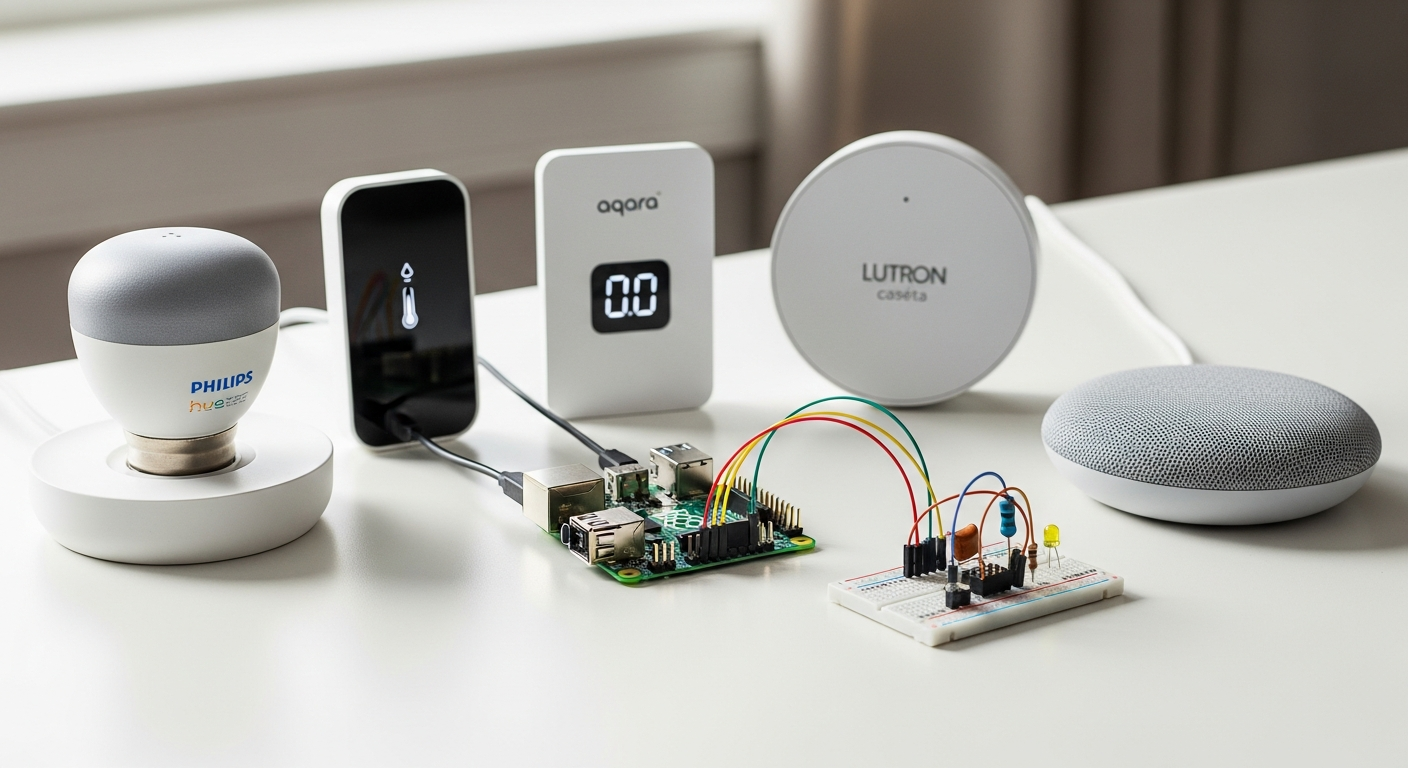
Why Raspberry Pi 4 Model B 4GB Dominates Smart Home Hubs
Smart home automation is no longer a luxury reserved for tech giants—it's now within reach of anyone with a Raspberry Pi 4 Model B 4GB and a creative idea. The Raspberry Pi 4 Model B with 4GB RAM has become the go-to single-board computer for home automation enthusiasts, smart home integrators, and IoT developers. Its powerful Broadcom BCM2711 quad-core processor, dual-band WiFi, Bluetooth 5.0, and Gigabit Ethernet create a rock-solid foundation for connecting and controlling every device in your home.
The magic of this platform lies in its ability to transform your living space into an intelligent ecosystem without requiring a fortune in hardware investment. Thousands of home automation builders have already proven this works at scale, deploying these boards in residential setups, commercial installations, and everything in between. The 4GB RAM variant specifically addresses the memory demands of modern smart home software, allowing simultaneous execution of multiple automation tasks without bottlenecks.
Get your Raspberry Pi 4 Model B 4GB today and start building your smart home.
Processing Power Meets Affordability
The quad-core ARM v8 64-bit architecture handles multiple simultaneous tasks without breaking your budget. You're getting genuine desktop-class processing power for a fraction of traditional server costs, enabling complex automation logic to run continuously without performance degradation.
4GB RAM Advantage
Sufficient memory for running Home Assistant, Node-RED, or custom Python automation scripts alongside system processes. This headroom prevents the sluggish behavior often experienced with lower-memory boards when managing dozens of connected devices and running memory-intensive monitoring tools.
Real-World Reliability
The proven track record speaks volumes. Thousands of active deployments in residential and commercial automation setups demonstrate this platform's dependability over months and years of continuous operation, handling everything from simple sensor reads to complex decision trees.
Energy Efficiency
Low power consumption (5V, 3A) makes 24/7 operation cost-effective compared to traditional PC-based hubs. Running your automation hub continuously costs pennies per month in electricity, making it financially practical to keep your smart home responsive at all hours.
Future-Proof Architecture
The 64-bit processor ensures compatibility with emerging smart home protocols and software updates. You won't outgrow this hardware quickly; the architecture supports next-generation automation standards and evolving community software for years.
Connectivity Features That Power Connected Homes
Dual-Band WiFi (2.4GHz & 5.0GHz)
Seamless switching between bands for optimal signal strength and bandwidth management. You can position your automation hub in a central location and let it intelligently choose the best frequency band based on network conditions, ensuring reliable communication with all wireless devices throughout your home.
Bluetooth 5.0 with BLE
Direct pairing with wireless sensors, smart locks, fitness trackers, and IoT devices without additional adapters. The extended range of Bluetooth 5.0 means your hub can communicate with BLE devices across multiple rooms, eliminating the need for separate Bluetooth repeaters in most residential settings.
Gigabit Ethernet Port
Hardwired connection option for maximum stability and throughput when controlling bandwidth-intensive devices. For users who prefer or require wired connectivity, this true Gigabit port delivers speeds far exceeding WiFi, critical for streaming video from security cameras or executing latency-sensitive automation commands.
True Network Reliability
You can eliminate WiFi dead zones by positioning the hub strategically with wired backup connectivity. The combination of wireless and wired options means your smart home remains operational even if one connection method experiences temporary interference or degradation.
Protocol Flexibility
Supports Zigbee, Z-Wave, and Thread through compatible USB dongles for comprehensive device ecosystem coverage. This flexibility ensures you're never locked into a single manufacturer's ecosystem; you can mix and match devices from different vendors based on features and price rather than protocol compatibility.
GPIO and Expansion Capabilities for Custom Automation
40-Pin GPIO Header
Direct control over relays, sensors, and custom hardware without requiring additional microcontroller boards. For advanced builders, this GPIO interface opens possibilities for integrating legacy home automation equipment, custom-built sensors, and specialized control circuits directly into your automation system.
MIPI DSI/CSI Ports
Connect camera modules for security monitoring, motion detection, or visual automation triggers. These dedicated ports eliminate the bandwidth overhead of USB camera connections, allowing the system to process video streams efficiently while simultaneously managing dozens of other automation tasks.
USB 3.0 and 2.0 Ports
High-speed expansion for Z-Wave dongles, Zigbee coordinators, USB cameras, and external storage. The multiple USB ports mean you can connect various wireless protocol adapters simultaneously without daisy-chaining or using power-hungry hubs that introduce latency.
HAT Ecosystem
Leverage hundreds of pre-built expansion boards (relay modules, environmental sensors, display screens) for rapid prototyping. The Hardware Attached on Top standard allows you to stack additional functionality onto your Raspberry Pi without complex wiring or custom circuit design.
Flexible I/O
Mix analog and digital signals to integrate legacy home automation hardware with modern smart systems. This adaptability makes the Raspberry Pi 4 Model B an excellent bridge between older home control systems and contemporary IoT platforms.
Order your Raspberry Pi 4 Model B 4GB now and unlock unlimited automation possibilities.
Real-World Smart Home Applications You Can Build
Centralized Device Hub
Consolidate control of smart lights, thermostats, locks, and appliances into a single, local interface. Instead of juggling multiple manufacturer apps, you access everything through one intuitive dashboard, whether you're home or away.
Automated Routines and Scenes
Create Good Morning, Movie Night, and Away Mode sequences triggered by time, location, or sensor data. Your home adapts automatically to your lifestyle—lights brighten gradually at wake time, entertainment systems activate on command, and security features engage when the house empties.
Security and Monitoring
Run continuous video surveillance, motion-triggered alerts, and door/window sensor integration. Process all security video locally on your hub for maximum privacy, eliminating the need to send footage to cloud servers while maintaining instant response to threats.
Energy Management
Monitor power consumption across circuits, optimize heating/cooling schedules, and reduce utility bills. Smart home automation reveals consumption patterns and automates efficiency improvements, often recovering the hardware investment through lower energy costs within a year.
Voice Assistant Backbone
Host local voice control with Rhasspy or integrate with Alexa/Google Home for privacy-conscious automation. You're not forced to choose between voice control and privacy; local speech recognition processes everything on your hardware while optional cloud integration remains optional.
Environmental Sensing
Track temperature, humidity, air quality, and occupancy to trigger automatic adjustments throughout your home. Sensors throughout your house feed real-time data to the Raspberry Pi, enabling sophisticated climate control and air quality management without manual intervention.
Software Ecosystem and Automation Platforms
Home Assistant
Industry-leading open-source platform with 2,000+ integrations and a thriving community. Home Assistant runs beautifully on the Raspberry Pi 4 Model B 4GB, offering a web interface so intuitive that non-technical household members can operate your smart home.
Node-RED
Visual programming interface for creating complex automation workflows without coding experience. Drag-and-drop logic flows replace traditional programming, making automation development accessible to users who don't speak JavaScript or Python.
OpenHAB
Vendor-agnostic home automation software supporting multiple protocols and device types. OpenHAB's flexibility appeals to advanced users building multi-protocol systems that integrate devices from numerous manufacturers seamlessly.
Domoticz
Lightweight alternative ideal for resource-constrained setups requiring minimal configuration. If you prefer simplicity over comprehensive features, Domoticz consumes minimal resources while providing essential automation capabilities.
Custom Python Scripts
Full programming flexibility for advanced users building proprietary automation logic. Python's extensive libraries and readability make it perfect for custom integrations and complex decision-making algorithms tailored to your specific needs.
MQTT Broker Support
Lightweight messaging protocol enabling communication between hundreds of IoT devices simultaneously. MQTT creates a publish-subscribe network where your Raspberry Pi acts as the central message router, coordinating communication across your entire smart home ecosystem.
Transform Your Home Into an Intelligent, Responsive Living Space
The Raspberry Pi 4 Model B 4GB has fundamentally changed what's possible in home automation—it's no longer reserved for engineers with deep pockets. Its quad-core processor, robust connectivity (dual-band WiFi, Bluetooth 5.0, Gigabit Ethernet), and flexible GPIO capabilities create the perfect foundation for smart home projects ranging from simple lighting automation to complex, multi-zone environmental control systems.
What makes this single-board computer truly remarkable is the ecosystem surrounding it. Whether you choose Home Assistant, Node-RED, or custom Python scripts, you're tapping into thousands of community-driven integrations and years of collective knowledge. Your first automation project could be live within hours of unpacking the hardware, and you'll immediately see how dramatically an intelligent home simplifies daily life.
Ready to build your intelligent home? Start with the Raspberry Pi 4 Model B 4GB, add a reliable power supply and microSD card, and explore one of the automation platforms mentioned in this guide. Your first project could be live within hours, and you'll join a global community of makers transforming their homes one automation rule at a time.
Purchase your Raspberry Pi 4 Model B 4GB today and begin your smart home journey.
Leave a Reply