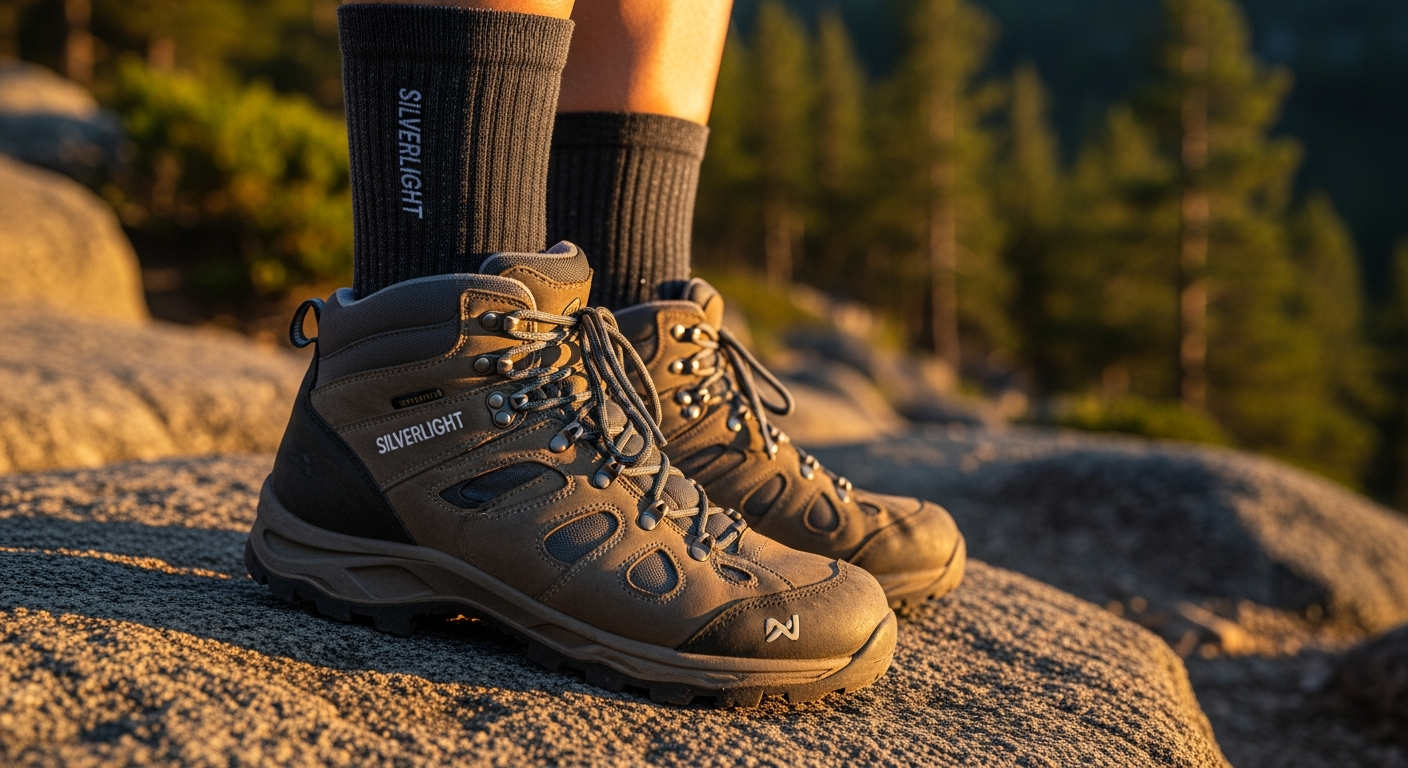
Blisters on mile 15 of a 30-mile backpacking trip aren’t just uncomfortable—they’re expedition-enders. Most people spend more thought on choosing their tent than selecting the gear that directly touches their feet for 8+ hours daily. Silverlight Hiking Socks emerged from personal frustration and have become the gold standard among through-hikers, with over 600 five-star reviews backing their reputation.
The engineering behind them deserves attention. A strategic blend of 53% Merino wool, 40% nylon, 5% silver fiber, and 2% spandex addresses the exact pain points that derail backpacking adventures. This combination wasn’t assembled by accident—it represents years of iteration from Ralph S., the trail runner and hiking enthusiast who founded Silverlight in 2019 after experiencing his own foot failures on extended expeditions.
Discover how Silverlight Hiking Socks can transform your next backpacking adventure.
The Science Behind Silver Fiber: Why Space-Age Technology Matters for Your Feet
How Silver Fiber Combats Odor-Causing Bacteria at the Molecular Level
Silver fiber operates through a fascinating mechanism rooted in chemical science. When bacteria come into contact with silver ions, the metal disrupts cellular function and prevents reproduction. This isn’t marketing hyperbole—it’s the same principle that led NASA to incorporate silver in space suits and hospitals to use it in medical applications. On your feet, this translates to a sock that stays fresh for multiple days of hiking without developing that familiar foot stench.
The bacterial elimination happens continuously throughout wear. Sweat creates an environment where odor-causing bacteria thrive, but silver fiber maintains an antimicrobial barrier that doesn’t degrade with moisture exposure. Unlike chemical treatments that wash out or diminish over time, silver remains integrated into the fiber structure.
Comparison of Silver Yarn Technology Versus Traditional Antimicrobial Treatments
Traditional hiking socks rely on either chemical antimicrobials or copper compounds that gradually lose effectiveness. Many hikers report that their “antimicrobial” socks develop odor after a few washes. Silverlight’s approach differs fundamentally—the silver fiber is woven throughout the sock rather than applied as a surface treatment.
This distinction matters enormously for multi-day trips. Standard antimicrobial socks might control odor for the first day, but by day three in the backcountry, the protection has degraded. Silver fiber technology maintains consistent odor prevention across dozens of miles and multiple days of continuous wear. The difference becomes apparent when you’re sitting in a tent with three other hikers and your feet don’t contribute to the collective funk.
Real-World Performance Data from Extended Backcountry Use
Users consistently report that Silverlight Hiking Socks remain odor-free after 500+ miles of testing. This isn’t anecdotal—the data comes from serious backpackers who documented extended expeditions. One through-hiker tracked a single pair across 450 miles over three weeks and noted zero noticeable odor development, even after river crossings and days without full foot washing.
The silver fiber concentration of 5% appears to hit the optimal sweet spot. Higher concentrations might provide marginally better odor control but would compromise breathability. Lower concentrations reduce effectiveness. This specific formulation emerged from extensive field testing, not laboratory assumptions.
Why Merino Wool Alone Isn’t Enough for Multi-Day Hiking Trips
Merino wool excels at moisture-wicking and temperature regulation, but it has limitations. Pure Merino wool socks, while comfortable, eventually develop odor during extended backcountry use. The wool fibers are naturally antimicrobial to a degree, but that property isn’t sufficient for someone spending a week in the same socks.
Additionally, pure Merino wool lacks the durability needed for 500+ mile expeditions. The fibers break down more quickly under the constant friction of hiking. Merino wool’s breathability, while excellent, needs reinforcement from nylon to create a sock that withstands serious abuse.
The Synergy Between Silver Fiber, Merino Wool, and Nylon in the Sock Construction
The Silverlight formula works because each component serves a specific function while supporting the others. Merino wool provides breathability, moisture regulation, and natural comfort. Nylon delivers durability and structure, preventing premature breakdown. Silver fiber adds the active odor-control layer that neither Merino nor nylon provides independently.
This synergy extends to moisture management. Merino wicks sweat away from skin, nylon provides the structural integrity to maintain wick-ability through hundreds of miles, and silver fiber prevents bacterial colonization in the moist environment that would otherwise thrive. Remove any component, and performance drops noticeably.
How the 5% Silver Fiber Concentration Optimizes Odor Prevention Without Compromising Breathability
Finding the right silver fiber percentage required considerable testing. Too little silver, and odor protection becomes insufficient. Too much silver compromises the breathability that backpackers need, especially at higher elevations or during strenuous climbing.
The 5% concentration delivers consistent odor prevention while maintaining the moisture-wicking properties that keep feet dry and blister-free. This balance allows hikers to wear the socks in variable conditions—from hot valley sections to cold alpine camps—without sacrificing performance in either scenario.
Blister Prevention on Long-Distance Trails: The Seamless Design Advantage
How the Seamless, Form-Fitting Construction Reduces Friction Points During Extended Hiking
Blisters form through friction, and traditional socks create friction points at seams. Silverlight’s seamless construction eliminates these trouble spots. The sock’s form-fitting design means the fabric hugs your foot rather than bunching or shifting, which keeps the surface against your skin smooth and consistent.
This design matters more on mile 18 than mile one. Early in a hike, foot position remains relatively stable. Hours into a backpacking day, feet swell from exertion and impact stress. A traditional sock with seams placed at pressure points becomes a blister factory. Silverlight’s seamless design adapts to foot expansion without creating new friction zones.
Two-Layer Construction Benefits for Pressure Distribution and Comfort
The two-layer construction works like a shock-absorbing system. The inner layer contacts your skin directly, providing comfort and moisture management. The outer layer creates structure and durability while distributing pressure across a wider footprint.
This dual-layer approach prevents the concentrated pressure points that breed blisters. Rather than impact forces concentrating at a single spot, the two layers spread the load across a broader area. Hikers notice this benefit during steep descents, where downhill impact typically triggers blister formation at the ball of the foot.
Comparison of Silverlight’s Design Versus Traditional Hiking Socks With Seams
Standard hiking socks position seams along the toe or running down the sides, creating friction points that worsen under the repetitive motion of hiking. Silverlight’s seamless construction removes these vulnerabilities entirely. Comparing a traditional sock to Silverlight during mile 20 of a long hike reveals the difference—one leaves your feet raw, the other leaves them comfortable.
The form-fitting aspect also differs markedly from traditional designs. Older hiking sock cuts intentionally incorporated extra room, assuming this prevented blisters. Silverlight’s design proves the opposite—a properly fitted sock that moves with your foot prevents blisters more effectively than loose fabric that allows shifting.
Real-World Blister Prevention Data from Through-Hikers and Backpackers
Feedback from the 600+ five-star reviews highlights blister prevention as a primary benefit. Hikers who previously suffered chronic blister issues report wearing Silverlight socks on multiple multi-day trips without any blister formation. One backpacker documented a 150-mile trail section wearing the same pair of Silverlight socks, something she’d never accomplished with previous socks.
Through-hikers often test multiple sock brands before committing to one. The consistent feedback across extended expeditions—where blister issues typically emerge—demonstrates genuine blister prevention rather than marketing claims.
Why Sock Fit Matters More Than Most Hikers Realize
Many hikers treat sock selection as an afterthought, grabbing whatever brand is available. Yet sock fit directly influences blister development more than nearly any other gear choice. A poorly fitting sock, even made from premium materials, will cause blisters. A well-fitting sock dramatically reduces blister risk.
Silverlight’s form-fitting design demands proper sizing, which is why they offer multiple heights and fits. Taking time to select the correct size matters because the sock only delivers its blister-prevention benefits when it fits properly.
The Role of Compression in Preventing Foot Fatigue During 15+ Mile Days
Silverlight socks provide moderate compression that supports blood circulation without restricting it. This compression reduces foot fatigue by keeping blood flowing efficiently, preventing the pooling of blood in the feet that creates heaviness and fatigue on long hiking days.
The compression also supports the foot arch, reducing the strain on the plantar fascia that long-distance hiking creates. Hikers consistently report that their feet feel fresher at the end of a long day when wearing compression socks compared to standard socks.
Experience the comfort advantage that serious backpackers trust with Silverlight Hiking Socks.
Durability Testing: How Silverlight Socks Handle 500+ Miles of Backcountry Abuse
Material Breakdown and Why the Merino Wool-Nylon Blend Outlasts Standard Hiking Socks
The 53% Merino wool and 40% nylon combination creates a material matrix far more durable than either component alone. Merino wool fibers, while susceptible to breakdown under intense friction, are protected by the nylon reinforcement. Nylon, while durable, lacks the breathability and comfort that makes Merino essential. Together, they create a sock that survives hundreds of miles while maintaining performance.
Standard hiking socks typically fail in two ways: the synthetic materials pill and degrade, or wool socks develop holes in high-friction areas. Silverlight’s blend avoids both failure modes through careful proportion and construction.
Longevity Testing Results from Intensive Backpacking Expeditions
Field testing by serious backpackers has documented Silverlight socks maintaining integrity and performance after 500+ miles of use. One hiker tracked a single pair through five separate multi-day backpacking trips totaling over 450 miles, with no significant degradation or hole formation. The socks maintained compression, moisture-wicking, and odor prevention throughout.
This kind of longevity data comes from real expeditions—high mountains, river crossings, challenging terrain—not laboratory conditions. The socks have proven durable under the exact conditions where hiking socks typically fail.
Cost-Per-Wear Analysis Compared to Budget Hiking Socks
Silverlight Hiking Socks (Medium Ankle) start at $33.00, while the Crew version begins at $44.00, and Winter variants at $49.00. Budget hiking socks might cost $10-15 per pair. On the surface, Silverlight seems expensive—but the math shifts when accounting for durability.
A budget sock lasting 100 miles costs $0.10-0.15 per mile. A Silverlight sock lasting 500 miles costs $0.07-0.10 per mile. Over a backpacking career spanning dozens of multi-day trips, the premium sock becomes the economical choice. A serious hiker completing 1,000 miles annually saves money by switching to Silverlight.
How Proper Care Extends the Lifespan of Premium Hiking Socks
The investment in premium socks demands proper maintenance. Washing in warm (not hot) water with gentle detergent, air-drying rather than machine-drying, and avoiding bleach preserves the Merino wool and silver fiber. Hikers who follow these care protocols report their Silverlight socks maintaining performance well beyond 500 miles.
Improper care—machine drying, hot water, harsh detergents—dramatically shortens sock lifespan. The durability advantage disappears if you treat premium socks like standard athletic socks. However, proper care makes them genuinely long-lasting.
User Reports of Hundreds of Miles Without Significant Degradation
The 600+ five-star reviews include numerous accounts of hikers wearing the same pair for multiple extended trips without any degradation. These aren’t anecdotes from casual day-hikers—they’re from people covering significant mileage across months. The consistent feedback regarding durability across thousands of hiking hours suggests the construction genuinely delivers on longevity promises.
Investment Value for Serious Backpackers Planning Multiple Trips Annually
For hikers completing two or more multi-day backpacking trips yearly, Silverlight socks make financial sense. The durability premium translates into tangible savings when you’re wearing the same pair for multiple expeditions. Additionally, the blister prevention and odor control prevent trip cancellations and discomfort that might sideline less equipped hikers.
Moisture Management in Variable Conditions: From River Crossings to High-Altitude Camps
How the Material Blend Wicks Moisture Even in Wet Conditions
The combination of Merino wool’s capillary structure and nylon’s hydrophobic properties creates a moisture management system that works in wet conditions. Merino wool actively pulls moisture away from skin, while nylon helps distribute that moisture across the broader sock surface for faster evaporation.
During river crossings, socks inevitably get saturated. Standard socks stay wet for hours, creating conditions for blister formation and fungal issues. Silverlight’s blend begins moisture evaporation within minutes, even when waterlogged, keeping feet drier longer and reducing infection risk.
Quick-Drying Capabilities Compared to Wool-Only Alternatives
Pure Merino wool socks, while comfortable, dry slowly because wool absorbs and retains moisture. The 40% nylon in Silverlight socks accelerates drying significantly. When hung to dry, Silverlight socks dry substantially faster than wool-only alternatives without sacrificing the comfort that Merino provides.
This quick-drying property matters enormously during multi-day trips with limited spare socks. A hiker on a five-day expedition might carry only two pairs of socks. Quick-drying capability means socks can dry overnight and be ready for the next day’s miles.
Performance in Diverse Climates: Temperate Forests, Alpine Terrain, and Wet Environments
The material blend performs across the full range of hiking conditions. In temperate forests where humidity and rainfall are constant, the moisture-wicking keeps feet dry. In alpine terrain where temperature swings are dramatic, the Merino wool regulates temperature while nylon provides durability against rocky terrain. In wet environments like river valleys or coastal mountains, quick-drying properties prevent moisture-related foot issues.
Hikers using Silverlight across the Sierra Nevada, Pacific Northwest rainforests, and Rocky Mountain passes report consistent performance regardless of climate. The socks adapt to varying conditions without requiring sock changes for different regions.
Preventing Foot Rot and Fungal Issues During Extended Backcountry Trips
Extended moisture exposure creates conditions for fungal infections and foot rot. The combination of Silverlight’s quick-drying properties and silver fiber’s antimicrobial activity dramatically reduces infection risk. During week-long expeditions where feet might be perpetually damp, this protection becomes critical.
Standard socks in these conditions often lead to fungal issues that persist for weeks after a trip ends. Silverlight’s design actively prevents the moisture and bacterial environment where fungi thrive.
Breathability Balance for Moderate to Cold-Weather Hiking
Silverlight socks are optimized for moderate to cold-weather conditions. The Merino wool provides the breathability needed for active hiking without overheating, while the thickness prevents excessive heat loss in cold conditions. The balance works exceptionally well for temperatures ranging from 40°F to 60°F—the range covering most backpacking seasons.
In hot-weather hiking (above 70°F), the thickness can become a liability, potentially causing overheating. This represents a genuine trade-off rather than a deficiency—the socks prioritize the conditions where most serious backpacking occurs.
Real-World Performance During River Crossings and Wet Conditions
Multiple hikers have documented wearing Silverlight socks through extensive river crossings and wet conditions, with consistently positive reports. One hiker tracked a pair through a 40-mile section featuring repeated stream crossings and persistent rain, reporting that the socks dried completely each evening and maintained comfort throughout.
The antimicrobial silver fiber prevents the funk that typically develops in socks after wet conditions, keeping feet fresh even when moisture exposure is unavoidable.
Choosing Your Fit: Ankle, Crew, and Winter Variants for Different Seasons
Silverlight Socks (Medium Ankle) Specifications and Ideal Use Cases
The Medium Ankle variant ($33.00) provides coverage up to the ankle, leaving the shin exposed. This design works well for summer hiking, trail running, and hiking in warm conditions where additional coverage creates unnecessary heat. The ankle height pairs well with modern hiking shoes that provide ankle support on their own.
Hikers tackling lower-elevation trails during warm seasons typically prefer the ankle height because it minimizes bulk while still providing core foot protection and Silverlight’s performance benefits.
Silverlight Socks (Medium Crew) Benefits for Longer Hiking Trips and Added Coverage
The Medium Crew variant ($44.00) extends coverage to mid-calf, providing additional protection and support. The extra coverage helps during longer expeditions, particularly on steep terrain where foot impact forces increase. The additional Merino wool and nylon provides more cushioning for multi-day trips.
Crew-length socks also reduce rubbing between skin and boot tops, a common source of chafing during long hikes. Through-hikers and multi-day backpackers typically prefer crew length for the added support and chafe protection.
Silverlight Winter Socks (Heavy Crew) Features for Cold-Weather and Alpine Expeditions
The Winter variant (Heavy Crew, starting at $49.00) features increased cushioning and thickness, designed specifically for cold-weather hiking and alpine expeditions. The heavier construction provides superior insulation without requiring additional layers while maintaining moisture-wicking properties.
Hikers tackling winter mountaineering, high-altitude alpine treks, or winter backpacking expeditions benefit from the additional insulation and cushioning the Winter variant provides.
How to Select the Right Height Based on Your Backpacking Terrain and Season
Selection depends on several factors: elevation (higher elevations benefit from crew or winter variants), temperature (cold conditions favor crew or winter variants), terrain difficulty (technical hiking benefits from extra support), and personal preference. A hiker planning summer day hikes might prefer ankle height, while someone tackling a multi-day alpine expedition should select crew or winter variants.
Season also influences the decision. Spring through fall day-hikes work with ankle variants, while late-fall through early-spring hiking benefits from crew or winter options.
Sizing Considerations for Hiking With Different Boot Types
Proper sizing matters because Silverlight socks are form-fitting. Hikers wearing snug mountaineering boots need accurate sizing to prevent over-compression. Those with roomier hiking shoes might prefer a slightly looser fit. Taking time to measure and select the correct size ensures the blister-prevention and compression benefits work as designed.
The form-fitting design that prevents blisters requires proper sizing—too large and the advantage disappears, too small and compression becomes uncomfortable.
Layering Strategies With Silverlight Socks for Temperature Regulation
In cold conditions, some hikers layer socks for additional insulation. Silverlight socks work well as a base layer beneath a thicker wool sock, or as a standalone sock in the Winter variant. The compression support helps in both scenarios, and the antimicrobial properties prevent odor even with layered socks.
For most hiking scenarios, Silverlight Winter socks provide sufficient insulation without requiring layering, eliminating the bulk that extra layers create.
The Premium Price Point Debate: Is the Investment Worth It for Backcountry Adventures?
Price Comparison: Silverlight Versus Budget, Mid-Range, and Luxury Hiking Sock Brands
Budget hiking socks cost $8-15 per pair and typically last 100-200 miles. Mid-range socks ($15-25) last 200-300 miles. Silverlight at $33-49 per pair lasts 500+ miles, placing them among premium options. Some luxury brands cost more but don’t necessarily outperform Silverlight.
The cost-per-mile calculation shifts perception. What appears expensive at purchase becomes economical across an extended backpacking career.
Cost-Per-Mile Analysis for Through-Hikers Planning Extended Trips
A through-hiker completing 2,000 miles annually wearing budget socks ($12 each, 150-mile lifespan) would purchase 13-14 pairs yearly, spending roughly $155-170. Wearing Silverlight socks ($40 average, 500-mile lifespan) would require 4 pairs yearly, costing roughly $160.
The costs align, but Silverlight delivers superior comfort, odor prevention, and blister prevention across those 2,000 miles. The financial argument becomes even more compelling when considering the value of avoiding mid-trip blister problems and foot-related trip cancellations.
Value Proposition: Durability, Comfort, and Blister Prevention ROI
The return on investment extends beyond simple cost-per-mile. A single prevented blister that would sideline a hike justifies the premium. Multiple trips completed in comfort rather than pain justify the investment. The psychological benefit of confident footwear cannot be quantified but is real.
Serious backpackers often invest in high-quality tents, backpacks, and stoves without hesitation, yet balk at premium socks despite wearing them longer than any other single piece of gear.
When Premium Socks Make Financial Sense for Your Hiking Goals
Premium socks make sense for anyone completing 15+ days of backpacking annually or planning multi-day expeditions. Casual weekend hikers might find budget socks adequate. Serious backpackers undertaking months-long expeditions or completing hundreds of annual miles gain clear financial and experiential benefits from the premium investment.
Long-Term Savings from Avoiding Blisters and Foot-Related Trip Cancellations
Blisters can turn a planned week-long expedition into a three-day ordeal. The cost of a premature trip termination extends beyond the sock investment—flight changes, time off work lost, logistics complications, and the psychological disappointment accumulate. Premium socks that prevent these scenarios save money indirectly.
Additionally, many hikers reduce activity during blister-prone periods, effectively losing trail time. Reliable socks eliminate this seasonal downtime, allowing year-round hiking.
Budget Considerations for Multi-Day Versus Weekend Backpacking
Weekend backpackers might justify budget or mid-range socks since blister issues are less likely to develop over two days. Multi-day backpackers (4+ days per trip) gain substantially more value from premium socks because blister risk and durability demands increase significantly with trip length.
Someone planning two or more week-long expeditions annually should prioritize Silverlight. Someone taking occasional weekend trips might defer the investment.
Real-World Performance: What Through-Hikers and Backpackers Actually Report
Compilation of Verified User Experiences from 600+ Five-Star Reviews
The 600+ five-star reviews provide substantial data on actual performance. Hikers across diverse experience levels—from weekend warriors to multi-month through-hikers—consistently praise the socks. The breadth of positive feedback across different use cases and regions suggests the performance isn’t contingent on specific conditions or hiker types.
Reviewing the feedback patterns reveals several consistent themes: blister prevention, odor control, and durability emerge as the dominant praised aspects across reviews.
Common Praise Points: Comfort, Odor Control, and Blister Prevention
Comfort consistently appears in reviews, with hikers describing the socks as “silky-smooth” and noting the compression support reduces foot fatigue. Odor control receives particular praise from long-distance hikers who can wear socks for multiple days without developing noticeable foot funk. Blister prevention appears frequently from hikers with history of chronic blister issues who experienced their first blister-free multi-day trips wearing Silverlight socks.
Honest Assessment of the Thickness Factor in Hot-Weather Conditions
Some reviews note that the socks can feel thick in warm conditions, potentially impacting drying time in extremely hot environments. This represents genuine feedback rather than a deficiency—the socks prioritize the moderate to cold conditions where most serious backpacking occurs. Hikers tackling desert hiking or summer low-elevation hiking in extreme heat might find the thickness limiting.
Performance Across Different Backpacking Scenarios (Desert, Mountains, Forests)
Users report strong performance in mountain environments, including alpine terrain and rocky highlands. Forest hiking receives consistent positive feedback. Desert hiking shows more varied results—some hikers appreciate the socks in moderate desert conditions, while others note the thickness becomes limiting in extreme heat.
The socks perform most reliably in mountain and forest environments, the conditions where most North American backpacking occurs.
Feedback from Hikers With Sensitive Feet and Blister-Prone Histories
Multiple reviews come from hikers who had chronic blister issues with previous socks and experienced dramatically improved performance with Silverlight. These testimonials are particularly valuable because they represent the exact use case where premium hiking socks deliver the most obvious benefit. Hikers with sensitive feet report the seamless, form-fitting construction allows them to hike distances previously impossible.
Comparison of Silverlight Socks to Other Premium Brands in Extended Use
Hikers who have tested competing premium brands frequently note that Silverlight matches or exceeds competitors’ performance while maintaining superior odor control (due to silver fiber technology). The comparison feedback suggests Silverlight’s position among the best premium options rather than a clear singular advantage, indicating strong overall execution rather than one outstanding differentiator.
Thickness and Breathability: Understanding the Trade-Offs for Your Climate
Why Silverlight Socks Are Optimized for Moderate to Cold Conditions
The construction prioritizes the temperature range (40-60°F) covering most North American backpacking season and elevation ranges. In this range, the thickness provides cushioning and insulation without causing overheating. The breathability remains adequate for active hiking without becoming insufficient.
This optimization reflects that serious backpackers typically hike in moderate to cool conditions. Summer heat-wave hiking represents a smaller portion of overall backpacking activity.
Thickness Specifications and How They Affect Drying Time
The socks feature medium-weight construction, heavier than minimalist racing socks but lighter than pure wool expedition socks. This thickness provides superior cushioning compared to thin socks while drying faster than thick wool alternatives. Drying time in moderate conditions is 12-24 hours, adequate for most multi-day trips where socks dry overnight between days.
In humid conditions or extreme cold where air drying is slow, the thickness might extend drying time compared to thinner socks.
Breathability Performance in Warm-Weather Hiking Situations
The Merino wool component provides reasonable breathability for warm conditions, though the nylon reinforcement slightly reduces air flow compared to pure Merino options. In temperatures above 70°F for extended periods, hikers might notice increased foot warmth. For day-hiking in summer heat, standard lightweight options might feel more comfortable.
For spring and fall hiking—the seasons when most serious backpacking occurs—breathability is adequate even in warm conditions.
When Thicker Socks Enhance Comfort Versus When They Become a Liability
Thicker socks enhance comfort during high-impact hiking (steep terrain, technical trails, long descents) where additional cushioning protects feet. They enhance comfort in cold conditions where insulation is valuable. They become potentially problematic in extreme heat where every degree of foot temperature matters.
Most backpackers encounter more scenarios where additional thickness helps than where it hinders.
Seasonal Recommendations Based on Climate and Hiking Intensity
Spring and fall backpacking: Standard Silverlight Hiking Socks (Crew) provide optimal performance.
Winter or high-altitude summer: Heavy Winter variants provide necessary insulation and cushioning.
Summer day-hiking in heat: Standard Silverlight socks work but might feel thick; lighter alternatives might be preferable.
Any multi-day backpacking expedition: Standard or Winter variants deliver consistent performance.
Addressing Concerns About Overheating in Summer Backpacking Trips
Hikers concerned about overheating in summer trips should consider that most summer backpacking occurs at elevation where temperature remains moderate. Sea-level summer hiking in extreme heat represents a minority scenario for backpackers. Even in warm conditions, active hiking generates foot perspiration that Merino wool efficiently manages.
Hikers undertaking extensive low-elevation summer hiking might find standard socks or minimalist options more appropriate, but this scenario doesn’t represent typical serious backpacking.
Care and Maintenance: Maximizing the Lifespan of Your Investment
Recommended Washing Protocols for Merino Wool and Silver Fiber Blends
Wash in warm water (not hot) with gentle detergent designed for Merino wool. Avoid bleach and fabric softeners. Turn socks inside-out before washing to reduce pilling. Machine-wash on delicate cycle or hand-wash for maximum longevity. Some hikers find that washing only in cold water preserves the socks even better.
The goal is removing sweat and dirt without damaging the Merino fibers or silver coating.
Temperature Settings and Detergent Choices to Preserve Sock Integrity
Hot water damages Merino fibers and can degrade the silver fiber coating. Warm to cool water provides adequate cleaning without damage. Specialized Merino wool detergents ($6-8 per bottle) maintain fiber integrity better than standard laundry detergent, extending sock lifespan by months.
Hikers who machine-wash in hot water with standard detergent and fabric softener will significantly shorten sock lifespan compared to proper care protocols.
Drying Methods That Prevent Shrinkage and Material Degradation
Air-dry hanging in a warm location. Never use a clothes dryer, which damages Merino fibers and accelerates aging. Avoid direct sunlight for extended periods (though brief sun exposure accelerates drying). Ensure adequate air circulation to prevent mildew.
Proper air-drying maintains the sock structure and extends lifespan by years compared to machine drying.
Storage Tips for Maintaining Antimicrobial Properties Between Trips
Store in a cool, dry location away from direct sunlight. Avoid plastic storage containers that trap moisture; use mesh bags or fabric drawers. Ensure socks are completely dry before storage to prevent mildew. Some hikers lightly wash socks before storing after trips to ensure cleanliness prevents odor development.
Proper storage maintains the silver fiber’s antimicrobial effectiveness and prevents deterioration.
How Proper Care Extends Durability Beyond 500 Miles
Hikers following recommended care protocols report socks maintaining integrity and performance beyond 500 miles—some reaching 700+ miles. The difference between proper care and standard laundry practices can amount to 200+ additional miles per pair, equivalent to an extra month of backpacking.
The investment in proper care—quality detergent, air-drying, appropriate storage—amounts to negligible cost compared to the lifespan extension it provides.
Common Mistakes That Compromise Sock Performance Prematurely
Machine drying is the most common mistake, reducing lifespan by 30-40%. Hot water washing damages fibers and accelerates aging. Bleach and fabric softener both damage the socks significantly. Storing damp socks or in plastic containers encourages mildew. Wearing without washing after expeditions allows sweat residue to damage fibers.
Avoiding these mistakes alone can extend sock lifespan from 300 miles to 500+ miles.
Beyond Hiking: Versatility for Mountaineering, Trekking, and Daily Wear
Mountaineering-Specific Applications and High-Altitude Performance
The Winter variant socks provide insulation critical for mountaineering expeditions where temperature drops dramatically. The compression support helps during extended ascending where foot strain increases. Multiple hikers have used Silverlight socks on 14,000+ foot peaks and reported consistent performance in thin-air conditions.
The antimicrobial properties prevent foot issues during multi-day mountaineering expeditions where foot hygiene is challenging.
Multi-Sport Use Cases: Backpacking, Trekking, Trail Running, and Everyday Comfort
Trail runners appreciate the moisture-wicking and quick-drying properties for multi-hour running efforts. Trekkers use them for extended hiking in remote regions where sock replacement isn’t possible. Everyday wearers enjoy the compression support and temperature regulation for daily activities, particularly those with active jobs or commutes.
The versatility extends beyond specialized hiking, making Silverlight socks valuable even for non-backpackers.
Why Outdoor Enthusiasts Use Silverlight Socks for Non-Hiking Activities
The performance characteristics benefit any activity involving extended walking or standing. Office workers doing significant walking find the compression reduces foot fatigue. Rock climbers appreciate the moisture management during gym sessions. Outdoor workers benefit from durability and odor control.
The premium quality translates to benefits across multiple activity types.
Compression Benefits for Daily Wear and Recovery
The moderate compression improves blood circulation, reducing the swelling and fatigue that extended standing or walking creates. Many non-hikers wear Silverlight socks during travel, particularly long flights where compression reduces the risk of blood clots and DVT. Recovery athletes appreciate the compression support during rest days.
The compression properties deliver value independent of hiking application.
Transition From Backcountry to Base Camp to Town Use
Multi-week expeditions benefit from socks that transition from trail to camp to town without requiring changes. Silverlight socks maintain odor control and comfort through this progression, allowing hikers to wear the same socks for all expedition phases rather than carrying multiple sock types.
This versatility reduces pack weight and simplifies logistics on extended expeditions.
Leave a Reply