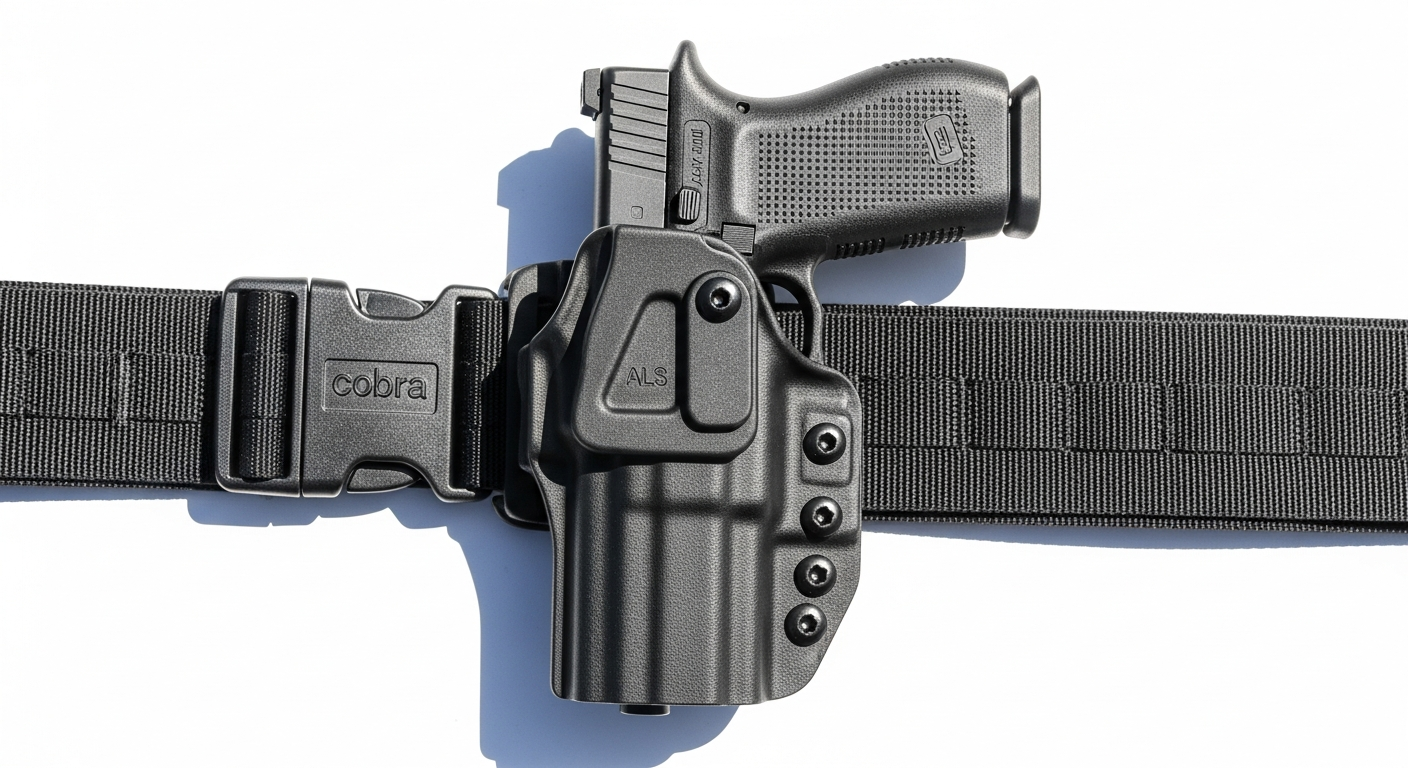
When officers carry a firearm into uncertain situations, retention isn't negotiable—it's survival. Over 95% of law enforcement agencies nationwide require Level III retention holsters for duty carry, yet many officers still struggle to find a system that balances security with speed. The Safariland 6360 ALS/SLS has earned its reputation as the gold standard in professional duty holsters through decades of field testing and agency adoption across the country.
The evolution of duty holster technology mirrors the evolution of threats themselves. As departments have encountered increasingly sophisticated attempts at weapon takeaways, the engineering demands on retention systems have intensified accordingly. What separates the 6360 from countless competitors isn't marketing—it's a proven dual-mechanism design that operators trust when stakes are highest.
I'll walk you through the engineering that makes the 6360 exceptional, break down how its dual retention systems actually work under pressure, explore its modern features like red dot compatibility, and help you determine whether this investment makes sense for your specific role. Discover why the Safariland 6360 is the duty holster choice of professional operators.
The Dual Retention System Explained—How ALS and SLS Work Together
Automatic Locking System (ALS) fundamentals
The Automatic Locking System operates as your first line of defense the moment your firearm enters the holster. An internal mechanism engages the ejection port of your weapon upon holstering, creating immediate Level I retention without requiring any conscious operator input. This passive security means your firearm is locked down instantly—no manual lever to flip, no button to press. The ALS does its work through pure mechanical geometry, a design philosophy that eliminates human error from the retention equation.
Self Locking System (SLS) operation
Building on the ALS foundation, the SLS adds a second layer through a rotating hood design. To release your weapon, you must first push the hood downward, then rotate it forward. This deliberate two-part motion prevents accidental disengagement during normal duty activities. The hood sits flush against your firearm when locked, creating a smooth profile while providing tactile feedback that confirms secure engagement.
Three-action draw sequence
Achieving Level III retention requires three distinct actions in sequence. First, you disengage the SLS hood through its downward and forward rotation. Second, the ALS internal mechanism must clear the ejection port. Third, you draw the weapon itself. This three-step process transforms a simple draw into a choreographed movement that becomes second nature through proper training but remains virtually impossible for an untrained aggressor to accomplish quickly.
Passive vs. active retention components
The ALS functions as your passive security—it works automatically without your attention. The SLS demands active engagement, requiring you to deliberately manipulate the hood. This combination is deliberate: automatic systems can't fail due to forgetfulness, while active systems allow you conscious control when you need it. Neither system alone achieves Level III retention; together, they create redundancy that protects against both accidental loss and intentional weapon takeaway attempts.
Redundancy advantage
Consider the protective benefit of this dual approach. An officer who stumbles while falling still has the ALS engaged. An aggressor who overcomes the SLS still faces the ALS barrier. Someone attempting a surreptitious weapon grab encounters two separate mechanical obstacles. This redundancy philosophy distinguishes professional-grade retention from simpler alternatives—there's no single point of failure when two independent systems must both be defeated.
Muscle memory development
The draw sequence becomes automatic through deliberate training. Early repetitions feel awkward—your hand positions the hood release, applies downward pressure, rotates forward, then continues to the grip and draw. Within weeks of consistent practice, your fingers perform this sequence without conscious thought. Officers report that under stress, their hands execute the retention release the same way their hands execute the draw itself—through ingrained motor patterns.
Comparison to Level I and Level II systems
Level I retention (ALS only) meets basic standards but leaves room for determined takeaway attempts. Level II systems add a single additional barrier—typically a thumb break or similar mechanism. Level III, with its dual independent systems, became the industry standard for professional duty carry precisely because it stops most realworld threats without requiring exotic mechanisms or extended draw times. The simplicity of the ALS/SLS combination has proven more reliable in high-stress scenarios than more complex alternatives.
Engineering Excellence—Materials, Construction, and Durability Standards
SafariLaminate™ construction
Safariland selected SafariLaminate—a proprietary composite material—as the foundation for the 6360's durability. This isn't standard polymer injection-molded in a factory mold and forgotten. SafariLaminate combines multiple materials into a laminated structure that resists cracking under impact while maintaining rigidity in the exact zones where retention forces concentrate. The material outperforms standard polymer alternatives in both longevity and weapon protection.
SafariSeven™ nylon blend
The 6360RDS variant that accommodates red dot sights utilizes SafariSeven, an advanced nylon blend engineered for superior element resistance. Officers carrying in wet environments, salt-air coastal regions, or extreme temperature swings report that SafariSeven maintains integrity where standard materials show degradation. The blend resists UV damage, salt corrosion, and the brittle failure that sometimes occurs when polymer materials experience thermal cycling.
Suede lining technology
Inside the holster, suede lining protects your firearm's finish and sight integrity during thousands of draws. The soft material prevents the abrading that occurs when hard polymer contacts gun metal. Red dot sights receive particular protection—the suede lining prevents the friction that could shift optic zero or damage lens coatings. This internal detail distinguishes holsters designed for longevity from those optimized purely for retention mechanics.
Mid-ride positioning
The 6360's mid-ride belt position affects both comfort during extended wear and draw speed efficiency. Sitting higher on the belt than drop-leg alternatives but lower than strong-side appendix carries, mid-ride positioning keeps your firearm close to your body centerline. This placement reduces printing—the visible outline of a concealed weapon—while maintaining quick access. During 8–12 hour duty shifts, officers appreciate the ergonomic balance mid-ride provides.
Universal Belt Loop (UBL) compatibility
The Universal Belt Loop attachment system accommodates duty belts up to 2.25 inches wide, the standard specification across most law enforcement agencies. The UBL design allows rotation for cant adjustment, letting operators fine-tune their draw angle for individual body mechanics. This compatibility standard ensures your 6360 works across different belt systems without requiring holster replacement.
Finish options
Safariland offers multiple finishes—basketweave for traditional duty aesthetics, plain SafariLaminate for low-profile appearance, and Cordura-wrapped options for operators who prioritize durability in rough environments. The choice is largely personal, though some agencies standardize on specific finishes for uniformity. None of these options compromise retention security; they're purely cosmetic and environmental considerations.
Weapon-specific molding
Each 6360 is precision-molded for specific firearm models from manufacturers like Glock and SIG Sauer. You must verify your exact weapon model before purchase—a 6360 designed for Glock 19 won't fit a Glock 17, though the difference is only millimeters in overall height. This weapon-specific approach ensures the retention mechanisms engage exactly where the manufacturer designed them to engage, maintaining the critical mechanical tolerances that make Level III retention reliable.
Durability testing standards
Professional-grade holsters undergo testing that civilian retention equipment never experiences. The 6360 has been subjected to impact tests, environmental exposure studies, and retention-force measurements that exceed any civilian standard. Agencies adopting the 6360 did so based on testing data showing how the holster performs after years in service—not theoretical performance, but real-world durability metrics.
Get the 6360 duty holster that meets professional standards.
Modern Duty Demands—Red Dot Sight Compatibility and Tactical Accessories
6360RDS variant specifications
The 6360RDS represents Safariland's response to the modern duty landscape where red dot optics have transitioned from specialized equipment to standard-issue upgrades. The RDS variant features internal clearances that accommodate various red dot mounting systems without compromising retention security. This isn't a modification bolted onto an older design—it's an engineered solution built into the holster architecture.
Red dot sight clearance
Modern red dots come in multiple configurations: some mount directly to the slide, others attach to the rear sight, still others sit on specialized mounting plates. The 6360RDS accommodates these variations through careful internal molding that provides clearance for the optic body while maintaining weapon retention. Your firearm with mounted red dot seats the same way every time—no shifting, no ambiguity about whether it's properly secured.
Weapon light integration
Tactical flashlights and laser systems add complexity to firearm geometry. The 6360RDS accounts for common weapon light configurations, ensuring smooth draws even when your firearm sports a tactical light mounted to the rail system. This compatibility verification matters before purchase—your exact firearm model with your exact light configuration must match the holster specification.
Accessory rail accommodation
Modern duty firearms typically include picatinny rails for accessory mounting. The 6360RDS accommodates standard rail systems without interference. The holster's internal geometry doesn't fight your accessory configuration—it works with it. This forward-thinking design kept the 6360 relevant as duty firearms evolved.
Sight picture protection
When your red dot is mounted and zeroed, that zero is sacred. The suede lining and precise molding protect your optic lens from contact during thousands of draws. Operatorsusing red dots report maintaining zero consistency with the 6360 across entire duty rotations—evidence that the holster design respects the delicate optical systems operators rely on.
Future-proofing your platform
Selecting the RDS variant is an investment in relevance. If you're currently using iron sights but considering future red dot adoption, the RDS model keeps that option open. Most modern duty holster purchasing happens infrequently, so choosing a system that accommodates probable future equipment evolution makes financial sense.
Optic-specific draw techniques
Drawing a firearm with a mounted red dot requires slightly different hand positioning than drawing iron-sight equipped weapons. The optic body sits higher, changing where your shooting hand naturally grips. Operators adapt quickly, but this adjustment is worth acknowledging during initial training. The retention release mechanics remain identical—only your hand's final grip position shifts slightly.
Real-World Performance—What Agency Adoption Reveals About the 6360
Law enforcement agency standards
The agencies requiring Level III retention holsters did so based on documented incidents where simpler retention systems failed. When a weapon is taken during a confrontation, the aftermath reshapes policy. Departments that mandate Level III systems have typically experienced—or studied agencies that experienced—officer disarmament incidents. The 6360 became standard-issue partly because it emerged as the most effective response to these hard-learned lessons.
Military unit preferences
Special operations and military tactical units operating under the most demanding conditions selected the 6360 for similar reasons law enforcement did: it works. Combat environments where your firearm absolutely cannot be lost or taken produced adoption patterns that reflected real-world requirements. Military operators don't conduct theoretical assessments—they validate equipment through use.
High-stress scenario testing
Agencies conduct stress testing in scenarios approximating actual threats. Officers draw under time pressure, in awkward body positions, while experiencing adrenaline spikes that degrade motor control. The 6360's retention release sequence remains accessible under these conditions—operators can execute the draw even when stress has temporarily degraded fine motor control. This stress resilience separates reliable systems from those that fail when functioning matters most.
Retention success rates
Statistical data tracking actual disarmament attempts involving officers using Level III retention systems shows markedly lower loss rates than Level I or Level II systems. These aren't perfect barriers—no mechanical system is—but they dramatically raise the difficulty and time required for successful weapon takeaways. The margin matters in encounters lasting seconds.
Officer feedback patterns
Operators across different roles report similar observations: the retention release becomes automatic quickly, the dual-system redundancy provides genuine peace of mind, and the mid-ride position balances security with accessibility. Complaints tend toward the bulkier profile compared to concealment holsters—a fair tradeoff when retention security is the priority.
Training academy integration
Police academies standardized on the 6360 or similar Level III systems because training recruits on multiple retention systems creates inefficiency and confusion. Once new officers develop muscle memory with one retention system during academy, switching to different systems in the field becomes problematic. Academy standardization on the 6360 produces officers who arrive at their first assignment already proficient.
Cross-platform adoption
SWAT teams, tactical units, and specialized squads adopted the 6360 based on its performance in high-risk scenarios. These operators made equipment selections based on what functioned in worst-case scenarios—not marketing claims or cost considerations. The 6360's prevalence among professional tactical operators reflects voting with equipment selections in environments where equipment failure has serious consequences.
Longevity in service
Officers report 5–7 years of reliable service from a single 6360 holster with proper maintenance. Some report longer service life. Compared to duty weapons that might require repair or replacement more frequently, the 6360's longevity makes it a cost-efficient investment. The SafariLaminate construction resists the material degradation that sometimes occurs with less robust alternatives.
Investment Breakdown—Pricing, Value Proposition, and Configuration Options
Current market pricing
The 6360RDS typically ranges from approximately $237 to $311.75, depending on specific configuration and retailer pricing. This range reflects variations in firearm model compatibility, finish selection, and accessory accommodation. A basic 6360RDS for common firearm models typically sits toward the lower end, while specialized configurations or premium finishes push toward the upper range.
Configuration variables
Your final price depends on multiple factors: which firearm model you're carrying, whether you need RDS accommodation, which finish you select, whether you require weapon light compatibility, and whether you want specific cant adjustments or attachment options. Each of these variables can influence pricing—some retailers charge more for less common firearm models due to lower production volumes.
Retailer pricing differences
Shopping across retailers reveals pricing variation, sometimes substantial. However, authenticate your purchase source carefully—counterfeit retention holsters exist and are dangerous. Reliable retailers willing to verify product authenticity typically price competitively with legitimate Safariland distributors. The slight premium for verified authenticity is worth the certainty.
Value-per-feature analysis
Comparing the 6360's cost against alternative Level III retention systems reveals competitive pricing. You're paying for proven technology, not premium branding. The $237–$311 range sits in the middle of professional-grade duty holster pricing—some competitors charge significantly more for systems with less extensive agency adoption and field-test data.
Long-term cost efficiency
Because the 6360 remains serviceable for years with proper maintenance, the per-year equipment cost is actually quite low. An officer who carries the same holster for 5 years is investing under $50 annually. Compared to replacing worn-out alternatives more frequently, the 6360's durability makes it cost-efficient over its service life.
Warranty and support
Safariland backs the 6360 with replacement policies that acknowledge legitimate defects. The company has maintained this support for decades, creating confidence among professional users. Your purchase includes access to support resources and the likelihood of warranty replacement if the holster fails due to manufacturing defect rather than misuse.
Bulk purchasing considerations
Agencies procuring holsters in quantity often receive volume discounting directly from Safariland. Individual officers purchasing single units typically pay the standard retail range. If your department is considering standardization on the 6360, inquiring about bulk pricing and procurement options might influence the decision.
Practical Considerations—The Learning Curve and Real-World Tradeoffs
Initial training requirements
Expect 20–40 repetitions before the retention release sequence feels natural. The first dozen draws feel deliberately mechanical—you're thinking through each motion. By repetition 30–40, your fingers execute the release automatically. Full proficiency—smooth, rapid draws under stress—typically develops within weeks of daily practice. This training timeline is minor compared to the years officers spend developing other professional competencies.
Bulk profile reality
Acknowledge honestly that the 6360 projects a larger silhouette than concealment-focused holsters. If you're accustomed to appendix carry or minimalist holster designs, the mid-ride 6360 profile will feel different. This isn't a defect—it's a direct consequence of housing dual retention systems. Officers adjusting from minimal profiles require a brief adjustment period to their body awareness.
Draw speed expectations
Competitive shooters sometimes achieve 1.0–1.2 second draws from retention holsters. Duty officers typically function in the 1.3–1.8 second range depending on stress levels and specific scenarios. These times are genuinely fast—many threat scenarios develop over several seconds. The retention release adds perhaps 0.2–0.3 seconds to draws from simpler holsters, a marginal penalty for the security gained.
Comfort during extended wear
Mid-ride positioning distributes weight across a larger area of your belt and waistband compared to appendix carry or minimalist designs. Officers report that the 6360 remains comfortable during full 12-hour duty shifts, though individual comfort varies with body geometry and belt configuration. Proper belt—a rigid duty belt with significant support—enhances comfort considerably.
Weapon-specific fitment
Your specific firearm model determines which 6360 variant you purchase. If you're carrying a Glock 19, you need the 6360 variant designed for Glock 19, not a Glock 17 variant. This weapon-specific requirement means you cannot share holsters between similar firearms. Verify your exact model and accessory configuration before ordering.
Accessory compatibility verification
If you're carrying a firearm with weapon light or red dot sights, verify that your exact configuration matches the holster specification. Safariland publishes compatibility information, but verifying before purchase prevents acquiring an incompatible holster. Contact Safariland's customer service if your configuration isn't explicitly listed.
Break-in period
New SafariLaminate and SafariSeven materials soften slightly during initial use. Your first week of carrying, the holster will feel marginally tighter than after extended use. This is normal and expected—the material isn't degrading; it's conforming slightly to your specific firearm's geometry. After 200–300 draws, the holster settles into its final fit.
Maintenance protocols
Regular inspection ensures optimal performance. Periodically remove debris that collects in the holster opening. Occasionally run a soft cloth through the interior to remove dust. Unlike leather holsters, SafariLaminate and SafariSeven require minimal active maintenance beyond cleanliness. Annual inspection of retention mechanisms confirms they're functioning properly. This is straightforward maintenance that most officers accomplish in minutes.
Making Your Move—The 6360 as Your Duty Carry Foundation
The Safariland 6360 ALS/SLS Level III Duty Holster represents more than just equipment—it's a commitment to a retention philosophy that has proven itself across thousands of officers and countless operational scenarios. Your decision ultimately hinges on three factors: whether your role or agency requires Level III retention, whether you're willing to invest time in mastering the dual-mechanism draw sequence, and whether the mid-ride positioning aligns with your comfort and accessibility needs.
Start by verifying your exact firearm model and accessory configuration, then cross-reference with Safariland's compatibility database. The investment—ranging from $237 to $311—pays dividends through years of reliable performance and the peace of mind that comes from carrying a retention system trusted by the agencies and operators who depend on their gear most.
Your duty carry deserves a foundation built on proven technology. Choose the Safariland 6360 and carry with confidence.
Leave a Reply