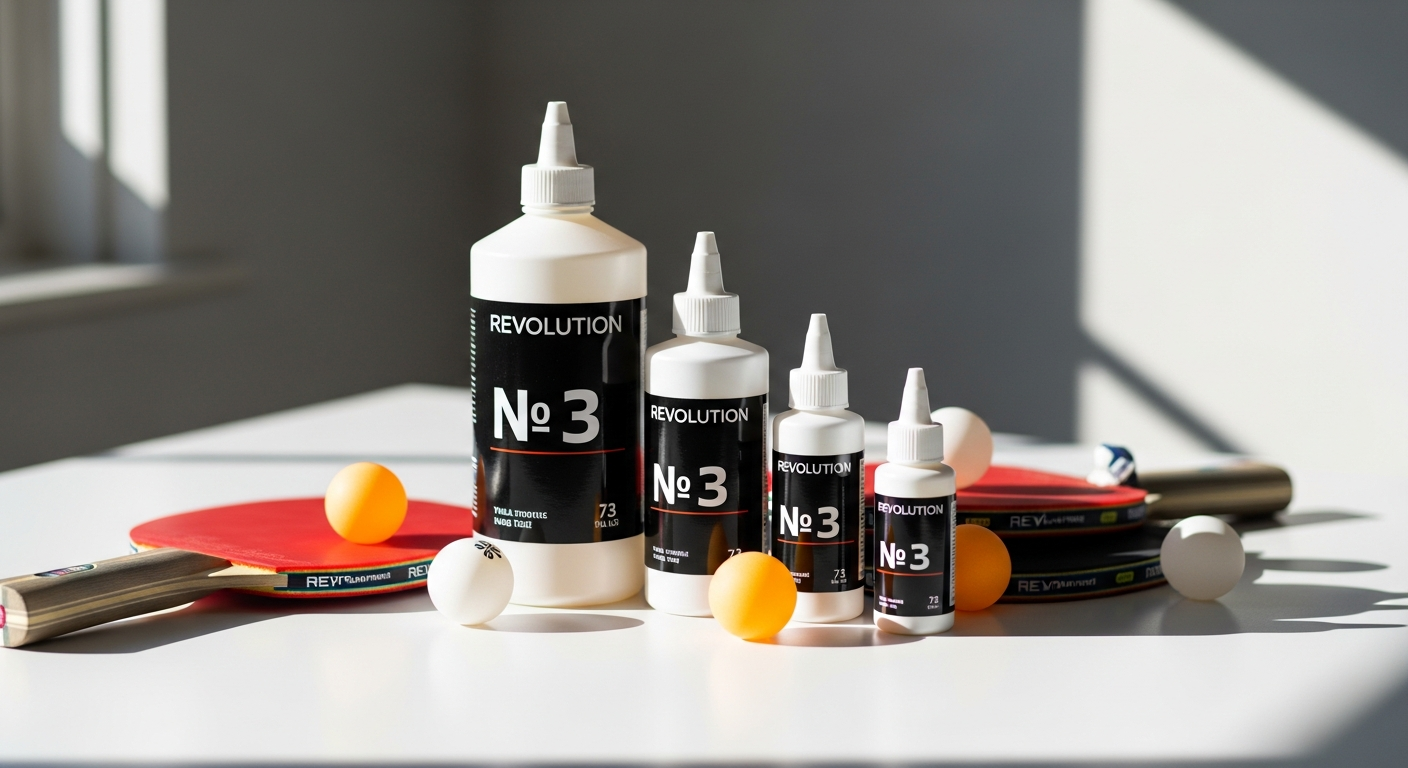
Most table tennis players face a frustrating dilemma: the best-performing glues either damage equipment during removal or violate tournament regulations. Since the banning of traditional speed glues, the table tennis community has searched for a legal alternative that actually delivers performance gains.
Revolution No. 3 emerged as the answer—a water-based, VOC-free adhesive engineered with elastic film technology that mimics the benefits of banned formulas while staying completely compliant with international regulations. This advanced glue represents a genuine shift in how competitive players approach racket setup and equipment management.
Discover how Revolution No. 3 can transform your table tennis equipment strategy today.
The Science Behind Elastic Adhesive Film Technology
How elastic adhesive film creates a dynamic layer between rubber and blade
Revolution No. 3’s core innovation lies in its elastic adhesive film—a specially formulated layer that bonds rubber to blade while maintaining flexibility. Unlike rigid adhesives that lock components in place, this elastic approach allows the rubber to respond dynamically to ball contact. The film forms a tough yet flexible barrier that transfers energy more efficiently between components.
Understanding dwell time and its impact on ball contact and spin generation
Dwell time refers to the duration the ball remains in contact with the racket surface during each stroke. The elastic properties of Revolution No. 3 influence this critical timing window. By allowing slight movement and flex within the adhesive layer, the glue extends dwell time slightly, giving the rubber more opportunity to grip and generate spin. This extended contact creates measurable improvements in spin generation without violating any regulatory standards.
The difference between elastic and rigid adhesive bonds in table tennis
Rigid adhesives lock the rubber completely static against the blade, creating a harder feel and less responsive contact. Elastic bonds used in Revolution No. 3 permit controlled movement within the adhesive layer itself, creating a more dynamic racket response. Players notice this difference immediately—the racket feels more alive, more responsive to technique variations, and more capable of generating spin on demand.
Why elasticity translates to improved speed, spin, and control on the court
The elasticity in Revolution No. 3’s formula creates several performance benefits. Speed improves because the elastic layer efficiently transfers force from the player’s stroke to the ball. Spin increases due to the extended dwell time and the rubber’s enhanced grip during contact. Control benefits from the more responsive feel—players can modulate their strokes more precisely because the racket responds more faithfully to their technique. Together, these factors create measurable performance gains that competitive players notice within the first few matches.
How Revolution No. 3 legally replicates banned speed-glue performance benefits
Traditional speed glues achieved performance gains through volatile organic compounds that created temporary expansion in the rubber layer. Regulatory bodies banned these substances due to health and environmental concerns. Revolution No. 3 achieves similar performance benefits through engineering rather than chemistry—the elastic adhesive film provides comparable dwell time extension and spin generation without any banned substances. This legal approach delivers results that satisfy competitive players while maintaining full tournament compliance.
The role of adhesive flexibility in racket responsiveness and feel
Racket feel determines player confidence and stroke execution. A racket that feels stiff and unresponsive discourages aggressive play. Revolution No. 3’s flexible adhesive film creates a more responsive feel that encourages players to commit fully to their strokes. The racket communicates ball contact more clearly, helping players develop better timing and technique. This responsiveness applies across all stroke types—loops, flicks, blocks, and counter-attacks all benefit from the enhanced feedback.
Equipment Protection: Why Easy Rubber Removal Matters
The damage caused by traditional glues when removing rubbers
Many conventional table tennis glues bond so aggressively that removing rubbers causes serious damage. The rubber surface tears and deteriorates. The blade surface gets scarred, making it difficult to apply new glue evenly. Players often damage expensive equipment while attempting rubber removal, forcing costly replacements. This damage cycle makes experimentation with different rubbers economically prohibitive for most players.
How Revolution No. 3 prevents blade scarring and rubber deterioration
Revolution No. 3’s elastic adhesive film separates cleanly from both the blade and rubber without tearing or scarring either surface. The rubber peels off smoothly, leaving minimal residue. The blade surface remains intact and ready for a fresh application of glue. Players can remove rubbers multiple times without degradation, making equipment changes practical and affordable.
Cost savings from preserving equipment across multiple rubber changes
Consider the economics: a quality blade costs €50-100+, and premium rubbers cost €30-50 each. If traditional glues damage blades after just 2-3 rubber changes, players face expensive replacements. Revolution No. 3’s non-damaging removal means a single blade can accommodate dozens of rubber changes without degradation. Over a player’s career, this equipment preservation translates to significant savings—potentially hundreds of euros.
The practical advantage for players who frequently experiment with different rubbers
Advanced players optimize their racket by trying different rubber combinations to find the perfect match for their playing style and technique. Traditional glues make this experimentation prohibitively expensive due to equipment damage. Revolution No. 3 removes this barrier—players can confidently experiment with different rubbers, switching between options weekly if desired. This flexibility accelerates improvement because players can find their ideal equipment configuration faster.
Comparison of removal difficulty between Revolution No. 3 and competitor products
Players switching from traditional glues to Revolution No. 3 report significantly easier removal. Competitor products often require scraping, heating, or extended soaking to remove rubbers. Revolution No. 3 simply peels away with gentle pressure, taking seconds rather than minutes. This practical advantage becomes more valuable the more frequently players change equipment.
Long-term equipment investment protection and resale value considerations
Equipment that’s been damaged by harsh glue removal becomes difficult to sell or trade. Blades with scarred surfaces fetch lower prices in the second-hand market. Revolution No. 3 protects equipment condition, maintaining resale value. A blade that’s been used with Revolution No. 3 multiple times looks and functions like new, preserving investment value throughout its service life.
Protect your equipment investment with Revolution No. 3’s non-damaging removal system.
Application Mastery: Getting the Most From Your Glue
Step-by-step application technique using included sponge applicators
Revolution No. 3 comes with specially designed sponge applicators that make application straightforward. The process begins with a clean, dry blade surface. Apply a thin, even layer using the sponge, working from the blade’s center outward to the edges. The self-leveling properties of the glue help distribute it evenly across the surface. Once the blade coating dries, repeat the process on the rubber backing. The sponges are reusable—simply rinse them between applications.
Understanding optimal layer count for different playing styles
The number of glue layers affects performance and drying time. Aggressive attacking players often prefer 2-3 layers for maximum dwell time extension and spin generation. All-around players typically use 2 layers for balanced performance. Defensive players may use just 1-2 layers since they prioritize control over spin generation. Experimenting with different layer counts during practice helps players identify their optimal configuration.
Drying time requirements and how to avoid weak adhesion
Adequate drying time between layers is critical for strong adhesion. Revolution No. 3 typically requires 3-6 hours between layers, though environmental conditions affect this timeline. Rushing the drying process results in weak bonds that cause rubbers to shift or deteriorate during play. Patience at the application stage prevents performance problems during matches. Some players apply glue the evening before play to ensure complete curing overnight.
The self-leveling effect and what it means for application consistency
Self-leveling means the glue automatically spreads evenly across the surface, minimizing visible streaks or uneven patches. This property simplifies application for less experienced players—even imperfect sponge work produces reasonably consistent results. The self-leveling effect contributes to Revolution No. 3’s reputation as the easiest glue to apply correctly.
Normal versus medium and high viscosity options and when to use each
Normal viscosity is the standard choice for most players—easiest to apply, quick-drying, and suitable for all rubber types. Medium viscosity flows more slowly, providing extra time for application adjustments and slightly stronger drying bonds. High viscosity requires more careful application but creates maximum adhesion strength, ideal for very thick rubbers or players who prefer absolute durability. Beginners should start with normal viscosity to master the application process before experimenting with alternatives.
Common application mistakes and how to prevent them
The most frequent error is applying glue too thickly, which prolongs drying time and can create adhesion problems. Use just enough glue to create a thin, visible layer—excessive amounts don’t improve performance. Another mistake is failing to dry adequately between layers, resulting in weak bonds. Additionally, applying glue to a damp blade creates poor adhesion; always ensure surfaces are completely dry before application. Finally, using old or improperly stored glue reduces effectiveness—store bottles upright in cool conditions with caps sealed tightly.
Storage tips to maintain glue quality between uses
Revolution No. 3 maintains quality when stored in cool conditions away from direct sunlight. Keep bottles upright with caps sealed tightly to prevent evaporation and air exposure. Avoid freezing, though the glue’s freeze-thaw resistance protects it if temperatures drop temporarily. Properly stored glue remains effective for months. Before use, if the glue has separated slightly, shake the bottle gently to recombine components.
Drying Time and Adhesion: The Patience Factor
Expected drying timeframes compared to alternative table tennis glues
Revolution No. 3 typically requires 3-6 hours between layers, which is longer than some solvent-based alternatives but comparable to other water-based formulas. The trade-off is worth it—longer drying times produce stronger, more reliable bonds. Solvent-based glues dry faster but contain VOCs that make them less safe and potentially non-compliant in some jurisdictions.
How improper drying leads to poor performance and equipment issues
Rubbers applied before glue fully cures create several problems. The rubber may shift during play, causing inconsistent contact and unpredictable spin. Weak bonds allow the rubber to flex excessively, producing dead spots and dead zones. In severe cases, rubbers peel away during matches. Patience during the drying phase prevents all these performance issues.
Temperature and humidity effects on drying speed
Warm, dry conditions accelerate drying—glue may be ready in 3-4 hours in summer heat. Cool, humid conditions slow the process—winter applications might require 6-8 hours. High humidity is the primary drying inhibitor since water-based glues depend on moisture evaporation. Players in humid climates should account for extended drying times or consider applying glue in controlled-environment spaces like heated training facilities.
Freeze-thaw resistance and year-round reliability
Revolution No. 3 maintains performance even after temperature fluctuations, an important feature for players in variable climates. The glue won’t degrade if stored in cool spaces and won’t fail if exposed to cold during transport. This reliability makes it suitable for year-round play in any climate.
Testing adhesion strength before competitive play
Before important matches, test adhesion by applying gentle pressure to the rubber edges. Strong adhesion resists peeling; weak adhesion shows visible lifting. If adhesion feels questionable, the glue wasn’t fully dried before application—remove the rubber, re-glue with proper drying time, and test again. This simple check prevents match-day equipment failures.
Accelerating drying without compromising bond quality
Slight heat acceleration is safe—using a fan or placing equipment in a warm (not hot) room can shorten drying time by 1-2 hours without damaging adhesion. Never use direct heat sources like hair dryers, which create uneven drying and weak bonds. Patience remains the most reliable approach; rushing this phase risks match-day failures.
Environmental factors that impact curing consistency
Air circulation improves drying consistency—equipment in breezy locations dries faster than in still air. Dust and airborne particles can settle on wet glue, affecting consistency, so apply in clean environments. Keep equipment undisturbed during drying to prevent vibrations that might affect curing uniformity.
Sizing and Pricing: Finding Your Sweet Spot
100ml bottle specifications and sponge applicator quantity
The 100ml bottle represents the standard starter size, priced around €14.90. Each bottle includes two large sponge applicators, sufficient for multiple applications before requiring replacement. A 100ml bottle provides approximately 10-12 full racket applications (blade and rubber), making it practical for players who glue their rackets 2-3 times monthly.
250ml bottle value proposition for regular players
The 250ml bottle, typically priced around €26.90, offers better value per application than smaller sizes. Regular players who change rubbers monthly or experiment frequently benefit from this size. The 250ml bottle provides roughly 25-30 applications, representing approximately 7-8 months of regular use at a lower per-application cost.
500ml bulk option for serious competitors and clubs
The 500ml bulk option serves players who apply glue weekly or clubs managing multiple rackets. Bulk purchases provide the lowest per-application cost, making them economical for serious competitors and training facilities. Clubs benefit significantly from bulk sizing when managing equipment for multiple players.
Price breakdown: €14.90 for 100ml, €26.90 for 250ml, and larger options
Cost per 100ml application using 100ml bottle: €14.90 ÷ 10 = €1.49 per application. Using 250ml bottle: €26.90 ÷ 25 = €1.08 per application. Using 500ml: approximately €0.80-0.90 per application. Players who glue frequently find larger sizes more economical.
Cost-per-application analysis across different bottle sizes
Calculate personal cost-per-application by estimating monthly applications. A player who glues twice monthly (24 applications yearly) using the 100ml bottle spends €35.76 annually. The same player using the 250ml bottle spends approximately €26.88 annually, saving €8.88. The savings accelerate with more frequent applications, making larger bottles increasingly attractive for serious players.
Reusable sponge economics and long-term value
Included sponges are reusable, reducing consumable costs. Rinse them thoroughly after each use and allow them to dry completely before storage. Some users report sponges lasting 10-15 applications before requiring replacement. Replacement sponges are inexpensive, further reducing overall costs.
Where to find competitive pricing and bulk discounts
Revolution No. 3 is available through major table tennis equipment retailers both online and at physical locations. Price shopping across retailers sometimes reveals €1-2 variations, worth checking before purchasing. Bulk purchases from specialized retailers sometimes offer additional discounts, particularly for clubs or serious competitors.
Viscosity Variations: Matching Glue to Your Rubber Type
Normal viscosity: ease of use and ideal player profiles
Normal viscosity is the standard formulation offering easiest application and fastest learning curve. It flows smoothly under sponge application, self-levels effectively, and provides reliable adhesion across all rubber types. Beginners should start with normal viscosity to master application technique before experimenting with alternatives. Most players never need to move beyond normal viscosity—it performs excellently for competitive play.
Medium viscosity: when to upgrade from standard formula
Medium viscosity flows more slowly than normal, providing additional time for careful application adjustments. Players with premium rubbers appreciate the slower flow—it allows precise positioning before the glue sets. Intermediate players seeking extra control during application sometimes prefer medium viscosity. The trade-off is slightly longer drying time and potentially steeper application learning curve.
High viscosity: advanced applications and specialized rubbers
High viscosity is the thickest formulation, requiring careful application technique but providing maximum adhesion strength. Players using very thick rubbers or those who prefer absolute durability benefit from high viscosity. Advanced players sometimes prefer the tighter, more controlled feel of high-viscosity adhesion. High viscosity requires more practice to apply correctly but rewards careful technique with superior bonding.
How viscosity affects application difficulty and drying time
Higher viscosity glues are more difficult to apply evenly—they flow slowly and require more deliberate sponge work. Drying time increases with viscosity; high viscosity may require 6-8 hours between layers compared to 3-4 for normal viscosity. Choose viscosity based on your experience level and time constraints.
Rubber compatibility considerations for each viscosity level
Thin, soft rubbers work well with all viscosities but especially suit normal viscosity’s easier application. Medium-thickness rubbers benefit from medium viscosity’s controlled flow. Thick, durable rubbers pair well with high viscosity’s strong adhesion. Most rubber-viscosity combinations work adequately, but optimal pairings enhance the application experience.
Switching between viscosities based on seasonal changes or equipment updates
Players might switch viscosity when changing rubbers or adjusting equipment for different seasons. Summer play sometimes benefits from slightly stiffer adhesion (high viscosity), while winter play might favor normal viscosity’s easier application. Experimentation across different viscosities helps players discover their preferences.
Professional recommendations for different playing styles
Aggressive attacking players often prefer medium or high viscosity for maximum responsiveness and spin potential. All-around players typically succeed with normal viscosity. Defensive players sometimes prefer normal viscosity for ease of application and slightly more controlled feel. These are preferences rather than requirements—all viscosity levels support competitive play.
Real Player Experiences: Strengths and Limitations
Performance gains reported by competitive players
Players who switch to Revolution No. 3 consistently report noticeable spin improvements within the first few matches. The increased dwell time translates to more aggressive topspins and deeper loops. Speed improvements are subtle but real—serves feel crisper, and attacks generate more power through the same physical effort. Control improves because the responsive racket feel provides clearer feedback on contact timing.
Ease of rubber removal testimonials and equipment preservation stories
Testimonials frequently highlight the effortless rubber removal—players compare it to simply peeling off a sticker. Equipment preservation stories describe blades used for years across dozens of rubber changes without any scarring or degradation. Players appreciate being able to experiment freely with different rubbers without worrying about equipment damage.
Drying time challenges and how experienced users manage them
The primary complaint involves drying time—some players find 3-6 hours between layers inconvenient. Experienced users manage this by planning glue applications in advance, often applying adhesive the evening before play. Clubs sometimes dedicate drying space where equipment can sit undisturbed, allowing multiple rackets to dry simultaneously.
Application learning curve and typical adjustment period
First-time users sometimes struggle achieving consistent application, producing slightly uneven glue layers. Most players master the technique within 2-3 applications. The self-leveling properties forgive minor application imperfections, speeding the learning process. Within a month of regular use, most players apply glue confidently and consistently.
Sponge durability concerns and workaround solutions
Some users report sponges deteriorating after 10-15 uses, particularly if not rinsed thoroughly after each application. Experienced players address this by rinsing sponges immediately after use and allowing them to air-dry completely. Replacement sponges are inexpensive and readily available, making sponge replacement a minimal concern.
Consistency across different bottle batches and production runs
Players report excellent consistency across different batches—Revolution No. 3’s quality control produces reliable results across production runs. This consistency means players can confidently repurchase the same viscosity knowing it will perform identically to previous bottles.
Comparison feedback from players switching from other brands
Players switching from premium competitors often report comparable performance but superior equipment protection and ease of application. Players switching from budget brands notice significant performance improvements. The consensus among switchers is that Revolution No. 3 represents excellent value for the combination of features it provides.
VOC-Free Safety and Tournament Compliance
What VOC-free means for player health and safety
VOC-free formulations contain no volatile organic compounds—chemicals that vaporize at room temperature and can damage human health through inhalation. Water-based VOC-free glues like Revolution No. 3 eliminate inhalation risks, making them safe for extended use in training facilities and poorly ventilated spaces. Players with chemical sensitivities appreciate the absence of strong fumes.
International table tennis federation regulations and approval status
The International Table Tennis Federation maintains regulations on allowable adhesives, specifically banning traditional speed glues containing volatile compounds. Revolution No. 3’s water-based, VOC-free formulation complies fully with ITTF regulations, making it legal for all sanctioned competitions worldwide. Players can use it with complete confidence at tournaments.
Legal advantages over banned speed glues
Traditional speed glues are banned at official competitions, limiting their use to practice. Revolution No. 3 provides legal alternatives that deliver comparable performance benefits, eliminating the risk of equipment bans or tournament disqualification. This legal status provides confidence for competitive players.
Environmental impact of water-based formulation
Water-based formulations produce minimal environmental impact compared to solvent-based alternatives. Revolution No. 3’s formulation poses no harm to aquatic ecosystems and doesn’t contribute to atmospheric volatile organic compound pollution. Environmentally conscious players appreciate this benefit.
Workplace safety considerations for clubs and training facilities
Clubs using Revolution No. 3 can maintain standard ventilation requirements—no special extraction systems or specialized safety equipment is needed. Facility managers appreciate the simplified safety profile. Coaches working directly with adhesive application face no health risks from fume exposure.
Certification standards and regulatory compliance verification
Revolution No. 3 meets international safety standards and carries appropriate certifications confirming VOC-free status and ITTF compliance. Players can verify this compliance through product documentation or manufacturer specifications before purchase.
Peace of mind for competitive players at sanctioned events
Using Revolution No. 3 eliminates worries about equipment inspection failures or tournament disqualification due to adhesive violations. Competitive players can focus entirely on performance rather than regulatory concerns.
Choosing Revolution No. 3: Is It Right for You?
Best suited for players who frequently change rubber configurations
Revolution No. 3 is ideal for players who experiment with different rubber combinations regularly. The non-damaging removal makes equipment changes practical without worrying about blade damage. If frequent experimentation is part of your equipment optimization process, Revolution No. 3 is nearly essential.
Ideal for those prioritizing equipment longevity and cost protection
Players invested in protecting expensive equipment benefit greatly from Revolution No. 3’s preservation properties. If your racket setup represents a significant financial investment, the equipment protection alone justifies the choice.
Competitive players seeking legal performance enhancement
Competitive players who previously used banned speed glues and want legal alternatives that deliver comparable benefits should prioritize Revolution No. 3. The performance gains through elastic adhesive technology satisfy competitive demands without regulatory compromises.
Amateur enthusiasts wanting professional-grade adhesion
Serious amateurs pursuing improvement benefit from Revolution No. 3’s consistent performance and ease of application. The responsiveness and spin enhancement support skill development and technique refinement.
Players in temperature-variable climates needing freeze-thaw resistance
Players in regions with seasonal temperature swings appreciate the freeze-thaw resistance that maintains adhesion quality year-round. Equipment reliability across seasons justifies the choice.
Budget-conscious players maximizing value per application
Players comparing per-application costs across different brands find Revolution No. 3 economical, especially when purchasing larger bottle sizes. The equipment preservation also adds value by extending blade lifespan.
When alternative glues might be better suited to your needs
Players who prioritize speed above all else and don’t care about equipment preservation might prefer faster-drying alternatives. Players in low-humidity environments might prefer solvent-based glues that dry more quickly. However, these scenarios are relatively rare—most players find Revolution No. 3 the optimal choice.
The Bottom Line on Table Tennis Adhesive Excellence
Revolution No. 3 table tennis glue stands out because it solves multiple problems simultaneously. You get legal performance enhancement through elastic adhesive technology, equipment protection through non-damaging removal, and reliable consistency through self-leveling application. Yes, the drying time requires patience, and the application technique demands practice—but these minor trade-offs disappear once you experience the benefits. For players serious about optimizing their racket setup while preserving expensive equipment, Revolution No. 3 delivers genuine value. Whether you’re investing in the 100ml starter size or committing to the 500ml bulk option, you’re upgrading a critical component of your competitive arsenal. Start with normal viscosity, master the application process, and prepare to feel the difference in your next match.
Upgrade your table tennis game with Revolution No. 3 adhesive excellence today.
Leave a Reply