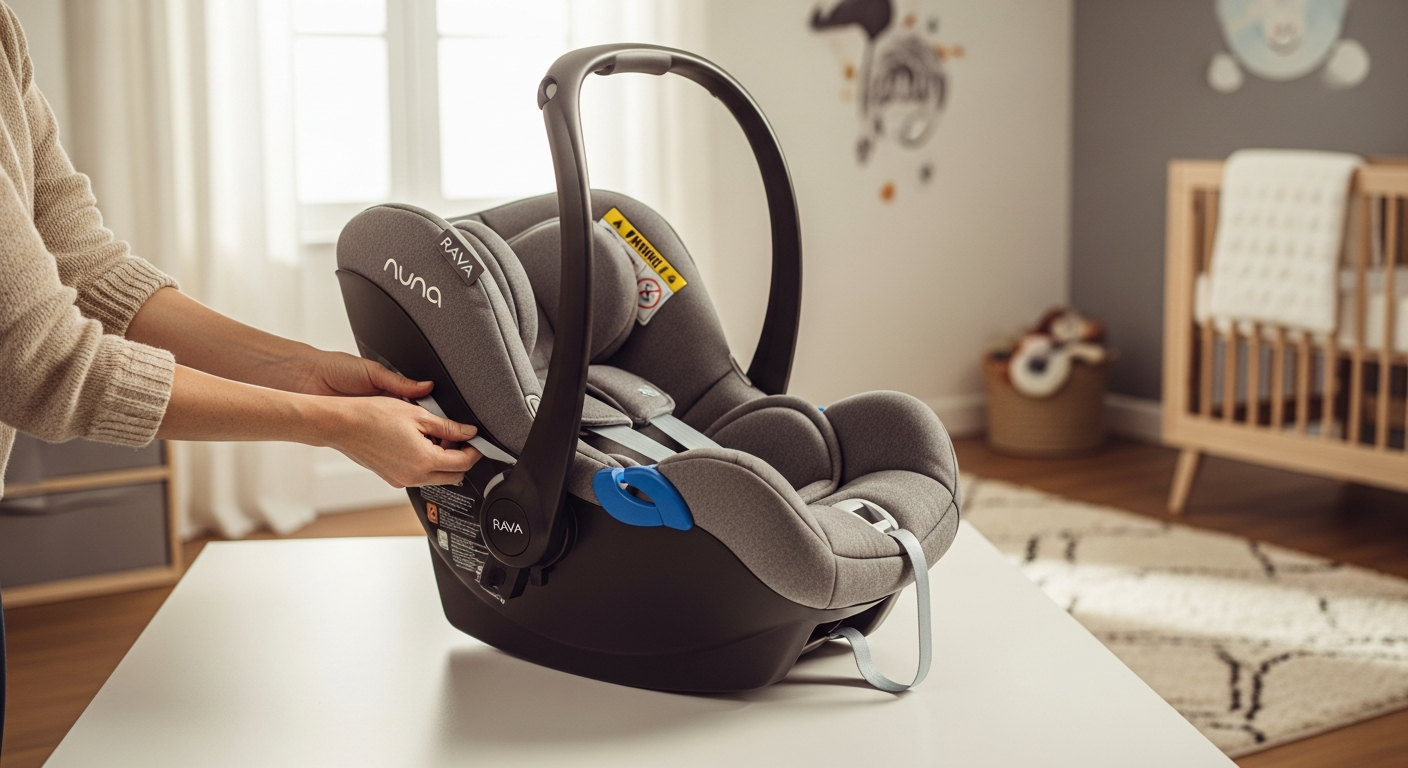
When it comes to car seat shopping, parents face an uncomfortable reality: you can spend anywhere from $300 to $600, yet still wonder if you're throwing money at a brand name rather than genuine engineering. The Nuna RAVA next commands attention precisely because it sits at that premium threshold where families start asking hard questions about value. Does this seat truly deliver safety innovations that justify its price tag, or are you simply paying for the label?
The convertible car seat market has fragmented into countless options, each claiming superiority through marketing language and feature lists. Yet Nuna has carved out a distinct position by consistently prioritizing thoughtful engineering, naturally flame-resistant materials without chemical additives, and safety standards that anticipate upcoming regulations rather than merely meeting current ones. This approach attracts both budget-conscious families seeking a single long-term solution and parents who view child safety as non-negotiable.
This analysis examines whether the Nuna RAVA next's premium positioning holds up under real-world scrutiny. Rather than simply listing features, this guide breaks down cost-per-year value, compares safety performance against direct competitors, evaluates practical comfort and convenience, and most importantly, helps you determine if this investment aligns with your family's actual needs and vehicle configuration.
Explore the Nuna RAVA next's features and specifications today.
The True Cost of Ownership: Breaking Down the RAVA next's Value Proposition
A $580 price tag stings, no question. But that number only tells half the story when you consider the actual timeline of use. The Nuna RAVA next spans from birth through approximately age 5—roughly five years of continuous use in most households. Divide $580 by 60 months, and you're looking at roughly $9.67 per month.
Compare this to families who purchase multiple cheaper car seats over the same period. A $200 infant carrier used for 18 months, followed by a $250 convertible seat for the remaining 42 months, totals $450 but often requires a stressful transition period where parents scramble to transfer their child between incompatible systems. The Nuna approach eliminates that disruption while providing a single, cohesive safety system calibrated for growth.
Beyond initial cost, the Nuna RAVA next demonstrates surprising resale value. Parents who complete the full five-year lifespan frequently list this seat on secondary markets with confidence, knowing that its reputation for durability and safety features commands buyer interest. Anecdotal reports suggest resale values between $300–$400 for well-maintained seats, effectively reducing the true net cost to families who eventually sell or pass it down.
Safety Performance That Justifies Premium Pricing
The all-steel frame represents a fundamental engineering choice that separates premium seats from budget alternatives. Where competitors cut costs with plastic components, the RAVA next employs steel construction that provides superior rigidity during impact events. This matters because during a collision, frame flex directly correlates with how much force transfers to your child—less flex means less stress on their developing body.
Energy-absorbing foam technology works in concert with the steel frame to dissipate crash forces gradually rather than transmitting them instantly. The RAVA next uses advanced foam formulations that compress predictably during impact, extending the time over which deceleration occurs. In physics terms, extending impact duration reduces peak deceleration—precisely what you want when protecting infants and toddlers whose bodies are far more vulnerable than adults.
The Side Impact Protection (SIP) pods deserve particular attention because they address a safety scenario that standard testing doesn't always emphasize sufficiently. Side impacts account for a significant percentage of real-world crashes, yet many manufacturers treat them as secondary considerations. The RAVA next's integrated SIP pods create a protective envelope around the child's head and torso, reducing lateral movement during broadside collisions. These pods actually exceed the protection requirements coming in the next-generation safety standards (213a and 213b), which means Nuna invested in safety features before regulations demanded them.
Installation Ease: Why the Simply™ Secure System Saves Parents' Sanity
Installation errors represent one of the most significant safety vulnerabilities in car seats, with studies suggesting that 80–90% of car seats are installed incorrectly. This isn't typically because parents are careless—it's because many installation systems involve confusing sequences, counterintuitive mechanics, or vague feedback about whether you've achieved proper tension.
Nuna's True Tension™ door technology addresses this directly. Rather than relying on parents to intuitively feel when the seat belt has reached correct tension, the True Tension doors provide tactile, mechanical feedback. As you tighten the seat belt, the doors progressively close—when they meet fully, you've achieved the precise tension needed. This removes guesswork and makes proper installation nearly automatic.
Seat belt installation versus LATCH compatibility presents another choice point. The RAVA next works with both systems, but the True Tension door system specifically enhances seat belt installation, which is advantageous because seat belt installation is the only method that works in every vehicle. LATCH systems have weight limits and anchor positioning challenges that sometimes make them impractical. By excelling at seat belt installation, the RAVA next becomes genuinely portable across any vehicle you might use.
The transition from rear-facing to forward-facing typically involves loosening straps, repositioning the harness, and re-threading everything through new slots. With the RAVA next, the no-rethread 5-point harness eliminates this entire process. Straps adjust vertically through a simple sliding mechanism, allowing height adjustments without disconnecting the harness system. This seemingly minor convenience actually matters significantly when you consider that you'll make these adjustments repeatedly as your child grows over five years.
Comfort Features That Keep Kids Happy on Long Drives
A uncomfortable car seat becomes a behavioral problem on any drive longer than 20 minutes. Cranky children distract drivers, encourage unsafe attempts at in-car entertainment, and generally turn family trips into ordeals.
The ventilation panel design uses strategic openings within the seat shell that facilitate air circulation without compromising structure. During warm months, these panels prevent the seat from becoming a sweat box while maintaining the frame's integrity. This represents thoughtful design—adding ventilation without creating structural weak points that might compromise safety.
Premium moisture-wicking fabric pulls sweat away from skin contact, preventing that clammy feeling that makes children uncomfortable during extended use. This choice matters more than it sounds because excessive sweating leads to skin irritation, which manifests as fussiness and resistance to sitting in the seat.
The 10-position height-adjustable headrest allows for granular customization as children grow. Rather than forcing a single headrest height to accommodate a wide age range, the RAVA next provides flexibility that maintains proper harness positioning relative to your child's shoulder height. The positioning of the shoulder straps relative to the headrest significantly impacts crash protection effectiveness, so this adjustability isn't purely comfort-focused—it directly supports safety performance across the full age range.
Discover how the RAVA next's comfort and safety features combine for optimal protection.
Health-Conscious Parenting: The Chemical-Free Advantage Explained
The flame-retardant chemical debate has evolved significantly as research has revealed potential health implications of traditional approaches. Most car seats achieve flame-resistance requirements through chemical additives—typically brominated flame retardants—that are sprayed onto or integrated into fabrics and foams.
The RAVA next achieves flame-resistance through naturally fire-resistant materials that don't require chemical enhancement. This fundamental approach avoids the controversy surrounding brominated compounds, which have raised concerns in pediatric health communities. Nuna's choice to prioritize naturally flame-resistant materials demonstrates a commitment to health that extends beyond minimum safety compliance.
The absence of added fire-retardant chemicals carries implications worth considering carefully. Traditional chemical flame retardants serve a legitimate safety purpose—they help seats resist burning in certain scenarios. However, the potential for chemical off-gassing, particularly in hot cars where interior temperatures can exceed 140°F, has prompted some health-conscious families to seek alternatives. The RAVA next provides that alternative without sacrificing fire protection.
GREENGUARD Gold Certification validates these health claims through rigorous testing. The certification process assesses chemical emissions, volatile organic compounds, and other potential indoor air quality concerns. Achieving GREENGUARD Gold means the seat has been independently tested and verified to meet standards stricter than most regulatory requirements. This certification matters to families who've already invested in air quality management throughout their homes and want that commitment to extend into their vehicles.
The RAVA next vs. Competitors: Is It Actually the Best Investment?
Direct comparison with other premium convertible car seats in the $500+ range reveals where the RAVA next stands. Competitors like the Britax One Safe, Graco Extend2Fit, and others offer strong safety records and some premium features, but each makes different prioritization choices.
The Britax One Safe emphasizes maximum rearward-facing duration, extending rear-facing use to higher weight limits than the RAVA next. For families whose children track larger on growth charts, this extended rear-facing window might offer additional value. However, the Britax comes with a narrower front-to-back depth, making it potentially easier to fit three seats across, though it doesn't match the RAVA next's focus on installation simplicity.
Mid-range alternatives in the $300–$400 price band—such as the Graco Extend2Fit or safety-focused models from Evenflo—offer perhaps 80% of the feature set at 60% of the cost. These seats provide acceptable safety performance that meets current standards and includes many convenience features. For budget-conscious families without strong preferences around chemical composition or cutting-edge safety innovation, these alternatives deserve consideration. However, they typically sacrifice either the installation simplicity, the chemical-free materials, or the anticipated safety standard improvements that distinguish the RAVA next.
The decision framework becomes clearer when you acknowledge that "best" depends entirely on what you're optimizing for. If minimizing cost is paramount, mid-range alternatives work fine. If you value installation ease above most other factors, the RAVA next's True Tension system has no direct equivalent at lower price points. If chemical-free construction is non-negotiable for your family's health priorities, the RAVA next stands apart in its natural approach.
The Bottom Line: Premium Pricing Meets Premium Performance
The Nuna RAVA next isn't just another convertible car seat—it's a calculated investment in safety, durability, and peace of mind that extends far beyond the initial purchase. When you break down the true cost of ownership across five years of use, factor in the advanced safety features that exceed current standards, and consider the chemical-free construction that aligns with health-conscious parenting, the premium price suddenly becomes more defensible.
Parents consistently report that the installation simplicity alone justifies the higher cost by eliminating the frustration and potential safety errors that plague cheaper alternatives. The real question isn't whether the Nuna RAVA next is expensive—it absolutely is. The question is whether its superior safety engineering, chemical-free materials, installation ease, and long-term durability align with your family's priorities and constraints. For parents who value safety above all else, appreciate the stress-free installation experience, and plan to use the seat for the full five-year lifespan, this premium investment delivers measurable returns.
Learn more about whether the Nuna RAVA next is right for your family.
Leave a Reply