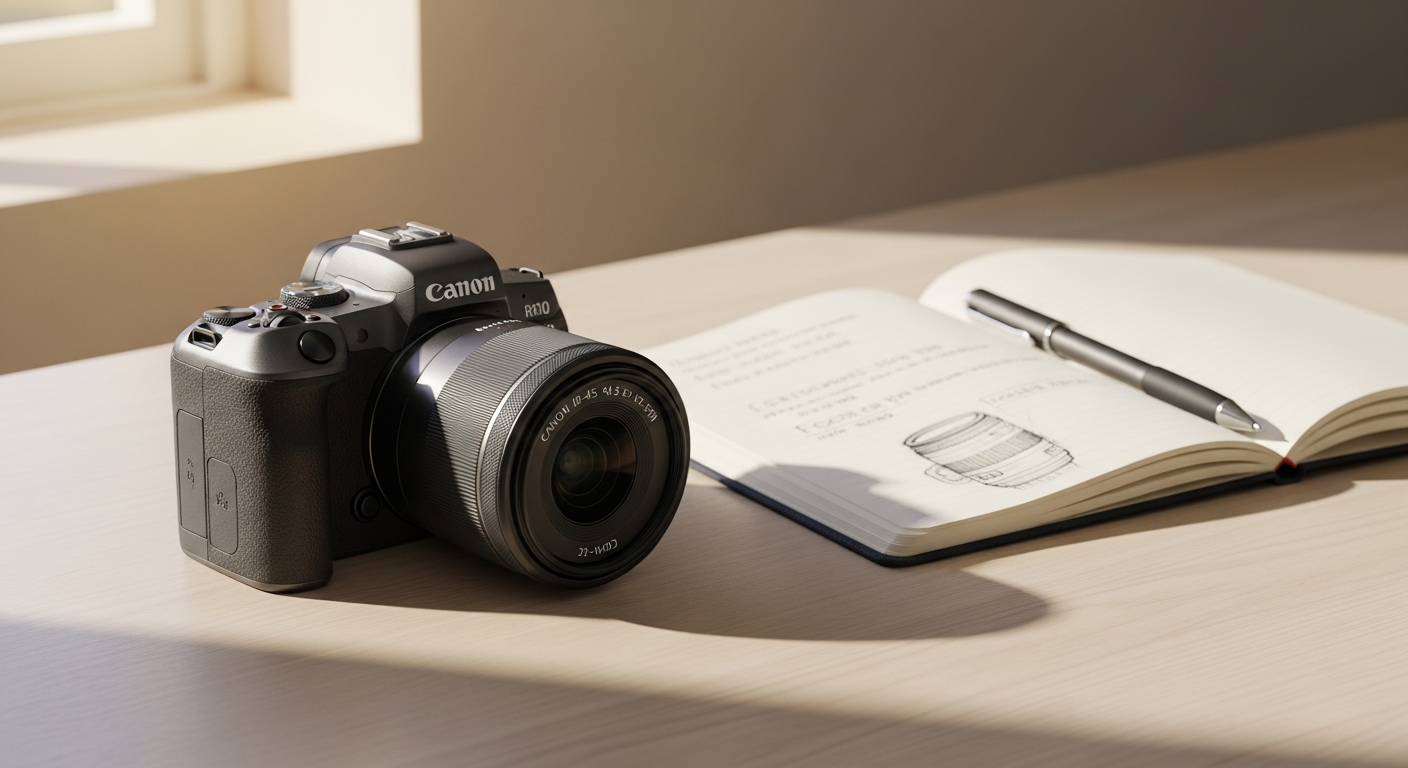
Content creators are abandoning traditional setups every single day—and for good reason. The barrier to professional-quality video and photography has shattered dramatically. The Canon EOS R10 mirrorless camera kit sits right at the intersection of power and portability that makes this shift possible.
The EOS R10, particularly when bundled with the RF-S 18-150mm lens, represents a paradigm shift for vlogging, short-form video production, and hybrid photo-video work. Canon engineered this camera specifically for creators who refuse to compromise—those who need reliable autofocus during fast-paced shoots, cinematic 4K footage, and a body light enough to carry all day without shoulder strain.
Check the current Canon EOS R10 kit pricing and availability here.
At AUD $2,049 (USD $1,379–$1,449), it delivers features previously reserved for cameras costing thousands more. This guide walks you through how the EOS R10's advanced autofocus system and high-speed shooting capabilities transform content creation workflows. You'll discover the video performance that makes it a vlogger's dream, explore its compact design advantages for on-location work, and understand where it genuinely excels versus where you might need workarounds. By the end, you'll have a clear picture of whether this kit deserves a spot in your creative arsenal.
Why Content Creators Are Switching to the Canon EOS R10 Mirrorless System
The shift toward mirrorless isn't accidental—it's driven by tangible advantages that matter in real production scenarios. The EOS R10 ticks every essential box for modern creators navigating demanding workflows.
AI-powered subject detection and tracking, borrowed from flagship EOS R3 models, eliminates the frustration of lost focus during unpredictable moments. When you're capturing a subject sprinting across frame or turning their head unexpectedly, the camera stays locked on with millisecond-level responsiveness.
The transition from smartphone or DSLR workflows feels natural. If you've been shooting on your phone, the EOS R10 preserves familiar interface patterns while unlocking professional capabilities. DSLR users appreciate the compact mirrorless form factor—no more mirror slap vibration, no more optical viewfinder lag.
The 429g body eliminates fatigue during extended shooting sessions. Shoulder strain becomes irrelevant when your camera weighs less than a water bottle. Creators who've upgraded report being able to shoot longer, more comfortably, and with fresher ideas at the end of the day.
Native compatibility with Canon's RF lens ecosystem plus adapted EF/EF-S options means you're not locked into a limited selection. Your investment compounds as you add glass over time, each lens unlocking new creative possibilities.
Competitive pricing removes financial barriers to mirrorless adoption. The gap between this camera and professional cinema equipment is intentional—Canon positioned the EOS R10 for emerging creators who've outgrown entry-level gear but haven't reached budget constraints that force compromise decisions.
The growing community of creators sharing workflows, tutorials, and best practices means troubleshooting happens faster. When you encounter a specific shooting scenario, someone in the Canon ecosystem has documented their solution.
Future-proof investment matters. Canon's continued R-series development and lens releases signal long-term ecosystem growth. You're buying into a system with momentum, not a dying platform.
Autofocus Performance That Keeps Up With Your Subjects
Autofocus performance separates cameras that frustrate you from cameras that enable you. The EOS R10's system is the latter category.
The Dual Pixel CMOS AF system delivers millisecond-fast subject acquisition. When you press the shutter, the camera locks focus before your subject realizes you've started capturing. This speed matters most during candid moments where hesitation costs the shot.
Real-time tracking for people, animals, and vehicles during dynamic scenes operates at the confidence level of professional equipment costing twice as much. The camera predicts subject movement and adjusts focus lead time automatically—you frame, and the autofocus handles the rest.
23fps burst shooting with electronic shutter captures fleeting moments reliably. When rapid sequences matter—a subject's expression changing, a gesture completing, an animal mid-leap—this frame rate preserves every critical moment.
AI subject recognition eliminates manual focus hunting during fast-paced action. The camera interprets your framing and automatically prioritizes the most important subject in frame. No more chasing focus; the camera chases your intention.
Eye-detection autofocus keeps sharp focus on talent during interviews and vlogs. When someone's eyes are sharp and their background falls away, the emotional connection with your audience increases measurably. This feature has become standard in professional broadcasting for good reason.
Continuous AF performance maintains lock even with challenging lighting or movement. High-contrast scenarios, backlit subjects, rapid pans—the autofocus adapts without hunting or losing track.
Compared against competing mirrorless cameras in this price tier, the EOS R10's autofocus ranks as a significant strength. Competitors at similar prices often compromise on subject tracking reliability or eye-detection capability; the EOS R10 doesn't make this sacrifice.
4K Video Capabilities That Rival Dedicated Camcorders
Professional video production traditionally required dedicated camcorders running specialized firmware. The EOS R10 collapses this distinction, delivering broadcast-quality output from a still camera designed around versatility.
4K 60p recording with 6K oversampling produces exceptional image quality and color grading flexibility. The 6K oversampling isn't marketing language—it means the camera captures at a higher resolution internally, then downsamples to 4K. This process reduces noise and increases detail retention compared to native 4K recording.
Full HD 120p slow-motion options enable dramatic effect sequences and cinematic storytelling. When you need slow-motion without sacrificing frame rate, this feature delivers. Think impact shots, emotional reveals, or technical demonstrations where slow motion adds weight to the moment.
The vari-angle LCD touchscreen enables creative framing from unconventional angles. Shoot over your shoulder, from waist level, or from above without twisting your neck or using awkward monitors. For vlogging specifically, this feature eliminates the need for external monitors in most scenarios.
Built-in flash and compact form factor eliminate need for additional lighting rigs on location. While professional productions benefit from dedicated lighting, solo creators often work in mixed environments where the built-in flash provides essential fill light without adding gear weight.
Start your 4K content creation journey with the Canon EOS R10 today.
The 4K 60p crop affects field-of-view at longer focal lengths. At 4K 60p, the camera crops approximately 1.6x, meaning your 18mm wide-angle effectively becomes 29mm. For fixed framing this matters less; for dynamic vlogging where ultra-wide shots matter, understanding this crop guides your lens selection strategy.
Audio input options and microphone compatibility support professional sound capture. The 3.5mm input accepts external microphones, lavaliers, and wireless systems. Quality audio separates amateur content from professional work—this flexibility ensures you're not limited by the camera's built-in audio capabilities.
Heat management during extended 4K sessions requires practical understanding. The EOS R10 can record 4K for extended periods before thermal management throttles performance. For typical YouTube content (5–15 minute takes), overheating rarely occurs. For longer documentary-style recording, planning break intervals or external cooling solutions prevents interruptions.
Portability and Ergonomics for All-Day Shooting Sessions
Cameras that stay at home remain useless. The EOS R10's design philosophy prioritizes being carried everywhere.
The lightweight body design (429g with battery) reduces neck and shoulder strain across full production days. This weight reduction compounds across eight-hour shoots. By the end of day three, your shoulders recognize the difference compared to heavier cameras.
Compact dimensions fit easily into camera bags, backpacks, or travel luggage. Unlike larger mirrorless bodies, the EOS R10 doesn't demand dedicated camera gear. A quality backpack with internal dividers works perfectly; you're not forced into expensive specialized bags.
Dual control dials provide intuitive manual adjustments without menu diving. One dial handles aperture, the other shutter speed. Physical controls beat menu navigation when you need adjustments during live recording.
The touchscreen interface accelerates menu navigation during time-sensitive shoots. Need to switch autofocus modes? One tap. Want to adjust white balance? Direct access. Physical buttons remain for critical settings, but the touchscreen eliminates frustration when you need rapid adjustments.
Weather sealing considerations matter if you're shooting in unpredictable conditions. The EOS R10 offers basic protection against dust and moisture, not full weather sealing. For outdoor content creation, protective measures—weather-sealed lenses, rain covers—extend durability in harsh conditions.
Battery life planning shapes production strategy. The EOS R10's battery lasts roughly 380 shots under ideal conditions. For video-focused shoots, expect 2–2.5 hours of continuous 4K recording per battery. Carrying multiple batteries becomes standard practice, not optional.
The accessory ecosystem—tripods, gimbals, rigs—pairs seamlessly with the kit. The compact body accepts standard quick-release plates, works with affordable gimbal systems, and balances naturally on lightweight tripods. Your existing gear likely works without modification.
Image Quality and Sensor Performance Under Real-World Conditions
A camera's sensor determines fundamental image quality. The EOS R10's 24.2 Megapixel APS-C CMOS sensor doesn't disappoint across varied scenarios.
Sharp, detailed captures across focal lengths remain consistent whether you're using the kit lens or expanded glass. The sensor resolves fine detail—facial features, texture, atmospheric elements—throughout the frame, not just the center.
The ISO range (100–32,000, expandable to 51,200) handles mixed lighting environments without forcing compromise decisions. Indoor venues with poor lighting, outdoor shadows during golden hour, nighttime events—the EOS R10 maintains usable image quality across these scenarios by pushing ISO when necessary.
JPEG and raw file quality maintains color accuracy during post-production grading. The camera's color science leans toward Canon's established signature—warm midtones, pleasant skin tones without unnatural enhancement. Raw files provide ultimate grading flexibility; JPEGs work beautifully without editing.
High-speed shooting preserves detail even in fast-moving action sequences. At 15fps mechanical or 23fps electronic shutter, motion blur becomes rare. The sensor captures enough information at each frame that fast-moving subjects stay tack-sharp.
Dynamic range performance in backlit and high-contrast scenarios impresses for the camera's class. The sensor handles situations where sky and foreground separate dramatically—typical outdoor scenarios—without forcing you to choose between blown highlights or crushed shadows.
Noise management at higher ISOs reveals when to push sensitivity and when to add light. ISO 3,200–6,400 produces clean, usable files. Beyond ISO 12,800, noise becomes visible in shadows and requires noise reduction in post-processing. Understanding these thresholds shapes shooting decisions.
Sensor performance against entry-level full-frame alternatives reveals the APS-C advantage for content creators. While full-frame sensors gather more light theoretically, the EOS R10's smaller sensor paired with faster autofocus and compact body often outperforms heavier, more expensive full-frame cameras in real production scenarios.
Lens Compatibility and Building Your Creative Toolkit
The EOS R10 arrives with the RF-S 18-150mm kit lens—a versatile workhorse covering 95% of everyday content creation scenarios. This lens eliminates the need for purchasing additional glass immediately. Wide enough for environmental shots, long enough for compressed framing—it's genuinely useful.
Expanding with native RF and RF-S lenses unlocks specialized focal lengths as your style develops. The RF 35mm f/1.8 Macro provides beautiful bokeh for talking-head content. The RF-S 55-200mm extends reach for detail shots. Each addition serves specific creative goals, not generic capability.
EF and EF-S lens adapter compatibility unlocks existing Canon glass investments. If you own Canon DSLRs and lenses, adapting EF glass to your EOS R10 costs $100–200 and provides instant toolkit expansion. Used EF lenses remain affordable, expanding your options without major investment.
Full-frame RF lens usage on APS-C body involves crop considerations. Full-frame RF lenses work natively on the EOS R10, but you lose the outermost edges of their designed image circle. Practically, the camera shows you exactly what you'll capture—no surprises.
Third-party lens options and recommended pairings for specific content types expand your flexibility. Sigma and Tamron manufacture quality RF-mount alternatives at competitive prices. For macro work, video-focused lenses with smooth focus rings exist from multiple manufacturers.
Lens stabilization (OIS) becomes essential given the camera's lack of in-body stabilization. When choosing lenses, prioritize optical stabilization, especially for video work. The kit lens includes OIS—a primary reason it remains so popular.
Budget-friendly lens progression moves from the kit lens to one specialty lens per year. Rather than buying expensive full-frame camera systems, building your EOS R10 toolkit methodically creates a cohesive system matching your creative evolution. By year three, you have a professional-level kit costing less than a single high-end full-frame body.
Addressing the Limitations: What You Need to Know
No camera excels universally. The EOS R10 has genuine limitations worth understanding before commitment.
In-body image stabilization (IBIS) doesn't exist—meaning reliance on optical stabilization and gimbal solutions becomes necessary. For handheld video work, stabilized lenses become non-negotiable. For tripod-based work, this limitation doesn't matter. Gimbal mounts (like DJI Ronin-SC series) paired with the EOS R10 produce studio-quality movement.
The small electronic viewfinder may require adjustment for some users. The 2.36M-dot viewfinder doesn't match larger competitors; some users prefer back-of-camera LCD shooting instead. Try before purchasing if viewfinder experience matters significantly to you.
4K 60p crop affects wide-angle framing and requires lens selection strategy. If ultra-wide environmental shots are critical, choose 4K 30p or 1080p 60p alternatives. For most interview and talking-head content, the crop becomes irrelevant.
Native RF-S lens range remains limited compared to mature lens ecosystems like Sony or Nikon. Canon continues releasing new glass, but photographers accustomed to eight lens options in a given focal range face fewer native choices. Adapting EF glass mitigates this disadvantage.
Battery life considerations shape shooting discipline. Carrying spare batteries becomes habit, not option. Three batteries typically cover a full production day; some creators carry four.
Workarounds and practical solutions address each limitation effectively. Gimbal stabilization replaces IBIS. Adapted EF glass expands lens choices. Spare batteries solve power concerns. None of these workarounds feel like compromises once you establish the workflow.
The EOS R10 reaches its ceiling in scenarios demanding extreme cinema features—extensive slow-motion libraries, RAW video recording, or multiple synchronous recording modes. When you outgrow these capabilities, professional R5C or R6 Mark II bodies offer the next steps.
Pricing, Value Proposition, and ROI for Creators
Financial decisions shape camera purchases more than enthusiasts admit. Understanding real costs ensures informed decisions.
Body-only pricing (AUD $1,499 / USD $979) versus kit bundle economics reveals the value in bundled offerings. The RF-S 18-150mm lens costs roughly $500–600 purchased separately; bundling saves money and ensures you have usable glass immediately rather than facing delayed purchasing decisions.
The RF-S 18-150mm lens value reflects what you gain versus purchasing separately. This lens alone justifies the bundle premium—buying body and lens separately typically costs $200–300 more than purchasing bundled.
Total cost of ownership including batteries, cards, backup gear, and software adds transparency. Budget $150–200 for extra batteries and fast memory cards. Software subscriptions for editing (Adobe Creative Cloud) run $55 monthly. These recurring costs matter in long-term financial planning.
Comparison against competing mirrorless kits in the $1,300–$1,500 range consistently favors the EOS R10. Sony a6400 kits cost similar amounts but lack the advanced autofocus tracking. Nikon Z50 II bundles position similarly, offering different ergonomics but similar performance profiles.
Resale value and long-term investment considerations reveal Canon's strong used market. EOS R10 bodies retain 60–70% value after one year, compared to 50–55% for some competitors. If you anticipate upgrading within three years, the EOS R10 loses less capital than alternatives.
Financing and payment plan options for budget-conscious creators reduce purchase friction. Most retailers offer 12-month interest-free financing on camera kits. Spreading payments across a year makes high-quality gear accessible earlier than cash-only purchasing.
Hidden costs warrant acknowledgment—accessories, software subscriptions, and workflow optimization expenses accumulate. A quality tripod runs $80–150. External storage for 4K video requires fast SSDs ($200+). Recognizing these costs prevents budget surprises.
Real Creator Workflows: How the EOS R10 Performs in Production
Theory matters less than execution. Real workflows reveal practical performance.
Vlogging setups for solo creators benefit tremendously from the EOS R10's compact design and face-detection autofocus. Mount the camera on a lightweight tripod, enable face detection, and the camera tracks your movement during entire takes. Add an external microphone, and you have broadcast-quality content produced entirely solo.
Two-person vlogging teams appreciate the camera's lightweight nature—handheld operation doesn't cause fatigue during extended conversations. The flip-out LCD enables framing confirmation without awkward positioning.
YouTube short-form video production with fast turnaround timelines accelerates significantly. The EOS R10's autofocus enables single-take recording more often—fewer retakes mean faster content production. Fast burst shooting captures B-roll efficiently.
Product photography and unboxing content remains sharp throughout thanks to continuous autofocus. Products moving toward or away from the camera stay perfectly focused without operator adjustment.
Travel and adventure content creation with minimal gear footprint becomes feasible. The entire kit—camera, lens, battery, card—fits into carry-on luggage. Professional results don't require professional equipment burden.
Hybrid photo-video projects combining stills and motion in single shoots benefit from the EOS R10's unified interface. Switching between photography and video modes happens without thought; both share the same autofocus system and ergonomics.
Multi-camera setups where the EOS R10 serves as B-camera or gimbal-mounted unit provide versatility. The compact form factor enables gimbal mounting and secondary angle capture without dedicated cinema camera investment.
Post-production considerations shape workflow efficiency. The EOS R10 records H.264 files compatible with all major editing software. Color science remains neutral enough for professional grading. File sizes remain manageable—4K 60p generates roughly 700MB per minute.
The Verdict: Is the Canon EOS R10 Mirrorless Kit Right for Your Creative Vision?
The EOS R10 is best suited for emerging creators transitioning from smartphones or tablets. The learning curve feels natural; fundamental controls match smartphone camera apps while offering professional depth.
Vlogging-focused producers discover a camera engineered precisely for talking-head content. The autofocus stays locked on your eyes, the compact body feels natural handheld, and 4K 60p produces cinematic output.
Hybrid photo-video work aligns perfectly with the EOS R10's design philosophy. When your projects demand both stills and video without compromising either, this camera delivers balance.
Ideal skill level encompasses beginners transitioning from smartphones and intermediate DSLR users. If you're comfortable with aperture and shutter speed, the EOS R10 feels intuitively organized. If you're unfamiliar with these concepts, the camera's guide mode provides structured learning.
Content types where it excels include fast-action, dynamic subjects, and location-based production. Wedding videography, sports photography, travel documentation—scenarios where speed and portability matter—reveal the EOS R10's strengths.
Scenarios where alternatives might serve better include studio-heavy work, extreme low-light environments, and professional cinema production. If you're primarily studio-based with controlled lighting, the compact design and fast autofocus provide less advantage. If you're shooting concert footage in darkness, full-frame competitors with superior low-light performance become more attractive. If cinema houses have minimum equipment requirements, professional cameras with RAW recording and greater sensor sizes become necessary.
Long-term growth potential within the Canon EOS R ecosystem remains strong. The R5, R6, and upcoming releases suggest Canon's R-series will dominate professional photography for years. Investing in R-mount glass today provides upgrade path flexibility later.
Community support and resource availability for troubleshooting and skill development are excellent. Canon's official YouTube channel, third-party creators, and active subreddits provide documentation, tutorials, and peer support.
The final recommendation framework requires matching camera capabilities to creative ambitions honestly. If fast autofocus, portable 4K video, and reliable performance matter more than cutting-edge cinema features, this kit deserves serious consideration.
Your Next Step in the Creator Journey
The Canon EOS R10 mirrorless camera kit represents something genuinely exciting—a tool that removes technical barriers without sacrificing creative control. Whether you're recording your first YouTube video or scaling your production to multiple platforms, this camera delivers the autofocus reliability, video performance, and portability that modern content creation demands.
The AI-powered subject tracking keeps pace with your movement, the 4K 60p output looks genuinely cinematic, and the compact body means you'll actually carry it everywhere instead of leaving it at home.
Success hinges on honest self-assessment. If you're primarily shooting in controlled studio environments with stationary subjects, the lack of in-body stabilization matters less. If you're constantly on the move capturing unpredictable action, the lightweight design becomes your secret weapon.
The RF-S 18-150mm lens covers most scenarios beautifully, but you'll eventually want to expand your toolkit as your creative voice develops. The real question isn't whether the EOS R10 is good—it absolutely is. The question is whether its specific strengths align with your content creation goals.
Spend time with the specs, watch creator reviews on YouTube, and honestly assess your shooting style. If fast autofocus, portable 4K video, and reliable performance matter more than cutting-edge cinema features, this kit deserves serious consideration. Your creative output will thank you for the upgrade.
Upgrade your creative toolkit with the Canon EOS R10 mirrorless camera kit now.
Leave a Reply