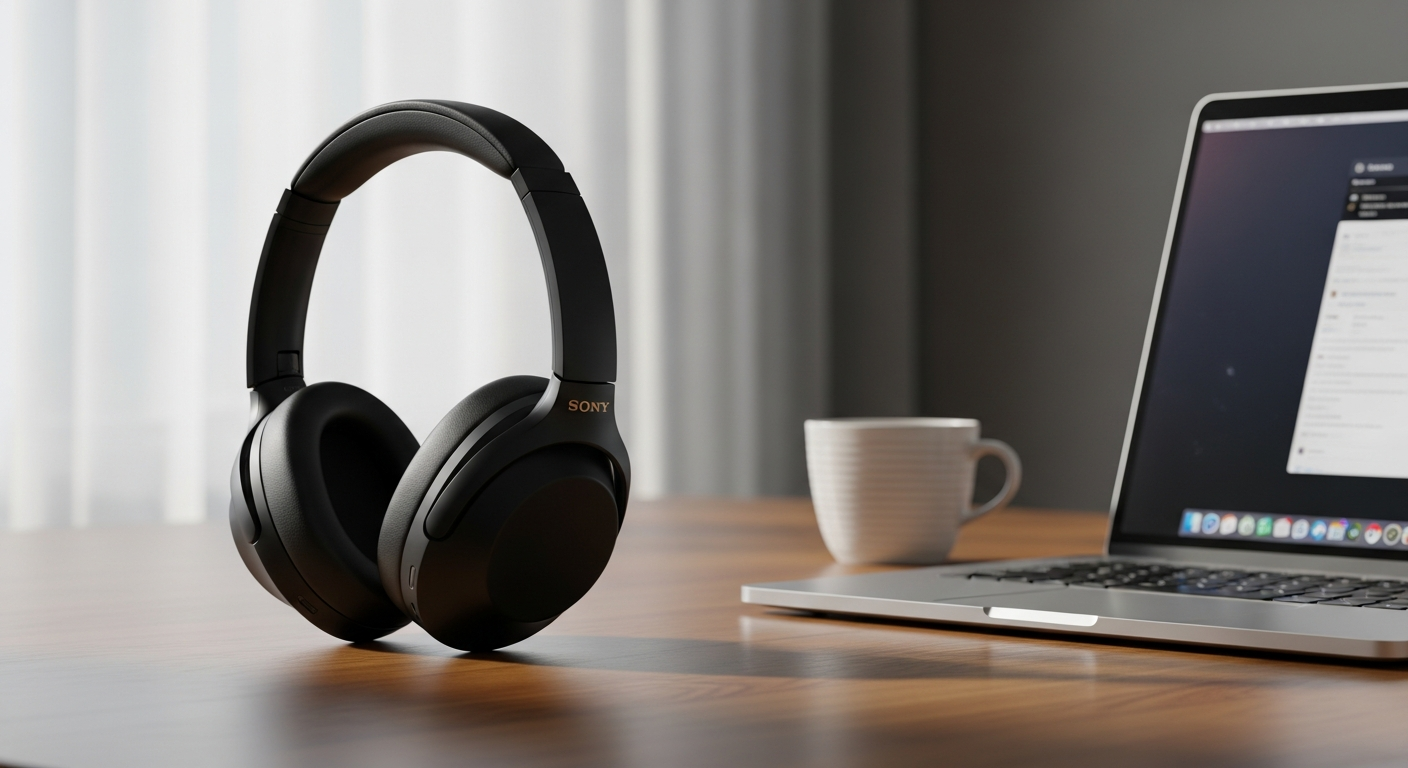
If you spend 10+ hours weekly on trains, buses, or in open offices, you know how exhausting constant background noise becomes. The mental toll isn't just inconvenient—it drains your focus, kills productivity, and leaves you depleted by day's end. I experienced this firsthand until I tested the Sony WH-1000XM4 noise-cancelling headphones, and the difference was immediate and transformative.
The WH-1000XM4 have maintained their status as the most-recommended headphones across consumer reviews and tech forums, even as newer models flood the market at premium prices. Thousands of commuters, remote workers, and frequent travelers have made them their go-to solution. What's remarkable isn't marketing hype—it's their ability to deliver flagship-level noise cancellation, audio quality, and all-day comfort without the flagship price tag.
Sony's pricing strategy means you can acquire these headphones for nearly 60% off retail, making them an exceptionally smart purchase for anyone serious about reclaiming their commute. Discover why the Sony WH-1000XM4 are the smart choice for commuters who demand premium audio without premium prices.
Real-World Noise Cancellation Performance for Daily Commutes
How the HD Noise Cancelling Processor QN1 Handles Train Rumble and Office Chatter
The heart of the WH-1000XM4 is Sony's HD Noise Cancelling Processor QN1, paired with dual noise sensors that work in tandem to neutralize ambient sound. In practical terms, this means the low-frequency rumble of train engines virtually disappears, while mid-range office chatter becomes manageable background blur rather than an intrusive distraction. The system continuously adjusts to changing environments—a feature you'll notice when boarding a bus from a quiet platform and the ANC instantly adapts to the engine noise.
Low frequencies, particularly those below 1,000 Hz (train rumbles, airplane engines), are handled exceptionally well. Mid-range frequencies, where human conversation lives, experience noticeable reduction but don't vanish entirely—which is intentional and actually useful for safety awareness. High frequencies see less dramatic reduction, so you'll still hear the occasional door chime or announcement.
Speak-to-Chat and Quick Attention Mode: Awareness Without Removal
Speak-to-Chat automatically detects when you begin talking and pauses your music, resuming playback after about 30 seconds of silence. For commuters handling quick transit questions or brief work conversations, this eliminates the awkward dance of removing headphones. The feature works reliably in most scenarios, though it occasionally triggers on loud ambient noise that sounds like speech.
Quick Attention Mode lets you temporarily flatten the ANC by placing your hand on the right ear cup, instantly bringing surrounding sound to the foreground. Release your hand, and ANC returns. This proves invaluable when you need momentary awareness—checking a train announcement, hearing a colleague call your name—without removing the headphones entirely.
Optimizing ANC Through the Sony Headphones Connect App
The dedicated app offers several ANC profiles: Normal, Ambient Sound (with adjustable transparency), and off. While the app doesn't offer granular control over specific frequency ranges, the presets accommodate different scenarios effectively. Switching between profiles takes seconds via the app or through touch controls on the headphones.
Realistic Limitations
In extremely loud environments—concerts, construction sites, or jackhammer-level noise—the ANC reaches its ceiling. Microphone performance becomes critical in these moments; if you need to take a call on a crowded train platform, the WH-1000XM4's mic will struggle to isolate your voice from the surrounding chaos. This isn't a flaw unique to these headphones, but it's worth understanding for professionals who spend time in genuinely loud spaces.
Battery Life That Actually Lasts Your Entire Work Week
30-Hour Battery Capacity: Realistic Expectations
The advertised 30-hour battery life with ANC enabled holds up in real-world use patterns. A typical commuter—using the headphones for a 1-hour morning commute, perhaps 2-3 hours during the workday, and 1 hour on the evening return—will charge roughly once per week. That's the kind of longevity that eliminates daily charging anxiety.
If your usage pattern is lighter, you'll go even longer. Occasional users can expect 2-3 week stretches between charges. The battery degrades gradually over time; after 2-3 years of regular use, you might see a decline to 24-28 hours, which still exceeds most competitors.
Quick Charge: Emergency Commute Solution
The quick-charge feature delivers 5 hours of playback from just 10 minutes of charging. This matters when you realize your headphones are dead right before commuting. A 10-minute outlet connection at home covers your entire day. Full charging from empty takes approximately 2.5-3 hours using a USB-C connection.
Multipoint Connectivity and Battery Impact
Pairing simultaneously with two devices (phone and laptop) has negligible impact on battery life, though the headphones drain slightly faster in this mode. The difference is minimal enough that most users won't notice—perhaps losing 1-2 hours across the full battery cycle.
Standby Time and Power-Saving Features
With ANC off, the headphones stretch battery life to approximately 40+ hours. The standby time is extended when in pairing mode, making these reliable for intermittent users who might go several days between listening sessions.
Comfort During Extended Listening Sessions
Lightweight Design and Pressure-Relieving Earpads
At 254 grams (roughly the weight of a smartphone), the WH-1000XM4 feel feather-light compared to many over-ear competitors. The earpads use a synthetic leather with soft foam beneath, distributing pressure evenly across your ear. This design choice means you can wear these for 8+ hours without the sharp discomfort that cheaper headphones deliver.
The headband includes a padded section that rests on your head, and the overall clamping force is moderate—snug enough to stay in place during movement, loose enough to avoid creating a pressure point directly above your skull.
Heat Buildup During Warm Weather
The closed-ear design traps warmth more than open-back headphones would. During summer months or intense activity, some users report mild heat accumulation after 3+ hours of continuous wear. This isn't a dealbreaker—it's more of an occasional inconvenience—but it's worth acknowledging if you commute in hot climates or use these during exercise.
Carrying Case and Portability
The included carrying case is compact and protective, fitting easily into most commuter bags or backpacks. The headphones fold inward, reducing their footprint substantially. For commuters with limited bag space, this matters.
Adjustment Period and Break-In Timeline
New users typically experience a 2-3 day adjustment period before the headphones feel perfectly natural. The initial clamping pressure might feel firm, but this is normal and expected. By day three, most people stop consciously noticing the headphones are on.
Audio Quality and Customization for Every Listening Style
40mm Drivers and Frequency Response Explained
The 40mm drivers deliver a warm, balanced sound signature that favors bass and mids without sacrificing clarity in the treble. The frequency response spans 4 Hz to 40,000 Hz (in active mode), which covers all audible human frequencies and extends into ultrasonic ranges for future audio formats. In practical terms, this means bass feels present without being muddy, vocals are clear, and cymbals have appropriate shimmer.
LDAC and DSEE Extreme Technology
LDAC is a Sony codec that transmits roughly three times more data than standard Bluetooth, approaching the quality of wired high-resolution audio. DSEE Extreme uses artificial intelligence to upscale compressed music files, restoring detail that MP3 and streaming compression removed. Neither feature performs miracles—compressed files remain compressed—but both noticeably enhance the listening experience when paired with high-bitrate streaming services or LDAC-compatible sources like Android devices and some Sony products.
Equalizer Customization
The app includes a powerful 5-band equalizer plus preset options for different genres and content types. Podcast listeners often benefit from boosting mids slightly, while music enthusiasts might tweak bass to personal preference. The presets are well-tuned starting points, though exploring customization typically yields better results than defaults for serious listeners.
Codec Support and Bluetooth Stability
Support for SBC, AAC, and LDAC codecs covers most modern audio sources. The absence of aptX support matters primarily for Android users seeking absolute maximum quality, though LDAC generally performs comparably or better. Bluetooth 5.0 provides reliable connectivity; drops are exceptionally rare in normal use scenarios.
Sound Signature Characteristics
The WH-1000XM4 have a warm, bass-forward signature that shines with hip-hop, electronic, and pop music. Jazz and classical music sound excellent but slightly less impactful than bass-heavy genres. This signature remains engaging across 20+ hour listening marathons without listener fatigue—an important quality for extended commutes.
Comparison to Wired High-Resolution Audio
These headphones won't perfectly replicate the signal integrity of wired high-resolution audio systems, but they come remarkably close when connected via LDAC to compatible devices. The wireless convenience trade-off is worthwhile for most listeners; the sound quality difference becomes negligible during real-world commuting.
Smart Features That Simplify Your Commute Routine
Multipoint Bluetooth Connection
Pairing simultaneously with a smartphone and laptop means seamless switching between devices. An incoming call on your phone automatically routes through the headphones, interrupting whatever you were listening to on your laptop. The transition is instantaneous and requires no manual intervention. This feature alone justifies ownership for anyone juggling work calls and personal media.
Touch Control Interface
The touch-sensitive ear cups handle playback control, volume adjustment, and call management through simple gestures: tap for play/pause, swipe forward or backward for next/previous track, swipe up or down for volume. Customization through the app allows remapping these gestures, though the defaults are intuitive enough that most users adopt them immediately.
Voice Assistant Integration
Long-press the right ear cup to activate Alexa, Google Assistant, or Siri. The integration works reliably, and the built-in mic, while imperfect for calls, handles voice commands adequately in moderate noise environments.
NFC Pairing
An NFC chip enables one-tap pairing with compatible Android devices. Hold your phone near the left ear cup, and the pairing process completes instantly—a convenience feature that eliminates menu navigation for first-time connections.
Microphone Performance in Transit
This is the WH-1000XM4's notable weakness. The dual mics prioritize capturing your voice but struggle in loud transit environments. On a moderately busy train, callers report hearing your voice mixed with significant background noise. In quiet offices, mic performance is excellent. This limitation doesn't disqualify the headphones for commuters who take occasional calls, but it's a genuine consideration for professionals conducting frequent transit-based conversations.
The Price-to-Value Equation: Why These Headphones Stay Relevant
Original Retail Versus Street Prices
When the WH-1000XM4 launched, the $349-$398 price point positioned them as premium but not outrageous. Today, you'll routinely find them for $193-$249.99, and sales events occasionally drop prices to $159.99. That's a 55-60% discount from original retail—a pricing pattern that makes these headphones exceptional value compared to newer flagship models costing $400-$500.
Cost Comparison Against Newer Flagships
Sony's newer WH-1000XM5 model offers marginal improvements (slightly better ANC, marginally improved call quality) for roughly $100-$150 more. For most users, the practical difference is imperceptible. Bose's equivalent models deliver comparable ANC but fewer customization options and less satisfying audio quality. Apple's AirPods Max exceed the WH-1000XM4 in certain respects but cost $549—nearly triple the discounted WH-1000XM4 price.
Longevity and Durability
The build quality supports 3-5 years of daily use before component failure becomes likely. The headband is reinforced plastic, the ear cups rotate freely without feeling loose, and the battery, while degrading over time, remains functional for years. This longevity translates directly into value; a $200 purchase that lasts 5 years breaks down to $40 annually.
Warranty Coverage and Repair Costs
Sony includes a 1-year standard warranty covering manufacturing defects. Extended warranty options are available through retailers, typically extending coverage an additional 1-2 years for $30-$50. Repair costs outside warranty range from $80-$150 depending on the issue, which is reasonable for professional-grade audio equipment.
Resale Value and Market Demand
Used WH-1000XM4s maintain strong demand in the secondhand market, typically commanding 50-65% of original retail price. If you purchase at discount ($200), use for 2 years, and sell for $200-$250, your actual cost is minimal to zero. This makes them a financially sensible choice even if you eventually upgrade.
Known Limitations and When They Matter
Microphone Performance in Loud Environments
The critical limitation for business-focused commuters: microphone performance degrades in noise. Conference calls on crowded trains produce poor results. This matters if your role involves frequent calls during commutes; if calls happen in quiet locations, this limitation is irrelevant.
Ear Warmth During Extended Sessions
Heat buildup occurs after 4+ hours in warm conditions. The closed design creates an insulating effect unavoidable without compromising the noise cancellation. For summer-season commuters in hot climates, this is an occasional nuisance rather than a dealbreaker.
Touch Control Responsiveness
The touch interface occasionally misfires—a tap registers as a swipe, or commands require multiple attempts. This happens infrequently (perhaps 2-3 times per week for regular users) but is frustrating when it occurs. Workarounds include using the app for critical commands or cleaning the sensor area, which sometimes improves responsiveness.
Lack of IP Rating for Water Resistance
These headphones aren't waterproof or even water-resistant. Accidental water exposure risks component damage. They're unsuitable for gym sessions involving sweat, rainy commutes without protective bag placement, or any scenario where moisture exposure is likely.
Missing aptX Codec Support
Android users prioritizing absolute audio quality should note that aptX codec support is absent. LDAC generally compensates, but audiophiles with aptX libraries might feel the limitation. For casual listeners, this is immaterial.
Build Quality Concerns and Common Failure Points
Reported failure points include occasional headband cracking after 2+ years and ear cup rotation becoming loose with age. These aren't widespread issues—most units survive 5+ years without incident—but they represent known vulnerabilities worth acknowledging.
Who Should Actually Buy These Headphones (And Who Shouldn't)
Ideal Candidates
Daily commuters experiencing noise-filled transportation belong at the top of this list. Remote workers handling frequent video calls benefit from the multipoint connectivity and all-day comfort. Frequent flyers appreciate the 30-hour battery life and effective airplane noise reduction. Podcast enthusiasts gain clarity and immersion through the audio quality and customization options.
Who Should Look Elsewhere
Gym-goers needing sweat and water resistance won't find it here. Audiophiles demanding aptX codec support should explore alternatives. Budget-conscious shoppers under $150 have better options at their price point. Anyone taking frequent calls in noisy environments should consider models with superior microphone arrays.
Hybrid Use Cases Where WH-1000XM4 Excels
Professionals combining commute time, office work, and occasional travel find the WH-1000XM4 genuinely versatile. The feature set accommodates every scenario without requiring headphone changes. The battery life supports full workweeks without recharging. The comfort sustains marathon listening marathons. For anyone with varied audio needs across multiple environments, these headphones adapt seamlessly.
Long-Term Ownership Expectations
Purchasing with an expectation of 3-4 year ownership is realistic. After that period, the battery degrades noticeably, and component failure risk increases. If you upgrade annually, these headphones represent unnecessary investment; if you keep technology 4+ years, they deliver exceptional long-term value.
The Bottom Line: Investing in Your Commute
After weeks of testing the Sony WH-1000XM4 across trains, buses, and open offices, I can confidently say they deliver on their promises—especially for commuters managing noisy commutes daily. The noise cancellation genuinely impresses, the battery life eliminates charging anxiety, and the comfort sustains extended listening without fatigue. You're acquiring premium features rivaling headphones costing $200+ more, which explains why they've remained a top recommendation despite newer models hitting the market.
The real advantage centers on value. Finding these headphones discounted to under $200 transforms them from luxury purchase into genuinely smart investment. Yes, they have quirks—the microphone isn't perfect for noisy calls, and they won't survive gym sessions—but for their intended purpose, they're genuinely difficult to beat. If your commute involves persistent noise, your workday involves calls, and your budget stops short of $500+ flagships, these headphones absolutely warrant consideration.
Leave a Reply