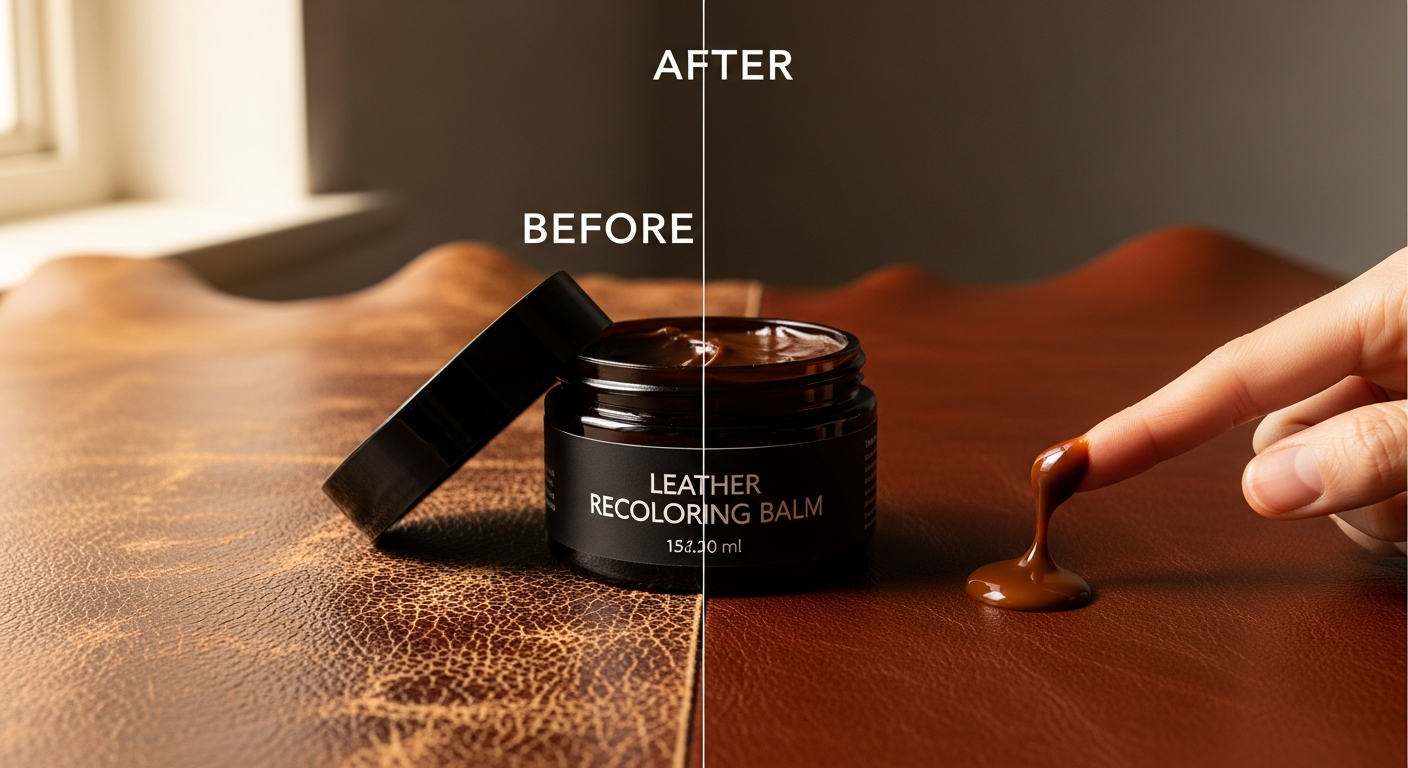
Your favorite leather handbag has lost its luster. Your car's steering wheel shows years of sun damage. You've accepted that these premium items are past their prime—but what if they weren't?
Thousands of leather owners have discovered a game-changing solution that breathes new life into faded, scratched, and worn leather without professional restoration costs. Leather deterioration happens to the best of us. Sun exposure fades rich colors to dull browns. Daily use creates micro-scratches that compound into visible wear. Heat warps the surface.
Discover how Furniture Clinic's Leather Re-Coloring Balm transforms worn leather back to life.
Traditional solutions meant either expensive professional restoration or accepting permanent damage. Furniture Clinic's Leather Re-Coloring Balm entered the market to solve this exact problem, and it's become one of the brand's most trusted products for a reason. I'm breaking down everything you need to know about this balm—from which leather types it actually works on to real-world application strategies for different items. You'll discover the color-matching process, understand why it lasts up to three years between applications, and learn whether it's the right solution for your specific leather goods.
Beyond Furniture: Unexpected Leather Items This Balm Transforms
When most people think of leather restoration, furniture comes to mind first. But this balm reaches far beyond couches and chairs. Car interiors represent one of the most dramatic use cases—steering wheels fade to a ghostly gray after years of sun exposure, while dashboard leather and door panels develop that worn, weathered appearance that makes older vehicles feel dated.
Designer handbags and luxury bags receive new life when color correction happens before structural damage sets in. A beloved Coach or Louis Vuitton piece that's faded from rich cognac to dull tan can be restored to its original warmth without the $200+ professional restoration bill.
Leather jackets and outerwear respond beautifully to this treatment. Motorcycle seats and equipment restoration has become a popular application—riders appreciate how the balm can even out color variations across well-worn seats without that plastic, painted-on appearance. Leather boots and shoes benefit from targeted color matching that blends worn areas with preserved sections.
Professional leather goods like briefcases and portfolios regain their polished appearance, while leather watch bands, belts, and straps receive precision color correction for accessories that are constantly visible. Even antique leather furniture pieces find new character when carefully treated, and leather belt and strap color correction extends the life of everyday accessories.
Different items require slightly different application approaches. Car seats involve larger flat surfaces that demand consistent, even coverage. Handbags often feature multiple leather types in one piece—handles, body, and trim may all require separate consideration. Curved items like steering wheels need careful attention to maintain natural-looking color transition, while flat surfaces can accommodate more aggressive layering for deeper color saturation.
The Science Behind Deep Penetration vs. Surface Coating
The fundamental difference between this balm and typical leather dyes lies in how it interacts with leather fiber structure. Rather than sitting on the surface like paint, the formula penetrates leather fibers, allowing the color to be absorbed from within. This absorption mechanism matters tremendously for durability and natural appearance.
Why does penetration matter? Surface coatings eventually crack, peel, and rub off. They create a plastic-like finish that feels foreign on genuine leather. Penetration-based formulas bond with the leather itself, becoming part of the material rather than a layer applied to it.
The relationship between deep penetration and leather softness retention explains why this product earns such consistent praise. As the balm absorbs, it maintains the leather's natural suppleness and flexibility. You're not coating leather; you're restoring its color while preserving its essential character.
The formula's ability to maintain suppleness while restoring color comes from carefully selected ingredients that nourish the leather as they color it. The balm doesn't dry out leather or create stiff, brittle areas—it conditions while it restores.
Surface coatings fail on leather because leather is a living, breathing material that flexes with temperature and humidity changes. Paint-like coatings crack at stress points and flake away from areas that bend frequently. This penetrating formula moves with the leather, maintaining color integrity even as the material shifts.
The drying process locks color into the leather through absorption rather than evaporation of a surface layer. As the balm sets, it bonds with leather fibers at a molecular level. This locking mechanism explains the three-year durability—the color doesn't simply sit on top waiting to be worn away.
Non-transfer technology prevents the balm from rubbing onto clothing once applied and dried. Many leather products stain white shirts and light fabrics, but this formula's composition ensures that once fully dried, color remains fixed to the leather surface and doesn't migrate to textiles.
Paint-on leather dyes represent the old approach—they obscure rather than restore, often creating an artificial, uniform appearance that ignores the leather's natural character. This balm's advantage lies in enhancing existing leather rather than replacing it with a new color layer.
Multiple coats build color depth without creating that plastic finish. You can apply additional layers to achieve exactly the depth you want. Each coat deepens the color gradually, allowing for precise control that surface dyes can't match.
Experience the difference of deep-penetrating leather restoration at Furniture Clinic.
Matching Your Leather: Navigating the 16-Color Selection
With 16 available colors, finding a match becomes feasible for most leather items. The selection covers warm tones, cool neutrals, rich jewel tones, and earth-based hues. Understanding your leather's undertones separates successful matches from frustrating mismatches.
Warm undertones lean toward yellows, oranges, and reds. These appear in saddle browns, cognacs, honey tans, and caramels. Cool undertones shift toward blues and purples, appearing in charcoal grays, true blacks, and burgundies. Most leather falls somewhere in between, with a dominant undertone that determines which colors work.
Photographing your leather in natural light—not artificial indoor lighting—provides the most accurate assessment. Sunlight reveals the true undertone, while tungsten bulbs add yellow warmth that distorts perception. Take photos of the area you'll be matching from multiple angles and lighting conditions.
Testing color matches on hidden areas before full application prevents costly mistakes. Apply a small amount inside a handbag, underneath car seat padding, or on furniture bottoms where mistakes won't show. This test reveals how the color interacts with your specific leather and whether the shade matches your expectations once dried.
Two-tone and mottled leather requires strategic color selection. You might match the predominant tone, or select a middle-ground shade that harmonizes with both colors without exactly matching either. Some users intentionally enhance the two-tone effect by applying color only to faded areas, preserving the original contrast pattern.
Color fading variations across the same item complicate matching—a handbag might show heavy fading on the handles while the body has faded less noticeably. In these cases, applying color more heavily to faded areas creates an evening-out effect rather than a uniform single color.
When your exact shade isn't available among the 16 options, select the closest match and test it extensively. Often, a slightly lighter or warmer option works beautifully once applied and dried. The leather's own tone influences the final appearance, so a color that seems slightly off in the bottle may look perfect on your specific item.
Blending techniques create custom color depth by applying colors in layers or combining multiple passes to achieve intermediate shades. Some users apply a base color, then add selective deeper applications to areas that originally had richer color, recreating the leather's natural depth variation.
Furniture Clinic provides color preview tools and resources on their website, including detailed photos of each color on various leather types. These references prevent guesswork and provide realistic expectations for how colors appear on actual leather rather than in theoretical swatches.
Common color-matching mistakes include selecting shades in artificial lighting, applying test colors to the exterior of items where lighting differs from the interior, or choosing based on what you wish the leather had been rather than what it actually is. Successful matching requires honest assessment of current tone and realistic selection of available options.
Leather Type Compatibility: What Actually Works
Aniline leather—the most delicate leather type—presents both opportunity and challenge. Its porous surface accepts color readily, but its sensitivity demands careful technique. Aniline leather restoration capabilities are excellent for fading and color loss, though heavily stained leather may require professional attention first.
Semi-aniline leather sits between aniline and pigmented types, with a light protective coating. Application best practices involve testing on a small area first due to the coating's variable absorbency. Semi-aniline accepts the balm well but may require slightly more careful matching since the protective layer influences how colors appear.
Pigmented leather responds exceptionally well to this balm. With its durable surface coating and uniform color, pigmented leather rarely presents matching challenges. Application is straightforward, and the results are consistently excellent across this leather type.
Oil and wax pull-up leather—beloved for its character and aging process—requires special handling. This leather type naturally darkens and develops patina over time. The balm can even out color variations without preventing the leather's natural aging process, though application should test whether the balm accepts readily on the pull-up finish.
Two-tone leather restoration without blending colors can be achieved by selectively applying color or matching a middle-ground shade. The challenge lies in respecting the original design while restoring faded areas without eliminating intentional color variations.
Mottled leather presents the challenge of uneven color restoration—the balm may absorb differently into lighter and darker mottled areas, potentially intensifying the mottled appearance. Strategic color selection and careful application prevent this from becoming an issue, though patience becomes essential.
Rub-off and antique finished leather demands preservation of character while restoring color. These leather types have intentionally distressed, worn, or two-toned appearances. The goal becomes evening out accidental fading while maintaining the intentional aesthetic that makes these leathers desirable.
Bonded leather and faux leather fall outside this product's intended use. These materials lack genuine leather's fiber structure, so the balm's absorption mechanism doesn't function properly. Similarly, suede and nubuck require alternative solutions—their velvety surface texture demands different restoration approaches.
Testing compatibility on your specific leather type removes doubt before committing to the full restoration. Apply a small amount to a hidden area, allow it to dry fully, and assess both the color match and how the balm interacts with your leather's specific finish and texture.
Real-World Performance: Durability and Reapplication Timeline
The three-year durability claim reflects average usage across the product's most common applications. What actually determines reapplication timing involves multiple factors working in concert. Daily use affects how long the color lasts—a steering wheel that's gripped hundreds of times daily wears faster than a briefcase that's carried occasionally.
UV exposure represents the primary driver of color fading over time. A car interior exposed to constant sun requires reapplication sooner than furniture stored indoors. Climate impact extends beyond just sun—heat accelerates fading, while humidity in certain climates affects leather's absorption properties and how well the balm bonds.
Maintenance routines that extend the time between applications include regular conditioning with quality leather conditioners, protective treatments that reduce UV exposure, and careful cleaning that doesn't strip the balm's protective qualities. Leather that receives consistent care maintains its color longer than neglected pieces.
Signs that your leather is ready for reapplication include noticeable color fading in high-use areas, visible scratches where the balm has worn away, or a dull appearance returning despite previous treatment. Many users find that high-friction areas like steering wheel grips or handbag handles need touch-ups before other areas.
Weather effects vary by climate. Humidity-heavy regions may experience slightly faster fading, while arid climates with intense sun present their own challenges. Temperature fluctuations cause leather to expand and contract, potentially accelerating color loss in areas subjected to constant flexing.
Comparing durability to professional restoration results reveals that this balm often outlasts professional treatments, which typically cost $200-500 and may require reapplication within two years. The three-year timeline on a $30 investment represents exceptional value per year of color maintenance.
Cost-per-year analysis demonstrates the economic advantage clearly. A single $30 application lasting three years costs $10 per year. Professional restoration at $300 costs $150 per year. For a leather enthusiast with multiple items, the savings compound dramatically.
Real user experiences with multi-year color retention confirm that properly applied balm maintains its appearance across the stated timeframe. Users report their leather looking as good in year two as it did when first applied, with only minor fading beginning in year three.
Building a leather care schedule around the balm means marking a calendar three years from application, then beginning to monitor for fading signs before reapplication becomes necessary. This proactive approach prevents leather from becoming significantly faded between maintenance sessions.
Application Mastery: Technique Matters on Large Surfaces
The step-by-step application process for beginners starts with cleaning the leather thoroughly but gently, removing dust and surface oils without stripping natural conditioning. A soft cloth and mild leather cleaner prepare the surface for optimal balm absorption.
Large, heavily damaged areas require patience and attention to detail. Rather than attempting full coverage in one application, experienced users work in small sections, applying thin coats and buffing thoroughly between passes. This methodical approach prevents over-saturation and ensures even color distribution.
Achieving even finish on car seats and furniture involves understanding how the balm pools in crevices and seams. Working in directional patterns—following the grain when possible—and using light pressure prevents uneven color buildup. Some users apply in circular motions, others in straight lines following the leather's natural grain.
Layering technique for building color depth means allowing each coat to dry completely before applying the next. Rushing between coats can trap solvents within the leather, creating uneven color development. Patience between applications pays dividends in final appearance.
Buffing and blending for seamless results involves using a soft, lint-free cloth to gently work the balm into leather fibers and remove excess product. This step bridges visible lines between treated and untreated areas, creating a natural gradient rather than stark color transitions.
Common application mistakes that create uneven coverage include applying too much product at once, working on overly large areas before buffing, and failing to work in sections. The balm's deep-penetrating nature means a little product goes a long way—more isn't better.
Tools that help include microfiber cloths for even application, foam applicators for precision work, and natural bristle brushes for seamless blending. Tools that hinder include paper towels that leave lint, plastic applicators that don't distribute product evenly, and rough cloths that can scratch delicate leather.
Time between coats typically requires four to six hours for the balm to dry sufficiently, though humidity affects drying speed. In humid climates, allowing overnight drying between coats prevents reapplication on incompletely dried balm.
Addressing drips, pooling, and over-application involves immediate blotting with a clean cloth before the balm fully absorbs. Once dried, these areas often blend naturally as you apply subsequent coats, though some users prefer reapplying over problem areas with thinner coats.
Fixing patchy or uneven application after drying requires strategic additional applications in areas that appear lighter, building color gradually until achieving desired uniformity. Complete sanding or removal isn't necessary—layering additional coats corrects most uneven applications.
The Good Housekeeping Seal: What It Actually Means
The Good Housekeeping Seal testing process involves rigorous evaluation of product safety, effectiveness, and quality standards. Products bearing this seal have undergone independent laboratory testing verifying manufacturer claims. Seals aren't given lightly—they represent third-party validation that the product actually works as advertised.
Why this certification matters for leather products stems from the crowded market of leather treatments with widely varying quality. A Good Housekeeping Seal immediately distinguishes legitimate, effective products from unproven alternatives or outright scams.
Third-party validation and quality standards mean independent laboratories tested the balm's ability to restore color, verified that it doesn't damage leather, confirmed it doesn't rub off onto clothing, and assessed its safety for consumer use. These aren't manufacturer claims—they're verified facts.
Thousands of five-star reviews reveal what customers actually praise: visible results, ease of application, long-lasting color, and exceptional value for money. Users consistently mention being surprised at how well the balm works, expecting something less effective at this price point.
Safety testing and ingredient scrutiny ensures that the balm won't cause allergic reactions, doesn't contain harmful chemicals, and safely handles the way real people actually use leather products. This examination catches potential issues before widespread use.
How certification affects product reliability creates a clear distinction—certified products have demonstrated reliability, while uncertified alternatives represent experimentation. The seal provides assurance that you're investing in a proven solution rather than gambling on an unproven treatment.
Comparing certified versus uncertified leather restoration products often reveals price differences, with certified options carrying slight premiums reflecting their testing costs. However, that premium vanishes when compared to professional restoration or product failure requiring repurchasing.
What the seal doesn't cover includes situations requiring professional restoration, heavily damaged leather needing specialized treatment, or items with structural damage beyond color loss. The seal verifies the product works for its intended purpose—color restoration—not for applications outside its design.
Warranty and guarantee information typically includes satisfaction guarantees reflecting manufacturer confidence in the product. Many users take advantage of return policies by testing on small areas first, ensuring they're comfortable with results before committing.
Budget Breakdown: Is $29.95 Worth the Investment?
The base price of $29.95 represents a single bottle adequate for most handbags, smaller furniture pieces, or car interior touch-ups. Larger projects or multiple items may require multiple bottles, though the per-bottle cost remains constant regardless of order size.
Cost per application across a three-year lifespan calculates to roughly $10 per year for most users. This assumes a single application provides satisfactory results, which proves accurate for most leather items. High-friction areas might require a second application sooner, but the cost per year remains remarkably low.
Professional leather restoration costs between $200-500 for an average handbag or car seat. This single service costs $200-500, with many items requiring reapplication within two years. The Furniture Clinic balm at $30 lasting three years represents dramatic savings.
Replacement costs for leather goods escalate quickly. A quality leather handbag costs $150-500 new. A car interior leather restoration costs thousands. The balm's ability to extend the useful life of these items by years pays for itself many times over.
Volume pricing rarely applies to this product given its reasonable base cost, but buying multiple bottles for a multi-item restoration project leverages economies of scale. A five-bottle purchase for a complete car interior and handbag restoration still costs under $150 total.
Hidden costs remain minimal with this product. You might invest in a lint-free cloth or applicators if you don't have appropriate tools at home, but most people can gather necessary application materials from existing supplies. Prep work requires only a gentle leather cleaner, typically already owned by anyone maintaining leather goods.
ROI on extending the life of designer handbags becomes obvious quickly. A faded designer bag worth $200-400 restored with a $30 treatment represents an incredible investment return. The alternative—replacing the bag—costs thousands more.
Value for car interior restoration projects emphasizes how the balm addresses the most visible wear on aging vehicles. A car with tired interior leather appears decades older than its actual age. Restoration with this balm can add perceived value far exceeding its cost.
Professional restoration becomes worth considering only when leather is severely damaged beyond color loss—deep gouges, structural deterioration, or extreme neglect requiring preparation work before color restoration makes sense. For standard fading and wear, this balm provides superior value.
Long-term savings for leather enthusiasts with multiple items compound impressively. Someone with five leather items rotated annually can maintain all of them for roughly $10-15 per year once initial applications are complete, while professional restoration for all five items would exceed $1500 annually.
Limitations and Honest Drawbacks Worth Considering
Color matching challenges arise when exact shades aren't available among the 16 options. While the selection covers most common leather colors, unusual or custom leather shades may require selecting a closest approximation and hoping for the best. Testing thoroughly before full application mitigates this risk.
Learning curve for achieving perfectly even coverage means first-time users often produce acceptable results on their first attempt but recognize room for improvement. The good news: subsequent applications improve technique, and minor unevenness often goes unnoticed in everyday use.
Time investment required for large surface areas shouldn't be underestimated. A car interior restoration might require 8-12 hours across multiple days if done properly. Rushing the process produces visible results in speed, but patience delivers superior outcomes.
Heavily cracked or severely damaged leather may need prep work before color restoration makes sense. Filling cracks or sealing damaged areas might be necessary before the balm can deliver optimal results on truly compromised leather.
Structural damage or deep gouges lie outside this product's scope. The balm restores color and addresses surface wear, but cannot repair torn leather, fix deep structural damage, or correct severe deterioration. Structural restoration requires professional intervention.
Reapplication frequency varies based on individual use patterns, making the three-year timeline more guideline than guarantee. Someone with an interior car driven daily in intense sun might need reapplication in 18-24 months, while someone with an office car sees five-year results.
Storage and shelf-life considerations mean keeping the balm in cool, dark conditions away from extreme temperatures. While it's stable at room temperature, heat exposure can affect product consistency. Opened containers should be used within a reasonable timeframe rather than stored indefinitely.
Climate conditions affect application quality, with high humidity potentially extending drying times and extremely hot conditions accelerating drying before even application is complete. Moderate temperatures and moderate humidity provide ideal application conditions.
Professional restoration becomes the actual better choice when leather requires more than color correction—when structural damage, chemical stains, or severe deterioration makes simple color restoration insufficient. Professionals have tools and expertise for situations beyond the balm's design scope.
Product performance on extremely worn or compromised leather may disappoint. The balm works best on leather that's structurally sound but color-faded or scratched. Leather that's deteriorated, flaking, or breaking down benefits more from professional intervention than DIY restoration.
From Faded to Fabulous: Transformation Stories Across Leather Items
Car interior transformations showcase some of the most dramatic results. Steering wheels fade from black or brown to a ghosty gray-tan, making older vehicles appear neglected. A single application of the balm restores rich color, making decade-old interiors look recently detailed. Seats and trim follow similar trajectories—faded leather becomes vibrant, updating an aging vehicle's entire interior aesthetic.
Handbag restoration demonstrates how beloved accessories regain their original appeal. Cognac leather faded to tan, caramel turned dusty, or chocolate darkened unevenly all return to their intended colors. Designer bags that owners stopped carrying because they looked shabby suddenly feel premium again.
Furniture piece revitalization transforms living spaces. Couches and chairs that developed faded patches from sun exposure regain their original character. High-traffic areas on furniture—armrests that show heavy wear, back cushions exposed to sunlight—return to color consistency with the rest of the piece.
Motorcycle and vehicle leather restoration extends beyond cars to motorcycles, boats, and recreational vehicles. Seat leather exposed to harsh sun on road trips can be restored between seasons, keeping adventure gear looking new despite heavy use.
Jacket and outerwear color correction allows favorite leather jackets to stay in the rotation for years longer. Black leather jackets fading to gray, brown suede jackets developing dusty appearance, or tan leather aging unevenly all respond beautifully to targeted application.
Accessory restoration covers belts maintaining professional appearance for business wardrobes, watch bands staying current with color-matched finishes, and straps on bags maintaining coordination with restored pieces. These smaller items often prove excellent first projects for learning application technique.
Timeline of visible results shows immediate transformation on some items and subtle enhancement on others. Car seats reveal results within days. Handbags show transformation immediately upon application and drying. Some leather requires the full drying period to reveal complete color saturation.
Photo documentation of real user transformations flood review sections, with before-and-afters revealing dramatic change on items owners expected to permanently retire. These user-generated examples prove more convincing than manufacturer claims.
What makes certain transformations more dramatic involves the severity of original fading and the leather's undertone matching the selected color. Items that were extensively faded or color-shifted show more dramatic change than those with only minor fading. Matching undertones perfectly produces more dramatic results than approximating colors.
Realistic expectations for different damage levels acknowledge that severely damaged leather shows less dramatic transformation than surface-faded items. However, even leather with visible wear responds noticeably, restoring enough color to make dramatic visual improvements.
Reviving Leather Doesn't Require Professional Pricing
The Furniture Clinic Leather Re-Coloring Balm occupies a unique space in leather care—it's affordable, effective, and accessible to anyone willing to invest 30 minutes of focused attention. Whether you're restoring a sun-damaged car interior, breathing color back into a beloved handbag, or reviving furniture that's seen better days, this product delivers visible results that justify its modest price tag.
The 16-color selection removes much of the guesswork, the Good Housekeeping Seal provides quality assurance, and the three-year durability means you're not constantly reapplying. That said, success hinges on realistic expectations and proper technique. Heavily damaged leather requires patience. Color matching demands careful observation. Large surfaces benefit from a methodical approach. But these aren't flaws—they're simply the reality of working with a product that penetrates leather rather than masking it with surface coatings.
Ready to transform your leather? Start with a small, hidden area to test both the color match and your application technique. Photograph your leather in natural light to ensure you've selected the right shade. Then commit to the process. Thousands of satisfied users have discovered that professional-looking leather restoration doesn't require professional pricing.
Start your leather restoration journey at Furniture Clinic today.
Leave a Reply