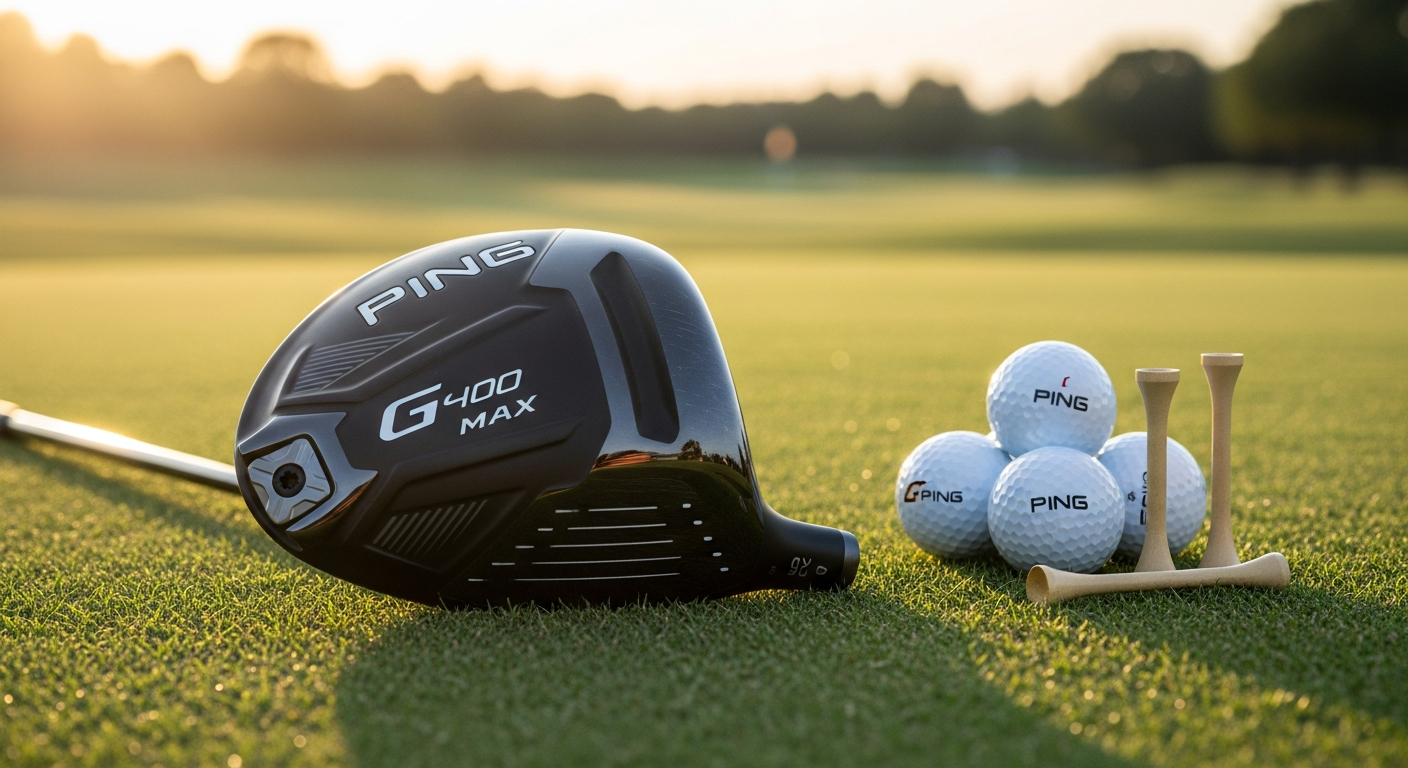
High-MOI Engineering: The Forgiveness Foundation
What Moment of Inertia (MOI) Actually Means for Your Drives
Moment of Inertia might sound like physics jargon, but it's really about one thing: resistance to twisting. When you hit the center of the clubface perfectly, you're in the minority. Most drives catch the toe, heel, or some area off-center. A driver's MOI determines how much that off-center strike destabilizes the clubhead. Higher MOI means less twisting, which means your ball doesn't veer wildly off course. The G440 Max is engineered with an exceptionally high MOI, addressing the reality that the average golfer needs stability more than anything else.
How the G440 Max's MOI Design Minimizes Twisting on Off-Center Hits
Ping's engineering team distributed weight strategically throughout the G440 Max's head to resist rotational forces. Instead of concentrating mass in one area, they spread it across the perimeter and deeper into the clubhead. This perimeter weighting is the secret. When you catch the heel or toe, the weight distribution prevents the clubface from closing or opening excessively, keeping your ball flight predictable even when contact isn't perfect.
The Relationship Between MOI and Ball Speed Retention on Mishits
Ball speed is the primary driver of distance. On center strikes, most drivers maintain 95%+ of ball speed. The real performance gap shows on mishits. Standard drivers lose significant ball speed when you miss the sweet spot by even half an inch. The G440 Max's high MOI preserves ball speed far better across the entire clubface. This means a heel strike still generates respectable distance rather than a weak, offline shot that costs you 30 yards and a stroke.
Why Higher MOI Matters More Than Swing Speed for Most Golfers
Golfers often obsess over swing speed, assuming faster swings automatically mean better drives. Reality is different. A 90 mph swing with consistent contact beats a 95 mph swing with wild dispersion every single time. The G440 Max elevates the performance floor—that is, what happens on your worst swings. You won't suddenly hit 280-yard bombs if you're naturally a 200-yard driver, but you'll hit 205 instead of 190 on a slightly off-center strike. Over 18 holes, that compounds into better scoring.
Ping's Multi-Material Construction Approach for Optimal Weight Distribution
Modern drivers aren't single-material clubs. Ping uses a combination of materials—carbon composites, steel, and other alloys—to position weight precisely where it helps most. The G440 Max leverages this multi-material strategy to lower the center of gravity, increase forgiveness, and optimize launch characteristics simultaneously. Each material choice serves a function rather than existing as marketing window dressing.
Adjustable Hosel Technology for Fine-Tuning Loft and Lie Angles
The G440 Max features an adjustable hosel that allows you to shift loft and lie angles after purchase. This flexibility matters because swing characteristics vary widely. One golfer might benefit from a slightly higher loft for better launch; another might need a lower loft to manage trajectory. Rather than forcing you into a one-size-fits-all configuration, Ping's adjustability lets you dial in settings that match your swing path and preferences.
Real-World Distance and Dispersion Data from 2nd Swing Fitters
Carry Distance Results Observed in Professional Fitting Sessions
2nd Swing's master club fitters have tested the G440 Max across hundreds of swings using launch monitors in controlled fitting environments. The data consistently shows impressive carry distances across different swing speeds. Golfers with 85 mph swing speeds see average carries in the 220-230 yard range, while those with 95 mph swings regularly achieve 250+ yard carries. These aren't outlier numbers; they represent typical performance across the customer base.
Dispersion Patterns: How the G440 Max Keeps Errant Shots in Play
Beyond raw distance, dispersion—how tightly grouped your shots cluster—reveals a driver's true value. The G440 Max consistently shows tight dispersion patterns compared to standard forgiveness drivers. On a 250-yard drive, you might expect a 20-25 yard variance side-to-side on a forgiving driver. With the G440 Max, fitters observe variance in the 15-18 yard range, even across different swing speeds and techniques. That tighter clustering means more fairways hit.
Ball Speed Consistency Across the Clubface
Launch monitor data shows ball speed variance of just 3-5 mph between center strikes and quarter-inch off-center impacts. This consistency is remarkable. It means a mishit doesn't become a disaster—it becomes a slightly shorter version of a good shot. That predictability transforms your course management. You know the G440 Max will deliver within a reasonable range, allowing you to commit confidently to your swing.
Comparison of On-Center vs. Off-Center Strike Performance
Professional golfers rarely miss the sweet spot. Amateurs do it constantly. The gap between an on-center strike and a half-inch off-center strike on a standard driver is severe. On the G440 Max, that gap narrows significantly. An on-center strike might produce 250 yards with a slight draw. An off-center heel strike might produce 242 yards with a similar draw pattern. That 8-yard difference is manageable; on most standard drivers, the difference would be 20+ yards plus a direction shift.
How 2nd Swing's Fitting Data Validates Distance Claims
Manufacturers make distance claims based on robot testing or elite golfer swings. 2nd Swing's data comes from real golfers with real swings—amateurs with inconsistent tempo, slight swing path variations, and genuine contact patterns. The fact that the G440 Max performs consistently across this diverse testing population validates its real-world applicability far better than marketing materials.
Launch Angle Characteristics and Spin Profile Expectations
The G440 Max is engineered for mid-range launch angles (around 16-18 degrees for most golfers) with moderate spin rates. This combination suits the majority of recreational golfers who lose distance to excessive spin. You won't get the ultra-low spin characteristics of specialty drivers designed for tour pros, nor should you. For your swing, mid-range spin is ideal—it produces distance without sacrificing control or consistency.
Explore the G440 Max Driver inventory at 2nd Swing to see current availability and pricing.
Fairway-Finding Accuracy: The Confidence Factor
Why Accuracy Matters More Than Raw Distance for Scoring
Scoring doesn't come from longest drives; it comes from position. A 240-yard drive in the fairway beats a 260-yard drive in the rough every single time. The fairway shot is simpler, more predictable, and requires fewer recovery mechanics. The G440 Max prioritizes accuracy through its high-MOI design and tight dispersion characteristics. You're not chasing an extra 10 yards; you're chasing the fairway. That shift in priority actually improves scoring.
How Minimized Dispersion Translates to More Fairways Hit
Let's do the math. An average fairway is 30-35 yards wide. If your driver has a 25-yard dispersion pattern side-to-side, you're missing fairways regularly even with solid contact. The G440 Max tightens that pattern to 15-18 yards. Suddenly, a slightly off-center strike still lands in play. Over 18 holes, you hit 4-6 additional fairways simply because your miss-hits are smaller misses.
The Psychological Impact of a Forgiving Driver on Tee Box Confidence
Golf is 90% mental. When you fear your driver, you tighten up on the tee. That tension produces worse swings. The G440 Max's forgiving nature means you can stand over the ball knowing that even an imperfect swing will produce a playable result. That confidence translates into more relaxed, natural swings—which often produce better contact. The psychological benefit is as real as the physical engineering.
Real Golfer Testimonials from 2nd Swing's Customer Base
2nd Swing's customer reviews consistently highlight confidence and reliability. Golfers report that the G440 Max "feels solid on every swing" and "doesn't punish you for missing the center." One mid-handicap player noted that switching to the G440 Max immediately dropped his driving fairway percentage from 35% to 50%. Another mentioned that the consistency reduced decision-making anxiety on the tee—he could focus on target selection rather than worrying about clubhead stability.
Consistency Across Different Swing Speeds and Techniques
The G440 Max doesn't play favorites. Whether you're a smooth, tempo-focused swinger or a more aggressive player, the driver delivers consistent forgiveness. High-swing-speed players appreciate that they're not forced into a low-speed forgiveness club. Lower-swing-speed players get the stability benefits without sacrificing distance. This versatility means the G440 Max suits a broad range of golfers.
Reducing the Penalty for Imperfect Contact
Most golfers improve through reduced penalties rather than perfection. A driver that reduces the consequence of off-center contact teaches you to commit more fully to your swing. Instead of tentatively swinging at 80% effort while worrying about mishits, you swing freely at 95% effort, knowing the club will forgive minor errors. Over time, that relaxed, committed approach produces better golf.
Who Should Buy the Ping G440 Max Driver?
Ideal Handicap Ranges and Skill Levels
The G440 Max works best for golfers with handicaps between 8 and 20. This range encompasses golfers who've developed fundamental swing mechanics but struggle with consistency and accuracy. Higher handicappers benefit from the forgiveness; lower handicappers get reliable distance without excessive spin. Beyond a 5 handicap, you might want the G440 LST (Ping's low-spin option) instead.
Why Mid-Handicap Golfers See the Biggest Performance Gains
Mid-handicappers hit the sweet spot for maximum G440 Max benefit. They have enough swing stability that the club's characteristics fully engage, but enough swing inconsistency that maximum forgiveness makes a genuine difference. A 12-handicap golfer might gain 4-5 strokes per round simply from the fairway accuracy improvement. A 3-handicap golfer would gain maybe 0.5 strokes, assuming they can use the adjustability features strategically.
Golfers Seeking Maximum Forgiveness Over Shot-Shaping Ability
If your priority is consistency and accuracy over drawing or fading on command, the G440 Max is your driver. It doesn't restrict shot shaping, but it doesn't encourage it either. You can still work the ball slightly, but the forgiving design naturally returns the clubface toward square, reducing exaggerated shot shapes. Accept this design philosophy, and you'll love the driver. Fight it by trying to force extreme shot shapes, and you'll be frustrated.
Players Transitioning from Older Driver Models
Golfers upgrading from drivers more than 5-7 years old will find the G440 Max revelatory. Older drivers simply don't have the MOI characteristics of modern designs. If you're playing a 10-year-old driver that performs inconsistently, the G440 Max will feel like a completely different experience. The transition usually produces immediate improvements in fairway accuracy and confidence.
Those Prioritizing Reliability and Consistency Over Workability
Some golfers want a driver they can trust completely. They don't care about hitting a specific shot shape on demand; they want the same reliable result 90% of the time. The G440 Max delivers that repeatability. You know what you're getting with every swing (within reason). That predictability allows better course management and lower scores.
Why It's Less Ideal for Low-Handicap Players Seeking Low-Spin Options
Low-handicap golfers with swing speeds above 95 mph often benefit from lower-spin drivers. They generate enough swing speed that maximum forgiveness becomes less critical. Instead, they want spin control to manage trajectory and workability to shape shots. Ping recognizes this market with the G440 LST. If you're a low-handicap player, evaluate whether you truly need maximum forgiveness or if a lower-spin option better suits your game.
Pre-Owned Pricing and Value on 2nd Swing
Current Price Range for G440 Max Drivers in Various Conditions
The G440 Max typically ranges from $199 to $349 on the pre-owned market, depending on condition and availability. Excellent condition models in the $249-$299 range represent the sweet spot—they're nearly indistinguishable from new but cost 40-50% less. Good condition models ($199-$249) show signs of play but perform identically; cosmetics are the only difference.
How Pre-Owned Pricing Compares to New Retail Alternatives
New G440 Max drivers retail for around $449-$479. Pre-owned pricing saves $150-$250 compared to new, which is substantial. You're essentially getting the same performance for 50% of the price. This value proposition explains why the G440 Max dominates 2nd Swing's pre-owned bestseller list—golfers recognize that buying used doesn't compromise performance while dramatically improving price.
Condition Grades and What to Expect at Each Price Point
Like condition, 2nd Swing grades clubs on their condition scale. Excellent condition ($249-$299) means minimal wear, cosmetically tight, and functionally perfect. Good condition ($199-$249) shows typical play wear but no structural issues. Fair condition ($149-$199) shows significant cosmetic wear but remains fully functional. Tour condition ($299+) means virtually unused. For drivers, the performance difference between excellent and fair condition is zero; the visual difference is substantial.
Cost Comparison with Similar Ping Models (G410, G425)
The G410 Plus starts around $186.99, making it slightly cheaper than the G440 Max. However, the G440 Max represents newer technology with improved MOI characteristics. The G425 sits between the two in age and pricing. If you find a G440 Max in excellent condition at $269, it's a better value than a G410 at $179, given the performance upgrade.
Why Buying Pre-Owned Maximizes Value Without Sacrificing Performance
Drivers don't degrade with use—they might accumulate cosmetic wear, but the clubhead's structural integrity and performance characteristics remain unchanged. A pre-owned G440 Max performs identically to a new one. The only difference is appearance. If you care about cosmetics, pay the premium for new. If you care about performance and value, pre-owned is the intelligent choice.
Warranty and Return Policies for Used Drivers
2nd Swing offers a 60-day return policy on pre-owned clubs and provides basic warranty coverage. If the driver develops a defect unrelated to normal use, you have recourse. This policy provides protection without the burden of new-club pricing. Many pre-owned buyers don't realize they have genuine recourse if something goes wrong, which is a significant risk reduction.
G440 Max vs. Competitive Drivers: Head-to-Head Breakdown
How It Compares to Callaway Paradym Max and TaylorMade Stealth Plus
The Callaway Paradym Max and TaylorMade Stealth Plus are direct competitors—both high-MOI, forgiveness-focused designs. In head-to-head testing, the G440 Max performs comparably on distance and slightly better on dispersion consistency. The Paradym Max appeals more to golfers who prefer Callaway's shaft options; the Stealth Plus attracts TaylorMade loyalists. Performance-wise, the differences are marginal—all three are exceptional drivers.
Forgiveness Rating Against Other Max-MOI Competitors
Across major golf equipment sites, the G440 Max consistently ranks in the top tier for forgiveness alongside the Paradym Max and Stealth Plus. Independent testing shows the G440 Max slightly ahead on overall consistency, though all three dominate the forgiveness category. The separations are small enough that brand loyalty and comfort often matter more than raw specs.
Distance Performance Benchmarks Across Brands
Distance testing across brands shows minimal separation in the max-forgiveness category. The G440 Max, Paradym Max, and Stealth Plus all produce 250+ yard carries with similar swing speeds. Callaway's advantage lies in shaft variety; TaylorMade's in adjustability flexibility; Ping's in consistency and reliability. No brand claims a significant distance advantage—that's not where these drivers compete.
Price-to-Performance Value Proposition
The G440 Max offers exceptional value in both new and pre-owned markets. New pricing is competitive with competitors. Pre-owned pricing on 2nd Swing is notably better than competing brands, giving the G440 Max a genuine value edge. If budget is a significant factor, the G440 Max's pre-owned availability makes it the smart choice.
When Alternative Drivers Might Be a Better Fit
If you prioritize ultra-low spin for high swing speeds, the TaylorMade Stealth Plus offers more spin reduction than the G440 Max. If you want maximum shaft customization, the Callaway Paradym Max provides more options. If you're a low-handicap player seeking a mid-MOI option rather than maximum forgiveness, explore other Ping models. The G440 Max is best for golfers specifically seeking maximum forgiveness and consistency.
Why Ping Fitters Consistently Recommend the G440 Max
2nd Swing's master fitters recommend the G440 Max for the same reason they recommend it frequently: it works. Across hundreds of fittings, the G440 Max consistently produces excellent results for golfers seeking forgiveness. Fitters aren't influenced by brand preference; they recommend what works. The G440 Max's consistent results earn its recommendation frequency.
Adjustability and Customization Options
Hosel Adjustment Capabilities for Loft Tuning
The G440 Max's adjustable hosel allows loft adjustments typically ranging from -1.5 to +1.5 degrees from standard. If you're a standard setup player (say, 10.5 degrees), you can shift to 9 degrees for a lower, more penetrating flight or 12 degrees for a higher, more forgiving trajectory. This flexibility means you're not locked into a single loft configuration.
Lie Angle Customization for Swing Path Optimization
Lie angle adjustments influence whether the clubface closes or opens relative to your swing path at impact. A golfer with an in-to-out swing path might benefit from a slightly open lie angle to manage draw bias; a golfer with an out-to-in path might prefer a closed lie angle. While these adjustments are subtle, they can meaningfully reduce shot bias for golfers with pronounced swing path characteristics.
Weight Distribution and Its Impact on Ball Flight
Modern drivers like the G440 Max feature adjustable weight systems. Shifting weight forward increases spin; shifting weight backward decreases spin. Some models allow side-to-side weight adjustments for draw/fade bias. The G440 Max's weight distribution is primarily optimized in the design itself, but understanding how weight placement influences launch characteristics helps you appreciate the engineering choices.
Shaft Options and Compatibility Considerations
The G440 Max accommodates standard driver shafts with .335" tips. You can swap the stock shaft for alternative options, though this requires professional fitting and installation. Some golfers benefit from stiffer or more flexible shafts; others prefer different weights or launch profiles. If you're considering shaft customization, work with a fitter to identify options that complement your swing.
When to Use Adjustability Features vs. Accepting Stock Settings
Most golfers should accept the G440 Max's stock settings initially. The driver is optimized out of the box. If you've had a fitting session and received specific loft or lie recommendations, adjust accordingly. If you're a low-handicap player seeking fine-tuning, work with a fitter to extract maximum value. For most golfers, stock settings are perfect.
How 2nd Swing's Fitters Guide Customization Decisions
2nd Swing's fitters help customers identify whether adjustability matters for their game. They'll conduct fitting sessions using launch monitors to determine whether your swing characteristics call for specific loft or lie adjustments. If adjustments would help, they guide the process. If stock settings are optimal, they'll recommend leaving the driver as-is. This personalized guidance ensures you maximize the driver's potential for your specific swing.
The Limitations Worth Knowing
Why Max-Forgiveness Drivers Sacrifice Some Workability
A driver engineered for maximum forgiveness naturally resists extreme shot shapes. The high MOI that prevents the clubface from twisting excessively on mishits also resists intentional manipulation. You can work the ball slightly, but forcing a dramatic draw or fade requires more effort than with mid-MOI drivers. This is a trade-off: maximum forgiveness for maximum shot-shaping ability.
Limited Appeal for Tour-Level Swing Speeds and Shot Shaping
Players with swing speeds above 100 mph who regularly shape shots often find max-forgiveness drivers frustrating. They want a driver that responds to their swing path changes and allows intentional shot manipulation. The G440 Max's design philosophy opposes this need. Tour professionals and elite amateurs typically choose different driver profiles.
Spin Characteristics and Whether They Suit Your Game
The G440 Max produces moderate spin rates, which is ideal for most golfers but potentially suboptimal if your swing characteristics call for higher or lower spin. A golfer who naturally produces excessive spin might benefit from a lower-spin option. Conversely, a golfer struggling with spin loss might benefit from a higher-spin option. The G440 Max's moderate spin is a compromise—optimal for many, but not universal.
Comparison with Ping's G440 LST for Low-Spin Seekers
Ping offers the G440 LST (Low Spin Technology) for golfers specifically seeking spin reduction. If launch monitor data shows you'd benefit from lower spin, the LST is worth comparing. It maintains the G440 Max's forgiveness while tuning spin characteristics. The choice between Max and LST depends on your fitting data and swing characteristics—there's no objectively correct answer.
When a Different Ping Model Might Serve You Better
If you're a tour-level player seeking shot-shaping capability, the G425 LST might suit you better. If you're a beginner seeking maximum forgiveness without paying for unnecessary adjustability, the G440 Plus might be better. If you're a mid-handicap player seeking balance, the G440 Max is likely optimal. Ping's model range addresses different needs; the G440 Max is best for forgiveness-focused players.
Realistic Expectations for Swing Improvement
A new driver won't fundamentally change your swing mechanics or eliminate fundamental flaws. If your miss-hit distance is poor because of inconsistent swing path, a forgiving driver won't fix your swing path—it'll just make the inconsistency less punishing. The G440 Max improves your performance ceiling and raises your floor, but it doesn't transform swing mechanics. Set expectations accordingly.
Putting the G440 Max in Your Bag: A Fitting Perspective
How 2nd Swing's Master Fitters Evaluate Driver Fit
2nd Swing's master fitters begin with interview questions about your swing characteristics, typical miss patterns, and performance goals. Then they use launch monitors to capture data: clubhead speed, ball speed, launch angle, spin rate, dispersion patterns, and more. This combination of qualitative understanding and quantitative data allows informed recommendations rather than guessing.
Testing Protocols That Reveal True Performance
Fitters typically have you hit 8-10 shots with each driver being evaluated, capturing data from center strikes and intentional off-center hits. This testing reveals not just peak performance but consistency. Can the driver maintain performance across different swing speeds? Does it handle the slightly-off-center hits that represent your reality? Does the ball flight match your preferences?
Launch Monitor Data and What It Tells You
Launch monitor data translates swing characteristics into numbers: launch angle tells you trajectory; spin rate tells you ball flight stability; smash factor tells you efficiency. A fitter interprets this data in context. If spin rate is 2500 RPM, is that optimal for your swing speed, or should you consider lower-spin alternatives? The data informs the recommendation.
Matching Driver Specs to Your Swing Characteristics
Your swing generates specific characteristics: a particular launch angle naturally, a certain spin rate, a specific swing path. The optimal driver complements these characteristics. If you naturally launch high with moderate spin, a driver tuned for mid-range launch is ideal. If you naturally launch low with high spin, a driver tuned for maximum launch might be better. Fitting ensures the driver matches your swing rather than fighting it.
Why Professional Fitting Beats Guessing Every Time
Too many golfers buy drivers based on marketing or friends' recommendations without understanding whether the club suits their swing. Fitting takes the guesswork out. You walk away knowing the G440 Max (or alternative) specifically suits your swing characteristics. That knowledge justifies the fitting investment through improved performance and confidence.
Next Steps After Selecting Your G440 Max
After a fitting session confirms the G440 Max is optimal, discuss inventory options with your fitter. 2nd Swing's pre-owned inventory changes constantly. Your fitter can identify available G440 Max models matching your condition preferences and budget. Once you've selected your specific club, the fitter can verify specifications and arrange purchase. Professional fitting ensures your driver purchase succeeds.
The Bottom Line: Why the G440 Max Earns Its Bestseller Status
The Ping G440 Max Driver delivers on its fundamental promise: exceptional forgiveness, impressive carry distance, and the fairway-finding accuracy that actually lowers scores. Its high-MOI design isn't marketing language—it's engineering that translates directly into fewer penalty strokes and genuine confidence standing over the ball. 2nd Swing's master fitters have observed this driver perform consistently across hundreds of actual swings from real golfers with real swing characteristics. That real-world validation matters infinitely more than any marketing claim or spec sheet.
Whether you're a 15-handicap golfer frustrated by wild dispersion patterns or someone upgrading from equipment that's simply aged out of competitive performance, the G440 Max deserves serious consideration. The pre-owned pricing on 2nd Swing makes it even more compelling—you're acquiring tour-proven performance without the premium new-equipment price tag. This driver isn't for everyone. Low-handicap shot-shapers might genuinely prefer the G440 LST, and tour-level players have different needs entirely. But for golfers prioritizing playability, consistency, and score improvement, the G440 Max is genuinely difficult to beat.
Ready to transform your tee game and start hitting more fairways?
Leave a Reply