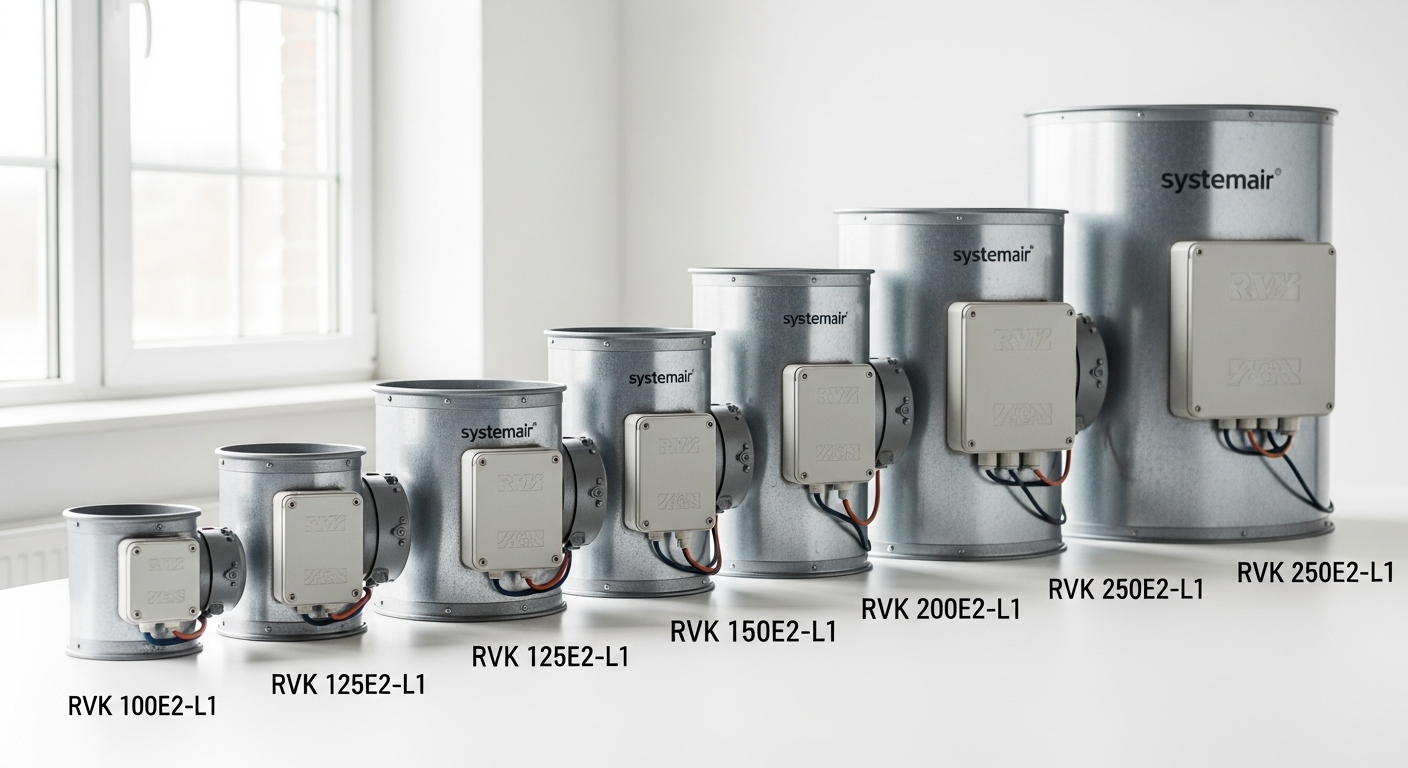
Understanding RVK Fan Sizes and Airflow Capacity
The Systemair RVK inline duct fan lineup spans six primary diameters: 100mm, 125mm, 150mm, 200mm, 250mm, and 315mm. Each size category represents a distinct performance tier, with airflow outputs scaling dramatically across the range. A compact 100mm model delivers approximately 184 m³/h, while the largest 315mm unit achieves up to 1360 m³/h—nearly a sevenfold increase in air movement capability.
Airflow Output and Diameter Relationships
The relationship between fan diameter and airflow is not linear; it accelerates significantly as size increases. The backward-curved radial impellers featured in RVK models are dynamically balanced to optimize efficiency at each size category. These impellers work in tandem with efficient AC external rotor motors, ensuring that air delivery remains consistent regardless of whether you're running a 100mm domestic unit or a 315mm industrial installation.
Motor Power and Performance Scaling
As fan diameter increases, motor power scales proportionally to handle larger volumes of air. This engineering approach means that each RVK size operates at its designed efficiency point, neither straining nor running idle. The motor compatibility extends to both 50Hz and 60Hz electrical systems, making RVK fans suitable for diverse geographical installations and facility requirements.
Noise Level Considerations Across Sizes
Noise output ranges from approximately 34.5 dB for smaller 100mm models to around 44.9 dB for high-power 315mm units. This progression reflects the increased air movement rather than inefficiency—larger fans can move more air at lower relative speeds, which helps maintain reasonable noise levels even at higher capacities. For noise-sensitive applications, understanding where your chosen size falls on this spectrum matters significantly.
Compact Design Benefits
Despite their increased capacity, larger RVK models maintain a compact footprint thanks to polypropylene and fiberglass construction. This lightweight yet hard-wearing casing allows even 315mm units to remain manageable for installation. The circular connection spigot and included mounting brackets provide flexibility, accommodating vertical, horizontal, or angled positioning without requiring extensive structural modifications.
Calculating Your Actual Ventilation Requirements
Determining the correct RVK size begins with a fundamental calculation: understanding how much fresh air your space genuinely needs. This isn't a matter of opinion or rough estimation—it's based on established ventilation standards and your specific application requirements.
The Air Changes Per Hour (ACH) Method
Air changes per hour represent how many times the entire volume of air in a room is completely replaced hourly. Residential spaces typically require 4-6 ACH, commercial environments demand 6-8 ACH, and horticultural applications like grow rooms often need 8-15 ACH depending on plant density and environmental control needs. To calculate required airflow, multiply your room volume (length × width × height in meters) by your target ACH, then divide by 60 to convert to m³/h.
Accounting for Duct Friction and System Losses
Theoretical calculations rarely account for real-world friction losses. Ductwork, bends, filters, and connection points all create resistance that reduces actual airflow. Industry practice adds a 15-25% safety margin to your calculated airflow requirement to compensate for these losses. This adjustment ensures your selected RVK model delivers the air exchange rate you actually need, not just what calculations suggest on paper.
Application-Specific Adjustments
Different environments introduce unique variables. Grow rooms require aggressive air exchange to prevent mold and regulate temperature swings. Server rooms prioritize consistent cooling capacity. Plant facilities in commercial settings balance humidity control with energy efficiency. Each application type has established guidelines that should inform your target ACH selection before you ever reference the RVK size chart.
Speed Regulators and Fine-Tuning
RVK fans come equipped with either 5-step or stepless speed regulators, allowing you to adjust performance after installation. This flexibility means you're not locked into a single operating point—you can optimize the fan for your actual needs rather than theoretical maximum capacity. This capability becomes particularly valuable when initial calculations prove conservative or when seasonal variations demand performance adjustments.
Common Sizing Mistakes
Undersizing typically occurs when installers calculate theoretical minimum airflow without accounting for duct losses or select a fan based solely on room volume without considering ACH standards. Oversizing happens when designers apply excessive safety margins or confuse maximum capacity with practical operating range. Both errors create problems: undersizing compromises air quality, while oversizing wastes energy and generates unnecessary noise.
Matching Room Size and Duct Diameter to the Right Fan Model
Your selected RVK size must align harmoniously with your duct diameter. This relationship directly impacts system efficiency, noise generation, and installation feasibility.
Duct Diameter and Fan Selection Interdependence
Standard ductwork comes in specific diameters that correspond to RVK fan sizes. A 100mm RVK connects to 100mm ducting, a 150mm fan to 150mm ducts, and so forth. Mismatches create problems—connecting a 150mm fan to 100mm ducts generates excessive pressure, noise, and strain on the motor. Conversely, oversizing duct diameter for your fan wastes material and reduces air velocity, compromising performance.
Preventing Excessive Noise and Pressure Drops
Optimal duct sizing maintains air velocity between 3-5 m/s for residential applications and up to 7 m/s for commercial installations. Higher velocities generate noise from turbulence; lower velocities fail to move air effectively. Your RVK size selection directly determines the appropriate duct diameter needed to maintain these velocity ranges across your system.
Explore the complete Systemair RVK inline duct fan range at eFans Direct to find your ideal match.
Installation Flexibility with Connection Spigots
RVK models feature circular connection spigots designed for straightforward integration with standard ducting systems. This standardized approach means you're not locked into specialized ductwork or complicated adapters—the fans work seamlessly within conventional ventilation infrastructure.
Positioning Flexibility Across Orientations
The compact design and included mounting brackets accommodate vertical runs (pulling air upward), horizontal installations (moving air across a space), and angled configurations (following architectural constraints). This flexibility means your RVK size selection isn't constrained by installation geometry—the fan adapts to your physical layout, not the reverse.
Space Constraints and Compact Design Advantages
In retrofit situations where space is severely limited, the RVK's lightweight fiberglass construction becomes invaluable. Even larger models can be positioned in tight ceiling cavities, attic spaces, or equipment rooms without requiring extensive structural modifications or custom mounting solutions.
Performance Characteristics Across Different Size Categories
Each RVK size category exhibits distinct performance profiles that extend beyond simple airflow numbers.
Energy Consumption and Efficiency Ratings
Smaller RVK models consume proportionally less energy—a 100mm unit might draw 15-25 watts, while a 315mm model draws 200-300 watts. However, efficiency (airflow per watt consumed) improves with size due to motor design. Selecting an appropriately sized fan optimizes energy consumption relative to your ventilation needs, avoiding the energy waste that comes from oversized models running at partial capacity.
Thermal Protection and Continuous-Duty Operation
RVK models incorporate integrated thermal protection systems that prevent motor overheating during extended operation. This safety feature becomes particularly important in continuous-duty applications like server rooms or commercial grow facilities where fans run 24/7. The thermal protection triggers before damage occurs, ensuring your investment remains protected under demanding operating conditions.
Terminal Box Ratings for Humid Environments
IP55 and IP44 rated terminal boxes accommodate moderately humid or damp environments without risking electrical failure. IP55 ratings provide superior protection against moisture and dust, making them ideal for agricultural applications, bathrooms, or any installation where humidity levels fluctuate significantly. IP44 ratings offer solid protection for most commercial and domestic installations while maintaining cost efficiency.
Motor Compatibility with Dual Frequency Operation
The ability to operate on both 50Hz and 60Hz electrical systems provides genuine global flexibility. This compatibility matters whether you're installing in the UK (50Hz standard) or need to relocate equipment to regions using 60Hz power standards. The motors maintain consistent performance across both frequencies without requiring conversion equipment.
Pressure and Static Resistance Capabilities
Larger RVK models deliver superior pressure ratings, enabling effective operation across longer duct runs or systems with multiple branches and bends. A 315mm RVK maintains adequate airflow even when connected to extensive ductwork, whereas smaller models begin losing effectiveness with extended duct lengths. Understanding your system's total duct length and bend count informs which RVK size provides adequate pressure capability.
Real-World Performance Data
Contractors across the UK consistently report that properly sized RVK installations deliver specified airflow values even in real-world installations with various ductwork configurations. This reliability—the "fit and forget" reputation—stems from conservative engineering that builds in performance headroom, ensuring fans deliver rated specifications rather than theoretical maximums.
Practical Applications: Which RVK Size Works Best Where
Real-world ventilation challenges differ dramatically depending on space type, size, and environmental demands.
Small Spaces and Domestic Applications
100mm and 125mm RVK models serve compact bedrooms, bathrooms, kitchens, and small residential spaces effectively. These sizes move sufficient air for 4-6 ACH in typical domestic rooms (up to about 20-25 m³) without generating excessive noise. Installation proves straightforward—most homeowners or DIY installers manage connections without specialized tools. Energy consumption remains minimal, making these models economical for intermittent or continuous operation.
Medium Commercial and Horticultural Environments
150mm and 200mm RVK units handle grow rooms, medium office spaces, retail environments, and small commercial facilities. These sizes deliver the 8-15 ACH that horticultural applications demand while maintaining reasonable noise and power consumption. Many professional growers use multiple 150mm RVK fans rather than a single larger unit, allowing precise zoning control and redundancy if one fan requires maintenance.
Large-Scale Facilities and Data Centers
250mm and 315mm RVK models power large server rooms, significant commercial installations, and industrial plant facilities. These sizes deliver the 1000+ m³/h airflow necessary for environments where temperature control and air quality directly impact operational outcomes. The superior pressure ratings handle complex ductwork networks and multiple extraction points without performance degradation.
Multi-Room Systems and Fan Configurations
Many installations benefit from distributing airflow across multiple smaller RVK units rather than concentrating everything into a single large fan. Two 150mm fans provide better zoning control, noise distribution, and operational flexibility than one 200mm model. This approach also provides redundancy—if one fan requires maintenance, the other maintains partial ventilation rather than complete system failure.
Retrofit Challenges and Existing Ductwork
Retrofitting existing systems often constrains size options. If your existing ductwork uses 150mm diameter, you cannot use a 200mm RVK without expensive modifications. Understanding your current duct dimensions before calculating requirements ensures your selected RVK size integrates seamlessly with existing infrastructure.
Future-Proofing Through Scalable Solutions
The RVK range spans such a wide diameter spectrum that you can typically find a size matching both your current needs and reasonable future expansion. Selecting a model with modest headroom accommodates modest increases in ventilation demand without requiring complete replacement—simply increase fan speed through the regulator to access additional airflow capacity.
Cost-Benefit Analysis: Size Selection and Budget Planning
The price range for Systemair RVK inline fans spans approximately £60 to £195, depending on size and specific model variant. This variance reflects genuine cost differences in materials, motor capacity, and manufacturing complexity rather than arbitrary pricing.
Price Progression Across Size Categories
100-125mm models typically fall in the £60-£85 range, 150-200mm units cost £90-£130, and the larger 250-315mm models reach £150-£195. While selecting the smallest fan in your viable range minimizes upfront cost, this approach frequently backfires—undersizing forces you to replace the fan within months or years, converting short-term savings into long-term expense.
Value of Correct Sizing From the Start
Investing modestly more in a properly sized fan on day one eliminates costly replacement expenses, system upgrades, and operational compromises. A correctly selected RVK delivers years of reliable performance without requiring intervention, whereas an undersized fan forces you to confront inadequate ventilation almost immediately.
Energy Savings From Proper Sizing
A properly sized RVK running at appropriate speed settings consumes less energy than an oversized model running continuously at reduced capacity. Modern regulators enable you to match fan operation to actual ventilation needs rather than maintaining maximum capacity regardless of circumstances. Over a multi-year installation lifespan, energy savings from proper sizing frequently exceed the initial cost difference between models.
Avoiding Costly Upgrades and Replacements
Undersized installations often require complete ductwork replacement to accommodate larger fans, adding thousands of pounds to rectification costs. Selecting the correct size initially prevents these expensive retrofits entirely. The modest upfront premium for appropriate sizing becomes negligible compared to upgrade costs.
Budget Balancing and Practical Decisions
If tight budget constraints force compromise, favor slight oversizing over undersizing. An oversized RVK running at reduced speed via the regulator still delivers adequate performance while consuming minimal energy. An undersized model simply cannot meet ventilation requirements, rendering budget concerns moot since replacement becomes necessary.
Additional Cost Considerations
Factor in IEC cables, plugs, mounting brackets, and installation materials beyond the fan itself. Most RVK models do not include these items, representing £20-£50 in additional expenses. Professional installation typically costs £150-£300 depending on system complexity. These costs matter, but they pale compared to addressing ventilation inadequacy after installation.
Installation Considerations for Different RVK Sizes
Proper installation transforms RVK fans from excellent products into reliable, long-term assets.
Mounting Bracket Options and Positioning
Included mounting brackets provide straightforward attachment to floor joists, wall studs, or ceiling frames. The compact design accommodates suspended installation, wall mounting, or floor-level positioning depending on your ductwork layout. Flexible mounting capacity means installation difficulty doesn't escalate dramatically with fan size—a 315mm unit mounts as easily as a 100mm model.
Duct Connection Requirements
Connection spigots must match your ductwork diameter precisely. Mismatches require adapters that introduce friction and noise. Verify your existing duct sizing before finalizing your RVK size selection to ensure seamless integration. Flexible ducting connections at the fan intake and discharge reduce vibration transmission to building structures, minimizing noise generation.
Vibration Isolation and Noise Reduction
Rubber vibration isolators beneath mounting brackets decouple fan vibration from building elements, substantially reducing noise transmission. This becomes increasingly important with larger models that generate more mechanical energy. Proper isolation transforms a potentially noisy installation into a quiet one, justifying the modest cost of isolation materials.
Electrical Wiring and Regulator Setup
Connecting the speed regulator requires straightforward wiring—typically a three-wire connection (live, neutral, earth). Professional electricians complete this work in minutes, though experienced DIY installers manage the connections competently. Verify that your electrical supply accommodates your selected RVK's power requirements; larger models demand adequate circuit capacity.
Integration With Existing Systems
If you're retrofitting into existing ventilation infrastructure, the RVK's standardized connection approach typically allows seamless integration. The backward-curved impeller design works effectively when replacing legacy fans or integrating into systems designed around conventional ductwork standards.
Professional Installation Versus DIY Feasibility
Smaller 100-150mm RVK models remain manageable for experienced DIY installers, particularly in retrofit situations where ductwork already exists. Larger models benefit from professional installation—electricians handle wiring safely, and experienced installers position equipment optimally for noise reduction and performance. The modest professional installation cost justifies itself through proper configuration and system optimization.
Why Size Accuracy Matters: The Consequences of Getting It Wrong
The stakes in fan sizing extend far beyond convenience—they directly impact occupant comfort, space functionality, and system longevity.
Symptoms of Undersized Fans
Poor air quality manifests as stuffiness, odor persistence, and CO₂ accumulation in underventilated spaces. Humidity problems develop when air exchange rates fall below ACH requirements, creating conditions where moisture accumulates rather than dispersing. Temperature control becomes erratic as insufficient airflow prevents even heat distribution or cooling circulation. These symptoms typically emerge within days or weeks of installation, creating immediate buyer's remorse.
Consequences of Oversized Fans
Unnecessary energy consumption represents the most obvious consequence—operating a 250mm RVK in a space requiring only a 150mm fan wastes thousands of pounds over years of operation. Excessive noise generation makes spaces uncomfortable, particularly in residential or office environments where tranquility matters. Motors strain under partial-load operation, potentially shortening equipment lifespan despite never reaching maximum design capacity.
System Longevity and Component Impacts
Properly sized RVK fans operate within design parameters, preserving motor lifespan and mechanical components. Undersized fans struggle against system resistance, forcing motors to overheat and burn out prematurely. Oversized models operating at minimal capacity experience bearing wear and mechanical degradation that reduced-speed operation doesn't prevent. Correct sizing optimizes component lifespan across your entire installation.
Fit and Forget Reputation Depends on Proper Sizing
The "fit and forget" description that characterizes RVK popularity applies specifically to correctly sized installations. A properly matched fan operates reliably for years without requiring intervention. Incorrectly sized units demand constant attention—adjusting regulators ineffectively, troubleshooting performance issues, or planning eventual replacement.
Warranty and Performance Guarantees
Systemair's warranty and performance guarantees assume proper sizing and installation. Undersized applications that claim inadequate performance may face warranty denials if analysis reveals improper size selection for the application. Understanding that warranties protect against defects, not design errors, reinforces the importance of correct sizing decisions.
Troubleshooting Performance Issues Post-Installation
If your system underperforms after installation, addressing the problem becomes complicated and expensive. Duct modification, fan replacement, or structural changes cost substantially more than investing in correct sizing initially. Post-installation troubleshooting frequently reveals that the original size selection was the fundamental error, converting a straightforward installation decision into an expensive correction project.
Making Your Final Decision: A Practical Selection Framework
With all considerations evaluated, you're ready to make your selection confidently.
Checklist of Essential Information
Before purchasing, gather: your precise room dimensions (length, width, height in meters), the applications your space will serve (residential, commercial, horticultural), existing ductwork diameter if retrofitting, your target air changes per hour based on application type, electrical supply specifications (50Hz or 60Hz, available circuit capacity), installation constraints (space limitations, vertical versus horizontal runs), budget parameters, and noise tolerance. This information directly maps to the correct RVK size.
Quick Reference Sizing by Application
100-125mm models suit small residential spaces (bedrooms, bathrooms, studies). 150-200mm units handle medium commercial spaces and standard grow room applications. 250-315mm fans power large commercial facilities, data centers, and intensive horticultural operations. These guidelines provide a starting point; your detailed calculations refine the selection within these brackets.
Consulting With Specialists
If any aspect of your calculation or matching process creates uncertainty, eFans Direct specialists possess expertise to guide you toward the precise model matching your requirements. They review your room dimensions, application type, existing ductwork, and performance expectations to recommend the optimal RVK size. This consultation costs nothing and eliminates selection risk.
Technical Documentation Review
Product documentation and specification sheets provide performance curves, noise data, and pressure ratings for each RVK size. Cross-referencing your calculated airflow requirement against these curves confirms that your selected model delivers adequate performance across your system's expected operating range.
Future Expansion Considerations
Consider whether your space might expand, use patterns might intensify, or environmental demands might increase over your installation's lifespan. Selecting an RVK size with modest headroom accommodates these changes through regulator adjustments rather than fan replacement. This forward-thinking approach maximizes your installation investment.
Confidence From German Engineering
The RVK's reputation stems from German manufacturing standards and proven reliability across decades of market presence. Contractors across the UK consistently specify these fans because they deliver specified performance reliably and durably. This track record, combined with your careful sizing decisions, provides genuine confidence that your selected RVK will meet your ventilation needs effectively.
Your Ventilation System Starts With the Right Size
Selecting the correct Systemair RVK inline duct fan size might seem technical, but it boils down to one fundamental principle: match your airflow needs to the right fan diameter, and everything else falls into place. You now understand how to assess your space, determine your actual ventilation requirements, and navigate the RVK range confidently based on the information covered here.
The stakes are genuinely high. An undersized fan leaves you struggling with poor air quality and moisture issues. An oversized unit wastes energy and creates unnecessary noise. But a properly sized RVK? That's the reliable workhorse that contractors across the UK have trusted for years. The fiberglass-reinforced casing handles demanding environments, the speed regulators let you fine-tune performance, and the thermal protection keeps everything running smoothly.
Take your room measurements, calculate your required airflow, and cross-reference the RVK size chart. If uncertainty emerges during any step, the eFans Direct team stands ready to guide you toward the exact model that will serve your ventilation needs reliably and efficiently.
Find your perfect Systemair RVK model today and transform your space's air quality.
Leave a Reply