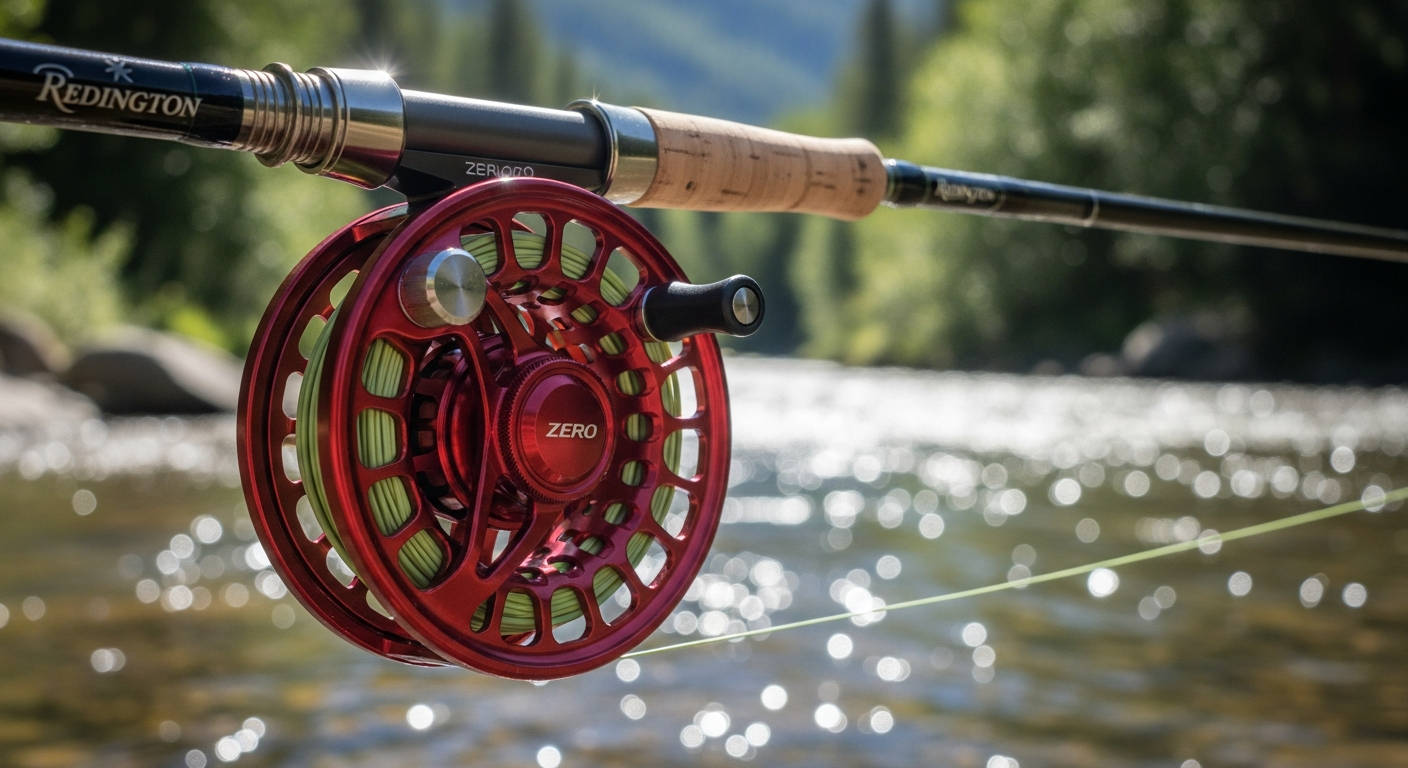
Most trout anglers underestimate the impact of reel weight on their fishing day. Shaving just a few ounces off your setup can transform fatigue levels, improve casting accuracy, and ultimately change how you experience small stream fishing. The difference between wrestling a heavy reel all day and gliding through a creek with an ultralight setup is more profound than you might think.
The Redington Zero Fly Reel has earned its best-seller status among trout anglers for good reason. This reel represents a genuine engineering breakthrough—it delivers featherweight performance through innovative die-cast construction while maintaining the reliability that matters on the water. Weighing just 2.7 to 3 ounces, the Zero achieves what traditional manufacturing methods cannot accomplish without astronomical cost premiums.
How Die-Cast Construction Delivers Featherweight Performance
Engineering Innovation vs. Traditional Manufacturing
Die-cast construction fundamentally differs from conventional CNC machining. Traditional methods start with solid aluminum blocks and remove material through precision cutting—a process that can only reduce weight so far before structural integrity suffers. Die-casting, by contrast, involves pouring molten aluminum into precision molds, allowing manufacturers to create complex geometries with strategic material placement and wall thickness variations.
This approach means the Zero uses material exactly where it’s needed for strength while eliminating unnecessary bulk elsewhere. A CNC-machined reel of comparable size would weigh significantly more because the manufacturing process doesn’t permit the sophisticated internal architecture that die-casting enables.
Material Density and Structural Integrity
The Zero achieves its remarkable weight without sacrificing the durability required for trout fishing. Strategic ribbing and internal bracing distribute stress loads effectively, while the die-cast aluminum maintains adequate hardness for spool bearing surfaces and drag mechanisms. The painted finish protects against corrosion without adding meaningful weight.
What separates this approach from cheaper die-cast products is Redington’s engineering discipline. Every gram saved came from thoughtful design rather than cost-cutting compromises.
The Engineering Breakthrough
Redington’s designers recognized that trout fishing rarely demands the robust construction required for saltwater or large pelagic species. By tailoring the Zero specifically for trout rather than attempting a universal solution, they optimized every aspect for the intended purpose. Both the 2/3 and 4/5 sizes achieve their remarkable weights through identical engineering philosophy—form following function precisely.
The Spring-Loaded Clicker Drag: Simplicity Built for Trout
Preventing Backlash During Casting and Stripping
The spring-loaded clicker mechanism prevents the spool from overrunning during casting—a critical function for maintaining line control during false casts and quick strip-and-mend movements. When you execute a forward cast, the clicker’s tension holds the spool firmly, then releases smoothly during the drift and retrieve phases.
During aggressive stripping, the clicker prevents that chaotic spool spin that creates loose line and tangles. The mechanism engages automatically; no adjustment needed between different fishing scenarios.
Why Simplicity Outperforms Complexity for Trout
Sealed disc drag systems found on premium reels offer infinite adjustment and powerful braking—capabilities utterly unnecessary for trout fishing. These systems add weight, complexity, and cost while introducing additional points of potential failure. The Zero’s clicker delivers straightforward tension without the sophistication aimed at saltwater or large-game fishing.
For trout, backlash prevention matters far more than precise tension adjustments. The clicker accomplishes this fundamental requirement reliably and predictably.
Tension Range and Species Considerations
The clicker delivers consistent tension across both size options, suitable for brookies, browns, and rainbows up to approximately 18-20 inches. For delicate presentations to native brookies in tight creeks, the light drag prevents break-offs while maintaining the finesse these fish demand. Brown trout and rainbow trout in small to medium streams find the tension adequate for sustained runs without excessive head-shaking.
Anglers pursuing larger species or aggressive fish requiring precise drag management will find this system limiting—a characteristic that actually benefits trout specialists by eliminating unnecessary features.
Large Arbor Design and Line Memory Reduction
Arbor Diameter and Retrieve Speed
Larger arbor diameter means greater line capacity per rotation—you retrieve more line with each handle turn without increasing rotational mass. The Zero’s large arbor design delivers faster line pickup during the critical strip-and-set sequence without the weight penalty of traditional large arbor designs.
This matters most when fishing tight cover or when you need to rapidly take up slack before a trout breaks downstream. The engineering balances retrieve speed against the ultralight weight requirement that defines this reel.
Line Memory and Modern Fly Lines
Line memory—the tendency of fly line to retain coiled shape from spool storage—diminishes dramatically with larger arbor sizes. A 3-inch arbor diameter allows fly line to relax naturally between casts rather than fighting coiled geometry. For modern weight-forward and double-taper lines that already incorporate memory-reducing treatments, the large arbor design compounds this benefit.
The practical result is casts that extend more efficiently and mend-ability that improves throughout the day, even after hours of spooled storage.
Small Stream Practical Benefits
Bluelining remote headwaters and fishing pocket water demand constant line management—stripping in, casting, adjusting position. The Zero’s large arbor eliminates the frustrating delays caused by line memory on smaller arbor designs. When you’re working tiny pockets on headwater streams where trout disappear in seconds, that fluid line management becomes genuinely important.
Quick-Change Spool System and Ambidextrous Conversion
Quick-Change Spool Mechanism
The Zero’s spool system employs a push-release design that requires no tools. Press the small button on the reel frame, pull the spool outward, and it disengages completely. Reverse the process to install a new spool in seconds. This mechanical simplicity eliminates any risk of cross-threading or stripped connections.
The spool seats securely with a solid click—you’ll feel and hear confirmation that it’s properly mounted. No guesswork or adjustment required.
Advantages of Multiple Spools
Carrying interchangeable spools means you can fish different line types—floating, intermediate, sink-tip—without purchasing multiple reels. For a small stream angler, this flexibility matters significantly. You might start a morning session on a small creek with a floating line, then transition to an intermediate line for deeper pools without breaking down your entire setup.
The economic advantage alone justifies maintaining a small spool collection. For less than $50, you can add a second spool rigged with a different line, effectively doubling your tactical options at a fraction of the cost of a second reel.
Left to Right-Hand Conversion
Converting between left and right-hand retrieve takes approximately two minutes and requires no specialized tools. You’ll remove the handle by unscrewing a single fitting, then reinstall it on the opposite side. The frame design permits this modification cleanly without any modification or permanent commitment.
This flexibility allows you to adapt the reel to your casting hand if your technique or preference changes, or to accommodate different anglers in your group.
Ideal Use Cases: Where the Zero Truly Excels
Small Stream and Creek Fishing
The Zero’s ultralight design transforms small stream fishing by eliminating arm fatigue during extended sessions. Fishing narrow creeks and pocket water demands constant false casting, quick repositioning, and sustained rod control throughout the day. Every ounce matters when your arm is extended for eight hours.
Anglers who have switched from heavier reels report that the reduction in fatigue allows longer productive fishing days with improved casting accuracy. The reel simply disappears from your physical awareness, allowing you to focus entirely on presentation and fish behavior.
Backcountry and Wilderness Trout Trips
Multi-day backpacking trips into remote drainages require absolute attention to pack weight. The Zero’s 2.7 to 3-ounce construction means you’re carrying less than half the weight of standard trout reels. Multiplied across a 10-mile backpack with 40-pound loads, those ounces accumulate into genuinely meaningful savings.
Wilderness anglers pursuing native brook trout populations in high-altitude creeks find this reel perfectly suited to their mission. You’re not compromising performance for remote water where aggressive fish rarely appear.
Bluelining Adventures
Bluelining—fishing small, unnamed tributaries upstream from mapped creeks—represents the purest small stream experience. These waters hold native brookies and require ultralight presentation, quiet movement, and patience. The Zero’s light weight and simple mechanics align perfectly with this style of fishing.
Limitations and Who Should Look Elsewhere
Clicker Drag and Larger Fish
The non-adjustable clicker drag functions optimally for trout up to approximately 18-20 inches. Anglers pursuing larger species—pike, musky, saltwater species, or large stripers—will find the clicker inadequate. It cannot provide the braking power or adjustability demanded by fish with aggressive runs and head-shaking power.
This limitation isn’t a design flaw; it’s an intentional constraint that keeps the reel ultralight. For trout specialists, it’s not limiting at all.
Die-Cast Construction Durability
Die-cast aluminum exhibits greater brittleness than fully machined aluminum when subjected to impact stress. In saltwater environments or high-impact situations, the reel’s integrity is more vulnerable than premium CNC-machined alternatives. For freshwater trout fishing in normal conditions, this is a non-issue.
The painted finish protects against corrosion adequately for freshwater use, though the reel isn’t engineered for extended saltwater exposure or extreme environmental abuse.
One-Reel Solution Limitations
Anglers seeking a single reel to handle multiple species and situations should look elsewhere. The Zero optimizes specifically for trout. If your fishing includes pike, bass, saltwater species, or large warm-water fish, you’ll outgrow this reel quickly.
For dedicated trout anglers with clearly defined priorities—small stream focus, ultralight performance, simplicity—these limitations vanish entirely because you’re fishing exactly as the reel was designed.
Your Ultralight Trout Fishing Solution Awaits
The Redington Zero represents a genuine breakthrough in accessible fly fishing equipment. It eliminates unnecessary complexity, delivers the featherweight performance that transforms small stream fishing, and accomplishes this without forcing you to choose between quality and affordability. At $99 to $110, it positions performance within reach of anglers who might otherwise settle for inferior alternatives.
If you’re pursuing native brookies in backcountry creeks, bluelining remote headwaters, or simply exhausted by arm fatigue during all-day small stream sessions, the Zero becomes the obvious choice. The lifetime warranty and sub-$110 price remove financial risk entirely. For trout anglers who have defined their priorities—ultralight performance, reliable simplicity, genuine value—the Redington Zero delivers on every front.
Leave a Reply