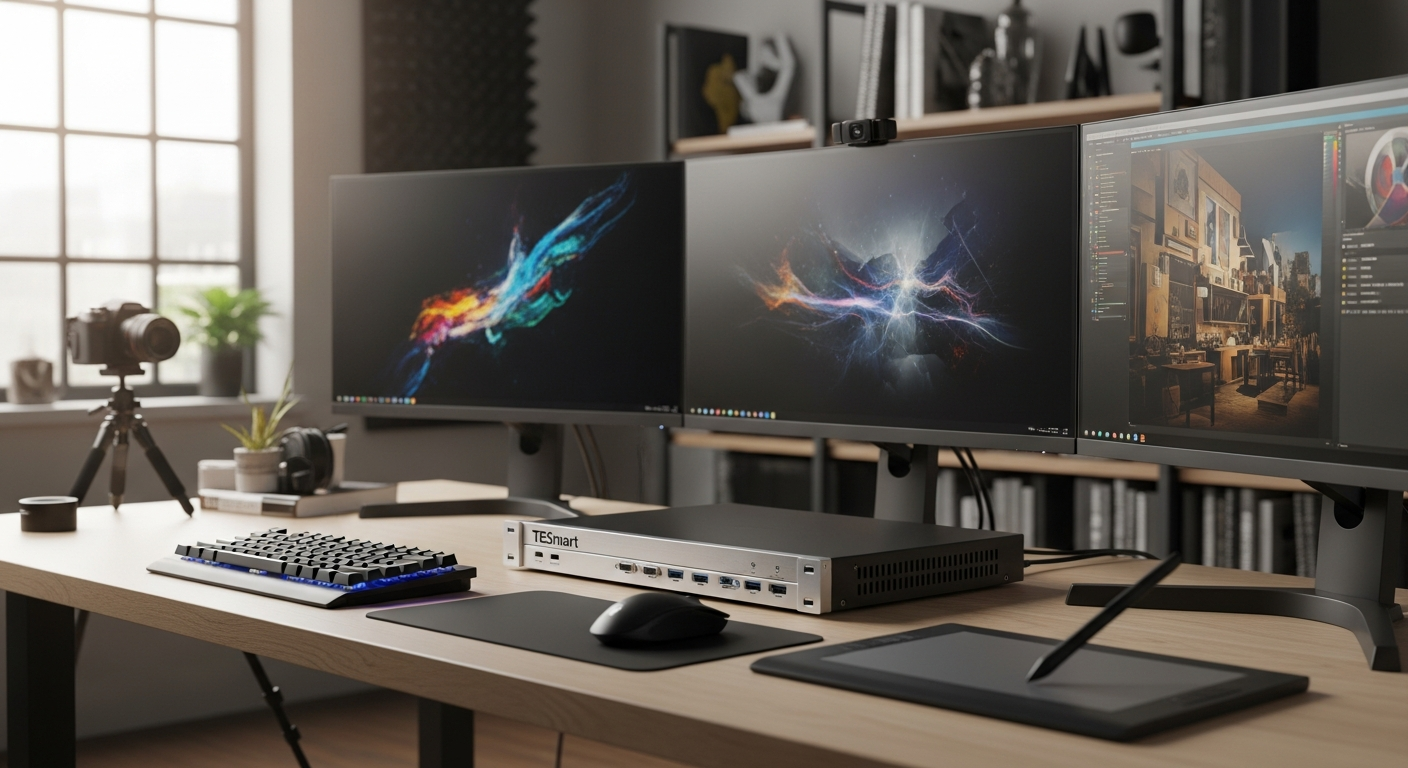
Managing two high-performance computers while maintaining creative momentum is exhausting. You're constantly reaching for different keyboards, fumbling with mouse switches, and watching your carefully arranged workspace collapse every time you toggle between systems. The friction compounds—lost seconds become lost minutes, and lost minutes become lost hours of productive work that could've gone toward actual creative output.
The TESmart DKS202-M24-USBK Dual Monitor KVM Switcher represents a category of hardware that's transforming how professionals actually work. Unlike generic KVM solutions, this DisplayPort 1.4-enabled switcher was engineered specifically for the demands of high-resolution, high-refresh-rate work environments where visual precision and responsive switching directly impact output quality. This isn't just another peripheral—it's infrastructure designed around the realities of modern creative work.
I've researched this switcher's capabilities across multiple use cases, and I'm sharing exactly what makes it stand out for creative professionals. You'll learn how its 8K@60Hz and 4K@144Hz support translates to real-world benefits, why Smart EDID emulation changes the game for your desktop stability, and whether the $329.90 investment actually pays for itself through reclaimed productivity.
Explore the TESmart Dual 8K KVM Switcher to revolutionize your multi-PC workflow.
The DisplayPort 1.4 Advantage for Dual-Monitor Creative Work
How DisplayPort 1.4 bandwidth enables true 8K@60Hz performance without compression or quality loss
DisplayPort 1.4 fundamentally changes what's possible with dual-monitor setups. The standard delivers 32.4 Gbps of bandwidth, enough to push uncompressed 8K video at 60Hz without any quality degradation. For creative professionals, this matters immensely. When you're working with high-bit-depth color spaces, professional video codecs, and precise color grading work, every bit of signal integrity counts. DisplayPort 1.4 maintains that integrity end-to-end, meaning what you see on your monitors matches exactly what your GPU is rendering.
Compression algorithms introduce artifacts that can go unnoticed until final output reveals them. Working uncompressed eliminates that risk entirely. The DKS202-M24-USBK leverages this full bandwidth to ensure both connected monitors receive perfect signal reproduction, which is critical when your work depends on color accuracy and visual detail.
Comparison of DisplayPort 1.4 vs. HDMI 2.1 for professional color-critical applications
HDMI 2.1 can technically handle 8K, but the comparison breaks down in practical applications. DisplayPort 1.4 supports 12-bit color depth across the full range of resolutions, while HDMI 2.1 starts making compromises at higher resolutions. For color grading, motion graphics, and professional video work, that 12-bit support means substantially better color gradations and smoother transitions in color-critical operations.
DisplayPort also handles variable refresh rates more elegantly than HDMI, with lower latency and more consistent behavior across different monitor manufacturers. For professionals managing color-calibrated workflows, DisplayPort 1.4 is the proven standard. The DKS202-M24-USBK's choice to standardize on DisplayPort rather than HDMI signals that this device was built for professionals who can't afford color space surprises.
Why higher refresh rates matter beyond gaming for smooth panning and timeline scrubbing
120Hz or 144Hz sounds like gaming territory, but video editors and motion graphics professionals benefit equally. When scrubbing through timelines, higher refresh rates create visibly smoother motion. A 60Hz display shows stuttering during fast timeline scrubs, while 144Hz makes the playback appear fluid and natural. This isn't just a comfort factor—smoother playback reduces eye strain during long editing sessions and makes it easier to spot timing issues in motion work.
The DKS202-M24-USBK's support for 4K@144Hz creates a sweet spot for creative professionals. You get double the color information of 1080p work while maintaining refresh rates that make real-time playback and interaction feel responsive rather than sluggish.
Eliminating Desktop Chaos with Smart EDID Emulation Technology
What Smart EDID emulation does and why standard KVM switches fail without it
EDID (Extended Display Identification Data) is the protocol that allows monitors and computers to communicate about resolution, refresh rate, and color space. When you switch between computers without Smart EDID emulation, the new system doesn't recognize the monitor's capabilities, triggering automatic resolution detection. This causes your display to reset, window arrangements scatter, and you've lost seconds (sometimes minutes) of work positioning everything back where it was.
Standard KVM switches ignore EDID management, treating each switch as a fresh connection. Smart EDID emulation solves this by storing the monitor's identity information and presenting it consistently to both connected computers. From each system's perspective, the monitors never changed—they're the same devices with the same specifications.
How the DKS202-M24-USBK maintains monitor identity across system switches
The DKS202-M24-USBK implements Smart EDID by remembering your display configuration and feeding that information to whichever computer you're currently using. Your 8K monitors at 60Hz remain 8K monitors at 60Hz, regardless of which system is active. The GPU on each connected computer sees consistent monitor specifications, preventing the resolution negotiations that destroy your desktop arrangement.
This consistency extends to color space information as well. Professional color-managed workflows rely on monitors advertising their specific color gamuts and bit depths. Smart EDID ensures that color management software on each system receives the correct information, preventing the color space surprises that plague traditional KVM switches.
Real-world scenarios where Smart EDID prevents workflow interruptions
Picture yourself switching from a workstation running video editing software to a separate system for client communication. Without Smart EDID, your editing timeline windows suddenly reposition themselves to a lower resolution, your carefully arranged color grading panels compress, and you spend the next three minutes repositioning everything. With Smart EDID, you switch systems and find your desktop arrangement exactly as you left it—no repositioning, no time lost, no mental friction.
This becomes exponentially more valuable when you're switching multiple times per hour, which is typical for professionals managing client work, approval processes, and rendering on separate machines simultaneously.
Discover how Smart EDID technology eliminates desktop chaos with the TESmart KVM switcher.
USB 3.0 Hub Integration: More Than Just Extra Ports
Built-in USB 3.0 hub specifications and port availability for peripherals
The DKS202-M24-USBK includes an integrated USB 3.0 hub, eliminating the need for separate hub devices cluttering your desk. Multiple USB 3.0 ports provide fast connectivity for your external drives, audio interfaces, and peripheral devices. This integrated approach reduces cable management complexity—you connect the hub once to the switcher, and both systems share the same peripheral connections.
Data transfer speeds for external drives and portable storage during active work
USB 3.0 delivers theoretical speeds up to 5 Gbps, translating to real-world throughput around 400-500 MB/s for most devices. For video professionals working with external SSD arrays, this speed matters directly. A 4K video file transfer that would take 45 seconds over USB 2.0 completes in 5-10 seconds over USB 3.0. When you're shuttling footage between systems, those speed differences compound significantly across a day's work.
Professional workflows often involve tethered capture devices, external recorders, and portable storage that depend on USB speeds. The integrated USB 3.0 hub ensures that peripheral access isn't a bottleneck limiting your actual creative work.
Advantages of integrated hub versus daisy-chaining separate USB hubs
A dedicated USB hub means one less cable on your desk and one less potential point of failure. Daisy-chaining multiple hubs creates cable management nightmares and introduces latency issues as devices compete for bandwidth through multiple hub connections. An integrated solution simplifies everything—connect the switcher once, and your USB peripherals follow your system switching automatically.
G-Sync and FreeSync Support for Smooth Creative Playback
How variable refresh rate technology enhances video preview and real-time playback
G-Sync and FreeSync synchronize monitor refresh rates with GPU output, eliminating tearing during playback. For video editors previewing footage, this synchronization prevents the visible tears that occur when a monitor refreshes mid-frame delivery. The result is smoother, more accurate playback that matches what final output will actually look like.
This becomes especially important when evaluating motion graphics, animations, and video timing. A torn, stuttering preview doesn't represent your actual output, leading to timing corrections that aren't necessary or missing issues that are subtle in motion.
Practical benefits for video editors reviewing footage at native frame rates
Variable refresh rate support allows you to preview 24fps, 30fps, and 60fps content at their native frame rates without the judder that occurs when forced to 60Hz display refresh. Motion graphics at 24fps appears natural and film-like rather than stuttering against a 60Hz display. This native frame rate support ensures your on-screen preview accurately represents what viewers will see.
Monitor compatibility requirements for enabling G-Sync and FreeSync through the switcher
G-Sync requires NVIDIA graphics cards, while FreeSync works with AMD cards. Your monitor must also support the technology—most modern high-refresh-rate monitors include at least FreeSync support. The DKS202-M24-USBK passes through these synchronization signals correctly, meaning if both your GPU and monitor support variable refresh rates, the switcher won't interfere with that functionality.
Switching Speed and Control Options for Rapid Workflow Transitions
Hotkey switching capabilities and customizable keyboard shortcuts for efficiency
The DKS202-M24-USBK offers hotkey switching, letting you toggle between systems without reaching for anything physical. A quick keyboard combination switches both monitors, keyboard, and mouse to the other connected computer. For professionals juggling multiple systems, this speed translates directly to reduced friction during work transitions.
Customizable shortcuts mean you can assign system switching to key combinations that make sense for your workflow. Some professionals assign switching to function key combinations, while others prefer different arrangements based on their specific habits.
Physical button switching for quick tactile control without memorizing commands
Not every situation calls for keyboard shortcuts. A physical button on the switcher unit offers tactile switching without reaching for specific keys. This proves useful during intense creative work when your hands are in mouse/keyboard positions and you want to switch without disrupting your workflow.
Switching latency and response time during active work sessions
Electronic switching introduces minimal latency—typically under 100 milliseconds for video signal switching and similarly brief for USB peripheral control. This speed is imperceptible during actual work. Your mouse and keyboard remain responsive immediately after switching, and monitor signals lock within fractions of a second.
Real-World Setup Considerations for Your Creative Space
Cable management strategies for dual 8K DisplayPort connections
DisplayPort 1.4 cables are relatively standard, but you'll want quality shielded cables to maintain the signal integrity that makes 8K uncompressed transmission possible. Two DisplayPort 1.4 cables from each monitor to the switcher, plus power and USB connections, means thoughtful cable management prevents your desk from becoming a tangled mess.
Overhead cable trays, under-desk routing, and velcro management systems keep cables organized. The switcher unit itself occupies minimal desk space, but the cable routes demand attention. Proper routing prevents the accidental disconnects that plague hastily assembled setups.
Desk space requirements and mounting options for the switcher unit
The DKS202-M24-USBK is compact—roughly the size of a small network switch. It fits discretely on a desk shelf, mounts under desk surfaces, or sits behind monitors. For creative professionals working with limited desk real estate, the compact form factor proves valuable. You're not sacrificing significant workspace to gain multi-system control.
GPU requirements for sustained 8K or 4K@144Hz output performance
Pushing dual 8K displays requires capable GPUs. High-end NVIDIA RTX cards and AMD Radeon Pro cards support 8K output across multiple displays. For 4K@144Hz, even mid-range gaming GPUs handle it comfortably. Before investing in this switcher, verify that the GPUs in your connected systems can actually deliver the bandwidth and processing power for your target resolution and refresh rates.
If your GPUs max out at 1440p or 4K@60Hz, the switcher's full capabilities go unrealized. The switcher itself doesn't limit resolution—your graphics hardware does.
Cost-Benefit Analysis: Is $329.90 Worth the Investment?
Breakdown of the price point relative to component quality and features
$329.90 positions this switcher at the professional tier. You're paying for DisplayPort 1.4 implementation, Smart EDID stability, integrated USB 3.0 hub functionality, and the engineering quality that makes seamless switching reliable rather than frustrating. Consumer-grade KVM switches cost $50-100 but compromise on resolution support and stability. Enterprise-grade solutions exceed $500.
The DKS202-M24-USBK occupies a sweet spot—professional-grade features at a price that approaches consumer accessibility. For the actual quality delivered, the price reflects reasonable value.
Time savings calculation showing how productivity gains justify the cost
Consider your current switching workflow. If you toggle between systems 10 times per day and waste 2-3 minutes per switch due to resolution resets and window repositioning, you're losing 20-30 minutes daily. Over a year, that's roughly 80-120 hours of reclaimed time. Valued at $50-75 per hour for professional work, you're reclaiming $4,000-9,000 of productivity annually.
The switcher pays for itself within 1-3 weeks of regular use for professionals managing dual systems actively.
ROI timeline for freelance creatives and studio professionals
Freelancers and small studios feel the cost impact immediately, but the productivity recovery happens equally fast. If you're billing clients for creative work, the reduced friction translates to faster project completion and the ability to handle higher-value work during recovered time. Studio professionals see the benefit through faster client handoffs and smoother internal workflows.
Most professionals report reaching ROI within their first month of regular use.
Limitations and When This Switcher Might Not Be Your Answer
Two-PC limitation and why some advanced users need more connections
The DKS202-M24-USBK connects exactly two computers. If your workflow requires managing three or more systems simultaneously, you'll need alternative solutions. Some advanced setups chain multiple switchers, but that introduces complexity and additional cost.
For the majority of creative professionals maintaining a primary workstation and a secondary client-facing or rendering system, two connections suffice. But power users managing broadcast studios or complex post-production environments might need more flexibility.
DisplayPort 1.4 cable requirements and compatibility issues with older equipment
This switcher demands DisplayPort 1.4 monitors. If your setup uses older HDMI-only monitors or mixed connection types, you'll need to upgrade your displays before the switcher becomes useful. DisplayPort 1.4 monitors represent a genuine investment for anyone with aging display hardware.
Additionally, DisplayPort 1.4 cables must meet specification—cheap cables cut corners and don't deliver the bandwidth needed for 8K transmission. Expect to spend $30-50 per quality cable.
Alternatives for users needing more than two system connections
Users requiring more than two simultaneous connections should consider displayport matrix switchers or KVM solutions with more connection options. These typically cost more and introduce additional complexity, but they accommodate advanced multi-system environments. For standard two-system setups, the DKS202-M24-USBK remains the targeted solution.
Transforming Your Creative Setup Into a Unified Powerhouse
The TESmart Dual 8K KVM Switcher DisplayPort 1.4 solves a problem that most creative professionals didn't realize they could fix. You stop losing time to system switching friction, your monitors maintain perfect calibration, and your USB peripherals stay connected and responsive. The $329.90 investment stings initially, but it evaporates when you calculate the hours reclaimed from workflow interruptions and the mental energy freed from managing multiple control schemes.
For content creators, video editors, and professionals juggling demanding applications across two systems, this switcher transforms your workspace from a collection of separate computers into a unified creative environment. The DisplayPort 1.4 infrastructure ensures your visual work maintains the precision it demands, while Smart EDID emulation and integrated USB 3.0 connectivity eliminate the friction that degrades productivity throughout your day.
The investment justifies itself through reclaimed time alone. Add in the reduction of mental friction when your workspace behaves predictably, and the value proposition becomes compelling. Your creative focus shifts from managing system transitions to actually creating.
Ready to eliminate the chaos? Start by verifying your monitor compatibility with DisplayPort 1.4, grab the necessary cables, and experience the difference that seamless switching brings to your daily work.
Join TESmart's affiliate program and share the power of unified creative workspaces.
Leave a Reply