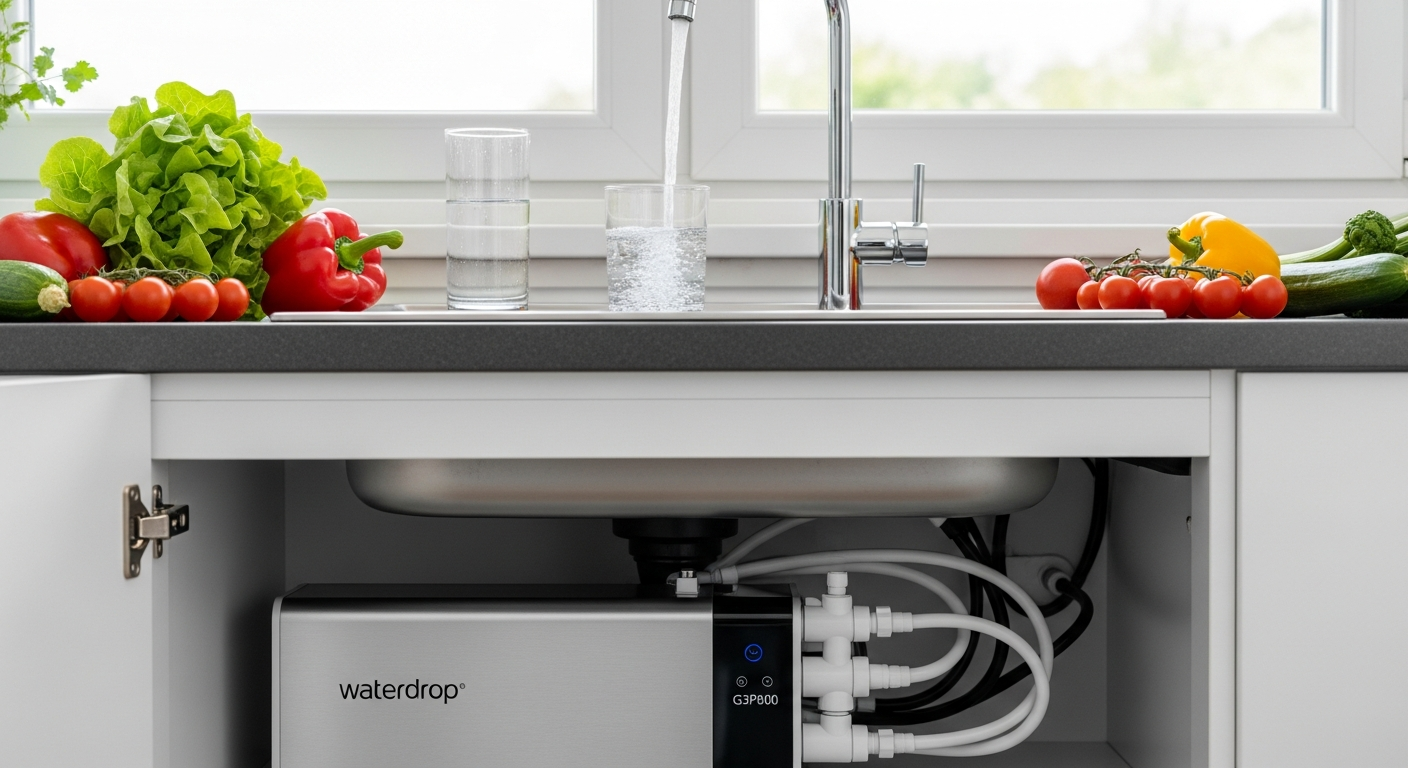
Most American households waste over 50 gallons of water daily through outdated filtration methods, and that’s before factoring in the time spent waiting for purified water to dispense. Traditional tank-based reverse osmosis systems occupy precious under-sink cabinet space while delivering water at a glacial pace, forcing families to plan ahead or resort to bottled water for convenience. The Waterdrop G3P800 represents a significant shift in premium water filtration, combining lightning-fast 800 GPD flow, space-saving tankless design, and intelligent monitoring features into a single integrated system.
This guide breaks down everything homeowners need to know about the G3P800, including its 10-stage filtration architecture, real-world performance metrics, true cost of ownership, and whether this $700-$1,000 investment makes sense for household water quality needs.
Explore the Waterdrop G3P800 and transform your water filtration today.
How Traditional Tank-Based Systems Limit Kitchen Functionality and Waste Water
Conventional reverse osmosis systems with storage tanks demand 12 to 24 inches of vertical under-sink space. This requirement eliminates room for cleaning supplies, trash bins, or basic kitchen organization. Worse, tank-based systems maintain a constant reserve of filtered water, meaning the water sitting in the tank degrades in quality over time. Users face a frustrating choice: wait for the tank to refill (often 2-4 hours for depleted tanks) or return to bottled water.
Tank-based systems also suffer from inherent inefficiency. Most older models operate on a 1:1 or 2:1 pure-to-drain ratio, meaning they waste significant water for every gallon produced. Families with hard water or higher contamination loads experience even worse waste ratios, translating to hundreds of extra gallons lost monthly.
The Compact Footprint Advantage: Reclaiming 12+ Inches of Under-Sink Cabinet Space
Tankless systems like the G3P800 fundamentally change the equation. By eliminating the bulky storage tank, these units occupy roughly the footprint of a small printer or router. The G3P800 measures approximately 18.11 inches long by 5.67 inches wide by 17.72 inches high—dimensions that fit neatly alongside existing plumbing without monopolizing cabinet real estate.
This space recovery transforms kitchen organization. Homeowners regain room for trash cans, cleaning supplies, and everyday items that previously required alternative storage. The psychological benefit matters too: a clean, uncluttered cabinet space contributes to overall kitchen satisfaction.
On-Demand Water Delivery Without the Wait—The Psychology of Instant Access
Speed changes behavior. When filtered water arrives in five seconds, families actually use it. They fill water bottles for the gym, prepare cooking water instantly, and ensure children drink filtered water instead of tap. The psychological shift from “waiting for the system to produce water” to “water is always ready” fundamentally changes household habits toward healthier hydration patterns.
Instant access eliminates the planning burden associated with tank-based systems. There’s no checking whether the reserve tank has capacity or calculating when the next refill might complete. This convenience factor, while seemingly minor, compounds across thousands of daily interactions over the system’s lifespan.
Unpacking the G3P800’s 10-Stage Filtration Architecture
Breaking Down Each Filtration Stage and What Contaminants It Targets
The G3P800 employs a multi-stage approach distributed across three cartridges. Early stages capture sediment, chlorine, and chloramines—the visible and invisible substances that affect taste and odor. Subsequent stages target specific contaminant categories: heavy metals in one stage, chemical compounds in another, and organic materials in yet another.
This stacked approach allows each stage to perform its specialized function without becoming overwhelmed. Rather than forcing a single filter to remove everything (which reduces effectiveness and shortens cartridge lifespan), the G3P800 distributes the workload across stages optimized for specific contaminant types.
The 0.0001 µm RO Membrane: How Ultra-Fine Filtration Removes 99% of Impurities
The core filtration stage employs a reverse osmosis membrane with a pore size of 0.0001 micrometers. For perspective, this pore size is approximately 5,000 times smaller than a human hair. At this scale, the membrane blocks virtually everything except water molecules themselves.
This ultra-fine filtration removes dissolved solids, ions, bacteria, viruses, and most organic compounds. The membrane operates through osmotic pressure principles: pressurized water forces molecules through the membrane while larger contaminants remain behind and drain away. The result is water so pure it requires remineralization consideration—a topic addressed in detail below.
Lead, Arsenic, PFAS, and Heavy Metals—What the NSF/ANSI Certifications Actually Guarantee
The G3P800 holds NSF/ANSI certifications 42, 53, 58, and 372—credentials verified by IAPMO R&T (an independent testing authority). These certifications represent third-party validation of specific contaminant reduction claims:
- NSF/ANSI 42 confirms reduction of chlorine and taste/odor issues
- NSF/ANSI 53 validates removal of health-related contaminants including lead, cryptosporidium, and giardia
- NSF/ANSI 58 specifically certifies reverse osmosis performance standards
- NSF/ANSI 372 ensures lead-free materials throughout the system
These certifications mean the G3P800 has undergone rigorous laboratory testing. Manufacturers cannot claim lead removal, arsenic reduction, or PFAS filtration without documented evidence. The certifications provide assurance that performance claims rest on verified test results, not marketing optimism.
The 800 GPD Flow Rate Explained: Real-World Performance
What 800 Gallons Per Day Means for Your Family’s Actual Water Consumption
Eight hundred gallons per day sounds substantial until converted to hourly or per-cup metrics. Eight hundred GPD equals approximately 33 gallons per hour or 0.55 gallons per minute during active operation. For household use, this translates to approximately 3.2 gallons per person daily—sufficient for typical drinking and cooking needs in a family of four.
Real-world consumption patterns matter more than daily totals. Most households concentrate filtered water usage in morning hours (coffee, breakfast) and evening hours (cooking dinner, evening beverages). The G3P800’s 800 GPD capacity handles peak demand periods without requiring the storage tank that traditional systems depend upon.
Five-Second Cup Fill Times: How Fast Water Production Improves Daily Convenience
The G3P800 fills a standard cup (approximately 8 ounces) in roughly five seconds. This speed eliminates the “waiting game” associated with older systems. Users can fill water bottles without planning ahead, refill cooking pots instantly, and satisfy children’s requests immediately.
The five-second metric reveals something important: the system maintains constant output pressure. There’s no initial delay while pressure builds or flow ramps up. This consistency creates seamless user experience across morning rushes, cooking sessions, and evening routines.
Comparing GPD Ratings Across Competitor Models and Why Higher Isn’t Always Necessary
The premium reverse osmosis market includes models rated at 600 GPD, 800 GPD, and 1,000+ GPD. Higher ratings come with larger equipment footprints, greater energy consumption, and increased costs. The critical question: do households need the extra capacity?
For most families, 800 GPD represents the practical optimum. It exceeds average household demand (typically 75-150 gallons daily for filtered water applications) while maintaining a compact footprint. Systems rated above 1,000 GPD serve primarily commercial or large-household applications where multiple simultaneous water draws occur. The G3P800 balances capacity against practicality.
Water Efficiency and the 3:1 Pure-to-Drain Ratio
Understanding Waste Water Ratios and Their Environmental Impact
Reverse osmosis systems inherently produce wastewater. The process pressurizes water to force molecules through the ultra-fine membrane. Contaminants unable to pass through the membrane exit as concentrated brine or “drain water.” The pure-to-drain ratio measures how much filtered water the system produces compared to how much water exits as waste.
A 3:1 ratio means the G3P800 produces three gallons of filtered water for every one gallon of waste. This efficiency dramatically reduces environmental impact compared to earlier RO generations that operated at 1:1 or 2:1 ratios—systems that wasted as much water as they purified.
How the G3P800’s Efficiency Compares to Older RO Systems (Often 1:1 or 2:1 Ratios)
Older reverse osmosis systems operated at approximately 1:1 or 2:1 ratios. A 1:1 system wasted one gallon for every gallon filtered—a fifty percent waste rate that alarmed environmentally conscious homeowners. A 2:1 system performed better but still discarded significant water.
The G3P800’s 3:1 ratio represents genuine advancement. Instead of wasting 50 percent or more of incoming water, the system wastes only 25 percent. Over months and years, this efficiency difference translates to thousands of gallons conserved—water savings that reduce environmental impact while lowering utility costs.
Calculating Monthly Water Waste and Its Effect on Utility Bills
Consider a household that uses 100 gallons of filtered water monthly. With a 3:1 ratio, the G3P800 produces 100 gallons of pure water while generating approximately 33 gallons of drain water. Total water consumption: 133 gallons.
With a 1:1 ratio system, that same 100 gallons of filtered water would generate 100 gallons of waste—200 gallons total consumption. The difference of 67 gallons monthly compounds across a year: nearly 800 additional gallons wasted. At typical municipal water rates ($0.01-0.02 per gallon), this represents $8-16 in annual utility costs alone. Water conservation agencies in drought-prone regions often provide rebates specifically for high-efficiency RO systems, potentially offsetting initial purchase costs.
Discover how the Waterdrop G3P800’s superior water efficiency saves resources and money.
Smart Monitoring Features That Actually Simplify Maintenance
Real-Time TDS (Total Dissolved Solids) Meter Functionality and What the Numbers Mean
The G3P800’s smart faucet incorporates a built-in TDS meter—a sensor that measures dissolved solids concentration in real-time. TDS represents the total amount of minerals and contaminants present in water, measured in parts per million (ppm). Lower TDS numbers indicate purer water.
Tap water typically registers 200-500 ppm depending on local water conditions. The G3P800’s RO stage reduces this to approximately 10-50 ppm. When filter performance degrades, TDS readings climb, providing early warning that replacement is approaching. Users can literally watch purification effectiveness on the faucet display—transparency that builds confidence in system operation.
Filter Life Indicators and How They Prevent Premature Replacement or System Damage
The smart monitoring system tracks filter usage patterns and predicts remaining cartridge lifespan. Rather than guessing when filters need replacement, users receive specific guidance: “Filter life remaining: 45% capacity” or “Replace filter in approximately 6 weeks.”
This precision prevents both premature replacement (wasting money on cartridges with remaining effectiveness) and overuse (allowing contaminant accumulation if filters remain installed too long). The system balances cost efficiency against water quality assurance, eliminating the guesswork that frustrates users of simpler systems.
Receiving Alerts Before Filters Need Changing—Reducing Guesswork and Water Quality Risks
The G3P800’s smart faucet can alert users when filter replacement approaches. Some versions integrate with mobile apps providing notifications and maintenance reminders. This proactive approach ensures users never operate the system with degraded filtration capacity unknowingly.
Alerts reduce water quality risks inherent in systems without monitoring. A family using older RO equipment might operate for months with declining filtration effectiveness, unaware that purification capacity has deteriorated. The G3P800’s transparent monitoring prevents this scenario entirely.
Installation Realities: DIY Versus Professional Setup
Step-by-Step Overview of What the Installation Process Involves
The G3P800 installation process requires four primary steps: (1) shutoff the main water supply or isolate the branch serving the kitchen sink, (2) connect the system’s input line to the cold water supply using the provided tee valve, (3) position the unit under the sink on a sturdy, level surface, and (4) connect the drain line to the existing sink drain or separate drain outlet.
The process also involves faucet installation at the sink itself. The new faucet replaces the standard supply line, requiring drilling through the sink deck if not already configured for filtered water dispensing. Finally, cartridge installation completes setup—operators insert the pre-assembled filter cartridges into the housing following manufacturer guidance.
Tools and Plumbing Knowledge Required for Successful Under-Sink Installation
Basic hand tools suffice for most installations: adjustable wrench, bucket (for water capture), and potentially a drill if faucet installation requires new mounting. The instruction manual provides specific torque specifications for connections, preventing over-tightening that damages components.
Plumbing knowledge requirements remain minimal. Users need familiarity with shutoff valves, ability to connect threaded fittings (torquing appropriately without excessive force), and basic understanding of gravity drain flow. These skills fall within typical homeowner capability ranges, though plumbing experience certainly eases the process.
Common Installation Mistakes That Lead to Leaks or Reduced Performance
Improper cartridge installation ranks among the most common mistakes. The filter cartridges require specific seating and O-ring positioning. Cartridges inserted incorrectly don’t seal properly, causing water to bypass filtration entirely or creating minor leaks visible only after initial operation.
Inadequate shutoff valve closure before installation causes water spills and system damage. Users sometimes assume a shutoff valve is functioning when mineral buildup or debris prevents complete closure. Testing the shutoff valve before disconnecting existing plumbing prevents water damage scenarios.
Over-tightening connection fittings represents another frequent error. Homeowners may assume tighter equals safer, but reverse osmosis system connections use specific torque specifications. Over-tightening cracks plastic fittings or strips threaded connections, resulting in persistent leaks. The instruction manual provides torque values for this reason.
The True Cost of Ownership Beyond the Purchase Price
Initial Investment Breakdown: Unit Cost Plus Installation Expenses
The G3P800 system itself retails for $700-$1,000, with typical pricing around $786.99. This represents the hardware cost. Installation expenses vary based on existing plumbing configuration and whether professional assistance becomes necessary.
Professional installation typically runs $200-$500, depending on plumber rates and site-specific complications. DIY installation eliminates this cost but requires time investment and carries risk of costly mistakes (water damage, improper connections affecting performance). Many homeowners find professional installation worthwhile despite the expense, trading cost for certainty of correct operation.
Replacement Filter Expenses and How Often Cartridges Need Changing
The G3P800 employs three filter cartridges requiring periodic replacement. Manufacturer guidance suggests replacement approximately every 12 months or when TDS readings indicate degraded performance. Actual replacement frequency depends on incoming water quality and household consumption patterns.
Replacement cartridge sets cost $150-$250 per complete set. Operating costs therefore amount to $150-$250 annually for filters alone. Some retailers offer subscription services providing automatic cartridge shipments at discounted rates, reducing per-cartridge expenses.
Comparing Total Cost of Ownership to Bottled Water or Pitcher-Based Systems
A family purchasing bottled water at typical retail prices ($1.50-$3.00 per gallon) spends $1,500-$3,600 annually for roughly 100 gallons per month. Pitcher-based filtration systems reduce this cost but provide lower quality water and require frequent replacement (monthly to quarterly) at $10-$15 per cartridge.
The G3P800’s combined first-year cost (system purchase + installation + one filter replacement cycle) totals roughly $1,000-$1,500. Subsequent years require only filter replacements ($150-$250 annually). This investment breaks even with bottled water consumption within 6-12 months for families currently purchasing premium water products.
Contaminant Removal Specifics: What Gets Filtered Out
Chlorine and Chloramines—Taste and Odor Improvement
Municipal water treatment adds chlorine and chloramines to prevent bacterial contamination during distribution. These chemicals serve important public health functions but create obvious taste and odor problems. Many users describe chlorinated water as smelling like swimming pools or having a chemical bite that obscures natural water taste.
The G3P800’s early filtration stages target chlorine and chloramines specifically. These contaminants are among the easiest to remove, requiring basic activated carbon filtration. Users notice immediate sensory improvement: water tastes clean and refreshing rather than chemical. This taste improvement alone drives satisfaction for many owners.
Heavy Metals Including Lead, Cadmium, and Chromium Reduction Rates
Heavy metal contamination presents more serious health concerns than chlorine. Lead exposure damages neurological development in children, while cadmium and chromium accumulation creates chronic disease risks. Municipal water treatment removes some lead, but older infrastructure introduces additional contamination through corroded pipes.
The G3P800’s reverse osmosis membrane removes lead, cadmium, chromium, and other heavy metals with 95%+ efficiency. NSF/ANSI 53 certification specifically validates lead removal to standards protecting public health. Families using well water or living in areas with aging infrastructure see particularly significant benefits from this heavy metal reduction capability.
Fluoride Removal and Considerations for Families with Specific Health Concerns
Fluoride presents a more nuanced contaminant discussion. Municipal systems add fluoride to promote dental health, with decades of evidence supporting this public health benefit. However, some families prefer to control fluoride exposure independently, particularly those with fluoride concerns or preference for natural mineral supplementation.
The G3P800’s RO membrane removes approximately 90% of fluoride, though some fluoride may remain depending on incoming concentration. This partial removal addresses concerns without complete fluoride elimination. Families with strong preferences regarding fluoride levels should test their specific water source and resulting product water to understand actual removal rates.
Addressing the Mineral Removal Trade-Off
Why RO Systems Remove Beneficial Minerals Along with Contaminants
The G3P800’s 0.0001 µm membrane cannot distinguish between harmful contaminants and beneficial minerals like calcium and magnesium. The physical filtration process removes both indiscriminately. This aggressive purification delivers exceptionally clean water but eliminates mineral content that contributes to water taste and some nutritional benefit.
Traditional water sources naturally contain minerals providing subtle flavor notes and contributing trace minerals to diet. Ultra-pure water lacks these characteristics, which some users describe as “flat” or “empty” tasting. This trade-off represents the practical cost of removing dangerous contaminants alongside minerals.
The Flat Taste Phenomenon and How It Affects User Satisfaction
Some users report that ultra-pure water tastes noticeably different—often described as lacking character or seeming bland compared to their previous water source. This subjective experience varies significantly among individuals. Some immediately notice the difference while others detect no perceptible change.
The flat taste phenomenon doesn’t indicate system malfunction. It reflects the absence of minerals rather than contamination or quality issues. User adjustment typically occurs within weeks as palates acclimate to the new water profile. Many families find the trade-off acceptable given the health and safety benefits of contaminant removal.
Optional Remineralization Filters: Cost, Effectiveness, and Installation Complexity
For families concerned about mineral content or preferring subtly mineralized water, separate remineralization cartridges add back calcium and magnesium after reverse osmosis filtration. These optional filters cost $50-$100 and install between the main filtration system and the faucet.
Remineralization filters require occasional replacement (annually or based on usage) similar to primary filters. They add marginal complexity but restore mineral content to levels approximating natural water. Testing both remineralized and non-remineralized water helps families decide whether remineralization justifies added expense and maintenance.
G3P800 Performance in Different Water Conditions
How the System Performs With High-Sediment Well Water
Well water often contains visible sediment, minerals, and organic particles that overwhelm standard filtration systems. The G3P800’s early filtration stages specifically target sediment removal, protecting downstream components including the delicate RO membrane.
In high-sediment conditions, the system’s pre-filters (handling sediment removal) may require more frequent replacement than in municipal water applications. Well water users should budget for potentially higher filter replacement frequency and monitor TDS readings closely. The system handles sediment water effectively but demands closer maintenance attention than municipal water scenarios.
Handling Hard Water Situations and Mineral Buildup Prevention
Hard water—water rich in dissolved calcium and magnesium—presents unique challenges for RO systems. These minerals can accumulate on the RO membrane, reducing efficiency and lifespan. The G3P800’s design includes preventive measures: automatic system flushing cycles that periodically reverse water flow through the membrane, removing accumulated mineral buildup.
Users in hard water areas should monitor TDS readings closely. Increasing TDS despite filter replacement may indicate mineral accumulation on the membrane requiring professional cleaning or early cartridge replacement. Water softening ahead of the RO system represents an optional approach (though this adds cost and complexity), or accepting higher filter replacement frequency as the cost of hard water operation.
Performance in Areas With Agricultural Runoff or Industrial Contamination
Regions experiencing agricultural runoff (pesticides, herbicides, fertilizers) or proximity to industrial operations face more aggressive water contamination profiles. The G3P800’s comprehensive filtration handles these scenarios effectively through its multi-stage architecture.
Users in contaminated water areas should obtain detailed water quality testing before installation. Some contaminants (certain industrial chemicals) may overwhelm standard cartridge capacity, requiring more frequent replacement than typical. However, the RO membrane’s ultra-fine pore size captures virtually all organic compounds and heavy metals that characterize agricultural and industrial contamination.
User Experience: What Real Owners Report
Taste and Odor Improvements Documented in Customer Reviews
Overwhelmingly, G3P800 owners report dramatic taste improvements. The most common comment cluster describes water as “crisp,” “fresh,” and “clean-tasting.” Families note that children drink significantly more water after installation, driven by improved taste. Users also report that beverages prepared with filtered water (coffee, tea, juice) exhibit noticeably better flavor.
Odor elimination represents another consistent theme. Users note that chlorine smell disappears immediately, and faint chemical or metallic odors present in their tap water vanish. This sensory improvement drives day-to-day satisfaction more than abstract contaminant removal statistics. People experience water quality improvement directly through taste and smell.
Reliability Over Extended Use Periods (6 Months to 2+ Years)
Customer reports suggest solid reliability across extended timeframes. Users operating systems for 6-24 months document consistent performance, with flow rate remaining stable and filtration effectiveness (measured by TDS readings) remaining predictable until scheduled filter replacement.
Some users report occasional connection leaks developing over extended operation, typically resolving through simple torque adjustment or cartridge reinstallation. These issues appear relatively rare and address readily without professional service. The overall reliability picture suggests the G3P800 performs dependably across years of operation when properly maintained.
Common Complaints and How Frequently They Occur
The most frequent complaint involves the flat water taste phenomenon discussed previously. Some users find ultra-pure water less satisfying than mineral-containing tap water, though this affects a minority of users.
A smaller complaint cluster mentions decreased flow rate after extended operation. While the 800 GPD rating refers to theoretical maximum, actual household flow (measured in gallons per minute to the faucet) sometimes decreases over time. This typically results from mineral accumulation on the RO membrane rather than cartridge degradation. The automatic flush cycles designed to prevent this don’t eliminate the possibility entirely, particularly in hard water areas.
Installation-related complaints occasionally surface, typically from users who experience minor leaks during DIY installation. These issues usually resolve quickly through proper cartridge seating or connection tightening. Users reporting successful installation rarely cite post-installation problems.
How the G3P800 Stacks Up Against Competitor Systems
Comparing Specifications With Other 800+ GPD Tankless RO Systems
The premium tankless RO market includes several comparable systems rated at 800+ GPD. Competitors like the AquaTru ProMax and similar high-capacity models offer similar flow rates and filtration architecture. The G3P800 distinguishes itself through the 3:1 efficiency ratio—most competitors cluster around 2:1 or 2.5:1.
Filtration stage counts vary across competitors, with some marketing “8-stage” systems while others claim “10-stage.” These stage counts sometimes reflect marketing approach rather than meaningful performance difference (dividing single filtration processes into counted “stages”). The G3P800’s approach to filtration proves effective regardless of how manufacturers count stages.
Price-to-Performance Analysis Across the Premium Filtration Market
At $700-$1,000, the G3P800 occupies the mid-premium price tier. Cheaper tankless RO systems ($400-$600) typically sacrifice either flow rate (600 GPD or less) or efficiency (inferior pure-to-drain ratios), while premium alternatives ($1,200+) add features like smart app integration or bypass remineralization systems rather than fundamental filtration improvements.
The G3P800’s price-to-performance ratio remains competitive within this market segment. Buyers receive flagship-level filtration, high flow rate, and superior efficiency without premium-tier pricing. This balance—strong performance at reasonable cost—partially explains the G3P800’s popularity.
Feature Differentiation: What Makes the G3P800 Unique
The combination of 800 GPD flow, 3:1 efficiency, 10-stage filtration, UV LED sterilization (on applicable models), and built-in TDS monitoring creates a genuinely comprehensive package. Some competitors offer individual features matching the G3P800, but assembling this complete feature set typically costs more.
The smart faucet with real-time TDS monitoring and filter life prediction represents perhaps the strongest differentiator. This transparency into system operation and maintenance timing directly improves user experience and prevents common ownership frustrations. Competitors often require separate monitoring equipment or manual filter tracking, adding complexity.
Taking the Next Step Toward Cleaner, Faster Water
The Waterdrop G3P800 isn’t just another reverse osmosis system—it’s a thoughtful response to real frustrations homeowners face with traditional water filtration. The combination of lightning-fast 800 GPD flow, space-saving tankless design, and intelligent monitoring features creates a genuinely compelling package for families willing to invest in premium water quality. You’re getting certified contaminant removal, impressive water efficiency, and peace of mind knowing exactly what’s in your drinking water.
However, the $700-$1,000 price tag, ongoing filter replacement costs, and mineral removal trade-off deserve honest consideration. The initial investment makes sense only when current water quality or consumption patterns justify the expense. Families currently purchasing bottled water, frustrated by sluggish pitcher-based systems, or dealing with documented contamination concerns find compelling value. Households with already-acceptable tap water may find the investment difficult to justify.
If you’re tired of waiting for filtered water, frustrated by cramped cabinet space, and committed to removing contaminants like lead and PFAS, the G3P800 deserves serious consideration. Start by checking your local water quality report—available free through municipal water authorities—then identify which contaminants concern you most. Compare the G3P800 against competitors in the same price range, evaluating flow rate, efficiency ratings, and monitoring features. The right system solves your specific water problems while fitting your budget and lifestyle.
Start your journey to superior water filtration with the Waterdrop G3P800 today.
Leave a Reply