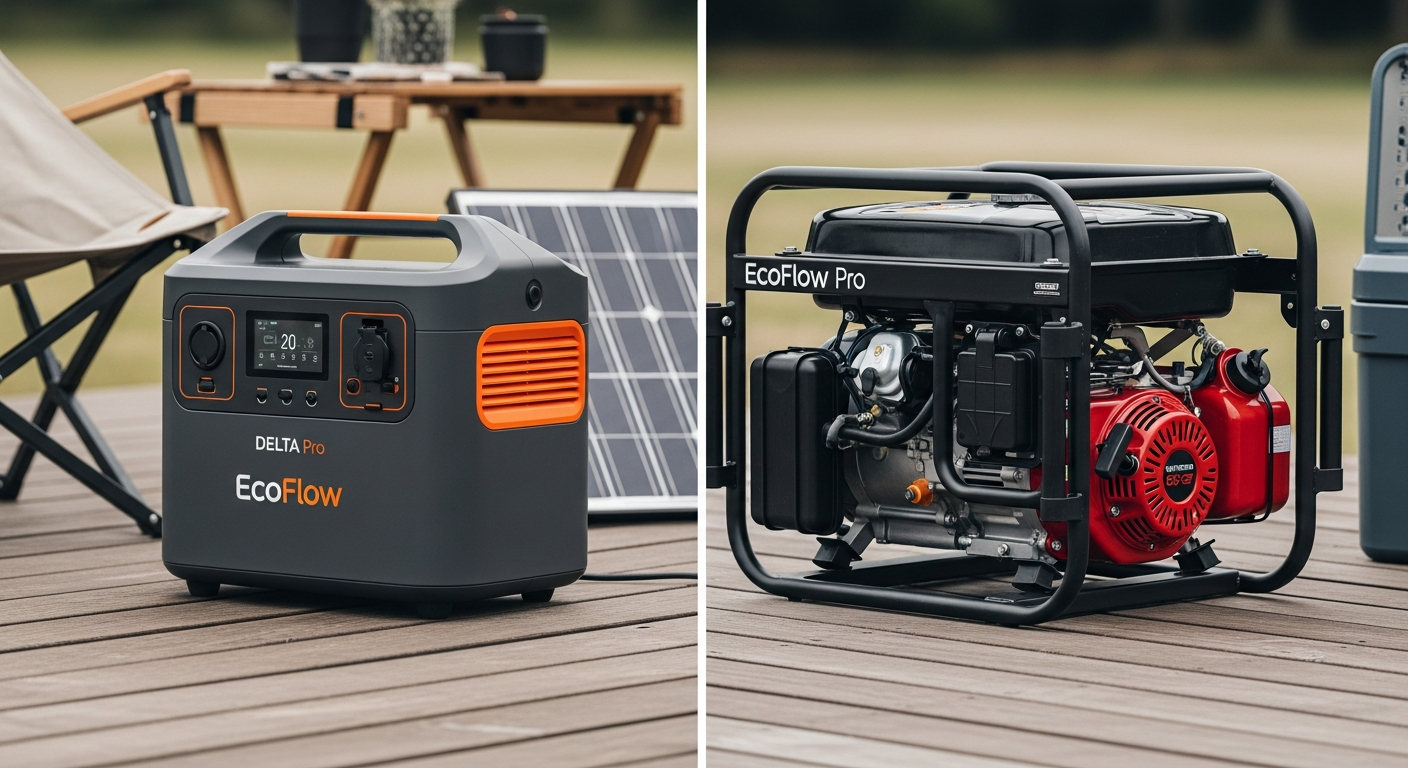
When the power grid fails, most homeowners reach for a diesel generator—loud, expensive, and requiring maintenance that feels like a second job. Yet here's the reality: portable power stations have evolved so dramatically that they're now challenging the generator industry's decades-long dominance. The EcoFlow DELTA Pro represents this shift, and it bridges the gap between portability and serious power output.
With expandable capacity reaching up to 36kWh and the ability to power 99% of household appliances, this isn't your typical camping gadget. It's engineered for homeowners who take energy independence seriously. The unit stands out as one of EcoFlow's most popular and best-selling products, frequently described as a leading solar generator on the market.
Explore the EcoFlow DELTA Pro and discover how it transforms home backup power.
How the EcoFlow DELTA Pro Outperforms Traditional Home Generators
Silent operation capped at 62dB maximum noise completely redefines residential backup power compared to diesel generators roaring at 80-100dB. Neighbors won't even notice your system running. Zero fuel storage requirements eliminate the entire maintenance headache—no oil changes, spark plug replacements, or fuel stabilization routines that consume weekends and dollars.
Instant power delivery without startup time means immediate response during outages. While generators require cranking and warm-up cycles, the DELTA Pro supplies electricity the moment you need it. Indoor-safe operation produces zero carbon monoxide emissions, allowing you to position the unit in your garage, basement, or utility room without ventilation concerns that plague traditional generators.
Scalable power through X-Boost technology expands output to 7200W, while traditional generators deliver fixed wattage regardless of your actual needs. Multiple recharge pathways—solar panels, AC wall outlets, EV charger stations, or smart generators—eliminate fuel-only dependency. You're never stranded waiting for a gas delivery.
Smart home integration through app monitoring and Smart Home Panel compatibility gives you control from your smartphone, something no traditional generator offers. The long operational lifespan of 10+ years with LiFePO4 technology outpaces generator engine degradation that typically requires rebuilds after 5-7 years of use.
Understanding the Expandable Battery Architecture
The base capacity of 3.6kWh handles essential appliances during short outages—refrigerator, lights, communication devices, and small electronics. This foundation provides real power without the full investment required for maximum capacity.
The modular expansion system allows incremental upgrades to 25kWh or 36kWh without replacing the unit. You're not locked into a single purchase decision. Start small, monitor your actual needs, and expand when budget allows or when circumstances demand greater capacity.
LiFePO4 chemistry advantages over standard lithium-ion include superior thermal stability, 3,500+ charge cycles to 80% capacity, and enhanced safety. This battery type won't spontaneously fail or degrade rapidly like older lithium formulations. Parallel battery stacking methodology enables seamless capacity increases without compromising reliability or performance.
The integrated battery management system (BMS) protects against overcharge, overdischarge, and temperature extremes. Warranty implications favor this expandable design—you're not purchasing redundant components when upgrading capacity. The cost-benefit analysis typically favors starting with the base unit and expanding later rather than purchasing full capacity upfront, especially if your power needs remain uncertain.
Real-World Power Delivery: What Actually Runs on the DELTA Pro
Continuous 3600W output powers refrigerators, water heaters, and HVAC systems simultaneously—something many power stations cannot achieve. The surge capacity of 7200W handles motor-start loads from pumps, compressors, and air conditioning units that require temporary power spikes.
240V appliance support emerges when two units combine, enabling electric dryers, ranges, and pool equipment operation. Heavy-duty tool compatibility—table saws, welders, air compressors—becomes possible with X-Boost technology enabling industrial-grade power delivery.
Runtime calculations based on actual wattage consumption matter more than manufacturer estimates. A refrigerator consuming 150W continuously delivers drastically different runtime than peak surge measurements suggest. Inverter efficiency maintains power quality for sensitive electronics and medical equipment, preventing damage from voltage fluctuations.
Real-world testing data consistently shows the DELTA Pro delivers specifications that match advertising, a rarity in the power station market. Users report reliable performance across diverse appliances and load profiles, validating the engineering behind this system.
The 45-Minute Charging Advantage and Its Practical Impact
AC charging speed from 0-80% capacity in 45 minutes reduces downtime between uses dramatically. Traditional generators require fuel sourcing and refueling cycles that consume hours and create logistical headaches. Solar charging integration with compatible EcoFlow panels provides off-grid sustainability, enabling continuous operation without grid dependency.
EV charger compatibility utilizes existing home infrastructure for rapid recharging. If your home already supports electric vehicle charging, you've got the framework for powering the DELTA Pro. Smart generator pairing creates hybrid backup systems combining multiple charge sources for maximum flexibility.
Charging time variables affected by ambient temperature, battery degradation, and input source mean real-world performance differs from lab conditions. Cold weather slows charging; extended battery aging slightly reduces speed; weaker input sources require longer cycles. Practical implications for homeowners managing multiple outages or frequent power disruptions become clear: you can recharge between events without extended waiting periods.
Cost per charge versus ongoing fuel expenses for traditional generators shows the DELTA Pro winning decisively over months and years of operation. No fuel purchases, no storage hassles, no price volatility—just plug in and recharge.
Check current EcoFlow DELTA Pro pricing and bundle options for maximum savings.
Breaking Down the True Cost of Ownership
Initial investment ranges from $1,599 to $2,399 for the base unit. Traditional generators with equivalent power output typically cost $1,200-$1,800, but this ignores ongoing expenses that add hundreds annually.
Bundle pricing analysis including solar panels (approximately $2,129 with a 400W panel) provides context for complete systems. Expandable battery costs when scaling capacity to 25kWh or 36kWh represent optional future investments, not required upfront spending.
The accessory ecosystem—additional batteries, solar panels, charging cables, mounting hardware—enables customization but adds expense. These investments deliver genuine value for permanent installations or serious off-grid setups, not casual power needs.
Maintenance costs approach zero compared to generator servicing, oil changes, and fuel stabilizers that consume $200-$500 annually. Long-term value calculation over the 10+ year lifespan with minimal degradation reveals the DELTA Pro's financial advantage compounds dramatically after year three.
Financing options and payment plans offered by EcoFlow make the investment accessible across different budgets. ROI timeline comparing total cost of ownership to traditional generator replacement cycles—typically every 7-10 years—shows the DELTA Pro becomes financially superior within the first half of its operational life.
Smart Features That Transform Home Backup Strategy
Wi-Fi and Bluetooth connectivity enables remote monitoring from smartphones anywhere in the world. You can check battery levels, power consumption, and system status without approaching the unit.
Real-time power consumption tracking through the dedicated mobile app reveals exactly which appliances consume the most energy. This visibility drives behavior changes and optimization decisions that extend runtime during outages.
Scheduled charging capabilities optimize utility rates and solar production windows. You can program the system to charge during off-peak hours when electricity costs less, or prioritize charging when your solar panels generate maximum power.
Smart Home Panel integration automates whole-home backup power distribution, seamlessly transferring loads during grid failures. You're not manually selecting which circuits receive backup power—the system handles routing intelligently.
Firmware updates continuously improve performance and add features without hardware replacement. EcoFlow regularly enhances capabilities through software, extending the system's relevance across its operational life.
Alerts and notifications warn of low battery, high temperature, or overload conditions before problems escalate. Multi-unit management controls several DELTA Pro units from a single interface, critical for homeowners running expanded capacity through multiple modules.
Data analytics show consumption patterns and identify efficiency improvements, enabling you to stretch runtime further through behavioral adjustments and load management strategies.
The Weight, Size, and Portability Reality Check
The 99-pound mass (45kg) makes true portability limited compared to smaller power stations. This isn't a grab-and-go solution for weekend camping trips. The DELTA Pro demands serious intent and permanent placement consideration.
Dimensions and footprint require dedicated space in basements, garages, or utility rooms. You're not tucking this unit in a closet. Mobility solutions like wheeled carts and handles assist occasional relocation, but expect physical effort involved.
Installation considerations for permanent home integration differ significantly from temporary setup. If you're connecting the Smart Home Panel for whole-home backup, professional electrician assistance ensures safety and code compliance.
Comparison to portable alternatives reveals the trade-off clearly: the DELTA Pro sacrifices casual portability for serious power capacity. If you need genuine on-the-go power for camping, RVing, and job sites, smaller 2-3kWh units serve better despite capacity limitations.
Placement optimization for solar panel proximity and charging infrastructure access matters for long-term performance. The location you choose impacts recharging speed and system reliability.
Noise isolation strategies when operating at high wattage in residential settings help manage the 62dB output, though this remains quieter than any generator alternative.
Reliability and Battery Longevity: The 10-Year Question
LiFePO4 chemistry superiority over standard lithium-ion shows in cycle life and safety metrics. This battery chemistry won't spontaneously degrade or fail prematurely like older formulations.
The 3,500+ charge cycles to 80% capacity translates to real-world lifespan projections. If you charge every other day, you're looking at roughly 20 years of operation before hitting that threshold. Most users will never reach the cycle limit before upgrading to newer technology.
Degradation patterns show realistic performance expectations across years. After five years, expect minimal capacity loss. After seven years, still retaining 95%+ functionality. After ten years, you're still operating reliably at 80% nominal capacity.
Warranty coverage protects against manufacturing defects and premature failure. EcoFlow stands behind this technology with robust warranties, signaling manufacturer confidence in longevity claims.
Environmental factors affecting battery health include temperature extremes, humidity, and storage conditions. Proper placement away from direct sunlight and temperature fluctuations extends lifespan measurably.
Maintenance practices maximizing lifespan involve proper charging protocols and seasonal storage. You're not required to babysit the system, but treating it respectfully yields better long-term results.
Comparison to generator engine longevity shows the DELTA Pro winning convincingly. Generator engines require rebuilds around year 5-7; the DELTA Pro maintains reliability across that entire period with zero intervention.
Replacement battery costs and upgrade paths as technology evolves remain unclear for newer units, but EcoFlow's commitment to backward compatibility suggests reasonable options will emerge.
When the DELTA Pro Falls Short (and What Matters)
Noise generation up to 62dB during high-wattage charging and discharging cycles may concern sensitive neighbors or sleep-disrupted users. It's quiet compared to generators but not silent.
Initial capital requirement creates a barrier to entry for budget-conscious homeowners. The $1,599 minimum investment exceeds many cheaper alternatives, even if long-term value justifies the expense.
Portability limitations affect users needing frequent relocation or true mobility. The 99-pound weight and permanent installation considerations don't match RV or frequent-travel requirements.
Charging dependency on external power sources means you lack fuel independence. Unlike generators, you cannot simply refuel and continue indefinitely. Extended multiday outages with no sun and no grid power eventually drain capacity.
Space requirements for expanded battery modules and solar panel arrays demand real estate. Apartment dwellers and compact-home residents face genuine limitations.
Learning curve for optimizing smart features and app functionality challenges users preferring simplicity. Older generations or non-technical users may find the ecosystem overwhelming.
Ecosystem lock-in with EcoFlow-specific accessories limits third-party flexibility. You're committed to EcoFlow's product roadmap and compatibility decisions.
Realistic runtime limitations exist even at maximum capacity for extended multi-day outages. A 36kWh system powering a typical 3,000-watt average household load delivers roughly 12 hours of operation. Without solar recharging, extended independence requires behavior modifications.
Sizing Your System: Base Unit vs. Expanded Capacity
The single 3.6kWh unit suits essential loads—refrigerator, lights, communication devices, and charging phones. This configuration preserves food, maintains communication, and powers through short outages without expansion.
Expanded 25kWh systems support whole-home backup for 24-48 hour outages. You're running air conditioning, water heating, and kitchen appliances alongside essential devices. This capacity handles most realistic disaster scenarios.
Maximum 36kWh configuration enables multi-day independence for off-grid living. You can operate normally for several days without solar recharging or grid power, approaching true autonomy.
Load assessment methodology calculates actual household power requirements by reviewing electricity bills and understanding peak usage patterns. Most homes average 2,000-3,000 watts during active use, helping you determine necessary capacity.
Redundancy benefits of multiple smaller units provide interesting advantages. Two 3.6kWh units deliver more flexibility than one 7.2kWh unit, allowing you to dedicate different batteries to different circuits and manage failures gracefully.
Scalability advantages starting small and expanding later suit users with uncertain needs. You gain experience with a 3.6kWh system, understand your actual usage, then expand informed by real data rather than speculation.
Future-proofing considerations anticipate growing power needs. If you're planning an electric vehicle purchase or home heating upgrade, factor those loads into capacity decisions.
Regional outage patterns inform optimal capacity decisions. Areas prone to three-day ice storms need more capacity than regions experiencing brief six-hour disruptions.
The EcoFlow Ecosystem: Batteries, Panels, and Accessories
Compatible extra battery modules seamlessly expand capacity without replacing existing equipment. You're not discarding your initial investment to scale upward.
EcoFlow solar panel options in 100W, 200W, and 400W variants provide renewable recharging pathways. The 400W panel offers practical charging speed, adding roughly $500-$650 to total system cost.
Smart Home Panel integration automates backup power distribution, critical for permanent installations. This accessory enables whole-home backup rather than managing individual outlets and extensions.
Charging adapters for car chargers, EV stations, and smart generators extend recharging flexibility beyond standard wall outlets. You're creating a multimodal power architecture.
Portable solar suitcase bundles combine panels and charging controllers, simplifying solar integration. These pre-configured systems reduce decision-making for users newer to solar technology.
Warranty and support across ecosystem components demonstrate manufacturer backing. EcoFlow extends coverage across battery modules, solar panels, and accessories—not just the main unit.
Third-party compatibility and limitations with non-EcoFlow accessories matter for long-term flexibility. You're somewhat locked into the EcoFlow ecosystem, though basic charging standards provide some alternatives.
Future product roadmap and backward compatibility considerations remain unclear for users purchasing today. The company's commitment to existing products suggests reasonable compatibility forward, but guarantees don't exist.
Real Scenarios Where the DELTA Pro Becomes Essential
Extended grid outages lasting days or weeks during ice storms, hurricanes, and wildfires represent the DELTA Pro's perfect use case. You're maintaining household function while neighbors queue at generators and gas stations.
Off-grid homesteads requiring energy independence without traditional utilities benefit dramatically. The expandable architecture scales to support full rural property operations without diesel dependency.
RV and mobile living requiring substantial power for extended trips positions the DELTA Pro as superior to traditional generators. Silent operation and fast recharging capabilities support extended travel without neighbor friction.
Home office power backup ensures uninterrupted work during outages. You're maintaining income during emergencies, a significant advantage for self-employed professionals.
Medical equipment support powering CPAP machines, oxygen concentrators, or dialysis equipment makes the DELTA Pro potentially life-critical. Reliable backup power enables safe home healthcare without hospital backup requirements.
EV owners leveraging vehicle-to-home (V2H) charging capabilities create powerful energy loops. Your vehicle becomes backup power supply while the DELTA Pro charges your car during off-peak hours.
Remote construction sites benefit from tool power delivery without diesel generators. The DELTA Pro powers compressed air tools, table saws, and welding equipment without fuel complexity.
Disaster preparedness for homeowners in high-risk regions represents proactive energy independence. You're not scrambling during emergencies—you're equipped before crisis strikes.
Setting Realistic Expectations for Your Investment
Honest runtime calculations based on actual consumption patterns beat manufacturer claims every time. Calculate your specific loads, determine continuous wattage draw, then divide capacity by consumption to get real numbers.
Peak versus continuous power output understanding reveals surge capacity limitations. The 7200W surge doesn't sustain indefinitely—continuous output maxes at 3600W. Understanding this difference prevents disappointment.
Efficiency losses in inverter conversion and charging cycles reduce accessible capacity roughly 5-10%. Your real usable capacity is slightly less than rated specifications.
Temperature performance in extreme heat or cold conditions varies from ideal testing environments. Cold weather slows charging and reduces capacity; heat degrades performance. Factor seasonal variation into planning.
Degradation timeline and performance expectations across years remain realistic with LiFePO4 chemistry. Year one through five shows negligible change; year six through ten shows gradual decrease toward 80% nominal capacity.
Comparison to marketing claims versus real-world user reports provides crucial perspective. EcoFlow's claims largely match user experiences, a positive sign distinguishing this product from competitors relying on exaggeration.
Backup power hierarchy determines when DELTA Pro alone suffices versus needing expansion. Essential loads (refrigerator, lights, communication) need minimal capacity; comfort loads (air conditioning, water heating) require substantial expansion; luxury loads (heated pools, multiple appliances) demand maximum capacity.
Total system cost including installation, solar integration, and accessories typically ranges from $2,500-$5,500 depending on expansion ambitions and accessory choices.
Powering Your Home's Future: Making the Right Choice
The EcoFlow DELTA Pro represents a genuine shift in how homeowners approach emergency power and energy independence. It's not a perfect replacement for every generator use case, but it excels precisely where traditional backup systems fall short: silent operation, zero maintenance, multiple recharge pathways, and the flexibility to expand capacity as needs evolve.
The 45-minute charging speed, LiFePO4 durability, and smart home integration create a compelling value proposition for serious power users. However, the $1,599+ investment and 99-pound weight demand honest self-assessment about your genuine requirements and commitment level.
If you're managing a rural property, running medical equipment, or committed to off-grid living, this system pays dividends quickly. If you need occasional backup power for a few essential appliances, starting with the base 3.6kWh unit and expanding later makes financial sense. The real question isn't whether the DELTA Pro can replace your generator—it's whether you're ready to embrace a smarter, cleaner approach to home backup power.
Once you experience silent, app-controlled backup power delivering reliable energy independence, you'll understand why countless homeowners never look back.
Visit EcoFlow today to configure your DELTA Pro system and step toward energy independence.
Leave a Reply