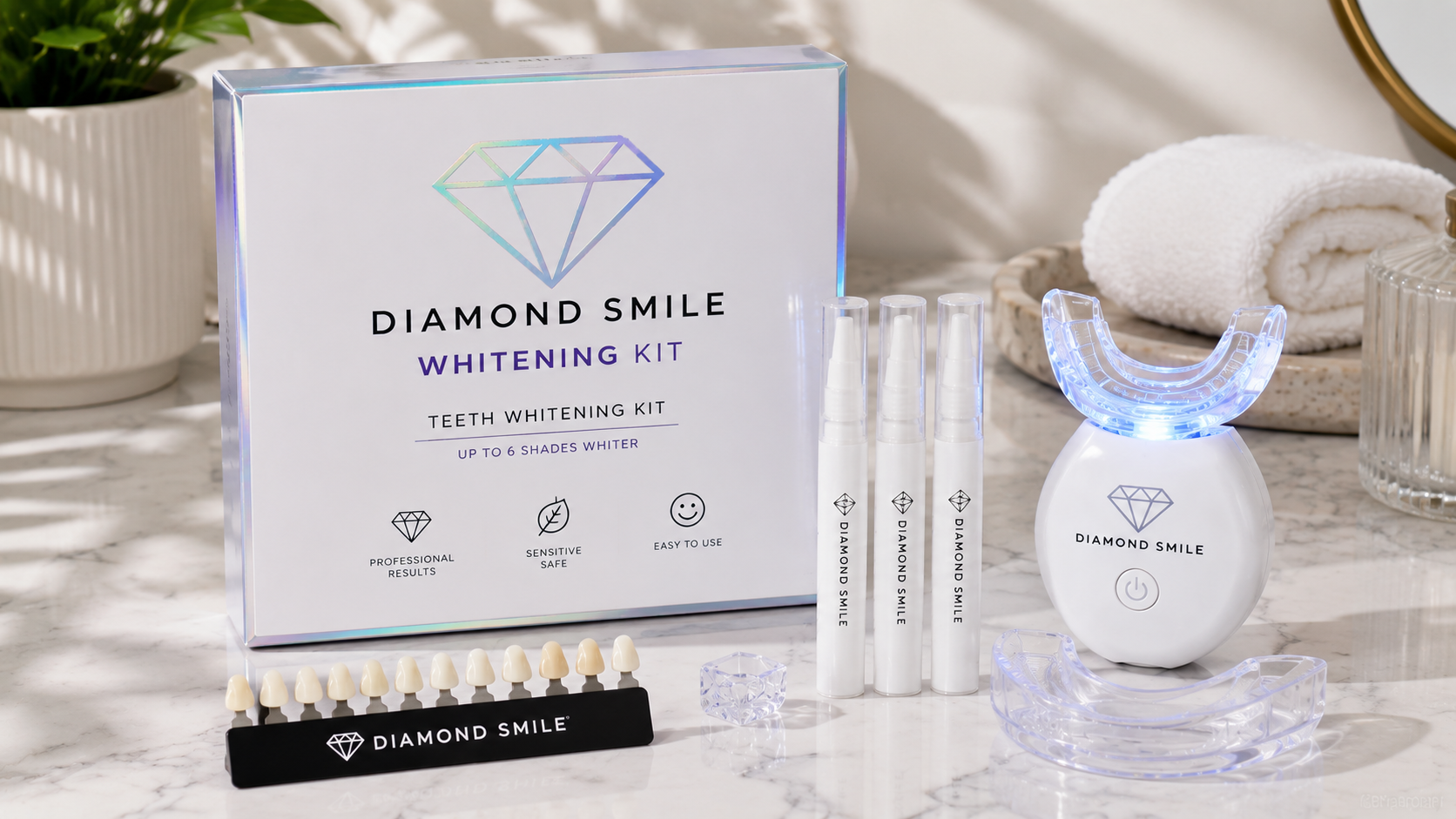
Over 40% of people feel self-conscious about their smile, yet professional whitening treatments can cost upwards of €500 per session. The Diamond Smile Teeth Whitening Kit promised professional-grade results from your bathroom for under €60, making it an attractive proposition for budget-conscious consumers across Europe.
When separating marketing claims from actual customer experiences, the reality proves far more nuanced than TikTok hype suggested. Diamond Smile FR built a reputation as an accessible at-home whitening solution during the early 2020s, particularly across European markets. The brand’s peroxide-free approach appealed to sensitivity-conscious consumers tired of traditional bleaching treatments, and with influencer endorsements and aggressive pricing strategies, it became a bestseller—though the brand’s closure and mixed review scores raised important questions about product efficacy and customer service reliability.
What Made Diamond Smile a TikTok Sensation
The influencer marketing machine behind Diamond Smile’s viral growth
Diamond Smile’s explosive popularity didn’t happen by accident. The brand strategically leveraged TikTok and Instagram influencers during a period when at-home beauty treatments were gaining mainstream acceptance. Content creators showcased dramatic before-and-after transformations, often filmed in bright natural light that maximized the appearance of whitening results. These videos accumulated millions of views, creating a self-reinforcing cycle where curiosity drove purchasing decisions faster than traditional advertising could achieve.
The strategy worked because influencer recommendations feel authentic in ways brand messaging doesn’t. When a trusted creator with 500,000 followers casually mentioned the kit while discussing their morning routine, followers perceived this as genuine endorsement rather than paid advertisement. This social proof proved remarkably effective at converting hesitant buyers into customers.
Why the 10-minute application time resonated with time-strapped consumers
Modern consumers face constant time pressure. A whitening treatment that demanded 30-45 minutes daily faced adoption barriers that Diamond Smile sidestepped entirely. The 10-minute session fit comfortably into existing routines—during a morning shower, while checking emails, or before bed. This minimal time commitment removed friction from the purchase decision.
The convenience factor became especially compelling for busy professionals and parents juggling multiple responsibilities. Unlike professional whitening appointments requiring scheduling, travel, and cost, the kit remained accessible whenever motivation struck. This flexibility aligned perfectly with contemporary wellness culture, where self-care products must integrate seamlessly into already-packed schedules.
The price-to-promise ratio that attracted budget-conscious buyers
At €59.99 (often advertised as discounted from €119.99), the kit occupied a sweet spot in consumer psychology. Professional treatments cost €300–€800, making the at-home option feel like an obvious bargain. The dramatic price difference didn’t signal inferior quality to most buyers; instead, it suggested that expensive dental clinic markups were unnecessary.
This positioning spoke directly to price-sensitive consumers who assumed professional-grade results required professional-grade pricing. The marketing narrative—professional formulation developed with dentists, but direct-to-consumer pricing eliminated middleman costs—resonated as logical and fair. Few consumers stopped to question whether this pricing supported adequate customer service infrastructure.
Breaking Down the Peroxide-Free Formula
How peroxide-free gels achieve whitening without traditional bleaching agents
The whitening industry traditionally relied on hydrogen peroxide or carbamide peroxide, proven agents that penetrate enamel and break down chromogenic compounds responsible for discoloration. Diamond Smile’s peroxide-free formula took a different approach, relying on alternative whitening agents that worked through surface oxidation and mineral deposition rather than chemical bleaching.
These alternative compounds achieve whitening through gentler mechanisms. Some formulations utilize sodium perborate compounds that release oxygen ions without hydrogen peroxide’s intensity. Others employ mineral-based whitening agents that gradually build on tooth surface, creating a brightening effect through accumulated applications rather than dramatic single-session transformation. The science supporting these alternatives exists—they work—but with reduced intensity compared to peroxide-based treatments.
The science behind LED light activation and gel efficacy
The LED accelerator light included in the kit served a specific function beyond marketing appeal. Light wavelengths in the 405-415 nanometer range stimulate chemical reactions within whitening gels, potentially accelerating the oxidation process that breaks down stains. This isn’t pseudoscience, though effectiveness varies considerably based on gel formulation and light specifications.
The 10-minute LED activation period provided legitimate physiological benefit. Studies demonstrate that light-activated whitening can enhance gel performance compared to gel-only applications. However, the magnitude of improvement depends heavily on the gel’s active ingredients and the LED light’s specifications—variables Diamond Smile’s marketing didn’t publicly disclose in detail.
Potential limitations of gentler formulations versus professional-strength treatments
Professional whitening treatments contain significantly higher concentrations of peroxide compounds, sometimes 35-40% compared to consumer products at 3-10%. This concentration difference means professional treatments deliver faster, more dramatic results. Diamond Smile’s peroxide-free approach prioritized safety and comfort over maximum whitening speed—a meaningful trade-off rather than an inferior alternative.
Gentle formulations require patience. Where a professional treatment might dramatically whiten teeth in a single session, at-home alternatives demand consistency across 5-7 applications before comparable results emerge. For consumers with mild-to-moderate staining, this timeline feels acceptable. For those with severe discoloration or urgent aesthetic goals, the limitations become apparent quickly.
Real Results vs. Marketing Claims
Analysis of the 4.8/5 star ratings versus the 2.4/5 Trustpilot score discrepancy
The stark difference between glowing reviews on some platforms and Trustpilot’s 2.4/5 average rating reveals something critical about online review ecosystems. The higher scores typically came from brand-controlled or brand-influenced platforms, while Trustpilot’s lower rating reflected unfiltered customer experiences without platform incentive structures favoring positive reviews.
Trustpilot’s 59% one-star review rate indicated serious customer dissatisfaction among a significant portion of buyers. These reviews concentrated on customer service failures, delivery delays, and unmet expectations rather than product chemistry itself. The gap between ratings suggests that product performance alone cannot explain the dramatic quality-of-life difference between a 4.8 and 2.4 rating—operational failures heavily influenced the lower score.
Which stain types showed the most dramatic improvement
Extrinsic stains—discoloration on tooth surfaces caused by coffee, wine, tobacco, and food—responded most effectively to Diamond Smile’s formula. These surface-level stains represent the whitening kit’s optimal use case. Users with moderate extrinsic staining frequently reported noticeable improvement within 3-5 applications.
Intrinsic stains, which develop inside the tooth structure due to aging, medication, or trauma, proved far more resistant. These deeper stains required either higher peroxide concentrations or professional interventions beyond what at-home kits could deliver. Consumers with intrinsic discoloration often experienced disappointing results, believing the product had failed when the formulation’s design simply didn’t target their specific problem.
Timeline expectations: first application results versus sustained whitening
Realistic expectations matter enormously. Many users did notice subtle whitening after the first application—a psychological boost that encouraged continued use. However, the dramatic transformations shown in influencer videos required 5-7 sessions across 2-3 weeks of consistent application.
First-application excitement often masked reality: the visible improvement remained modest. Subsequent applications delivered gradual, cumulative brightening that became obvious only when comparing week-one and week-three results. Consumers expecting cinema-worthy transformations after one session inevitably felt disappointed, contributing to the 2.4 Trustpilot rating as they shared their unmet expectations.
The Complete Kit Contents and Ease-of-Use
What’s included: three syringes of gel, LED accelerator, mouth tray specifications
The standard Diamond Smile package contained three 5-milliliter syringes of whitening gel, a USB-rechargeable LED accelerator light, and a universal-fit mouth tray. Three syringes provided enough gel for approximately 15-21 applications depending on usage efficiency, supporting roughly 3-4 weeks of regular whitening.
The LED accelerator featured blue light wavelengths and charged via standard USB, eliminating the need for specialized equipment or batteries. The mouth tray utilized a flexible thermoplastic material designed to accommodate various tooth sizes, though some users reported fit inconsistencies that affected application comfort and gel retention.
Step-by-step application process and design accessibility
The application process proved straightforward enough for first-time users. Step one involved gently applying whitening gel from the syringe into the mouth tray’s reservoir. Step two required inserting the tray and ensuring complete coverage across all visible teeth. Step three involved inserting the tray into the LED light bracket and activating the 10-minute timer.
This simplicity represented genuine design intelligence. Users didn’t need dental knowledge or special equipment beyond what the kit provided. The process took minimal manual dexterity, making it accessible for people with varying abilities. Clarity of instructions and intuitive design eliminated common barriers that prevent consistent usage of other at-home dental products.
Comfort considerations and fit issues some users encountered
The universal-fit tray concept worked well for most users but created problems for others. People with unusually large or small mouths sometimes experienced poor tray fit, leading to gel leakage and inconsistent application. The thermoplastic material, while flexible, lacked the customization of professional trays molded to individual tooth geometry.
Sensitivity during the 10-minute light exposure proved minimal for most users—a significant advantage of the peroxide-free formula. However, those with existing tooth sensitivity reported occasional discomfort, particularly during the first few applications before teeth acclimated to the treatment. The gentle formulation helped, but individual variation in enamel integrity meant not everyone experienced complete comfort.
Explore the complete Diamond Smile whitening experience and learn if this kit matches your needs.
Sensitivity and Safety Considerations
How the peroxide-free formula reduces tooth sensitivity concerns
Traditional whitening agents cause sensitivity by penetrating enamel and irritating the pulp chamber. Diamond Smile’s peroxide-free approach avoided this mechanism, making sensitivity reduction genuine rather than marketing exaggeration. Users switching from other whitening systems often experienced noticeably lower discomfort levels, validating the formulation choice for sensitivity-prone individuals.
The gentle activation process matched the formulation’s philosophy. The 10-minute LED exposure avoided the thermal stress that extended whitening sessions sometimes created. The cumulative effect meant less chemical and physical stress on tooth structures compared to aggressive whitening protocols.
Enamel safety compared to professional treatments
Professional whitening treatments, despite delivering faster results, carried measurable enamel risk when used repeatedly or without proper interval spacing. The peroxide-free formula’s lower intensity meant reduced enamel stress during each application. For users pursuing maintenance whitening every few months rather than aggressive monthly treatments, Diamond Smile’s approach offered legitimate safety advantages.
However, peroxide-free didn’t mean risk-free. Overuse of any whitening agent, regardless of formula composition, created potential for damage. Consistent daily application beyond recommended protocols could still stress enamel. The formulation’s gentleness permitted longer-term use without professional supervision, but responsible usage remained essential.
Potential side effects reported by users
Most users experienced minimal side effects beyond occasional mild sensitivity during initial applications. Some reported temporary gum irritation if gel contacted soft tissue—an issue generally preventable through careful application. A small percentage experienced slight jaw discomfort from tray wear during the 10-minute sessions, though this typically resolved as users adapted to the device.
Rare reports mentioned uneven whitening or patchy results, though these typically reflected application technique rather than formulation failure. Users who applied gel inconsistently or used the tray improperly sometimes noticed uneven brightening. Proper application technique, emphasized through instruction, minimized these issues.
The Price Paradox and Value Proposition
Cost comparison to professional whitening at €300–€800 range
At €59.99, Diamond Smile cost one-fifth to one-tenth of professional whitening treatments, creating an obvious value comparison that drove purchasing decisions. Professional options offered speed, guaranteed results, and professional supervision—but demanded substantial investment. The at-home alternative offered accessibility and affordability with the trade-off of patience and personal responsibility.
This price positioning worked brilliantly for consumers skeptical about expensive dental procedures or unable to afford them. The affordability created psychological permission to experiment. If the kit delivered any meaningful whitening, users felt they’d received exceptional value. This dynamic sustained positive word-of-mouth despite realistic limitations in results.
Hidden costs: gel refills, replacement trays, electricity for LED use
The €59.99 price captured initial purchase costs, but ongoing usage involved additional expenses. Replacement gel syringes typically cost €15-€25 for a 3-pack, making sustained whitening an ongoing investment. While significantly cheaper than professional treatments, these refill costs accumulated for users pursuing regular maintenance whitening.
Replacement trays became necessary if the original tray degraded or fit poorly, adding €20-€35 to lifetime costs. Electricity consumption from USB charging proved negligible, but over months of regular use, minor electrical costs accumulated. Few consumers factored these ongoing expenses into their initial value calculation, a common budgeting oversight that affected overall satisfaction.
Whether the €59.99 price point justified the actual results delivered
For consumers achieving light-to-moderate whitening through consistent 5-7 applications, the price point felt justified. They’d invested roughly €80-€100 total (initial kit plus gel refills) and achieved noticeable improvement that lasted months, representing excellent value compared to professional options. For this segment, Diamond Smile delivered on its value proposition convincingly.
For users expecting Hollywood-level transformation or those with severe staining, the price point felt deceptive. They invested the same amount but achieved minimal visible improvement, creating resentment that professional options seemed to deserve higher prices. The perception of fairness depended entirely on alignment between expectations and actual results—where marketing’s promises often exceeded product capability.
Customer Service Issues That Damaged Trust
Timeline of service complaints between 2023 and 2025
Service issues intensified notably during 2023 and 2024. Initial complaints focused on delivery delays exceeding promised timelines by 2-3 weeks. Customers ordered with reasonable expectations for shipping speed and faced extended waits without adequate communication. This frustration compounded when customers attempted to contact support about delays.
By late 2024 and early 2025, service complaints escalated beyond logistics. Refund requests faced delays or denials, replacement products weren’t shipped promptly, and customer service response times extended to weeks. The gap between a brand built on influencer credibility and its operational reality became increasingly apparent to customers actually dealing with problems.
Slow response times and their impact on customer satisfaction scores
Customer service responsiveness proved critical to perception. When issues arose—tray fit problems, gel quality concerns, or delivery delays—customers expected timely resolution. Extended waits for responses created secondary frustration beyond the original issue. A tray fit problem becoming a customer service nightmare transformed a minor inconvenience into a major satisfaction killer.
The Trustpilot 2.4 rating concentrated heavily on customer service complaints rather than product complaints. Customers might have forgiven product limitations with responsive, empathetic support. Instead, they encountered delays, dismissive responses, and unresolved issues that compounded initial disappointment. This operational failure directly contributed to the dramatic rating collapse.
How poor customer support influenced the brand’s eventual closure
Reputation damage accumulates. Each negative experience on Trustpilot influenced potential customers, shifting conversions downward. The positive reviews on other platforms couldn’t counteract Trustpilot’s visible criticism, which ranked prominently in search results. New customer acquisition became increasingly difficult and expensive as word-of-mouth reputation deteriorated.
The brand faced a compounding crisis: operational issues created dissatisfied customers who left negative reviews, which deterred new customers, which reduced revenue needed to fix operational issues. The financial pressure eventually forced closure in late 2024 or early 2025. Diamond Smile’s failure represented not a product failure but an operational and customer experience failure that made a viable product unsustainable.
Who Benefits Most From This Kit
Ideal candidates: light staining, sensitivity concerns, budget constraints
Diamond Smile worked exceptionally well for specific customer segments. People with light extrinsic staining—yellowing from coffee or wine but not deep discoloration—saw transformative improvements within 2-3 weeks of consistent use. These users felt the product exceeded expectations and represented outstanding value.
Budget-conscious consumers unable to afford professional treatments gained a legitimate accessible option. The €59.99 investment removed financial barriers to teeth whitening, democratizing an aesthetic treatment previously accessible primarily to affluent individuals. For this segment, Diamond Smile delivered psychological and practical benefits that professional price points couldn’t justify.
Sensitivity-prone users benefited significantly from the peroxide-free formulation. People who experienced pain with traditional whitening systems could finally pursue whitening without discomfort. This specific population saw genuine innovation in the product—a meaningful advancement matching their particular needs.
Not suitable for: severe discoloration, existing enamel damage, professional expectations
Severe intrinsic staining remained beyond this kit’s capability. Customers with gray teeth from aging or medication-related discoloration faced inevitable disappointment. The formula simply lacked the intensity needed for dramatic transformation of deeply stained teeth. These individuals required professional intervention, not budget alternatives.
Users with existing enamel damage or extreme tooth sensitivity needed to avoid whitening altogether until addressing underlying issues professionally. Diamond Smile’s gentleness didn’t mean safety for compromised teeth. Applying whitening to already-vulnerable enamel could accelerate deterioration.
Customers harboring Hollywood-level expectations—perfectly white veneers—would inevitably feel disappointed. The kit achieved natural whitening within biological limits, not cosmetic dentistry results. Expectation management from the outset would have prevented much of the dissatisfaction reflected in negative reviews.
Best use cases: maintenance whitening, confidence boosts before events
The kit excelled as a maintenance tool for people already achieving professional whitening or naturally lighter teeth. Using it every 2-3 months preserved brightness without professional intervention or expense. This specific use case played entirely to the product’s strengths.
Pre-event whitening represented another ideal application. Someone noticing subtle yellowing a week before a wedding or important event could address it affordably and conveniently at home. The modest investment made sense for temporary aesthetic improvement before significant social occasions. This use case accepted modest whitening goals and worked within realistic timelines.
Honest Alternatives and Comparisons
Professional in-office whitening: cost, speed, and guaranteed results
Professional treatments cost €300–€800 but delivered results in a single 60-90 minute session that typically looked noticeably better than weeks of at-home whitening. The higher peroxide concentrations and professional application expertise created superior results for severe staining. Dentist oversight added safety assurance, and warranty guarantees came standard.
The trade-off involved cost, appointment scheduling, and potential sensitivity during professional application. For consumers who could afford professional treatment and prioritized speed and guaranteed results, the at-home option made less sense. The price difference reflected genuinely different treatment intensities rather than simple markup.
Whitening strips: convenience versus effectiveness trade-offs
Whitening strips offered similar convenience to Diamond Smile at comparable prices (€25–€45) but worked through direct gel contact rather than LED light activation. Strips lacked the elegant simplicity of the mouth tray approach and often created uneven whitening patterns since gel concentration wasn’t uniform across all tooth surfaces.
Effectiveness varied considerably between brands. Premium whitening strips sometimes matched Diamond Smile’s results, while budget options underperformed. The trade-off involved slightly lower cost but less consistent results and less comfortable application. For consumers prioritizing simplicity and even coverage, Diamond Smile’s approach superior to strips.
Other peroxide-free brands: how they compare in formula and customer service
Competing peroxide-free brands existed but typically faced the same fundamental limitation: gentleness meant slower results. Some alternatives included whitening pen applicators offering more targeted application but requiring more manual precision. Others offered gel trays similar to Diamond Smile but without LED light components, potentially reducing effectiveness.
Customer service distinguished brands as much as formulations. Competitors with responsive support and reliable delivery built better reputations despite similar products. Diamond Smile’s operational failures represented its competitive disadvantage rather than product inferiority. Consumers might have found comparable or even better experiences with alternative brands offering similar chemistry paired with reliable operations.
The Brand’s Closure and Future Implications
Why Diamond Smile FR shut down despite bestseller status
Bestseller status didn’t guarantee business sustainability. The brand faced mounting pressure from accumulated customer service failures, reputation damage on Trustpilot, and increasing acquisition costs as negative word-of-mouth spread. Operating a high-volume consumer business requires reliable fulfillment infrastructure and responsive customer support—areas where Diamond Smile demonstrably failed.
The closure likely reflected economic reality: fixing operations would require significant investment, reputation recovery would take months or years, and profitability had already eroded. Rather than attempt turnaround, stakeholders chose exit. This represented a business failure rather than product failure—a distinction important for understanding what actually went wrong.
Implications for warranty claims and customer support going forward
Brand closure created immediate problems for customers with pending warranty claims or replacement requests. The company no longer existed to honor guarantees or process issues. Money-back guarantees became effectively worthless, creating legitimate grievances among customers with problems.
Anyone considering purchasing remaining inventory or refurbished units faced significant risk. Without operational customer support infrastructure, they’d have limited recourse if products arrived damaged or failed to deliver expected results. This closure risk added substantial uncertainty to post-brand-closure purchasing.
Availability of replacement gels and accessories post-closure
One practical concern involved replacement gel syringes. After the brand closed, obtaining compatible gel became impossible through official channels. Third-party sellers might offer alternatives, but compatibility and quality remained uncertain. Customers who purchased the kit and wanted sustained whitening faced the challenge of finding suitable replacements.
The mouth tray and LED accelerator light could continue functioning indefinitely, but replacement gels represented consumable products essential to ongoing usage. The closure essentially created an expiration date for the kit’s practical usefulness—a significant limitation affecting long-term value proposition. Customers who purchased toward the brand’s end of operation discovered their investment had limited utility potential.
Making Your Final Call: Is Diamond Smile Worth Your Money in 2026?
The Diamond Smile Teeth Whitening Kit represents a fascinating case study in modern consumer marketing—where viral hype, competitive pricing, and genuine innovation collided with operational challenges and mixed real-world results. The product genuinely delivered for some users, particularly those with light-to-moderate staining and sensitivity concerns. The peroxide-free formula worked, the LED light accelerated results, and the 10-minute sessions fit seamlessly into busy routines.
However, the stark contrast between glowing social media reviews and Trustpilot’s 2.4/5 rating tells a critical story. Customer service failures, delivery delays, and overpromised results damaged what could have been a sustainable brand. The gap between expectation and reality reflected as much a failure in communicating realistic outcomes as in product performance itself.
The brand’s closure in late 2024 or early 2025 introduces a significant complication for anyone considering purchase in 2026. Without operational customer support or replacement gel availability, the kit’s long-term value has substantially diminished. Customers seeking ongoing maintenance whitening would lack reliable supply chains for consumables.
If considering this kit—or exploring similar at-home whitening solutions—approach the decision with clear-eyed expectations. You’ll likely see noticeable improvement within 5-7 sessions if you have light-to-moderate staining, but dramatic transformations require professional treatments. The €59.99 price point made it worth testing if you were sensitive to traditional whitening or budget-conscious, but brand closure eliminates ongoing support infrastructure.
The realistic assessment: Diamond Smile worked for maintenance whitening or confidence boosts before events. For severe discoloration or guaranteed results, professional options remain necessary despite higher cost. The best whitening approach is the one you’ll actually use consistently with realistic expectations about what’s achievable.
Your smile’s future depends on understanding what each solution can accomplish—not what marketing promises. If you’re specifically seeking a peroxide-free option and can accept the risks associated with purchasing from a brand no longer operating, existing inventory might still deliver value. Otherwise, exploring active competitor brands offering similar formulations paired with reliable operations would be the prudent choice.
Leave a Reply