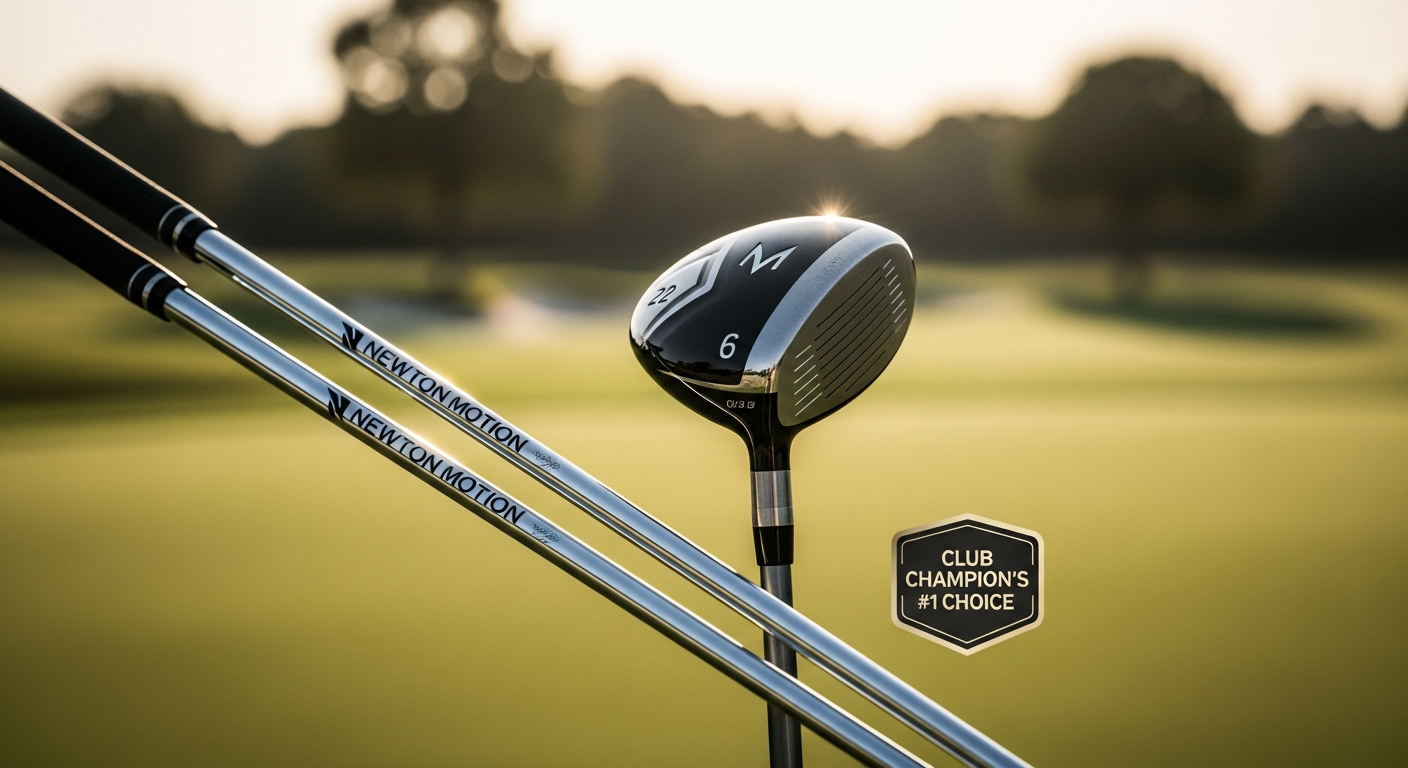
What if the shaft in your bag was actually limiting your potential rather than unlocking it? The golf industry has long relied on generic flex categories—stiff, regular, senior—that treat every golfer like they swing the same way. Newton Motion and Fast Motion shafts are challenging that outdated approach, and the numbers speak volumes: they've claimed the #1 spot for driver and fairway wood sales at Club Champion in 2025, outpacing every competitor on the market.
This isn't random success. Club Champion, the nation's leading professional club fitting retailer, bases every recommendation on measurable data and swing analysis. When a shaft dominates their sales charts, it's because real golfers with real swing speeds are experiencing tangible improvements. Newton Golf Company has engineered something different here—a shaft that combines the precision of modern fitting technology with a feel that encourages a more natural, rhythmic swing.
For golfers tired of chasing distance through brute force, this represents a genuine shift in how premium shafts can perform. Discover how Newton Motion and Fast Motion shafts can transform your game.
The Dot-Based Flex System: Precision Fitting Beyond Traditional Labels
How the 1-7 Dot System Replaces Vague Terminology
For decades, golfers have relied on confusing flex ratings that barely scratch the surface of what actually matters in shaft performance. "Stiff" and "regular" are broad generalizations that miss the nuance of individual swing characteristics. Newton's dot-based system operates on a scale from 1 to 7, eliminating the vagueness that plagues traditional naming conventions. This approach treats each golfer's swing as unique, because it actually is.
Personalized Flex Matching Based on Swing Speed and Tempo
The real power of the dot system lies in its connection to measurable swing metrics. Rather than guessing which flex category fits your swing, the system matches you based on concrete data: your swing speed, tempo consistency, and rhythm. A golfer with a smooth, deliberate tempo might thrive at a 3 or 4 dot rating, while a faster, more aggressive swinger could benefit from a 5 or 6. This precision ensures that your shaft works in harmony with your natural swing pattern, not against it.
The Science Behind Matching Dots to Individual Swing Characteristics
Each dot number corresponds to specific stiffness characteristics that interact predictably with different swing speeds and tempos. The system accounts for how shaft flex influences launch angle, spin rates, and overall ball flight. When you're matched to your ideal dot number through professional fitting, you're essentially getting a shaft engineered for your exact swing dynamics. The result is more consistent contact, improved ball striking, and better shot dispersion.
Eliminating the Guesswork in Standard Shaft Selection
Traditional shaft selection often involves trial and error. A golfer might grab a "regular" flex from the rack, hit a few balls, and assume it's the right choice. The dot system removes this guesswork by anchoring the recommendation in actual swing data. Professional fitters use launch monitors and swing analysis to identify your ideal dot number, taking the uncertainty out of the equation.
Real-World Examples of Golfers Finding Their Ideal Flex
Golfers across the amateur and professional ranks have discovered their best performance through the dot system. A player with a smooth, rhythmic swing who previously struggled with a standard "regular" flex might find that a 3-dot Motion shaft delivers the feel and consistency they've been seeking. Another golfer with a faster swing speed could unlock additional distance and control by moving up to a 5 or 6-dot Fast Motion. These aren't theoretical benefits—they're measurable improvements in shot dispersion and distance that golfers experience immediately.
Comparison: Traditional Flex Ratings vs. Newton's Precision Approach
Traditional flex ratings like stiff, regular, and senior are buckets that contain wide ranges of actual shaft stiffness. Two "regular" flex shafts from different manufacturers can feel and perform quite differently. Newton's numbered system creates a standardized, reproducible scale that allows for genuine comparison and precise matching. This shift from categorical to numerical rating represents a meaningful advancement in how golfers can find equipment that truly fits their swing.
Symmetry 360® Technology: The Spineless Design That Changes Everything
What Spineless Design Means and Why It Matters
Most traditional golf shafts have a spine—a stiffer plane running along the shaft's axis. This spine is designed to face a particular direction in the clubhead, and shaft installers typically orient the spine to optimize performance. Spineless design, as implemented in Symmetry 360® technology, eliminates this directional dependency entirely. The shaft performs identically regardless of how it's installed, removing a variable that has historically complicated shaft performance.
How Symmetry 360® Ensures Identical Performance Regardless of Orientation
Because the shaft has no preferred direction, rotation around the central axis doesn't change its performance characteristics. Whether the shaft is installed with a seemingly optimal orientation or a different one, the flex profile and feel remain consistent. This consistency translates directly to more predictable performance shot after shot.
The Connection Between Spineless Design and Improved Dispersion Patterns
Inconsistent shaft orientation has historically contributed to dispersion issues—those occasional wild shots that seem to come from nowhere. By eliminating the spine variable, Symmetry 360® technology tightens the relationship between your swing and the ball's flight. The result is improved grouping on the range and more predictable performance on the course.
Why This Technology Builds Confidence in Your Swing
When you know your equipment will perform consistently regardless of minor installation variations, confidence follows naturally. You're not wondering if an off-shot was caused by something you did or something about how the shaft was installed. That mental clarity allows you to focus on your swing mechanics and course strategy rather than equipment variables.
Technical Breakdown of How This Differs From Traditional Spined Shafts
Traditional spined shafts require precise orientation during installation. The shaft is mapped, and installers position it with the spine in the designated plane. Any deviation from this orientation introduces performance variation. Symmetry 360® eliminates this step entirely by designing a shaft that performs identically in all rotational positions. From an engineering perspective, this requires sophisticated design work to ensure that all radial directions exhibit the same flex characteristics.
Real-World Impact: Tighter Groupings and Fewer Erratic Shots
Golfers using Newton Motion and Fast Motion shafts frequently report improved consistency. The practical benefit manifests as tighter dispersion patterns on the range and fewer inexplicable shots on the course. Shots that should go left don't mysteriously find the right rough. The ball flight becomes more predictable, and scoring improves as a natural consequence.
The Elongated Bend Profile: Creating That Signature Fluid Feel
How the Bend Profile Influences Load and Release During the Swing
A shaft's bend profile—the specific way it flexes along its length during the swing—fundamentally influences how it feels and performs. An elongated bend profile means the shaft's flex is distributed along a longer section of the shaft's length rather than concentrated in one area. This distribution creates a smoother, more gradual load and release through the impact zone.
Why an Elongated Profile Promotes a Natural, Whip-Like Sensation
When the shaft flexes gradually along its length, the sensation mirrors a more natural club movement. Golfers often describe this as a "whip-like" feel—the shaft loads smoothly on the backswing and unloads naturally through impact. This sensation encourages a rhythmic swing without requiring the golfer to force anything. The shaft's mechanics align with what feels natural to the human swing.
The Relationship Between Bend Profile and Swing Tempo Consistency
A shaft that naturally promotes smooth loading and releasing has a subtle effect on swing tempo. Golfers tend to fall into a rhythm that matches the shaft's characteristics. With Newton's elongated bend profile, that rhythm tends toward smooth and unhurried rather than abrupt or jerky. Over time, this consistent feel can help stabilize your overall swing tempo.
How This Design Encourages an Unhurried, Smooth Rhythm Without Forcing It
The elongated bend profile doesn't force a tempo change—it encourages one through feel. A golfer who has struggled with an overly quick tempo might find that the shaft's natural feel promotes a more deliberate pace. This happens because the shaft rewards smooth tempo with better feel, creating positive feedback that naturally adjusts swing dynamics.
Why Golfers With Varying Swing Speeds Respond Positively to This Profile
The beauty of the elongated bend profile is its versatility. Golfers with slower swing speeds appreciate the smooth, controlled sensation it provides. Faster swingers benefit from the efficient load and release that maximizes their speed without requiring any technical changes. The profile works across a spectrum of swing speeds because it aligns with how the human body naturally wants to move.
The Feel Factor: Why Fluid Translates to Better Control and Confidence
Feel in golf is often dismissed as subjective, but it's actually a direct window into equipment performance. When a shaft feels fluid and smooth, that sensation corresponds to consistent, repeatable flex patterns. A shaft that feels jerky or unpredictable is likely performing inconsistently. Newton's elongated bend profile creates that fluid sensation because the shaft is actually performing fluidly, and that translates directly to better control and shot consistency.
Newton Motion vs. Fast Motion: Choosing Your Ideal Shaft
Core Similarities: Shared Technologies and Design Principles
Both Newton Motion and Fast Motion shafts share the foundational technologies that make Newton shafts distinctive: the dot-based flex system, Symmetry 360® spineless design, and the elongated bend profile that creates that signature fluid feel. Both come with the color-shifting paint job that blends blues, purples, and greens. Both are compatible with major brands like TaylorMade, Callaway, and PXG. The fundamental engineering and philosophy behind these shafts are identical.
Key Difference: The 10-Gram Weight Reduction in Fast Motion
The primary distinction between the two is weight. Fast Motion shafts are approximately 10 grams lighter than the standard Motion. This seemingly modest difference has meaningful consequences for swing speed and overall club dynamics. The lighter weight reduces the overall club's moment of inertia, making it easier to generate clubhead speed.
Who Benefits From the Standard Motion Shaft
The Newton Motion shaft is ideal for golfers who prioritize feel and rhythm above all else. If you've found that your best golf comes when you're in a smooth, deliberate tempo, the Motion shaft's standard weight provides excellent feedback and control. Golfers with moderate swing speeds—say, 85–100 mph driver speeds—typically find the Motion to be their sweet spot. It's also the right choice if you've struggled with overswinging or tempo inconsistency; the shaft's weight encourages that measured rhythm naturally.
Who Should Consider Fast Motion
The Fast Motion is engineered for golfers seeking a tangible increase in swing speed without sacrificing the fluid feel that makes Newton shafts special. If you're hovering around 100 mph driver speed and believe you could generate more, the Fast Motion's lighter weight can help you reach that next threshold. It's also attractive to golfers who want maximum distance potential or those returning from injury who are rebuilding swing speed. The 10-gram reduction doesn't transform your swing, but it removes resistance and makes acceleration more accessible.
Performance Comparison: Distance Gains, Ball Flight Characteristics, and Control
In back-to-back testing, the Fast Motion typically produces slightly higher launch angles and increased carry distances compared to the Motion, primarily due to the weight advantage and slightly different balance point. The Motion shaft may produce a marginally lower ball flight and offer slightly more workability for golfers who prefer shaping shots. Both deliver improved consistency through the Symmetry 360® technology and elongated bend profile. The control difference is minimal; both shafts inspire confidence in shot execution.
Price Point Analysis: Motion vs. Fast Motion
The Newton Motion Driver Shaft typically ranges from $275 to $300, with fairway wood versions around $250 to $275. The Fast Motion Driver Shaft is priced around $325, with fairway wood pricing in a similar range relative to the Motion. The $25–50 premium for Fast Motion is modest compared to some competitors, making the choice between them based on performance needs rather than budget constraints for most golfers.
Compatibility With Major Brands
Both Newton Motion and Fast Motion shafts are compatible with clubheads from TaylorMade, Callaway, PXG, and other major manufacturers. This compatibility means you can retrofit existing clubheads with these shafts or work with a fitter to build new clubs. Explore Newton Golf Company's full selection of Motion and Fast Motion shafts.
Your Next Move: Take the Club Champion Advantage
Newton Motion and Fast Motion shafts have earned their #1 status through a combination of innovative technology, measurable performance gains, and genuine feel that golfers crave. The dot-based flex system removes the guesswork from shaft selection, while Symmetry 360® technology guarantees consistency you can trust. Whether you're chasing increased swing speed with the Fast Motion or prioritizing that fluid, rhythmic feel of the standard Motion, these shafts deliver on their promise without the astronomical price tags attached to some competitors.
The real question isn't whether these shafts perform—Club Champion's sales data has already answered that. The question is whether you're ready to experience the difference that precision fitting and innovative design can make in your game. If you've been struggling with inconsistency, searching for better feel, or simply wanting equipment that matches your swing rather than fighting against it, these shafts deserve serious consideration.
Your next step is to visit a professional fitter who can analyze your swing with data, match you to your ideal dot number, and get you into a shaft that actually works with your tempo instead of against it. Start your journey with Newton Golf Company and discover your ideal shaft today.
Leave a Reply