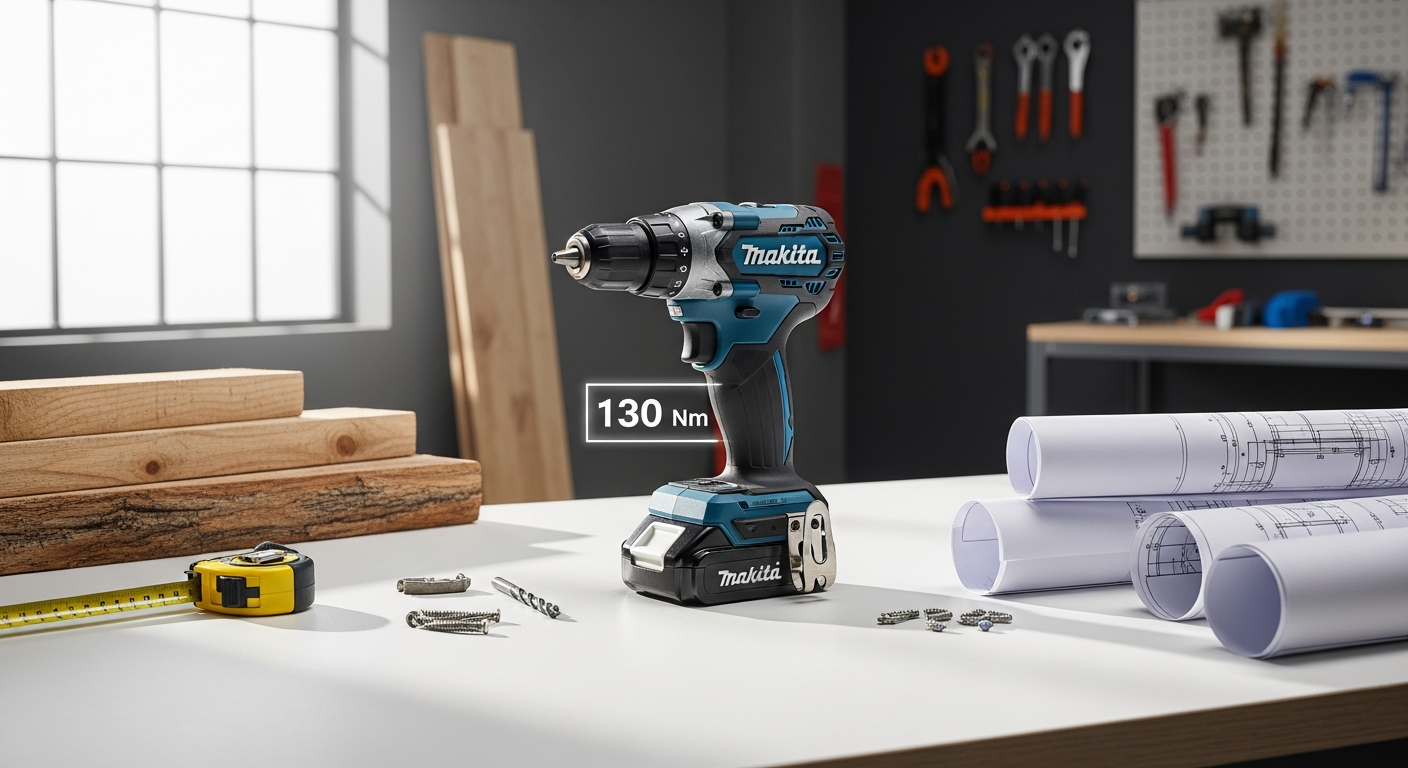
Concrete walls, dense hardwood, and stubborn fasteners are no match for the Makita DHP486RTJ. This 18V brushless impact drill has become the go-to choice for contractors and serious DIY enthusiasts who demand raw performance. With 130 Nm maximum torque, impact drilling capability, and a two-speed gearbox, it's a genuine workhorse for multiple material types.
Whether you're anchoring into masonry, driving through steel, or tackling wood framing, this tool adapts to the job with precision and reliability. The engineering behind this drill represents a significant leap forward in cordless power tool design, combining brushless motor efficiency with intelligent gear management and comprehensive battery support.
Brushless Motor Technology: Why It Matters for Heavy-Duty Work
Brushless Motor Advantages Over Traditional Brushed Designs
The brushless motor at the heart of the DHP486RTJ represents a fundamental shift in power tool engineering. Unlike brushed motors that rely on carbon brushes making constant contact with a spinning commutator, brushless designs eliminate this mechanical friction entirely. This means fewer moving parts, reduced wear, and a tool that maintains its cutting edge performance across hundreds of hours of use.
The absence of brush wear translates directly into a longer tool lifespan. Contractors who rely on their equipment day in and day out notice this difference immediately—the DHP486RTJ simply outlasts conventional alternatives. Beyond durability, brushless motors run cooler and more efficiently, converting a higher percentage of battery energy into actual drilling and fastening work rather than wasting it as heat.
Direct Correlation Between Technology and 130 Nm Torque Output
The 130 Nm maximum torque figure isn't arbitrary—it's the direct result of brushless motor optimization. Because brushless designs deliver power more efficiently without brush-related power losses, manufacturers can engineer higher torque outputs from the same battery voltage. The DHP486RTJ's brushless motor uses electronic commutation to deliver precise power management, ensuring that every amp-hour from the battery translates into productive work.
This torque rating makes the difference when driving large fasteners into hardwood or anchoring heavy fixtures into masonry. You're getting sustained power delivery rather than the gradual decline that occurs with brushed motors as their brushes wear down.
Heat Management and Sustained Power During Extended Drilling
Job sites demand continuous operation. The brushless motor's thermal efficiency keeps the DHP486RTJ cooler during extended use, preventing the thermal throttling that degrades performance on traditional drills. When the motor runs cooler, the battery management system can deliver consistent power throughout the working day without protective shutdowns triggered by excessive internal temperatures.
Energy Efficiency and Extended Battery Runtime
Brushless technology fundamentally changes the battery equation. Because the motor operates at higher efficiency, the two included 5.0 Ah Li-ion batteries deliver more actual work before requiring a charge. On demanding applications—drilling multiple holes through steel beams or driving hundreds of fasteners—this efficiency means the difference between completing a job and swapping batteries mid-task.
Impact Drilling Capability for Masonry and Concrete Applications
How the Impact Function Activates for Concrete and Stone
The impact drilling function operates as a separate mechanism from the rotational drilling motion. When you select impact mode, a mechanical hammer mechanism inside the drill begins striking the bit thousands of times per minute while simultaneously rotating it. This rapid succession of impacts breaks material apart rather than relying purely on rotational force, making concrete and stone drilling dramatically more efficient.
The activation is straightforward—the DHP486RTJ's design allows seamless switching between standard drilling for wood and metal, and impact drilling for masonry applications. This versatility means one tool handles an entire scope of work rather than requiring separate equipment for different materials.
Standard Drilling Versus Impact Drilling Modes
Standard drilling mode works through rotational force alone, ideal for wood framing, fastening operations, and metal drilling where impact would be counterproductive. Impact drilling mode activates the mechanical hammer, making it essential for concrete, stone, and masonry work. The distinction matters because using impact mode on fasteners risks stripping threads and damaging the work, while attempting standard mode on concrete consumes batteries and dulls bits without making meaningful progress.
Real-World Applications on Job Sites
Contractors use the DHP486RTJ's impact capability for anchoring structural elements into concrete foundations, drilling holes for electrical conduit runs through masonry walls, and installing mechanical fasteners into stone surfaces. These aren't occasional tasks—they're staple elements of construction and renovation work. On large projects, the time savings from efficient impact drilling directly translates into reduced labor costs and faster project completion.
Suitability for Anchor Installation and Structural Fastening
When installing heavy fixtures, equipment mounting brackets, or load-bearing anchors, the impact function's efficiency becomes critical. The drill penetrates concrete without the frustrating delays of traditional tools, and the 130 Nm torque provides the force needed to seat large fasteners securely.
Two-Speed Gearbox and Torque Management
Low-Speed High-Torque and High-Speed Low-Torque Settings
The two-speed gearbox addresses a fundamental design challenge: the same motor cannot simultaneously deliver maximum torque and maximum speed. The DHP486RTJ solves this by offering two gear ratios. Low speed delivers maximum torque for fastening heavy bolts and driving large screws through dense materials. High speed sacrifices some torque in exchange for faster rotational velocity, making it ideal for rapid drilling through softer materials or driving numerous fasteners quickly.
Switching between speeds takes seconds, allowing workers to match the tool's performance characteristics to the immediate task without swapping equipment.
Selecting the Correct Gear for Specific Applications
Experienced users develop an intuitive sense for gear selection. Fastening applications almost always demand low-speed operation to maximize torque and minimize the risk of stripping fastener heads or damaging threads. Drilling through wood or plastic benefits from high-speed operation, which allows faster material penetration. Mixed-material projects—common on renovation work—require frequent speed adjustments throughout the day.
Torque Rating Translated to Real-World Fastening Power
130 Nm represents genuine fastening capability. To contextualize this figure: it's equivalent to hanging nearly 13 kilograms on a one-meter lever arm. In practical terms, the DHP486RTJ can drive 10mm bolts through steel plates, seat large structural fasteners, and handle fastening tasks that entry-level cordless drills cannot accomplish. Contractors who regularly work with fasteners larger than 8mm diameter recognize this as a meaningful performance threshold—the difference between "this tool can technically drive this fastener" and "this tool drives it efficiently and reliably."
Efficiency Gains on Mixed-Material Job Sites
Construction and renovation projects rarely present a single material type. A typical day might involve drilling through wood framing, then switching to concrete, then fastening steel connection plates. The dual-speed gearbox allows the DHP486RTJ to optimize performance for each material type without tool switching, reducing transition time and keeping work flowing smoothly.
Battery System and Runtime Efficiency
Two 5.0 Ah Li-ion Batteries for Extended Work
The complete DHP486RTJ set includes two 5.0 Ah lithium-ion batteries rather than a single smaller battery. This represents a deliberate design choice: while one battery charges, the other powers the drill, keeping work moving without downtime. On job sites where stopping to charge batteries breaks workflow rhythm and delays the entire crew, this dual-battery approach proves invaluable.
The 5.0 Ah capacity means each battery delivers substantial runtime on most applications. Fastening work drains batteries more quickly than drilling, but even intensive fastening sessions typically permit several hours of continuous operation between charges.
Fast Charger Specifications and Charging Efficiency
The included fast charger significantly reduces time-to-ready. Rather than waiting hours between battery swaps, a fast charger can refresh a depleted battery to operational capacity in roughly 45-60 minutes, depending on charger specifications and battery condition. This recovery time allows workers to maintain steady productivity throughout an eight-hour shift with only brief charging breaks.
Battery Management System Protection
Modern Li-ion battery systems incorporate electronic management that prevents common failure modes. The DHP486RTJ's batteries include overcharge protection that stops charging once full capacity is reached, overheating protection that suspends charging if temperature exceeds safe limits, and overdischarge protection that prevents batteries from draining to levels that permanently reduce their capacity. These protections extend battery lifespan and ensure consistent performance throughout their operational life.
18V Ecosystem Compatibility and Tool Expansion
The 18V platform represents Makita's standard for mid-range cordless tools. This means the DHP486RTJ's batteries work interchangeably with other Makita 18V tools—impact drivers, reciprocating saws, angle grinders, and numerous other equipment. Users who invest in additional 18V tools can consolidate their battery inventory rather than maintaining separate charging systems for different tool brands.
Complete Accessory Package and Storage Solution
Makpac System Case for Organization and Transport
The Makpac case included with the DHP486RTJ isn't merely a carrying container—it's an organizational system designed for job-site efficiency. Compartments store the drill, batteries, charger, and accessories in fixed positions, eliminating the time wasted searching for specific items in cluttered toolboxes. The case's rugged construction protects equipment from damage during transport and storage.
Stackability and Portability Advantages
Makpac cases stack on top of each other, creating organized tool management systems in vehicles or on job sites. This stacking capability allows contractors with multiple tools to maintain orderly equipment without requiring dedicated storage infrastructure. The portability means workers can carry an entire equipped kit—drill, batteries, charger, and accessories—in a single trip from vehicle to work area.
Organization Features and Setup Time Reduction
Well-organized tools reduce work delays. When bits, fasteners, and accessories occupy defined positions within the case, workers spend seconds locating needed items rather than minutes rummaging through disorganized collections. On projects with multiple crew members, this organizational clarity reduces confusion about equipment location and status.
Long-Term Value of the Complete Package
Purchasing the DHP486RTJ as a complete set costs less than assembling equivalent components separately—buying a drill body, adding batteries, purchasing a charger, and sourcing a storage case individually would exceed the set price. The bundled approach delivers better value while ensuring all components are matched and compatible.
Your Next Power Tool Upgrade Starts Here
The Makita DHP486RTJ Akku Schlagbohrschrauber Set represents a strategic investment in capability, reliability, and efficiency. You're acquiring a brushless powerhouse with 130 Nm of torque, dual-speed versatility, and the battery ecosystem to keep working without interruption. The complete package—two 5.0 Ah batteries, fast charger, and Makpac storage system—eliminates frustration and downtime. You'll spend less time managing equipment and more time completing projects.
Ready to experience professional-grade impact drilling performance?
Leave a Reply