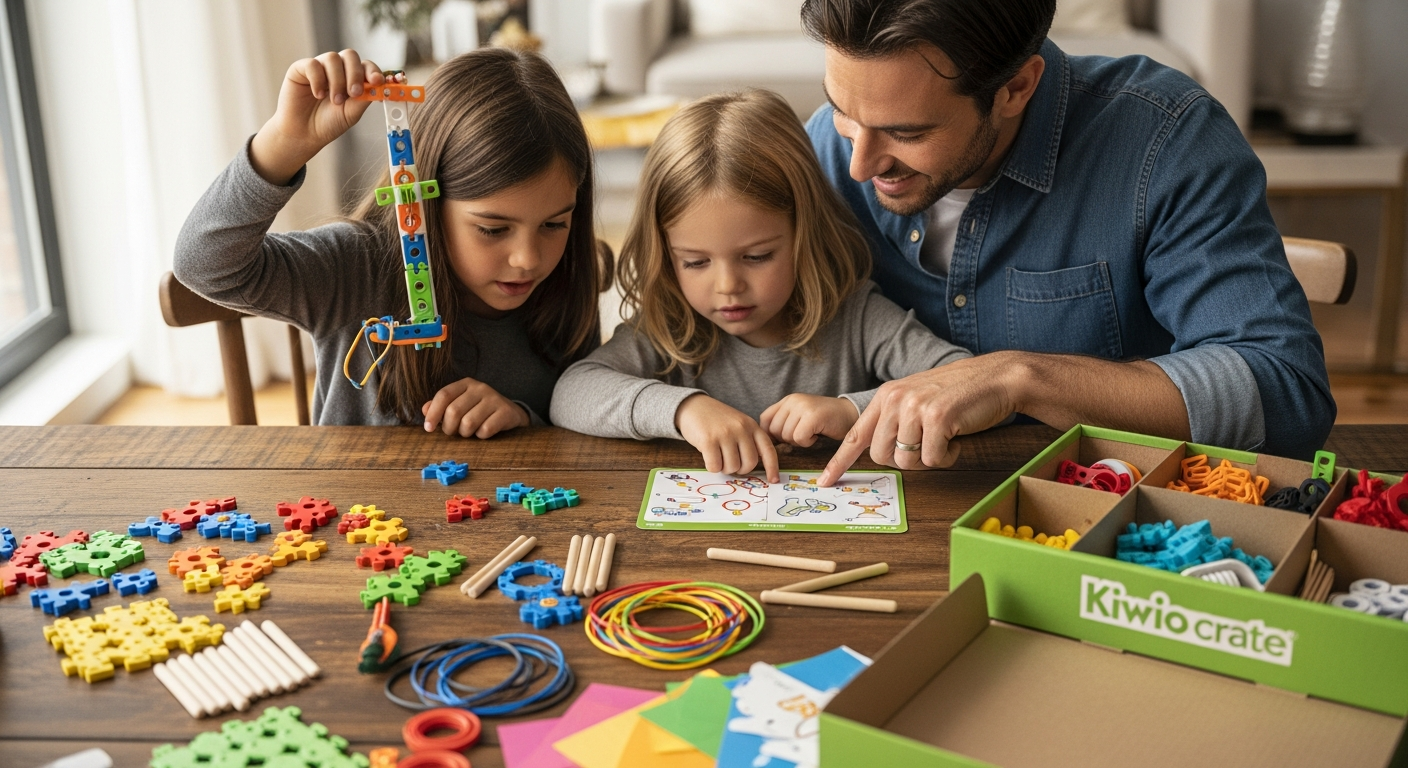
Over 70% of parents struggle to find engaging STEM activities that don't require advanced preparation or a degree in engineering. The constant juggling act—work, school schedules, the endless search for activities that actually hold your child's attention—leaves most families exhausted before they even begin. Finding that sweet spot between educational value and practicality feels nearly impossible.
The Kiwi Crate STEM subscription box has emerged as a genuine game-changer for elementary-aged children, offering a curated solution that arrives at your doorstep each month ready to captivate young minds. Designed specifically for kids aged 5 to 8, this flagship offering from KiwiCo combines hands-on building projects with legitimate educational value—all without requiring you to source materials or decipher complicated instructions.
Explore the Kiwi Crate STEM subscription box today and transform how your child learns.
What Sets Kiwi Crate Apart From Other Educational Subscription Boxes
Open-and-go convenience
The first thing parents notice is how refreshingly simple the setup is. All materials arrive pre-packaged and ready to use. Your child opens the box, follows the straightforward instructions, and begins building within minutes. Minimal prep work means busy families can integrate STEM learning into their routine without additional stress or complex material sourcing.
Age-appropriate project design
Projects are specifically engineered for the 5-8 age range with scaffolded difficulty levels that grow alongside your child's skills. The developers understand what this age group can accomplish and what concepts genuinely resonate with their developing minds. Nothing feels too babyish or frustratingly beyond reach.
Dual-learning approach
Each box combines hands-on building with the included Explore Magazine—a critical component that bridges the gap between doing and understanding. Kids build a hydraulic system, then read stories and comics explaining the science behind it. This combination transforms isolated activities into cohesive learning experiences.
Quality materials
Premium components distinguish Kiwi Crate from generic craft boxes. Materials feel substantial and durable, encouraging repeated play long after the initial project completion. Children sense that quality and engage more seriously with the work.
Clear instruction design
Step-by-step guides reduce both parental frustration and child confusion. Instructions use visual cues and simple language that young readers can follow independently, though adult support remains available when needed.
Thematic consistency
Monthly themes connect individual projects to real-world science and engineering applications. Rather than random activities, each crate tells a coherent story about how people use these concepts in everyday life.
Lasting value
Finished projects serve as toys, not just one-time activities destined for the recycling bin. A built hydraulic system becomes a plaything kids return to repeatedly, reinforcing the learning through continued interaction.
The Types of Projects Your Child Will Build and Explore
Engineering challenges
Children construct hydraulic systems, experiment with lever mechanisms, and tackle structural engineering concepts. These hands-on challenges teach fundamental principles through direct experience rather than textbook explanation.
Physics exploration
Sound science projects, gravity experiments, and motion-based activities give kids tangible ways to understand invisible forces. They see physics principles in action and grasp concepts that often confuse older students.
Creative making
Art-integrated STEM combines engineering with artistic expression, recognizing that creativity and technical thinking aren't separate domains. Children build painted bird feeders or decorated weather instruments, merging aesthetics with function.
Seasonal and themed collections
Projects tie to holidays, space exploration, nature studies, and technology, keeping content fresh and connected to what children notice in their world. A holiday-themed box feels timely and relevant, not randomly inserted.
Hands-on experimentation
Activities teach the scientific method through direct discovery. Rather than memorizing steps, children naturally follow the observe-hypothesize-test-conclude cycle as they work through each project.
Building with various materials
Projects incorporate wood, cardboard, plastic components, and everyday items repurposed for learning. This material variety teaches that engineering uses whatever works best for the challenge at hand.
Incremental skill progression
Projects grow in complexity as children advance through the subscription. A child who struggled with fine motor control in month one finds month six projects well-matched to their developing abilities.
How the Explore Magazine Enhances the Learning Experience
The Explore Magazine isn't an afterthought—it's a sophisticated educational tool designed to cement learning and extend engagement far beyond the initial build.
Concept reinforcement
Comics and stories explain the science behind each month's project in age-appropriate language. A child who built a lever system reads a story about how construction workers use levers every day, connecting abstract principles to concrete applications.
Extended activities
The magazine includes additional experiments and challenges that go beyond the main build. These supplementary activities give children pathways to deepen their understanding and explore related concepts independently.
Visual storytelling
Engaging illustrations make STEM concepts relatable for young learners. Complex ideas become accessible when presented through compelling visuals and narrative rather than dense text.
Vocabulary building
Scientific terminology appears in context, helping children naturally absorb the language of science. They learn words like "hydraulic," "pulley," and "structural integrity" through actual use, not rote memorization.
Parent guidance notes
Tips for facilitating conversations about the science involved help parents become effective learning partners without requiring subject-matter expertise. Parents learn alongside their children.
Connection to real-world applications
Stories show how concepts appear in everyday life—the bridge their parents drive across, the crane at the construction site, the lever in a bottle opener. This relevance makes learning stick.
Reusable reference material
Content that children revisit and reference long after the project is complete transforms the magazine into a personal science resource rather than disposable paper.
Subscribe to Kiwi Crate and get a month of hands-on STEM learning delivered to your door.
Pricing Breakdown and Value Proposition for Families
Monthly subscription cost
A standard monthly commitment typically runs $20-$25 per box. This mid-range pricing positions Kiwi Crate as an accessible investment for most families without being budget-breaking.
Discount structure
Longer subscription commitments offer reduced per-box pricing. Committing to 6 or 12 months drops the per-box cost, rewarding families ready to embrace consistent STEM enrichment.
What's included
All materials, instructions, and the Explore Magazine arrive in one package. No hidden costs or surprise additional purchases sneak up during checkout. Families know exactly what they're spending.
Cost per activity
Compare this to purchasing individual craft kits or STEM materials separately. The materials alone in a single Kiwi Crate often exceed the subscription price when bought individually, making the value proposition genuinely compelling.
Budget-friendly alternatives
Families can pause or skip months as needed without penalty. If money is tight in a particular month or schedules are overwhelming, you're not locked into payment.
Promotional opportunities
Seasonal discounts and first-box offers for new subscribers reduce entry barriers. Many families start with a discounted initial box, removing the risk from trying the subscription.
Long-term investment perspective
An annual commitment of $240-$300 provides twelve months of structured STEM enrichment, screen-time alternatives, and measurable skill development. Compared to other educational investments, the value becomes clear.
The Strengths That Make Parents Choose Kiwi Crate
Accessibility of complex concepts
Projects make abstract STEM ideas tangible and understandable. Children grasp hydraulics because they've built and operated a working system, not because they read about pressure and displacement.
Critical thinking development
Each project encourages problem-solving and experimentation. When something doesn't work perfectly the first time, children naturally troubleshoot, test alternatives, and iterate—the core of engineering thinking.
Reduced parental burden
High-quality materials and clear instructions minimize the need for adult intervention. Parents appreciate that their involvement is optional support rather than required expertise.
Engagement consistency
Monthly variety prevents boredom and maintains excitement about learning. Children look forward to the arrival of each new box, turning education into an anticipated event rather than a chore.
Skill-building progression
Projects develop fine motor skills, spatial reasoning, and engineering thinking systematically. Parents observe measurable improvement in how children approach problems over several months of engagement.
Screen-time alternative
Hands-on activities provide meaningful engagement away from devices. In a world of constant digital distraction, Kiwi Crate offers genuinely captivating offline activity.
Parent testimonials
Families consistently report genuine enthusiasm from children and measurable learning outcomes. Parents describe watching their children gain confidence in their ability to build and solve problems.
Educator endorsement
Teachers recognize the quality and educational merit of the projects. Kiwi Crate aligns with elementary science standards and supports classroom learning objectives.
Honest Considerations Before You Subscribe
Cost accumulation
Monthly fees add up significantly. Families should budget $240-$300 annually and consider whether this fits their educational spending priorities.
Age-dependent independence
Younger children in the 5-6 range may require more adult involvement than marketing suggests. Seven- and eight-year-olds often work more independently, but younger participants thrive with parental participation.
Space requirements
Projects need a designated work area. Families with limited space may struggle with the setup and cleanup demands.
Material storage
Finished projects require display or storage space. A household with limited shelving may find finished projects piling up quickly.
Subscription commitment
Monthly recurring charges require active cancellation to stop. The auto-renewal model catches some families off-guard if they forget to cancel when circumstances change.
Individual learning styles
Some children prefer different types of hands-on activities. A child who loves dramatic play might find engineering-focused projects less engaging than a child who loves building.
Pacing concerns
The monthly rhythm may not match all families' schedules or preferences. Some families want faster pacing; others need more time between projects.
Real-World Performance: What Parents and Educators Actually Report
Families consistently praise the convenience factor. The open-and-go nature and time-saving benefits match the marketing promises. Parents report that setup and cleanup take minimal effort, making the subscription genuinely practical for busy households.
Child engagement levels often surprise parents positively. Children show sustained interest across multiple months and projects rather than fading interest after month two. The monthly novelty seems to reignite excitement consistently.
Skill development becomes visible over time. Parents observe improvements in problem-solving and creative thinking—qualities that transfer beyond the Kiwi Crate projects to how children approach other challenges.
Quality durability impresses families. Projects hold up to repeated play and experimentation rather than falling apart after initial construction.
Educational alignment matters for many families. Projects align with elementary science standards and learning objectives, creating a natural fit between home and school learning.
Sibling appeal works surprisingly well. Boxes function for mixed-age groups, though projects are optimized for the 5-8 range. Older and younger siblings often collaborate productively.
Retention and play value stand out. Finished projects remain toys rather than becoming clutter that parents eventually discard. A hydraulic system becomes part of the toy collection, played with repeatedly.
Worth-the-price sentiment emerges strongly despite mid-range pricing. Families feel they receive genuine value for their investment when accounting for convenience, materials, and learning outcomes.
Making the Decision: Is Kiwi Crate Right for Your Family?
Assessment questions
Ask yourself: Does your child enjoy hands-on making? Do you have monthly budget flexibility? Is convenience important to your family? Positive answers suggest Kiwi Crate might be an excellent fit.
Ideal subscriber profile
Families seeking structured STEM enrichment, busy parents managing multiple commitments, and children who love building and creating align well with what Kiwi Crate offers.
Alternative considerations
KiwiCo offers other boxes—Maker Crate, Doodle Crate, and others—tailored to different age groups and interests. If your child is outside the 5-8 range or prefers different activities, exploring alternatives makes sense.
Trial approach
Starting with a single month or discounted first box lets you test fit before committing long-term. This low-risk entry point removes pressure from the decision.
Subscription flexibility
The ability to pause, skip, or cancel without long-term commitment provides reassurance. You're not locked into something that stops working for your family.
Complementary learning
Consider how Kiwi Crate fits alongside school, other extracurriculars, and home learning. Does it supplement existing activities well, or does it create schedule overload?
Long-term value
Think about cumulative learning benefits of sustained monthly engagement with quality projects. The value compounds over a year of consistent, thoughtful STEM enrichment.
Building Curiosity, One Project at a Time
The Kiwi Crate STEM subscription box delivers on a promise that feels increasingly rare: educational enrichment that actually excites kids and respects parents' time constraints. From hydraulic systems to sound science experiments, each monthly box arrives packed with quality materials, clear instructions, and the supporting Explore Magazine that transforms hands-on building into genuine learning.
Yes, the $20-$25 monthly investment adds up over time, and younger children will need your involvement and support. But families consistently report that the convenience factor, the sustained engagement from their kids, and the real skill development make it worth the cost. Children develop problem-solving abilities, gain confidence in their capacity to build and create, and cultivate genuine curiosity about how the world works.
Whether you're a parent searching for screen-time alternatives, an educator looking to supplement classroom learning, or someone seeking to spark your child's interest in engineering and science, Kiwi Crate offers a thoughtfully designed solution. Start with a single month, watch your child's eyes light up during the first build, and decide from there.
Start your Kiwi Crate subscription and begin building curiosity this month.
Leave a Reply