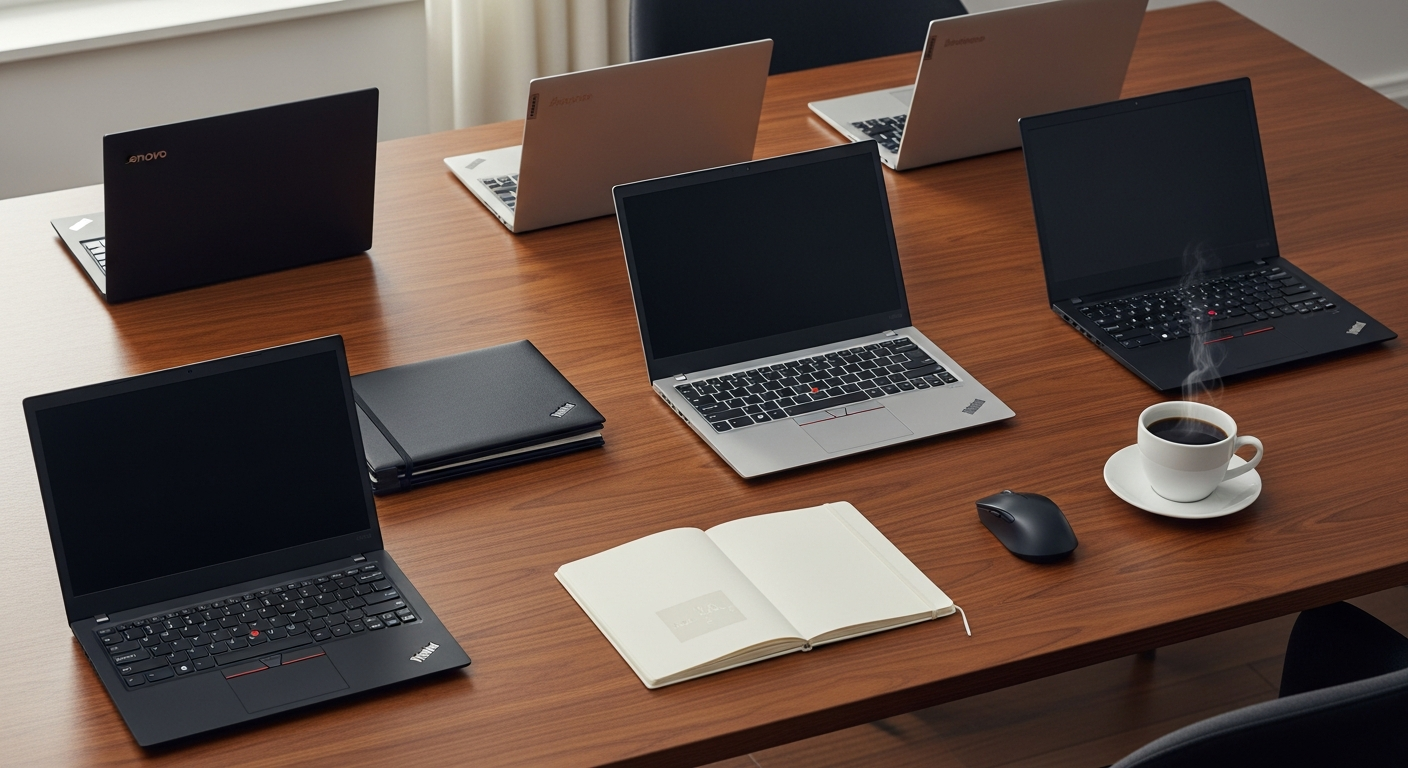
AfB social & green IT, a non-profit certified refurbisher, has become the go-to source for businesses that refuse to compromise between budget and quality. These aren’t mystery machines—they’re corporate-grade notebooks professionally restored, thoroughly tested, and backed by warranties extending up to three years. The Austrian market particularly embraces this approach, recognizing that sustainable procurement doesn’t mean settling for less.
Why Remote Teams Are Switching to Refurbished Business Notebooks
The hidden costs of buying new laptops for every team member
New laptop purchases carry expenses that extend far beyond the initial price tag. When organizations equip an entire department with brand-new devices, they’re not just paying for hardware—they’re absorbing significant markup costs built into manufacturing, marketing, and distribution channels. A team of ten employees purchasing new Lenovo business notebooks might spend €15,000 or more for comparable configurations that could be sourced refurbished for €9,000. That €6,000 difference represents real capital that could fund training, software licenses, or infrastructure improvements.
Beyond the purchase price, new devices come with hidden financial burdens. Setup time, driver installations, and IT configuration require labor hours that compound costs. New hardware also arrives with predetermined software stacks and bloatware that often requires removal. Refurbished devices from AfB arrive pre-configured and deployment-ready, eliminating these indirect expenses.
How refurbished devices eliminate the new laptop depreciation cliff
New laptops experience a dramatic depreciation curve. A €1,500 new notebook loses 20-30% of its value within the first year and continues declining steeply for three years. Organizations that purchase new equipment face a harsh reality: their €150,000 fleet investment becomes worth roughly €60,000 within 36 months. Refurbished devices already exist on the downslope of this depreciation curve. A refurbished Lenovo notebook priced at €600 has minimal remaining depreciation—it maintains functional and resale value far more predictably than a new device.
This pricing stability matters when planning multi-year technology cycles. Refurbished notebooks continue performing reliably through their warranty periods without losing value at the accelerated rates that plague new purchases. Teams can confidently project replacement schedules without factoring in sudden equipment obsolescence.
Real-world ROI: comparing total cost of ownership over 3-5 years
Total cost of ownership analysis reveals why refurbished devices make financial sense across longer time horizons. Consider a scenario with five new Lenovo business notebooks at €1,400 each (€7,000 initial investment) versus five refurbished units at €840 each (€4,200 initial investment). The refurbished option saves €2,800 immediately.
Over five years, add support and maintenance costs. New devices typically include one year of standard warranty, requiring €400-600 per device for extended coverage. Refurbished devices from AfB include warranties up to three years as standard, reducing additional coverage needs. The cumulative five-year cost for new devices approaches €9,500 per unit (including extended warranty, occasional repairs, and eventual replacement). Refurbished devices maintain €1,200-1,500 per unit in total five-year costs. The difference scales dramatically across larger teams: a 50-person department realizes €400,000-500,000 in savings over five years.
Understanding AfB’s Refurbishment & Certification Process
Certified data erasure protocols that exceed industry security standards
AfB’s approach to data security sets the standard for responsible refurbishment. Every device undergoes certified data erasure using methods that exceed industry requirements, ensuring complete removal of previous organizational data. The refurbishment process involves multiple verification stages where certified technicians confirm that erasure protocols meet and surpass standards set by international data protection regulations. This commitment matters especially for teams handling sensitive client information or proprietary materials—they gain assurance that purchased devices arrive genuinely clean.
The certification process includes documentation proving that erasure protocols followed specific standards (such as DBAN or equivalent). Organizations receive verification paperwork with each purchase, providing audit trail evidence that purchased equipment meets compliance requirements. This transparency distinguishes AfB from less rigorous refurbishers operating without documented security procedures.
Multi-stage quality testing procedures before devices reach customers
AfB implements comprehensive quality testing across multiple stages before notebooks reach customers. Initial assessment identifies physical condition and functional status. Hardware diagnostics run on processors, RAM, storage drives, displays, and peripherals to verify performance specifications. Thermal testing ensures cooling systems function properly under load—critical for devices handling video conferencing and resource-intensive applications.
Subsequent stages involve stress testing where devices run demanding applications over extended periods. Technicians verify battery health, keyboard responsiveness, trackpad functionality, and port operations. Display quality checks assess for dead pixels and color consistency. Network connectivity receives testing on both wired and wireless connections. Operating system testing confirms that Windows 11 licensing activates properly and system stability remains solid. Only devices passing all testing phases proceed to customer delivery.
Professional cleaning and component upgrades that restore devices to like new condition
Physical restoration complements technical verification. Professional cleaning removes accumulated dust, fingerprints, and debris from internal and external surfaces, returning devices to aesthetic condition. Where warranted, AfB technicians replace worn components—upgrading storage drives to faster SSDs, installing additional RAM where applicable, or refreshing thermal paste on processors. These upgrades enhance performance beyond original specifications, particularly benefiting devices with several years of previous use.
The cosmetic grading system transparently communicates condition levels. Devices graded “like new” show minimal signs of previous use. “Good” condition units display typical light wear patterns. “Fair” condition devices may have more visible scratching or minor dents but function identically to higher grades. This tiering allows organizations to match budgets with acceptable cosmetic standards while maintaining identical technical performance guarantees.
Specifications That Actually Matter for Remote Work Performance
Processor power breakdown: Intel Core i5 vs. i7 for video conferencing and multitasking
Remote work performance depends substantially on processor capability, particularly for teams relying on video conferencing and simultaneous application use. Intel Core i5 processors (such as the i5 10310U or i5 1145G7 commonly found in AfB’s inventory) deliver reliable performance for typical remote work scenarios. These processors handle video conferencing with screen sharing, email management, document editing, and web browsing simultaneously without performance degradation. Teams managing calendar applications, messaging platforms, and productivity software operate smoothly on Core i5 hardware.
Intel Core i7 processors provide noticeably superior performance for power users managing demanding workloads. Creative professionals working with image editing software, data analysts running complex spreadsheet operations, or developers compiling code benefit from Core i7’s additional processing power and cache. For standard remote work roles—account managers, customer service representatives, administrative professionals—Core i5 processors deliver excellent performance at lower cost. Core i7 justifies selection primarily when team members regularly handle CPU-intensive tasks that Core i5 would struggle to manage efficiently.
RAM requirements: why 8GB works for basic tasks, 16GB for power users
System memory fundamentally affects multitasking capability. Remote work on 8GB RAM handles web browsing, email, document editing, and standard video conferencing without performance issues. Single-application focus or light multitasking operates flawlessly. However, when team members maintain twenty browser tabs, run video conferencing alongside document editing and background file syncing, 8GB RAM creates noticeable slowdown and occasional freezing.
16GB RAM provides comfortable headroom for intensive multitasking and power users managing demanding applications. Data analysts, creative professionals, and developers benefit substantially from 16GB configurations. Most refurbished Lenovo business notebooks from AfB come equipped with either 8GB or 16GB DDR4 RAM. Assessing team member work patterns guides selection: operational teams performing lighter tasks succeed with 8GB systems, while technical and creative roles justify 16GB investment.
SSD storage advantages: 250GB versus 500GB for typical remote work workflows
Storage capacity and drive type significantly impact user experience. Solid-state drives (SSDs) dramatically outperform older mechanical drives, offering rapid application launches, quick file access, and responsive system operation. Modern Windows 11 and typical business applications consume approximately 50-80GB of storage space, leaving substantial capacity for user files, downloads, and documents.
250GB SSDs provide adequate capacity for team members who primarily access cloud-stored documents and files. Organizations using Microsoft 365, Google Workspace, or similar cloud platforms find that local storage requirements remain minimal. Team members store working documents temporarily during active editing, then sync to cloud storage. 250GB systems work effectively when cloud infrastructure handles primary data storage.
500GB SSDs benefit users who maintain larger local file libraries, download frequent project materials, or require backup copies of critical documents. Creative professionals managing multiple project folders and media files appreciate the additional breathing room. For most remote teams operating through cloud-based workflows, 250GB represents sufficient capacity at lower cost.
The Financial Reality: Where the 40% Savings Actually Come From
Detailed price comparison: refurbished versus new equivalent models
The 40% cost savings reflected in AfB’s pricing stems from multiple sources. A new Lenovo ThinkPad E14 with Intel Core i5, 8GB RAM, and 256GB SSD typically retails at €1,200-1,400 in Austrian markets. The equivalent refurbished configuration from AfB prices around €700-840. This variance reflects several factors: eliminated marketing and distribution costs, absence of new product development expenses, and reduced overhead from refurbishment versus new manufacturing.
Retailers selling new hardware embed substantial margins and advertising costs into pricing. AfB operates as a non-profit organization without pressures to maximize shareholder returns, allowing pricing that passes savings directly to customers. When comparing five-unit purchases, the financial difference becomes compelling: a €2,200-2,800 savings across five notebooks represents real budget impact.
Breakdown of factors affecting refurbished pricing based on age, specs, and cosmetic grading
Refurbished pricing incorporates several variable factors. Age matters significantly—more recent business generations command higher prices than older models, reflecting superior components and longer expected functional lifespans. A 2021 Lenovo ThinkPad notebook costs more than a 2018 equivalent because its processor, RAM availability, and storage technology represent more current standards.
Specification levels directly influence pricing. 16GB RAM configurations cost substantially more than 8GB equivalents. 500GB SSD storage exceeds 250GB pricing. Higher processor generations (Core i7 versus Core i5) increase cost proportionally. Cosmetic grading also affects price: “like new” condition devices command premium pricing over “good” or “fair” condition notebooks with identical technical specifications. Organizations can optimize purchasing by selecting specifications matching actual needs and accepting cosmetic condition appropriate for budget constraints.
Extended warranty value: how 3-year protection compares to new device coverage
Standard new device warranties typically extend one year with optional extensions costing €300-500 for three-year coverage. AfB includes three-year warranties as standard on most refurbished notebooks, eliminating additional warranty expenses that would apply to new purchases. This warranty coverage provides genuine value: device repairs or replacements during the three-year period occur at no additional cost to purchasing organizations.
The warranty value becomes apparent when comparing total cost calculations. A refurbished notebook at €800 with included three-year warranty versus a new device at €1,400 with one-year standard warranty represents approximately €900 additional cost for the new purchase when adding three-year extended coverage. This warranty differential contributes substantially to the 40% savings realization. Organizations gain protection extending well into the device’s useful lifespan while avoiding expensive extended warranty premiums.
Sustainability Impact Beyond the Price Tag
E-waste reduction: quantifying the environmental benefit per device
Electronic waste represents one of the fastest-growing waste streams globally, with an estimated 57 million tons generated annually. Each new laptop manufactured requires extraction of rare earth metals, copper, and other materials, consuming substantial energy and water resources. Refurbished devices dramatically reduce environmental burden by extending hardware lifespan and preventing premature disposal.
A single refurbished Lenovo notebook prevents approximately 50-70 kilograms of electronic waste from landfills. Organizations purchasing fifty refurbished devices collectively divert 2,500-3,500 kilograms of e-waste from environmental harm. When multiplied across the thousands of devices AfB refurbishes annually, the cumulative e-waste prevention becomes extraordinary. Each refurbished device represents one fewer notebook requiring mining operations, manufacturing energy, and eventual toxic disposal.
Carbon footprint comparison: refurbished versus new manufacturing and shipping
Manufacturing carbon footprint for new electronics represents a substantial environmental cost. Creating a new laptop generates approximately 300-400 kilograms of CO2 emissions when accounting for mining, manufacturing, and transportation. Refurbishing existing hardware generates approximately 20-30 kilograms of CO2 through cleaning, testing, and shipping—roughly 90% lower carbon impact compared to new manufacturing.
Consider an organization equipping a fifty-person department. New notebooks would generate 15,000-20,000 kilograms of CO2 through manufacturing processes alone. Refurbished alternatives create just 1,000-1,500 kilograms of carbon emissions. The environmental impact differential scales substantially across larger purchasing decisions. Organizations committed to corporate sustainability goals find that refurbished procurement delivers measurable carbon reduction aligned with ESG objectives.
How purchasing refurbished supports circular economy principles and corporate ESG initiatives
The circular economy model emphasizes extending product lifecycles rather than pursuing linear extraction-to-disposal patterns. Refurbished hardware exemplifies circular principles by extending device functionality through additional useful years, reducing the constant demand for new manufacturing. Organizations purchasing refurbished equipment actively participate in circular models rather than perpetuating consumption cycles dependent on continuous new production.
Corporate ESG (Environmental, Social, and Governance) initiatives increasingly emphasize sustainable procurement. Purchasing decisions that reduce environmental impact while supporting non-profit organizations creating employment opportunities for people with disabilities score strongly on ESG metrics. AfB’s business model combines environmental responsibility with social inclusion, allowing purchasing organizations to advance multiple ESG objectives simultaneously through single procurement decisions. Transparent reporting on refurbished notebook purchases provides documentation supporting corporate sustainability reporting and stakeholder communications.
The Smart Shift: Refurbished Performance Meets Responsible Procurement
Your remote team deserves equipment that works flawlessly, your budget deserves breathing room, and your environmental conscience deserves peace. Refurbished Lenovo business notebooks from AfB deliver on all three fronts simultaneously.
The 40% cost savings alone justify consideration, but that’s genuinely the least compelling reason to make this switch. You’re gaining access to business-grade hardware professionally restored and thoroughly tested, supporting a non-profit organization that employs people with disabilities, and actively participating in the circular economy. The devices arrive configured and deployment-ready, come backed by warranties extending up to three years, and maintain functional value far more predictably than new purchases depreciating steeply over identical timeframes.
The only real question isn’t whether refurbished Lenovo business notebooks make sense—it’s why you haven’t already explored AfB’s current inventory. Start by assessing your team’s actual performance needs: will they benefit from 16GB RAM or does 8GB suffice? Do they require 500GB storage or will 250GB handle cloud-based workflows? Does your team perform tasks justifying Core i7 processors or will Core i5 deliver the performance you need?
Compare those requirements against available specifications in AfB’s current stock. Request a quote for your configuration and review the cosmetic grading options matching your budget parameters. Calculate your three-year total cost of ownership comparing refurbished options against new equivalent models.
Leave a Reply