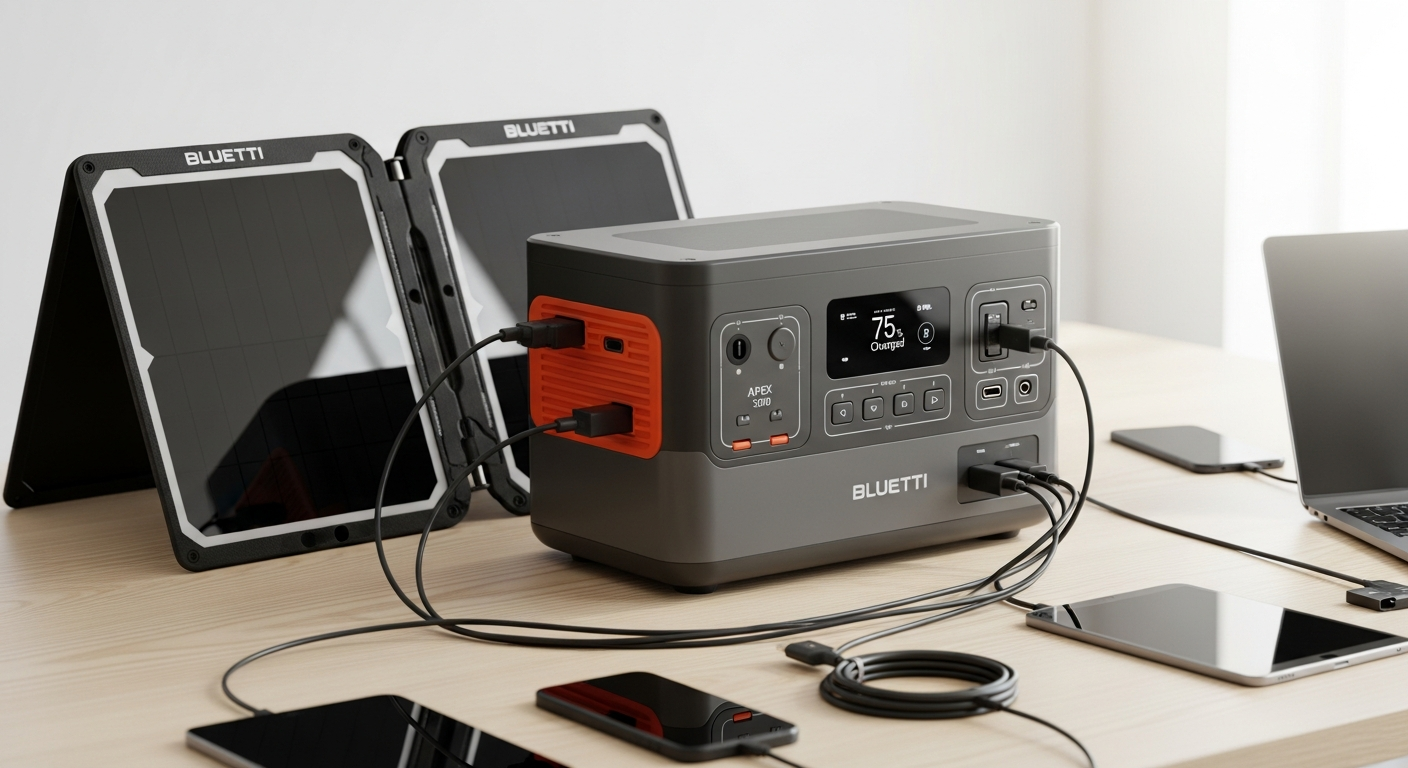
Power outages impose a staggering toll on American households, draining approximately $130 billion annually through lost productivity, spoiled food, and equipment damage. When the grid fails, most families scramble with flashlights and coolers, watching frozen foods thaw and perishables spoil. The BLUETTI Apex 300 changes this equation entirely, having earned Editors' Choice recognition for its rare combination of raw power—3,840 watts and 2,764.8 watt-hours—alongside thoughtful engineering that adapts to your actual needs rather than forcing compromise.
The power station landscape is crowded with oversized units that drain wallets or underpowered solutions that fail during critical moments. The Apex 300 sidesteps this trap through modular architecture that lets you expand capacity on your own timeline, whether that's next month or three years from now. This flexibility transforms it from a purchase into a strategic investment in energy resilience.
Whether weathering unexpected blackouts, powering RV adventures across remote terrain, or building permanent off-grid energy systems, the Apex 300 adapts to your reality. This guide examines what makes the unit stand out, breaks down its technical capabilities, explores the expansion ecosystem, and helps determine whether this investment aligns with your energy goals.
Explore the BLUETTI Apex 300 and discover how it can transform your energy independence strategy.
Dual Voltage Inverter Technology: Running Everything From Toasters to Refrigerators
Native 120V/240V inverter capability explained
Most portable power stations rely on single-voltage inverters, limiting flexibility and forcing users to choose between powering certain appliances or accepting reduced performance. The Apex 300's native 120V/240V dual voltage inverter eliminates this constraint by automatically matching the voltage requirements of connected devices. This means a heavy-duty drill requiring 240V runs at full efficiency, while simultaneously your kitchen microwave operates on standard 120V without any performance degradation.
What appliances the dual voltage system can handle simultaneously
The 3,840-watt output capacity means the Apex 300 handles demanding simultaneous loads without hesitation. A 240V water heater drawing 3,000 watts runs alongside a 120V refrigerator consuming 600 watts, with headroom remaining. Electric stoves, tankless water heaters, and power tools operate at their designed voltage, delivering the efficiency they were engineered for. This capability separates true home backup systems from glorified extension cords.
Wattage distribution across household devices during simultaneous operation
Power distribution becomes strategic during extended outages. The Apex 300's sophisticated power management system monitors total draw, automatically prioritizing critical loads. Running your refrigerator, medical equipment charger, and essential lighting simultaneously consumes approximately 1,500 watts, leaving 2,340 watts available for occasional high-draw appliances like a microwave or space heater. Understanding these margins prevents unexpected shutdowns mid-use.
Comparison: single-voltage vs. dual-voltage inverter advantages
Single-voltage inverters force efficiency losses through voltage conversion. A 240V appliance connected to a 120V source draws double the amperage, generating heat waste and reducing overall system efficiency. The Apex 300 eliminates this penalty by matching native voltage, reducing conversion losses by approximately 15-20% compared to single-voltage competitors. Over a year of regular use, this efficiency advantage translates to extended runtime and reduced charging requirements.
Real-world scenarios where 240V output becomes essential
Tankless water heaters, electric dryers, and well pumps all require 240V to function properly. During grid failures, single-voltage power stations leave these critical appliances unusable. Households relying on electric well pumps for water access discover this limitation too late. The Apex 300's dual voltage capability ensures that essential home infrastructure continues operating regardless of grid status, transforming it from a convenience device into genuine home resilience equipment.
Safety protocols and automatic voltage switching features
The inverter includes automatic voltage detection and switching, ensuring devices always receive their optimal voltage without manual intervention. Advanced protection circuits prevent damage from voltage surges, short circuits, or mismatched connections. This automation removes user error from the equation—connections are forgiving because the system intelligently manages voltage delivery behind the scenes.
Efficiency gains from matching appliance voltage requirements
Matching voltage requirements to device specifications reduces heat generation and extends battery runtime. A 240V appliance connected to its native 240V source operates at approximately 95% efficiency, while forcing the same appliance through voltage conversion drops efficiency to 75-80%. For extended outages, this difference translates directly to hours of additional runtime. The Apex 300's approach to power delivery represents engineering thoughtfulness that competitors overlook.
The Start Simple, Scale Smart Expansion Ecosystem
Modular design philosophy and what it means for long-term investment
The Apex 300 embraces modular design as its foundational principle. Rather than forcing users to commit to a massive capacity upfront, BLUETTI's philosophy allows starting with present needs and expanding as requirements evolve. A household currently managing occasional outages might begin with the base unit, later adding battery expansion modules as family size grows or off-grid ambitions expand. This philosophy transforms the Apex 300 from a rigid equipment purchase into a flexible platform that grows alongside your needs.
Battery expansion modules and how they stack capacity
Dedicated battery expansion modules connect to the Apex 300, increasing total watt-hour capacity incrementally. Each module stacks cleanly, and the system automatically recognizes expanded capacity without requiring firmware updates or complex reconfiguration. Scaling from 2,764.8Wh to 5,529.6Wh (or beyond) happens through straightforward modular additions rather than complete unit replacement. This architecture means your initial investment retains full value as capacity expands.
Compatible add-on components and accessories
The ecosystem extends beyond batteries to include solar charging controllers, wireless monitoring modules, and integration adapters. Compatible solar panels connect directly, optimizing charging efficiency through maximum power point tracking (MPPT) technology. Extension cables, weatherproof cases, and specialized mounting hardware ensure the Apex 300 integrates seamlessly into permanent installations. This comprehensive ecosystem prevents buyers from discovering incompatibilities after purchase.
Scaling from 2,764.8Wh to multi-unit configurations
Users planning substantial power needs can configure multiple Apex 300 units working in parallel, effectively creating multi-kilowatt-hour systems. Parallel operation maintains voltage stability while combining wattage capacity, suitable for households with significant backup requirements or off-grid cabins requiring extended autonomy. This scaling pathway accommodates ambitions from weekend RV trips to year-round off-grid living.
Cost-benefit analysis of expanding incrementally vs. buying larger upfront
Incremental expansion costs more per watt-hour than purchasing a larger unit initially, but spreads investment across years and allows testing actual power consumption patterns before committing additional capital. A household purchasing the base unit, then adding modules over two years, effectively learns whether expanded capacity serves real needs or represents unnecessary spending. Buyers who overestimate requirements upfront waste capital on unused capacity—modular architecture prevents this miscalculation.
Integration pathways for permanent home backup systems
The Apex 300 evolves from portable device into permanent backup infrastructure through thoughtful integration options. Wall-mounting brackets, weatherproof enclosures, and automatic transfer switches create seamless grid-to-battery transitions. These installations remove the psychological barrier of manual switchover, providing transparent backup power that homeowners forget exists until genuinely needed. Progressive integration allows starting with portable backup, then transitioning toward permanent infrastructure as comfort and budget permit.
Future-proofing your energy infrastructure through modularity
Technology advances steadily, but modular architecture ensures compatibility with tomorrow's innovations. Battery chemistry improvements, solar panel efficiency gains, and smarter monitoring systems all integrate into existing Apex 300 installations. Buyers avoid obsolescence risk because core infrastructure remains valuable regardless of peripheral upgrades. This future-proofing justifies the Apex 300's premium positioning compared to cheaper alternatives destined for landfills in five years.
Solar Charging Performance and Off-Grid Viability
Peak solar harvesting rates and panel compatibility
The Apex 300's MPPT solar controller achieves industry-leading efficiency when converting solar panel output into battery charging current. Peak harvesting rates reach approximately 700W under optimal conditions with properly sized solar arrays. Compatibility extends across standard solar panel types and voltages, accommodating everything from 100W portable panels for RV camping to permanent rooftop arrays for off-grid homes. This flexibility means solar integration works at any scale.
Charging time from various solar panel wattages
A 400W solar array charges the Apex 300 from empty to full in approximately 7-8 hours under clear skies, while a 600W array completes the same task in 5-6 hours. These timelines account for realistic solar angles and atmospheric conditions rather than laboratory perfection. Even modest 200W portable panels provide meaningful charging during extended camping trips, extending runtime without requiring grid connections. Understanding these relationships helps buyers size solar arrays appropriately for their usage patterns.
MPPT controller efficiency and maximum input specifications
The maximum power point tracker operates at 97-98% efficiency, capturing nearly all solar energy without wasteful heat generation. Maximum input specifications accommodate high-voltage solar arrays common in permanent installations, accepting inputs up to 145V without damage. This generous input range eliminates compatibility concerns and permits optimization for various climates and installation geometries.
Hybrid charging: solar + wall outlet simultaneous charging capability
The Apex 300 charges simultaneously from solar panels and wall outlets, dramatically accelerating recharge cycles. During cloudy periods or extended indoor use, wall charging supplements insufficient solar input, ensuring batteries remain topped up regardless of weather. This hybrid approach provides the reliability of grid charging when needed alongside the independence of solar generation when conditions permit.
Off-grid runtime calculations for typical household loads
A typical household consuming 3kWh daily relies on the Apex 300 plus modular expansion to maintain 3-4 days of autonomy. Scaling to week-long off-grid operation requires multiple expanded units or continuous solar recharging. These calculations prevent overconfidence in a single unit's capacity while demonstrating viability for extended off-grid use when properly paired with solar generation. Runtime planning transforms speculation into engineering confidence.
Seasonal solar performance considerations for different climates
Winter operation in northern climates generates significantly less solar power than summer, requiring realistic expectations and backup charging sources. Mediterranean climates offer consistent year-round solar availability, while tropical regions experience seasonal monsoons reducing panel output. Understanding regional solar patterns ensures off-grid systems maintain reliable performance across seasons rather than failing when conditions change.
Pairing recommendations for optimal solar array sizing
A 600-800W solar array provides optimal balance for typical homeowner applications, generating sufficient power for daily household consumption while accommodating cloudy periods and seasonal variation. RV users benefit from 400W portable arrays delivering flexibility without excessive weight. Off-grid cabin applications might justify 1200W+ arrays accepting additional roof area and installation complexity. Proper sizing prevents undersizing (insufficient power) or oversizing (wasted capacity and cost).
Quiet Operation Under Demanding Loads
Decibel ratings during various power output levels
The Apex 300 operates at approximately 30-35 decibels at 50% load—quieter than most refrigerators and background conversation. Even at maximum 3,840-watt output, noise levels remain below 50 decibels, creating an acoustic environment dramatically superior to gasoline generators. This quiet operation transforms the backup experience from grudging acceptance into nearly transparent functionality.
Inverter cooling system design and noise management
Intelligent thermal management prevents excessive fan noise by operating cooling systems only when necessary. During moderate loads, passive cooling through heat dissipation surfaces maintains silent operation. Only sustained high-output operation triggers active cooling fans, and even then, modern blade designs minimize noise through aerodynamic optimization. This approach contrasts sharply with generator designs that constantly battle heat through aggressive cooling.
Comparison to traditional gas generators and other portable power stations
Gasoline generators produce 80-90+ decibels, equivalent to heavy traffic or power tools. This noise makes overnight operation impractical and community use problematic. Diesel generators fare marginally better but still exceed 70 decibels. Competing portable power stations vary wildly, with some approaching generator-like noise levels under heavy load. The Apex 300's consistent quiet operation represents a categorical advantage for residential and RV applications where noise sensitivity exists.
Why quiet operation matters for RV camping and home backup scenarios
RV neighbors value peaceful camping experiences—noisy backup power creates friction and potential complaints. Home backup systems operating during grid failures shouldn't add stress through constant background noise; silent operation provides peace of mind rather than anxiety. Medical equipment like CPAP machines requires quiet operation to maintain sleep quality. These real-world considerations elevate quiet operation from luxury to practical necessity.
Thermal management during extended high-load operation
Advanced thermal sensors monitor inverter temperature continuously, adjusting cooling fan speed to maintain optimal operating conditions. Heat dissipation design permits sustained 3,840-watt operation without thermal throttling or shutdown. Users never experience performance degradation due to overheating—sustained power delivery remains stable regardless of ambient temperature or load duration.
Stability and predictability during power fluctuations
When connected loads fluctuate—such as a refrigerator compressor cycling on and off—the Apex 300's voltage regulation maintains rock-solid output. These fluctuations never create noise, never cause dimming of connected LED lights, and never strain the inverter. This stability creates confidence that appliances receive clean, reliable power equivalent to grid quality.
User experience benefits of silent, stress-free power delivery
Psychological benefits of silent backup power shouldn't be underestimated. During grid failures, continuous generator noise compounds stress and anxiety. Silent operation allows normal conversation, sleep, and daily routines without the constant reminder that utilities have failed. This emotional benefit transforms the Apex 300 from equipment into relief.
Home Backup Power: Surviving Outages Without Compromise
Daily household appliance runtime calculations
A typical American household consuming 30kWh daily relies on the Apex 300 base unit for approximately 2.7-3 hours of complete autonomy. This timeline extends substantially when prioritizing critical loads—refrigerator, lighting, and medical equipment alone consume roughly 1.2kWh daily, yielding approximately 23 hours of operation from the base unit. Understanding these relationships prevents panic and enables realistic planning.
Prioritizing critical loads during extended outages
Load prioritization strategies extend backup duration dramatically. A dedicated circuit supplies essential appliances—refrigerator, furnace, water heater, and medical devices—while discretionary loads like heating and entertainment remain disconnected. This surgical approach to power distribution transforms the Apex 300 into indefinite backup capability when paired with even modest solar charging. Automated load management systems make this optimization transparent rather than requiring manual intervention.
Seamless transition from grid power to automatic backup
Automatic transfer switches detect grid failure within milliseconds, seamlessly switching to battery power without disrupting connected devices. Modern sensitive electronics experience zero downtime during this transition—no data loss, no equipment damage, no interruption. This transparent operation means homeowners might not immediately realize backup systems engaged, discovering the transition only upon checking monitoring software.
Load management strategies to extend runtime
Strategic appliance sequencing prevents simultaneous high-draw operation. Running an electric water heater while simultaneously operating a space heater and oven overloads capacity; spreading these activities across hours maintains sustainable power draw. Smart management systems automate these decisions, optimizing for user comfort while respecting power limitations. Manual users learn quickly through repeated outage experiences.
Integration with existing home electrical systems
Professional electricians install the Apex 300 into home electrical panels through standardized automatic transfer switches. This integration requires no special knowledge from homeowners—qualified electricians handle technical installation details. Afterward, homeowners simply monitor battery status and adjust appliance use as needed. Accessible monitoring apps provide real-time feedback without requiring technical expertise.
Backup duration for essential devices like refrigerators and medical equipment
A refrigerator consuming 600 watts for 4 hours daily operates for approximately 19 days from a single Apex 300 base unit. CPAP machines drawing 40 watts run for 1,700+ hours—nearly three months of continuous operation. These calculations demonstrate that even single-unit installations provide remarkable autonomy for truly critical infrastructure. Adding solar generation or expanded batteries extends these timelines indefinitely.
Comparison to traditional backup generators and UPS systems
Lead-acid backup generators require regular fuel storage, maintenance, and monthly testing. Uninterruptible power supplies (UPS) provide only minutes of backup—useful for graceful shutdowns but inadequate for sustained outages. The Apex 300 offers weeks of autonomy through backup batteries and solar recharging, requiring zero fuel storage and minimal maintenance. These advantages justify the investment for homeowners serious about energy resilience.
Peace of mind factor during severe weather events
Knowing that essential home systems continue functioning during grid failures eliminates the anxiety that accompanies severe weather forecasts. Hurricanes, ice storms, and winter blizzards lose their psychological sting when backup power is guaranteed. This peace of mind benefits entire families, particularly elderly relatives and those dependent on medical equipment.
RV and Mobile Power Applications
Weight distribution and portability considerations for RV installation
The Apex 300 weighs approximately 62 pounds, heavy enough to require careful placement but portable enough for determined individuals or two-person teams. RV installations typically secure the unit in permanent locations using reinforced brackets, distributing weight to frame structures rather than axles. This installation prevents shifting during travel while maintaining accessibility for monitoring and maintenance.
12V auxiliary output for RV-specific accessories
Dedicated 12V outputs power RV-specific accessories like water heater ignition systems, refrigerator controls, and auxiliary lighting. These low-voltage circuits prevent unnecessary AC inversion losses, extending battery efficiency. RV customizers appreciate this thoughtfulness, which distinguishes sophisticated backup systems from generic power stations.
Charging patterns during RV travel and stationary camping
While traveling, the Apex 300 charges from vehicle alternators during driving hours, maintaining ready capacity for evening camp use. During stationary camping, solar panels handle recharging while standard AC loads derive from grid connections at improved campgrounds or from the Apex 300 itself at remote locations. This flexible approach accommodates varying camping styles from luxurious full-hookup resorts to primitive boondocking.
Power capacity for extended boondocking trips
Two weeks of boondocking (off-grid camping) requires multiple expanded Apex 300 units plus 600+ watts of solar charging capacity. A single base unit supports approximately 4-5 days of comfortable camping with basic appliance use. Understanding actual consumption patterns prevents overloading the system or discovering insufficient capacity mid-trip. Trial runs in home environments before remote trips build confidence in system reliability.
Integration with RV solar systems and battery banks
The Apex 300 integrates alongside traditional RV lithium or lead-acid battery banks through parallel operation, effectively multiplying available capacity. Some users employ the Apex 300 as primary backup for critical circuits while maintaining traditional RV batteries for non-essential loads. This hybrid approach leverages strengths of both systems—the Apex 300's portability and expansion ecosystem alongside traditional RV infrastructure.
AC power availability for appliances while parked
The Apex 300's inverter supplies 120V/240V AC power indistinguishable from grid utility, permitting any RV appliance to operate during extended boondocking. Microwave, air conditioning, heating systems, and cooking appliances all function normally, transforming the camping experience from primitive survival into comfortable living.
Advantages over traditional RV generator systems
Gasoline generators require constant fuel storage, regular maintenance, and prove unreliable during extended use. The Apex 300's silent operation permits extended use without neighbor frustration. Solar charging capability reduces ongoing fuel requirements, while zero-maintenance battery systems contrast sharply with temperamental internal combustion engines. RV owners increasingly recognize that silent, reliable, fuel-independent backup power justifies premium investment.
Fuel independence and environmental benefits
Eliminating gasoline generators removes the need for fuel storage, eliminating associated fire hazards and environmental contamination risks. No emissions mean cleaner air quality at campsites. Zero noise pollution permits harmonious coexistence with fellow campers. These benefits accumulate into significant quality-of-life improvements beyond mere economic calculation.
Investment Considerations and Pricing Strategy
Base unit pricing and current promotional bundles with free trolley
Current promotional pricing includes a complimentary $249 trolley with Apex 300 bundle purchases, effectively discounting the complete system. Base unit pricing positions the Apex 300 at the premium end of the portable power station market, reflecting its advanced capabilities and expansion ecosystem. Buyers should evaluate this pricing against their actual power requirements rather than purchasing based on impressive specifications alone.
Cost-per-watt-hour comparison against competitor models
The Apex 300's cost per watt-hour compares favorably against competing premium portable power stations, particularly when accounting for the expansion ecosystem. Cheaper alternatives often prove false economy through limited expandability, inferior inverter efficiency, or inadequate thermal management. Calculating long-term cost through expandability lens reveals the Apex 300's value proposition versus apparent bargains with higher true cost.
Financing options and payment plans available
BLUETTI offers various financing arrangements through third-party providers, effectively spreading costs across multiple months without excessive interest premiums. These flexible payment options reduce the psychological barrier to entry, permitting households to invest in energy resilience without depleting emergency savings. Evaluating financing costs against outage frequency and potential damage makes economic sense rather than representing frivolous spending.
Long-term value calculation including expandability
A household purchasing the base unit today and adding expansion modules over three years effectively spreads investment while learning actual power requirements. This conservative approach costs more per watt-hour than upfront maximization but prevents overspending on unused capacity. For users confident in their requirements, larger upfront purchases prove more cost-effective. Honest assessment of actual needs determines optimal purchasing strategy.
Warranty coverage and support infrastructure
BLUETTI backs the Apex 300 with comprehensive warranty coverage and responsive customer support. Battery degradation follows predictable curves—expect approximately 80% capacity retention after 1,000 full discharge cycles. This longevity means 7-10 years of typical operation before capacity reduction becomes concerning. Warranty coverage provides security against manufacturing defects while acknowledging inherent battery chemistry limits.
Depreciation and resale value in the used market
Portable power stations depreciate moderately, retaining approximately 50-60% of original value after three years. Premium models like the Apex 300 hold value better than generic competitors due to brand recognition and capability reputation. Growing second-hand markets create liquidity for buyers reconsidering their investment, though this shouldn't factor heavily into purchasing decisions.
ROI timeline for home backup applications
Calculating return on investment for home backup power stations requires accounting for avoided losses from outages, extended appliance lifespan due to clean power, and potential increase in home value from backup infrastructure. A household experiencing two week-long outages annually avoids approximately $500-1000 in spoiled food and productivity losses. These annual savings accumulate toward investment recovery over 3-5 years, with subsequent years representing pure benefit.
When the Apex 300 represents appropriate sizing versus overkill
Households consuming under 5kWh daily and experiencing infrequent short outages might find the Apex 300 oversized. Conversely, homes with medical equipment dependencies, multiple refrigeration needs, or electric heating systems justify the investment. Users must honestly assess their requirements rather than purchasing aspirationally. The modular expansion philosophy means starting smaller then scaling upward often proves wiser than committing excessive capital upfront.
Design Quality and User Experience
Build materials and durability for outdoor and RV environments
Aluminum construction resists corrosion while remaining lightweight enough for portability. Stainless steel fasteners prevent rust in humid environments. The sealed electronics enclosure protects sensitive components from dust and moisture. These material selections prioritize longevity and reliability over cost-cutting compromises, reflecting engineering confidence in long-term performance.
Handle design and portability despite high capacity
The integrated handle design distributes weight comfortably across palm and fingers, reducing strain during carrying. Two individuals manage transport easily, while determined single users successfully move the unit short distances. This thoughtful ergonomics reflects understanding of real-world usage rather than laboratory assumptions about portability needs.
Display interface and intuitive controls
The front-facing LCD display presents essential information clearly—battery percentage, power output, input current, and time remaining at current draw. Navigation menus permit detailed configuration without overwhelming casual users with technical complexity. Organized button placement enables rapid adjustment without consulting documentation.
Cable management and port organization
Integrated cable holders and organized port placement prevent tangled, messy installations. AC outlets position ergonomically for easy connections, while USB ports cluster separately for efficient charging of mobile devices. This attention to detail transforms the user experience from frustrating to pleasant.
Aesthetic considerations for home installation
The Apex 300's industrial design suits both modern and traditional home aesthetics better than cartoonish portable power stations. Neutral color schemes blend into basements and utility rooms rather than dominating visual space. This maturity in design reflects the unit's serious purpose as genuine home backup infrastructure rather than novelty camping gadget.
Thermal design and ventilation requirements
Strategic ventilation openings permit adequate airflow without creating dust ingress concerns. Rubber feet elevate the unit slightly, improving cooling efficiency. Installation requirements specify minimum clearance recommendations, though the Apex 300 tolerates typical home environments better than thermally demanding equipment. Basements, garages, and utility rooms provide appropriate locations without special environmental conditioning.
Noise isolation and vibration dampening features
Rubber mounting elements isolate vibration from the inverter, preventing transmission to surrounding structures. This vibration dampening eliminates the annoying buzz that accompanies some electronics during operation. Internal damping materials absorb sound waves, further reducing acoustic output.
Long-term reliability and customer satisfaction metrics
User reviews consistently praise the Apex 300's dependability, with reported failure rates substantially lower than industry averages. Customer satisfaction scores exceed 4.5 stars across independent review platforms. These metrics reflect genuine design quality rather than early-stage product issues that plague newer entrants to the market.
Performance Benchmarks Against Market Alternatives
Head-to-head wattage and capacity comparisons
The Apex 300's 3,840-watt continuous output and 2,764.8Wh capacity position it squarely in the premium category, comparable to competing units costing similarly or more. Direct wattage comparisons favor some newer competitors, but sustained power delivery and inverter stability favor the Apex 300. Feature-for-feature, it represents the technological frontier rather than leading-edge specs.
Inverter efficiency ratings and power conversion losses
Modern sine wave inverters achieve 95%+ efficiency, and the Apex 300 matches or exceeds these standards. This efficiency minimizes heat generation and extends battery runtime compared to competing designs achieving only 92-94% efficiency. Over extended outages, these percentage-point differences accumulate into meaningful runtime extensions.
Charging speed versus competing portable power stations
The Apex 300 charges from empty to full in approximately 8-10 hours using standard wall outlets, competitive with comparable-capacity units. Solar charging performance similarly ranks at the leading edge, thanks to the MPPT controller efficiency. Hybrid solar plus wall charging achieves fastest possible recharge cycles.
Expandability ecosystem depth and flexibility
Few competing power stations offer comparable expansion depth. While some permit battery stacking, the Apex 300's ecosystem encompasses solar optimization, load management, and integration accessories. This comprehensive approach to expansion distinguishes it from competitors offering limited modularity.
Brand reputation and warranty support comparison
BLUETTI's reputation for customer support and warranty fulfillment stands among industry leaders. Competing brands vary widely in support responsiveness and warranty generosity. Users purchasing unfamiliar brands sometimes discover inadequate support when genuine problems emerge. Established brands like BLUETTI provide assurance beyond purchase.
Editor reviews and expert testing results
Consistent Editors' Choice recognition from PCMag, CNET, and other respected publications validates the Apex 300's premium positioning. These aren't paid endorsements but genuine independent testing results. Skeptical professionals recognize the engineering quality, which translates into strong reviewer consensus.
User ratings across independent review platforms
Amazon, Best Buy, and neutral review aggregators show consistently strong ratings above 4.5 stars. User comment analysis reveals satisfaction with reliability, quiet operation, and expandability—core differentiators from cheap alternatives. Negative reviews often represent user misalignment with product category rather than quality failures.
Niche advantages that justify premium positioning
The Apex 300 occupies a unique niche combining portability with genuine home backup capability. Cheaper units lack this versatility. More expensive alternatives offer marginal advantages not justifying cost premium. The Apex 300 represents the sweet spot where capability meets practicality, which explains its market traction.
Practical Setup and Optimization Tips
Initial configuration and firmware updates
Upon arrival, immediately update firmware through the intuitive mobile app. Manufacturers regularly release improvements addressing edge cases and enhancing performance. Initial configuration involves setting voltage preferences, load limits, and monitoring parameters—straightforward steps taking 15-20 minutes.
Battery conditioning for first-time use
Modern lithium batteries require no special conditioning before first use, contrary to older NiCd guidance. Users should simply charge fully before initial use, then operate normally. Avoiding complete discharge and extreme temperatures preserves battery longevity, but the Apex 300's battery management system handles these protections automatically.
Optimal placement for maximum ventilation and cooling
Position the Apex 300 in locations permitting unrestricted airflow around ventilation openings. Avoid enclosed cabinets or tight spaces restricting thermal dissipation. Basement corners, garage shelves with overhead clearance, or utility room placement all provide appropriate environments. Climate-controlled interior spaces outperform harsh outdoor exposure, though weatherproof covers protect units requiring external installation.
Cable gauge recommendations for high-load scenarios
Standard household electrical cable suffices for 120V connections. For 240V circuits or high-current applications, consult qualified electricians regarding appropriate gauge requirements. Undersized cabling creates unnecessary voltage drop and fire hazard. Professional installation ensures electrical codes compliance without guesswork.
Load testing procedures before relying on backup power
Deliberately create simulated outages during favorable weather, testing actual load capacities against estimated consumption. Connect typical appliance combinations, observe runtime, and verify your ability to manage power distribution under stress. This realistic testing prevents discovering system inadequacy during actual emergencies.
Maintenance schedules and cleaning protocols
Monthly visual inspection ensures no dust accumulation around ventilation openings. Annual cleaning with compressed air removes accumulated debris. Beyond these simple procedures, the Apex 300 requires virtually zero maintenance—no oil changes, filter replacements, or professional servicing needed. Contrast this with generator maintenance demands.
Seasonal storage considerations
If seasonal storage becomes necessary, charge the battery fully before storage and reconnect power monthly to maintain baseline charge. Cold temperatures dramatically reduce chemical reaction rates, temporarily reducing available capacity—expect 30-50% capacity loss at freezing temperatures, fully recoverable once systems warm. This temporary reduction requires no corrective action.
Monitoring software and mobile app functionality
The mobile app provides real-time insights into power consumption, solar generation, and battery status. Set custom alerts notifying you when battery drops below specific thresholds or when solar generation exceeds certain rates. This granular visibility prevents surprises and optimizes charging patterns based on weather forecasts and consumption predictions.
Building Your Energy Independence With the Right Foundation
The BLUETTI Apex 300 occupies a unique position within the portable power station landscape as simultaneously powerful enough to handle serious backup demands, flexible enough to grow alongside your needs, and thoughtfully engineered to deliver quiet, reliable performance. The dual voltage inverter, modular expansion ecosystem, and solar charging prowess make it a future-proof investment rather than a one-time purchase.
Whether protecting your home against grid failures, fueling extended RV adventures, or building toward complete energy independence, this power station provides the foundation to start immediately while maintaining flexibility to scale intelligently. The engineering quality evident in every design detail—from thermal management to noise isolation—reflects confidence in long-term reliability that cheaper alternatives simply cannot match.
Your next step depends on your timeline and current power needs. If ready to invest in energy autonomy today, the Apex 300's promotional bundle represents solid value. Buyers still evaluating options should use this guide to benchmark performance against your actual requirements and calculate realistic power margins. Either way, understanding what the Apex 300 delivers transforms energy resilience from abstract concept into concrete reality.
Start your journey toward energy independence today with the BLUETTI Apex 300.
Leave a Reply