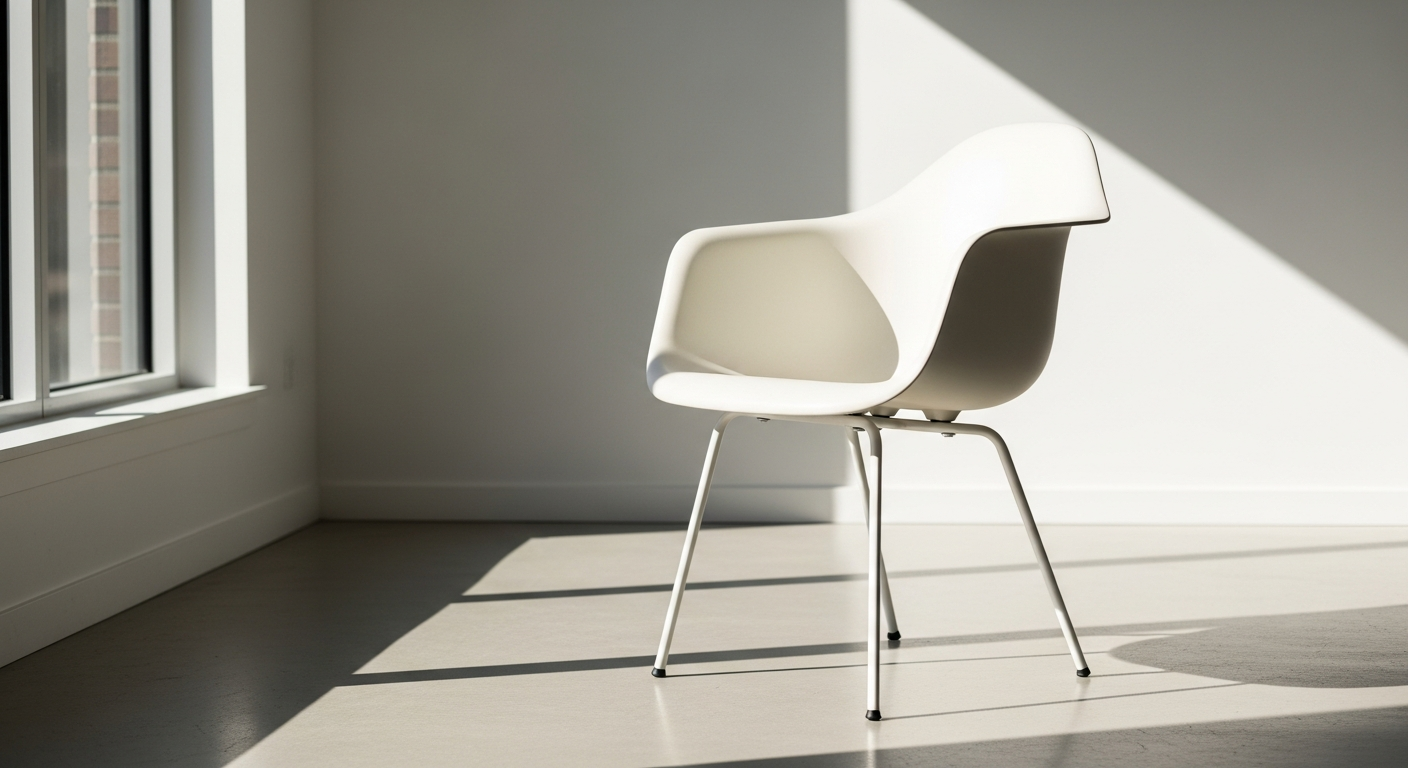
Over 75 years after its debut, the Eames Plastic Side Chair continues to dominate modern interiors—and now, the recycled RE version is reshaping how we think about luxury furniture and environmental responsibility. When Charles and Ray Eames first introduced their plastic side chair in 1950, they revolutionized furniture manufacturing. Today, Vitra's RE iteration takes that legacy further by crafting each shell from recycled polypropylene, proving that sustainability and timeless design aren't competing values.
This chair represents a fundamental shift in how premium furniture brands approach environmental stewardship without sacrificing the aesthetic or functional excellence we expect from a design classic. The marriage of heritage craftsmanship with modern ecological responsibility creates something genuinely rare in the furniture world—a piece that feels both timeless and contemporary.
Discover the Eames Plastic Side Chair RE at Bruno Wickart CH.
From Iconic Original to Recycled Reimagining—The Evolution of a Design Classic
Design lineage: How the original 1950s Eames plastic chair established the template for modern side seating
The original Eames plastic side chair arrived in 1950 as a radical departure from furniture convention. Charles and Ray Eames saw opportunity where others saw limitation: plastic wasn't viewed as a premium material, yet the designers understood its potential for organic molding and democratic production. Their vision produced a chair that could be manufactured affordably while maintaining sculptural elegance—a duality that challenged everything the furniture industry believed about cost and quality.
This design lineage matters because it established the vocabulary for modern seating. The single-piece shell, the minimalist base, the almost biological curve of the seat—these became the blueprint that countless manufacturers attempted to replicate. What made the original revolutionary wasn't just material innovation; it was the principle that good design should serve many, not remain exclusive to the wealthy.
The RE designation explained: What recycled polypropylene means and why Vitra chose this material
The "RE" designation signals Vitra's commitment to circular design principles. Rather than sourcing virgin polypropylene from petroleum extraction, Vitra sources recycled plastic—material that has already completed one lifecycle and would otherwise occupy landfill space. This choice required no compromise on the chair's fundamental properties: recycled polypropylene maintains the same structural integrity, aesthetic potential, and manufacturing flexibility as virgin material.
Vitra's decision reflects a deeper recognition that heritage brands carry responsibility. By maintaining production of this beloved design while reducing its environmental footprint, Vitra honors both the Eames legacy and contemporary ecological imperatives. The recycled content doesn't mark the chair as "lesser"—it marks it as evolved.
Manufacturing innovation: How contemporary production techniques maintain quality while reducing environmental impact
Modern production techniques for the RE version incorporate advances the Eames themselves never imagined. Computer-controlled injection molding ensures consistency across every shell, while material sourcing networks have become sophisticated enough to guarantee recycled content traceability. These innovations mean that each chair meets exacting standards while consuming fewer resources than traditional manufacturing.
The environmental benefit extends beyond material sourcing. Contemporary production facilities operate with greater energy efficiency, waste reduction systems, and water conservation measures than mid-20th-century factories. Manufacturing innovation and sustainability aren't separate pursuits—they're integrated into every stage of production.
Material Science Meets Minimalist Aesthetics—Understanding the Recycled Shell
Recycled polypropylene properties: Durability, weight, and structural integrity compared to virgin plastic
Recycled polypropylene possesses remarkable durability characteristics that directly address historical concerns about plastic furniture. The material resists warping from temperature fluctuations, maintains color stability over decades, and withstands the wear patterns of daily use—whether in residential dining rooms or high-traffic commercial environments. Weight distribution remains light enough for easy moving and stacking, yet the structural integrity proves robust enough to support regular use without degradation.
The comparison to virgin plastic reveals an important truth: recycled polypropylene doesn't underperform. Manufacturing processes have evolved to the point where recycled content achieves equivalent mechanical properties through careful material selection and processing control. Users gain durability without guilt, strength without waste.
Single-piece molding advantage: How the organic shell design improves both comfort and ergonomics
The single-piece molded shell creates an ergonomic form that responds intuitively to the human body. Rather than assembling separate back support and seat components, the unified shell curves to support the natural spine alignment and distribute weight evenly across the sitting surface. This integration delivers comfort that assembled chairs struggle to match.
From a manufacturing perspective, single-piece molding reduces assembly complexity, minimizes fastener use, and creates stronger joints than bolted connections ever could. The organic form isn't merely aesthetic—it's functionally superior and more sustainable to produce.
Environmental impact reduction: Carbon footprint savings from using recycled versus new materials
Sourcing recycled polypropylene typically requires 50-60% less energy than producing virgin polypropylene from crude oil. This energy reduction translates directly to decreased carbon emissions during production. Over the manufacturing lifecycle, the RE version produces measurably lower greenhouse gas emissions than comparable chairs made from virgin plastic.
These calculations matter because they quantify what purchasing an RE chair accomplishes. Each purchase represents concrete environmental benefit—not aspirational greenwashing, but actual emissions reduction.
Invest in sustainable design with the Eames Plastic Side Chair RE from Bruno Wickart CH.
Base Configurations That Transform Function and Aesthetic—Finding Your Perfect Match
DSR (Rod Base) variant: Best for dining applications and contemporary minimalist spaces
The DSR designation indicates a dining height side chair with a rod base—a configuration that prioritizes visual simplicity and spatial openness. The thin metal rods supporting the shell create minimal visual bulk, making the chair feel almost weightless in a room. This variant works particularly well around dining tables where sightlines matter; the open base design preserves views and doesn't interrupt conversation.
Contemporary minimalist interiors benefit enormously from the DSR's restraint. The chrome or powder-coated steel base echoes modernist principles, allowing the shell's organic form to become the focal point rather than the supporting structure.
DSX (X-Base) variant: Why this geometric base appeals to mid-century modern enthusiasts
The X-base configuration references classic mid-century modern geometry—the crossing lines create visual tension and sophistication. This variant appeals to spaces already furnished with mid-century pieces, where the geometric base language resonates with existing tables, sideboards, and lighting. The X-base offers slightly more visual presence than the rod variant, creating a bolder visual statement.
Structurally, the X-base provides excellent stability while maintaining the open aesthetic. Its geometry reads as intentional and controlled, suggesting the precision of 1950s design philosophy.
DSW (Wood Base) variant: How maple or oak options warm up industrial or Scandinavian-inspired interiors
Wood bases transform the chair's aesthetic character entirely. Maple introduces warm, light tones that bridge gap between industrial and organic aesthetics. Oak darkens the visual weight, creating sophistication appropriate for traditional or Scandinavian-inspired interiors. The wood base makes the chair feel more grounded, more tactile, more connected to natural materials.
This variant particularly suits spaces where warmth matters—residential dining rooms, home offices, or commercial environments seeking to soften industrial edges. The wood base signals intentionality: this isn't a generic molded chair, but a thoughtfully configured piece.
Versatility Across Interior Contexts—Where This Chair Truly Shines
Dining room integration: Stacking capability and visual lightness around tables of various sizes
The Eames Plastic Side Chair RE earns its place in dining rooms through practical and aesthetic advantages. The lightweight shell allows stacking for storage between gatherings, solving real challenges that face households with limited space. Visually, the chair's compact profile suits both intimate four-person tables and expansive twelve-seat dining scenarios. Around larger tables, multiple chairs create rhythm without visual clutter.
The molded plastic shell wipes clean easily, proving practical for dining environments where spills happen. Unlike upholstered chairs requiring careful maintenance, this design welcomes family life.
Home office applications: Ergonomic support for desk work without the bulk of traditional task chairs
Home offices benefit from chairs that function without demanding visual attention. The Eames chair provides legitimate ergonomic support—the shell curves to support the lower back, and the seat height aligns with standard desk configurations. Unlike elaborate task chairs with mechanical adjustments and expansive footprints, this design occupies minimal space while delivering comfort for extended sitting.
The chair's iconic status also provides psychological benefit: sitting in a design classic while working creates subtle elevation of the everyday experience. It's a small luxury that compounds across hours of daily use.
Style compatibility matrix: Seamless pairing with contemporary, mid-century modern, Scandinavian, and eclectic interiors
Contemporary minimalist spaces embrace the chair's reduction to essential forms. Mid-century modern homes appreciate its direct lineage and geometric grace. Scandinavian interiors—whether in pure form or hybrid versions—welcome the chair's functionality and material honesty. Even eclectic, personality-driven interiors accommodate the chair's neutrality and stylistic flexibility.
This compatibility exists because the design distills fundamental principles that transcend trends. The chair doesn't compete with surrounding pieces; it conversed with them, adapting to diverse visual environments while maintaining its character.
Evaluating the Investment—Cost, Quality, and Long-Term Value
Price positioning: Understanding the CHF 236.00–275.10 range in the context of designer furniture
The CHF 236.00–275.10 price point positions the Eames Plastic Side Chair RE in the accessible luxury segment—higher than mass-market furniture, substantially lower than bespoke or handcrafted options. For a design classic produced by a heritage brand using recycled materials, this pricing reflects genuine value rather than premium markup.
Understanding this range requires context. Mass-produced dining chairs might cost CHF 80–120 but require replacement within 5–10 years. Designer chairs from emerging or niche brands might occupy similar price territory with limited availability and production longevity. The Eames chair's pricing acknowledges its heritage, manufacturing quality, and production certainty.
Comparison to mass-produced alternatives: Why premium pricing reflects materials, manufacturing, and design heritage
Mass production achieves low costs through volume and design standardization—but this efficiency creates brittleness, material degradation, and frequent replacement cycles. The Eames chair's premium pricing funds several intangibles: design heritage (75 years of refinement), manufacturing precision (computer-controlled injection molding), material quality (recycled polypropylene engineered for durability), and brand reputation (Vitra's commitment to longevity).
Purchasing a cheap chair means accepting planned obsolescence. Purchasing the Eames chair means acquiring something designed to last decades—a distinction that profoundly affects true cost of ownership.
Durability ROI: How decades of use justify the initial investment versus cheaper chairs requiring replacement
Cost-per-use calculations reveal the economics clearly. A CHF 100 chair requiring replacement every five years costs CHF 20 annually. The Eames chair at CHF 250 used for 20+ years costs roughly CHF 12.50 annually while providing superior comfort and aesthetic satisfaction across those years.
Beyond pure economics, durability ROI includes the psychological benefit of ownership: living with an object that appreciates (rather than depreciates) in cultural value, using something the Eames designed, participating in a 75-year design legacy. These intangibles don't appear on spreadsheets but matter in lived experience.
The Sustainability Story—Why Environmentally Conscious Designers Choose RE
Circular economy principles: How recycled material sourcing aligns with zero-waste design philosophy
Circular economy thinking rejects the linear model of extract-manufacture-dispose. Instead, materials cycle continuously: postconsumer plastic becomes new chair shells, which eventually cycle back into production again. Vitra's recycled sourcing participates in this circular logic, reducing dependence on virgin material extraction and fossil fuel consumption.
Zero-waste design philosophy extends beyond material selection. It encompasses manufacturing efficiency, packaging reduction, product longevity (fewer replacements = less total production), and end-of-life recyclability. The RE designation acknowledges commitment to this comprehensive approach.
Carbon footprint advantages: Quantifiable environmental benefits compared to virgin plastic production
Manufacturing recycled polypropylene produces approximately 50-60% fewer emissions than virgin polypropylene. For a single chair, this represents modest but meaningful reduction. Across thousands of chairs produced annually, these reductions aggregate into substantial environmental benefit—equivalent to removing vehicles from roads or reducing home energy consumption across numerous households.
These quantifiable advantages matter to environmentally conscious consumers because they move beyond intention to measurable impact. Choosing the RE version isn't aspirational; it's concrete environmental stewardship.
End-of-life considerations: Recyclability and disposal options for the polypropylene shell
The polypropylene shell remains recyclable at end-of-life, continuing the circular cycle. Unlike furniture combining multiple materials in permanent assemblies, the Eames chair's single-piece shell simplifies material recovery. This design for disassembly—or in this case, design for mono-material simplicity—enables future recycling rather than landfill.
Understanding end-of-life recyclability provides perspective on true environmental cost. The chair doesn't merely reduce impact during manufacturing; it maintains low impact across its complete lifecycle, including eventual disposal or recovery.
The Lasting Impact of Choosing Timeless, Sustainable Design
The Eames Plastic Side Chair RE represents far more than a furniture purchase—it's a commitment to quality, environmental responsibility, and design integrity that compounds over decades. Whether furnishing a dining room, outfitting a home office, or curating a commercial space, this chair delivers across multiple dimensions: exceptional comfort, visual sophistication, and genuine sustainability credentials. The recycled polypropylene shell and versatile base options mean you're not sacrificing functionality or aesthetics for environmental values; you're gaining both simultaneously.
At CHF 236.00–275.10 through Bruno Wickart CH, the investment reflects the craftsmanship, heritage, and longevity you're acquiring—not just a seat, but a piece of design history that works harder and lasts longer than cheaper alternatives. The chair's 75-year legacy, Vitra's manufacturing excellence, and the material's proven durability create confidence that this purchase will reward you across years of use.
If you value durability, timeless appeal, and making thoughtful choices about the objects that inhabit your space, this iconic chair deserves serious consideration. The decision to choose the RE version specifically acknowledges that heritage and environmental responsibility can coexist—that honoring design classics and protecting the planet aren't contradictory goals.
Bring home the Eames Plastic Side Chair RE today at Bruno Wickart CH.
Leave a Reply