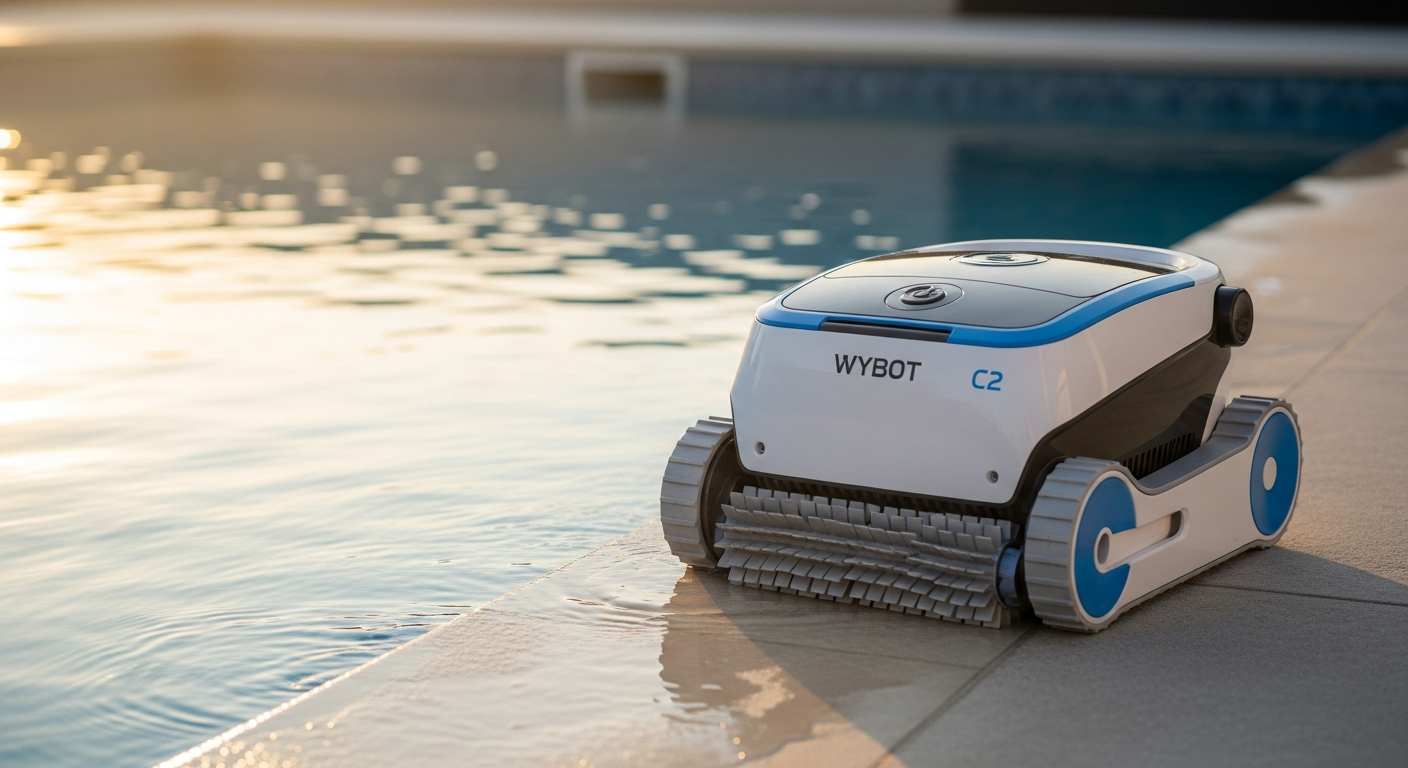
Over 60% of pool owners admit they neglect regular maintenance because manual cleaning feels like a second job. The WYBOT C2 promises to change that game with cordless convenience and smartphone control. But does it actually deliver on that promise, or is it another gadget that sounds better than it performs?
I've spent time analyzing the real performance data, user experiences, and technical specs of the WYBOT C2 to help you make an informed decision. You'll learn whether this cordless robot fits your pool's needs, uncover its genuine limitations, and discover if the $700 price tag represents solid value or a missed opportunity.
Discover the current pricing and availability of the WYBOT C2 on the official Wybot EU store.
Cordless Convenience vs. Battery Reality: What You Actually Get
The cordless design of the WYBOT C2 eliminates tangled cables and removes the need for connections to pool equipment—a genuine quality-of-life improvement for pool owners tired of managing cords. No more wrestling with extended cables or worrying about power cord damage.
Real-world runtime expectations sit at approximately 2 hours under standard cleaning conditions, extending to around 3 hours when operating in Eco Mode. The 4600 mAh Lithium-ion battery requires 180 minutes to reach a full charge, making this a straightforward process that takes roughly three hours from dead to ready.
One limitation that catches most buyers off-guard is the weekly timer functionality. The system provides 180 minutes of total cleaning time for the entire week—not per day or per cycle. For owners imagining daily automated cleaning sessions, this constraint quickly becomes frustrating. A pool requiring regular attention may exhaust its weekly cleaning allowance in just a few sessions.
Coverage extends to pools up to 2,152 square feet, making the C2 suitable for small to medium-sized residential pools. The practical implications vary significantly based on your specific pool dimensions and cleaning frequency requirements.
App Control and Cleaning Modes Explained
The WYBOT C2 offers 7 different cleaning modes, each targeting specific cleaning scenarios and debris types. Bluetooth pairing happens seamlessly, and the smartphone app handles mode selection and scheduling with straightforward functionality.
Automation features allow you to schedule cleaning cycles in advance, supporting routine maintenance without constant manual intervention. The interface prioritizes simplicity for basic operations—starting a cycle or selecting a mode takes just a few taps.
However, the app reveals its limitations quickly. There's no real-time tracking of the robot's position, no advanced pool mapping capabilities, and none of the sophisticated monitoring features found in premium competitors. Users seeking granular control over cleaning patterns or detailed progress information will find the app lacking in these areas.
Filtration System Performance for Everyday Debris
The dual-layer filtration system combines a 180μm initial filter with a 10μm ultra-fine filter, creating a two-stage approach to capturing both large and microscopic contaminants. Dirt, sand, fine particles, and debris suspended in the water column all get caught by this system.
Water flow reaches 3592 GPH, a respectable rate that supports effective cleaning of debris without requiring excessive runtime. This flow rate particularly excels at handling the common pool contaminants most residential pool owners encounter regularly.
Filter longevity depends on your pool environment—dusty areas or high debris loads will require more frequent cleaning and eventual replacement. The system performs admirably for seasonal or moderate use, though heavy-use pools may need filter attention more frequently.
Navigation and Obstacle-Crossing Capabilities
The enhanced obstacle-crossing ability allows the robot to navigate across pool features that would stop lesser models. Transitions between the floor and walls, movement around steps, and negotiating slope changes all happen with reasonable consistency.
Coverage consistency varies depending on pool shape and layout. Rectangular pools with simple geometry see more predictable cleaning patterns, while pools with complex shapes, multiple depth changes, or unusual features can result in inconsistent coverage. Some areas may receive thorough attention while others get missed.
The automatic parking feature positions the robot near the pool edge upon completing a cycle, eliminating the need to search the entire pool for retrieval. This convenience factor significantly improves the user experience.
Performance across pool floors, walls, waterlines, steps, and slopes covers the essential areas most residential pools require. The compact design proves particularly useful when cleaning steps and confined spaces where larger robots can't reach.
Mechanical durability concerns have emerged in user reports, with some units experiencing track issues after extended use. While not universal, these reports suggest quality control inconsistencies in certain production batches.
Setup, Maintenance, and User Experience
Plug-and-play operation means minimal setup requirements—unbox the unit, charge the battery, and start cleaning. There's no complex configuration, no professional installation needed, and no steep learning curve.
Charging procedures are straightforward: connect the robot to the charging dock and wait 180 minutes. Daily maintenance involves emptying the filter basket and rinsing the filters, tasks that take just minutes.
The 20-pound weight presents both advantages and challenges. It's light enough to handle for most people during normal operation, yet heavy when waterlogged after extended cleaning cycles. Removing it from the water for charging can be awkward if your pool design doesn't offer convenient access.
The compact size (roughly 17 inches in diameter) fits easily into tight spaces and climbs pool steps more effectively than larger competitors. Storage requires minimal space in a shed or garage.
Coverage under the 2-year warranty includes both parts and labor, providing solid protection against manufacturing defects during the critical first years of ownership.
Price Point and Value Proposition
The WYBOT C2 typically sells for approximately $700, though promotional pricing and sales often bring the cost down further. This positions it as a mid-range option in the robotic pool cleaner market—more affordable than premium models but pricier than basic manual alternatives.
Affordability compared to premium robotic cleaners (which frequently exceed $1,500) makes it accessible to budget-conscious pool owners. Entry into automated cleaning no longer requires a premium investment.
Value assessment depends heavily on pool size and maintenance philosophy. Small to medium pools benefit most from this device, while larger pools may require multiple units or more powerful alternatives.
Cost-benefit analysis against corded competitors reveals trade-offs. Corded models typically offer stronger suction power and unlimited runtime, but they demand cable management and fixed charging locations. The WYBOT C2 trades raw power for convenience.
ROI considerations shift based on usage patterns. Seasonal pool owners who clean 3-4 times per week see faster value realization than year-round owners who need daily cleaning, where the weekly timer becomes a significant constraint.
Who Should Buy the WYBOT C2 (And Who Shouldn't)
Ideal users include weekend pool owners with routine maintenance needs—those cleaning 2-4 times per week without expecting constant automation. If your pool sits peacefully between uses with moderate debris accumulation, this robot handles the task efficiently.
Perfect for small to medium pools with simple layouts and straightforward cleaning requirements. Rectangular pools without extensive features maximize this robot's effectiveness.
Best suited for those prioritizing ease of use and convenience over maximum cleaning power. First-time robotic cleaner buyers seeking affordability and simplicity find this device an excellent entry point without overwhelming complexity.
Not recommended for owners needing daily automated cleaning or expecting the robot to maintain pool perfection throughout the week. The weekly timer makes it unsuitable for continuous automation.
Great match for buyers who value cordless simplicity and don't mind occasionally choosing when to schedule cycles rather than having a fully autonomous system.
Common Drawbacks You Need to Know About
The weekly timer constraint stands as the most significant limitation. 180 minutes per week divided across multiple cleaning sessions forces choices about when to clean rather than enabling daily automation.
Suction power comparison with corded robotic competitors reveals a notable gap. This robot prioritizes convenience over brute force, making it potentially inadequate for pools with heavy debris loads or stubborn contaminants.
Heavy retrieval when waterlogged presents a practical challenge. After extended cleaning sessions, the saturated robot becomes significantly heavier and more awkward to remove from the water.
Inconsistent pool coverage has been reported in certain conditions, particularly with pools featuring complex layouts or unusual depth variations. Some areas may remain inadequately cleaned while others receive redundant attention.
Track durability concerns and potential mechanical failures suggest quality control inconsistencies. While many units perform flawlessly, some owners have experienced track issues requiring warranty service.
App functionality gaps remain notable—the absence of pool mapping, real-time tracking, and advanced monitoring features limits the automation potential that users might expect from a $700 investment.
Making Your Pool Maintenance Decision
The WYBOT C2 cordless robotic pool cleaner shines brightest for weekend warriors who value convenience over maximum automation. It tackles everyday dirt and sand effectively, charges quickly, and requires virtually no setup—making it an attractive entry point into robotic cleaning. However, that weekly timer limitation and modest suction power reveal its true identity: a convenience-focused cleaner, not a heavy-duty workhorse. If you're managing a small to medium pool, don't mind a hands-on approach to scheduling, and appreciate cordless simplicity, this $700 investment delivers genuine value. But if you're seeking daily automated cleaning or battling stubborn debris, you'll likely feel frustrated by its limitations. The real question isn't whether the WYBOT C2 is good—it's whether its specific strengths align with your actual pool maintenance habits. Ready to test it out?
Leave a Reply