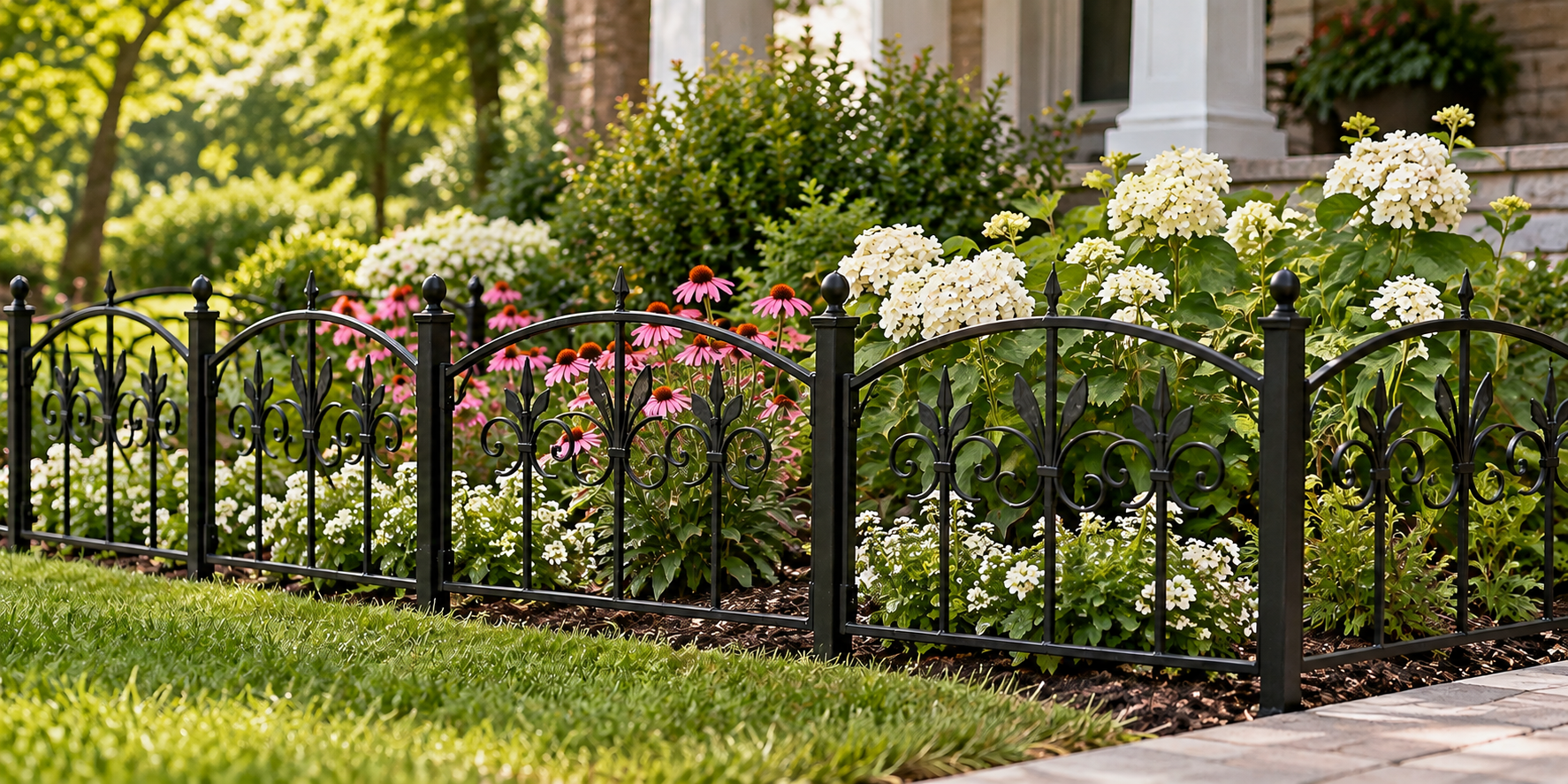
A Paloma Decorative Garden Fence can suit homeowners who want a timber boundary that combines privacy with decorative detailing. The Forest Garden Paloma range, also sold under the
Europa Prague name by some retailers, uses pressure-treated timber, smooth-planed components, horizontal boards, and a curved trellis-style upper section.
Before buying, you should compare panel heights, construction, treatment, installation requirements, and how the design fits your outdoor space.
Paloma Decorative Garden Fence Design and Construction
The Paloma design differs visually from a basic solid timber panel. Forest Garden’s 1.8 m version uses a horizontal weave construction with a decorative curved upper section. The panel has a mortised frame, and the retailer lists galvanized water-resistant screws as part of its construction.
For buyers comparing decorative fence panels, this design can work well when you want a boundary to contribute to the appearance of a planted garden rather than function solely as a plain divider.
The smooth-planed timber gives the panels a finished appearance, while the decorative upper portion reduces some of the visual heaviness associated with completely solid fencing.
Key Product Details
For the 1.8 x 1.8 m model, current retailer specifications list:
- Width: 1,800 mm
- Maximum height: 1,800 mm
- Lowest height: 1,580 mm
- Thickness: 40 mm
- Construction: weave
- Frame type: mortised
- Finish: smooth
- Treatment: pressure treated
- Cladding: hit and miss
These measurements apply specifically to the 1.8 x 1.8 m version and should not be assumed for every Paloma panel.
Available Heights Give You Different Boundary Options
Panel height should be one of your first buying decisions.
A 1.8 x 1.8 m Paloma panel is available for taller boundaries, while a 1.8 x 1.5 m version provides a lower alternative. The 1.5 m panel reaches 1,500 mm at its highest point and 1,280 mm at its lowest point because of its curved profile. Retailer information also identifies a 1.2 m version in the range.
Your preferred height will depend on where the fence is going and how much screening you want. Taller wooden garden fencing generally creates a stronger visual boundary, while shorter panels can feel less enclosed around patios, planting areas, or smaller gardens.
Local planning or property rules can affect permissible fence height, so check the requirements that apply to your property before installation.
How Much Privacy Does the Paloma Design Provide?
The Paloma panel combines relatively enclosed lower sections with an open decorative section near the top. As a result, you should not expect the same visual screening from the entire panel that you would receive from a fully solid privacy panel.
That difference may work in your favor if you prefer garden privacy fencing that still has decorative openings.
Think carefully about sightlines before choosing a height. A panel that looks sufficiently private in a product photograph may provide different screening once installed beside a raised patio, neighboring property, or sloping garden.
Pressure-Treated Timber and Maintenance
Forest Garden states that the Paloma timber is pressure treated to protect it against rot and fungal decay. The retailer lists a 15-year anti-rot guarantee for the panel.
That guarantee is a manufacturer-backed product term rather than an independent prediction of exactly how long every installed panel will remain in the same condition.
The retailer also recommends applying a semi-transparent stain or paint if you want to maintain the panel’s coloring.
Pressure treatment can make pressure treated fence panels attractive to buyers who want timber fencing without relying solely on an untreated wood surface.
You should still follow the manufacturer’s care and installation guidance because exposure, drainage, ground contact, and installation quality can affect a timber fence over time.
Decorative Trellis Adds Visual Detail
One of the defining elements of the Paloma range is its curved decorative upper section.
This makes the panel worth comparing with conventional trellis top fence panels. Rather than placing a completely separate trellis above an ordinary panel, the Paloma design integrates the decorative section into the overall panel shape.
That design can work particularly well beside:
- flower beds
- lawn boundaries
- patios
- garden seating areas
- pathways
- planted borders
Climbing plants may also be positioned near decorative fencing, although plant weight, moisture, attachment methods, and ongoing maintenance should be taken into account before allowing vegetation to cover a timber panel.
Paloma Fence vs Standard Solid Fence Panels
A comparison can help you decide which format suits your garden.
| Feature | Paloma Panel | Standard Solid Panel |
|---|---|---|
| Upper design | Curved decorative section | Usually straight |
| Visual screening | Varies across panel height | Usually relatively consistent |
| Decorative emphasis | Higher | Usually simpler |
| Timber treatment | Paloma is pressure treated | Depends on product |
| Best suited to | Decorative boundaries and screening | Straightforward boundary screening |
A conventional panel may make sense if maximum screening is your main concern. Paloma becomes particularly relevant when appearance carries greater weight in your decision.
What Should You Check Before Installation?
Installation deserves as much attention as panel appearance.
Buy Fencing Direct recommends planed fence posts to complement the planed decorative panel. Its product information says the required post may be 1.8 m or 2.4 m depending on the installation method.
A general fencing installation may require posts, suitable fixings, post caps, concrete, gravel boards where appropriate, measuring equipment, and installation tools. Buy Fencing Direct also recommends two people for garden fencing installation.
Before ordering, measure your boundary at several points rather than relying on a single measurement. Account for panel width, posts, corners, gates, changes in ground level, and any obstacles along the boundary.
Matching Gates Are Available
A matching Paloma/Prague decorative gate is available for buyers who want a coordinated entrance.
The listed 1.8 x 0.9 m gate uses pressure-treated timber and a decorative lattice-style upper section. The retailer states that gate fixings are sold separately, so include hardware when estimating the total project cost.
A matching gate may matter if your fence crosses a regular access route. Buying panels without planning the entrance can leave you trying to match materials and proportions later.
How Does Paloma Compare With Other Decorative Fencing?
The Paloma is one option within a broader category of decorative timber fencing.
Current retailer listings include other formats such as slatted, double-slatted, acoustic tongue-and-groove, and alternative decorative panels.
Your decision can therefore come down to several priorities:
Privacy: Decide how much visibility through the upper section you can accept.
Design: Compare curved decorative detailing with straight slatted or solid panels.
Height: Pick a panel size suited to the location and applicable local rules.
Maintenance: Decide how much ongoing appearance maintenance you are prepared to perform.
Budget: Calculate the complete installation rather than comparing panel prices alone.
Access: Include gates and hardware where entry is required.
These factors make comparing garden boundary fencing by complete project requirements much more useful than selecting a panel solely from a photograph.
Is the Paloma Decorative Garden Fence Worth Considering?
The Paloma range makes sense for buyers who place decorative design alongside practical boundary screening. Its pressure-treated timber, smooth finish, curved upper detailing, multiple listed heights, and matching gate give you several ways to plan a coordinated garden boundary.
It may be less suitable if your priority is a completely solid panel from top to bottom or if you prefer contemporary horizontal slats without decorative detailing.
Before ordering several panels, check the current Paloma panel options, dimensions, and pricing from the retailer so you can calculate the full cost for your boundary.
Leave a Reply