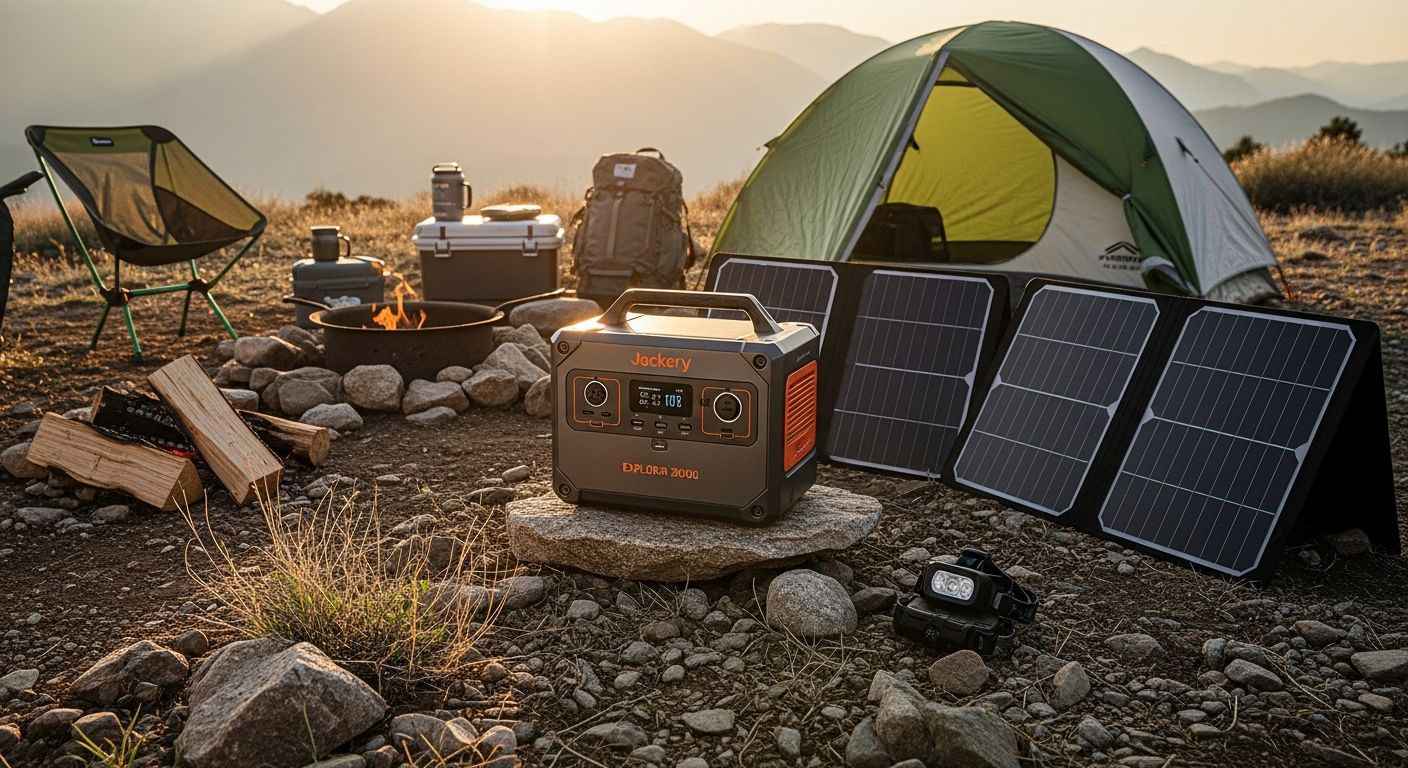
Over 40% of Americans fantasize about leaving the grid—but most abandon the dream when they realize how complicated sustainable power actually gets. The reality hits hard: unreliable generators, expensive solar arrays, and the constant anxiety about whether you'll have enough juice to keep the lights on.
What if there was a way to build genuine energy independence without sacrificing comfort or reliability? The Jackery Explorer 2000 Plus has emerged as a game-changer for remote homesteaders, cabin owners, and sustainability enthusiasts. Distributed by Hinnovation IT, this Italian-backed power station combines serious capacity—2042.8 Wh expandable to 12 kWh—with intelligent LiFePO4 battery technology designed to last a decade.
Discover the Jackery Explorer 2000 Plus and transform your off-grid living strategy today.
It's engineered specifically for people who want to escape the grid without settling for second-rate power solutions. This guide walks you through how the Explorer 2000 Plus transforms off-grid living from a risky experiment into a sustainable lifestyle choice. You'll learn why its expandable architecture beats fixed-capacity competitors, how its ChargeShield technology keeps your battery thriving for years, and whether this investment truly delivers the energy independence you're seeking.
Beyond Camping: Why Off-Grid Homeowners Choose the Jackery Explorer 2000 Plus
Off-grid living requirements differ dramatically from weekend camping trips—continuous power demands require different thinking. A cabin that needs to run a refrigerator 24/7 operates under entirely different constraints than a tent-based adventure.
The Explorer 2000 Plus capacity of 2042.8 Wh handles essential loads: refrigeration, lighting, water pumps, and communication devices. These aren't luxury items in remote settings; they're the foundation of functional living.
Real-world off-grid scenarios where this power station excels include remote cabins, rural properties, sustainable homesteads, and backup during extended outages. Each situation demands different power profiles, yet the Explorer 2000 Plus adapts to all of them.
Comparison to traditional solutions reveals the advantage clearly. Diesel generators produce noise, pollution, and high maintenance costs. A gasoline generator requires constant fuel storage and creates fumes that damage air quality around your property. The Explorer 2000 Plus offers a clean, silent alternative that requires no combustible fuel.
Scalability represents the genuine differentiator. Single units can expand to 12 kWh by connecting up to five additional batteries—growing with your needs rather than forcing you to replace equipment. This modular approach means your initial investment remains valuable as your energy demands evolve.
The cost efficiency for homesteaders becomes obvious when you consider alternatives. One investment grows rather than multiple separate systems requiring complex integration. You avoid the coordination nightmare of connecting incompatible battery banks or managing hybrid inverters from different manufacturers.
The LiFePO4 Battery Advantage: 10-Year Longevity for Remote Living
LiFePO4 chemistry matters significantly for off-grid applications because it delivers superior cycle life, thermal stability, and safety compared to standard lithium-ion batteries. Standard lithium-ion degrades faster and carries higher thermal runaway risk—problematic for unattended systems in remote locations.
The 4000 charge cycles to 70% capacity translates to approximately 10 years of daily use—a realistic timeline for remote property owners. Unlike inflated marketing claims, this figure comes from actual LiFePO4 chemistry specifications and represents conservative estimation.
ChargeShield Technology deserves specific attention. This variable-speed charging algorithm extends battery life by 50%, protecting your investment through intelligent power management. Instead of forcing maximum charging speed constantly, the system adjusts input speed based on battery state and temperature conditions. Your battery gets treated more gently, which directly translates to longevity.
Temperature performance matters for off-grid living. LiFePO4 operates reliably in diverse climates, crucial for remote locations with extreme seasonal swings. Spring thaw and winter freeze cycles that would damage conventional batteries barely stress LiFePO4 chemistry.
Safety considerations shouldn't be overlooked. Built-in protections against overcharge, short circuit, and thermal runaway are critical for unattended off-grid systems. If you're not constantly monitoring your power station, automatic safeguards become essential rather than optional.
Understanding degradation patterns helps with long-term planning. Capacity gradually decreases over years, but predictably so. At year five, you might expect roughly 85-90% of original capacity. At year ten, perhaps 70%. This knowledge allows you to plan expansion timing and adjust your energy strategy accordingly.
Warranty implications carry real weight. The 10-year lifespan claim is backed by realistic battery chemistry, not marketing hype. Hinnovation IT stands behind this product because LiFePO4 specifications support the promise.
Expandable Architecture: Growing Your Power System Without Replacement
Modular design philosophy distinguishes the Explorer 2000 Plus from competitors. You connect up to five additional batteries to scale from 2 kWh to 12 kWh total capacity. This isn't a gimmick; it's fundamental architecture that changes how you approach system planning.
Parallel connection mechanics allow multiple units to work together, increasing both capacity and peak output. With multiple units connected, you can achieve up to 6000 W peak output instead of 3000 W—enabling simultaneous use of heavy-duty tools or running larger appliances.
A phased expansion strategy makes financial sense. Start with one unit and add batteries as your off-grid needs evolve or energy demands increase. First year, you might discover that 2 kWh covers your baseline needs. Year three, perhaps you're running more equipment and need 4 kWh. Expansion becomes organic rather than a massive upfront commitment.
Cost-effective scaling prevents over-investing upfront. Purchase additional batteries only when needed rather than guessing your future requirements. This approach spreads investment across time while keeping your system right-sized to actual demands.
Integration simplicity matters when you're managing off-grid infrastructure. The proprietary connection system ensures compatibility and eliminates complex wiring requirements. You don't need an electrician to add another battery; the connections are designed for straightforward expansion.
Capacity planning examples clarify the options. Two kWh works for seasonal cabin use where you only need power during summer visits. Six kWh supports year-round remote living with moderate power demands. Twelve kWh scales up for small community applications or commercial off-grid scenarios.
Explore expandable battery options and scale your off-grid power system with Hinnovation IT.
Future-proofing through expandable design means your initial investment remains relevant as technology improves. You're not locked into today's capacity; you can grow the system as your needs change.
Multi-Source Charging: Solar, AC, and Vehicle Power for Remote Independence
Solar charging speed impresses with a full charge achievable in approximately 2 hours using six 200W solar panels—realistic for sunny climates. This speed transforms your system dynamics because you can recover from heavy power drain during a single day of good sunlight.
AC charging option provides 1.7-hour recharge when near grid power or backup generator—flexibility for hybrid systems. You might spend winter at a cabin near grid connections, then move to a fully off-grid location during summer. This dual capability eliminates system limitations.
Vehicle charging capability allows 25-hour car charging, providing emergency top-up during travel or mobile off-grid scenarios. If your property sits far from the main residence, you can partially recharge during drives and maintain power reserves.
Solar panel compatibility works with standard 200W panels. Calculate your panel array based on seasonal sun availability in your location. Remote properties in sunny climates might deploy six panels year-round. Northern locations might use six panels in summer but add more to compensate for winter's shorter daylight.
Hybrid charging approach combines solar panels with occasional AC charging for consistent power year-round. Your system doesn't depend entirely on solar performance during cloudy seasons; grid access provides backup.
Weather adaptability ensures reliability during cloudy periods or seasonal variations. Multiple charging sources mean you're never trapped by one input method. Seasonal snow can reduce solar output; your AC charging option keeps the battery charged during extended gray periods.
Off-grid charging strategy should design around local climate patterns and available energy sources. Research your region's seasonal sun patterns, average cloud cover, and rainfall to optimize your configuration.
Charging algorithm intelligence through app control monitors charging speed and battery health across all input methods. The system automatically adjusts based on current state, protecting battery longevity while minimizing charge time.
Powering Your Off-Grid Essentials: What Actually Runs on 3000 Watts
Essential load analysis reveals what operates reliably. Refrigerators draw 600-800W. Water pumps require 750-1500W. Lighting systems use 200-500W. Communication devices add modest loads. Together, these essentials define your baseline power requirement.
Heavy-duty tool capability extends the Explorer 2000 Plus beyond household essentials. Circular saws, angle grinders, and power drills operate reliably with 3000W continuous output. If your off-grid property requires maintenance work, this power station supports the tools you need.
Simultaneous device charging becomes possible through multiple USB-C and USB-A ports. While AC devices run, you're charging phones, laptops, and tablets. This multi-tasking capacity eliminates the frustration of rationing power.
Peak power handling with 3000W continuous output addresses most household appliances. The system handles brief surge demands that exceed continuous rating, accommodating devices with startup current requirements.
Load management prevents overload situations that reduce battery lifespan. Understanding wattage requirements for your specific devices lets you plan usage patterns that keep the system operating efficiently.
Off-grid priority planning distinguishes non-negotiable loads like refrigeration and medical equipment from convenience items. During extended cloudy periods, you may need to postpone tasks that consume heavy power while maintaining essential systems.
Expansion necessity calculation determines whether 2 kWh capacity suffices or additional batteries become essential. If your load analysis reveals sustained power demands exceeding available capacity, expansion makes financial sense.
Real-world runtime examples provide practical perspective. Eight to ten hours of powering essential cabin systems is achievable. Alternatively, two to three hours of continuous power tool use is possible before battery depletion becomes a concern.
Portability Meets Practicality: The 62-Pound Reality Check
Integrated wheels and telescoping handle reduce strain compared to lifting 62.3 lbs directly. The design acknowledges weight reality and implements practical solutions that make movement feasible without heroic effort.
Terrain limitations deserve honest assessment. Smooth surfaces work well; rough terrain, gravel, and slopes challenge the plastic wheel system. Rocky ground or significant elevation changes require careful technique and possibly assistance.
One-person transport challenges are real despite wheels. Moving this unit solo across difficult ground demands strategic planning and sometimes compromise between efficiency and practicality.
Placement strategy becomes important during initial setup. Position the power station near your main power hub to minimize frequent relocation. This centralized approach maximizes efficiency and reduces strain.
Transport for seasonal properties becomes feasible through wheels, though not effortless. If you move between locations seasonally, the integrated handle and wheels handle the logistics reasonably well for level terrain.
Installation considerations suggest planning power station placement during initial setup rather than repeatedly moving it later. Choose your location after thinking through your energy distribution and access needs.
Hybrid portability approach acknowledges real-world constraints. Use wheels for level surfaces; recruit assistance for challenging terrain. There's no shame in recognizing when two people handle equipment better than one.
Weight distribution understanding makes handling significantly easier than brute-force lifting. Gripping near the wheels reduces strain and improves control. Technique matters more than raw strength when managing equipment this heavy.
App Control and Monitoring: Managing Your Off-Grid Power Remotely
Real-time battery status monitoring lets you check capacity, charging speed, and system health from your smartphone. You don't need to walk outside to see how much power remains—information reaches you instantly.
Load management interface identifies which devices draw power and reveals energy consumption patterns. This visibility helps optimize your usage and plan expansion timing based on actual behavior rather than guessing.
Charging optimization sends app alerts notifying you of charging completion, weather-dependent solar performance, and efficiency metrics. You receive information exactly when you need it for decision-making.
Remote diagnostics identify potential issues before they impact your off-grid lifestyle. Early warning of problems prevents unexpected system failures during critical times.
Historical data tracking reviews power usage patterns to optimize future expansion and energy planning. Over months and seasons, patterns emerge that guide intelligent decision-making about system upgrades.
Notification system delivers alerts for low battery, charging faults, or system anomalies. You stay informed without constant manual checking.
User-friendly dashboard presents information intuitively without requiring technical expertise. Understanding your power situation becomes straightforward even for users unfamiliar with energy management systems.
Integration possibilities explore compatibility with smart home systems and energy management platforms. Your power station can coordinate with other systems for optimized ecosystem performance.
Investment Analysis: Is the Jackery Explorer 2000 Plus Worth €1,775–$2,699?
Price positioning places this in the premium tier among portable power stations, reflecting LiFePO4 battery quality and expandable architecture. This isn't budget equipment, but the specifications justify the investment.
Cost-per-watt-hour calculation compares favorably to competitors offering fixed capacity or inferior battery chemistry. When you factor in the ten-year lifespan and expansion capability, the per-watt-hour cost becomes competitive.
Total cost of ownership accounts for the 10-year lifespan, minimal maintenance, and zero fuel requirements. Unlike generators that demand constant fuel and service, this system operates quietly and reliably with virtually no ongoing costs.
Off-grid alternative comparison clarifies the economics. Generator costs accumulate through fuel purchases, maintenance, and eventual replacement. Solar arrays demand installation and experience degradation. Battery banks from other manufacturers require complex integration. The Explorer 2000 Plus integrates smoothly and expands predictably.
Expandability ROI becomes apparent when you realize the initial investment remains valuable as you add capacity. You avoid replacing entire systems every few years.
Warranty and support value comes through Hinnovation IT backing, providing confidence in product longevity and customer service. Professional distributor support matters when equipment sits in a remote location.
Financing options may spread investment across multiple months if upfront payment strains your budget. Many retailers offer payment plans that make the system accessible without demanding immediate full payment.
Long-term savings accumulate through no fuel costs, minimal maintenance, and reliable performance offsetting premium pricing. Five years into operation, your power investment looks significantly different than purchasing a generator that consumed thousands in fuel.
Real-World Off-Grid Scenarios: Where the Explorer 2000 Plus Excels
Remote cabin power for seasonal or year-round use supports heating, lighting, refrigeration, and entertainment. Whether you visit seasonally or live permanently, the system adapts to your actual usage pattern.
Sustainable homestead foundation serves as a core component of energy-independent living when combined with solar panel arrays. The expandable architecture accommodates growth as your property evolves.
Backup during grid outages provides reliable emergency power for critical loads during extended blackouts. Urban properties benefit from this security just as much as remote locations.
RV and mobile living gains expandable capacity supporting comfortable nomadic lifestyle without generator noise. Travel enthusiasts escape the constant drone of diesel engines.
Rural property independence powers remote locations without expensive grid extension infrastructure. Some properties sit too far from utility connections to justify the cost of extension; this system eliminates that concern.
Research station or remote office operation requires reliable power for internet connectivity, computing, and essential equipment. Scientific work and remote business operations depend on consistent electricity.
Disaster preparedness with multi-unit setup provides extended emergency power for communities or large properties. Coordinated systems keep entire neighborhoods functioning during extended outages.
Transition strategy bridges the gap between grid-dependent and fully off-grid living while you build solar infrastructure. Start with one unit and expand as your renewable generation capacity grows.
Limitations and Honest Considerations for Off-Grid Buyers
Weight factor at 62.3 lbs remains substantial; terrain challenges may require two-person handling. Acknowledge this reality during your planning stage rather than discovering it after purchase.
Screen readability presents genuine challenges under intense sunlight—plan for app-based monitoring as your primary interface rather than relying on the physical display during daytime use.
Wheel durability concerns arise with plastic construction that may wear under repeated rough terrain use. Consider protective upgrades if your property demands frequent relocation across challenging ground.
Initial capacity planning often reveals that a single 2 kWh unit is insufficient for most year-round off-grid scenarios. Budget for expansion early rather than discovering limitations after installation.
Solar panel investment required for ultra-fast 2-hour charging means six 200W panels—a substantial additional expense beyond the power station itself. Factor this into your total system cost.
Space requirements demand dedicated placement for the unit and any expansion batteries. Not ideal for truly mobile applications or properties with severe space constraints.
Learning curve exists for app features and load management requiring initial setup time and understanding. The system isn't plug-and-play for users unfamiliar with energy management concepts.
Climate considerations reveal that extreme cold significantly reduces battery efficiency. Northern properties need to plan for seasonal performance variations and potentially adjust usage patterns during winter.
Building Your Complete Off-Grid Power System Around the Explorer 2000 Plus
Solar array sizing calculates panel wattage based on your climate, seasonal sun patterns, and daily energy needs. Work backward from your power consumption to determine the array that keeps your batteries charged year-round.
Battery expansion roadmap plans when additional batteries become necessary based on growing power demands. Anticipate your needs rather than rushing into emergency purchases.
Charge controller integration requires understanding how solar input connects and optimizes charging efficiency. Proper integration maximizes the benefit from your solar panels.
Backup generator role considers diesel or propane generators for extended cloudy periods or emergency situations. Your power station works best as part of a system rather than as a standalone solution.
Load management strategy prioritizes essential systems and schedules flexible loads during peak solar hours. Run dishwashers and power tools when the sun is strongest; reserve battery power for nighttime essentials.
Monitoring infrastructure establishes app alerts and historical tracking to optimize your energy ecosystem. The system performs better when actively managed based on real data.
System redundancy plans for component failures and understands backup options if the power station requires service. Don't leave yourself stranded by making one piece of equipment your only power source.
Professional consultation benefits from expertise when designing off-grid systems. Consider working with experienced installers who understand local conditions and can optimize your configuration.
The Verdict: Off-Grid Living Meets Reliable Technology
The Jackery Explorer 2000 Plus represents a genuine breakthrough for remote property owners, off-grid homesteaders, and anyone serious about energy independence. Its combination of substantial 2042.8 Wh capacity, LiFePO4 longevity, and expandable architecture addresses the core frustration with portable power stations: the need to upgrade or replace equipment as your lifestyle evolves.
You're not buying a static solution; you're investing in a foundation that grows with your ambitions. The reality is straightforward: this power station won't single-handedly power your entire homestead without solar panels and careful load management. That's not a weakness—it's honest engineering.
What it does deliver is reliability that matches your commitment to off-grid living. The 10-year battery lifespan, ChargeShield technology, and 4000 charge cycles mean you're making a genuine long-term investment rather than gambling on equipment that fails after a few seasons.
For remote cabin owners, sustainable homesteaders, and off-grid enthusiasts willing to invest in quality, the Explorer 2000 Plus justifies its €1,775–$2,699 price tag through years of dependable performance. Start with one unit, expand as your energy demands grow, and enjoy the quiet confidence that comes from genuine power independence.
Leave a Reply