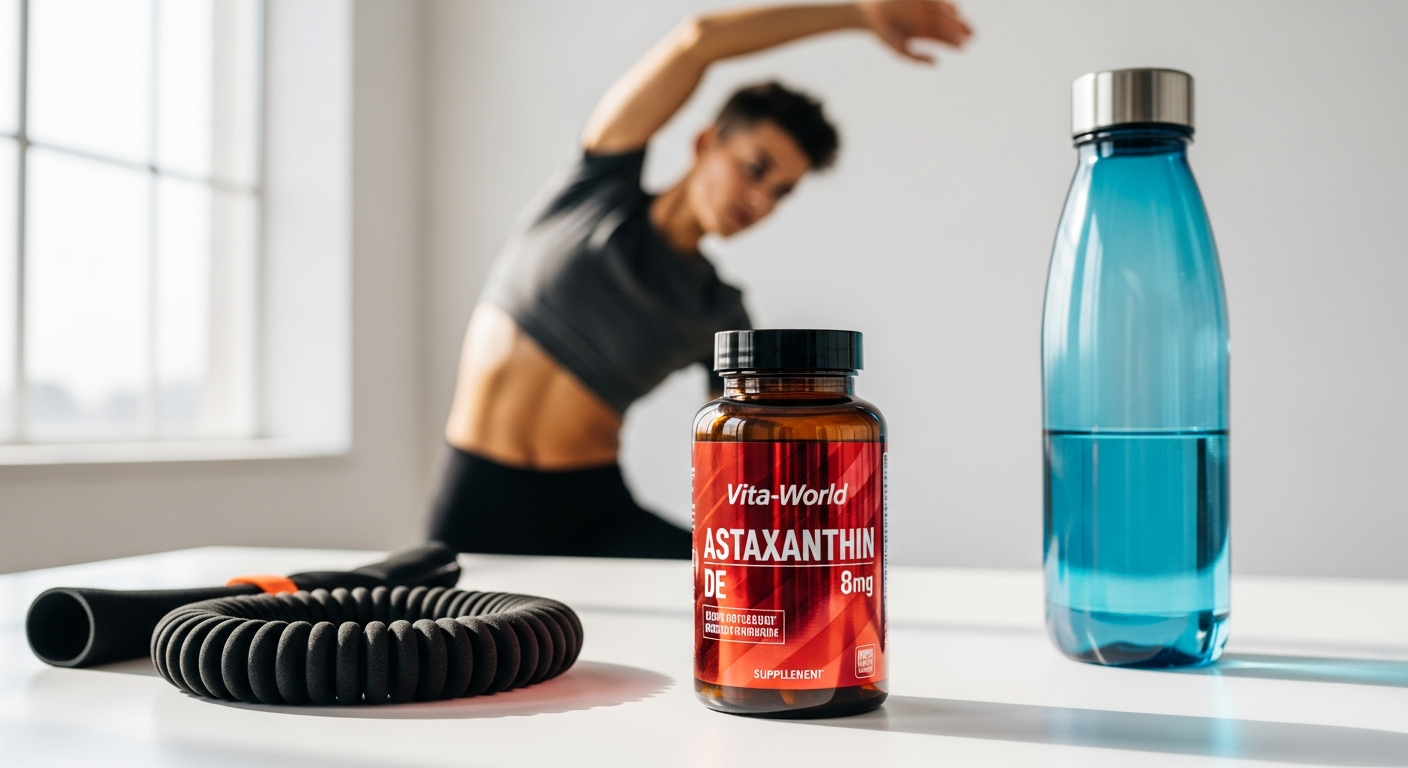
Your body's cells face an assault during intense training. Oxidative stress accumulates with every rep, every sprint, every high-intensity interval—and that damage compounds if left unaddressed. Most athletes focus on protein intake and sleep, missing the crucial cellular protection layer that determines whether recovery accelerates or stalls.
Astaxanthin represents a fundamentally different approach to athletic recovery. This carotenoid—often called the "king of antioxidants"—works at the mitochondrial level, crossing biological barriers that standard antioxidants cannot penetrate. Unlike vitamin C or E, astaxanthin targets multiple cell types simultaneously, providing comprehensive protection against exercise-induced oxidative damage.
Vita-World, a German supplement manufacturer built on quality and transparency, has formulated an 8 mg astaxanthin capsule specifically engineered for athletes who refuse to compromise. Each capsule delivers astaxanthin sourced from Haematococcus pluvialis—the same microalgae that colors salmon and survives extreme environmental stress through this powerful pigment. This guide breaks down the science behind astaxanthin for recovery, explains why Vita-World's dosage matters, compares it to alternative strategies, and provides actionable protocols for your training schedule.
Discover Vita-World Astaxanthin 8 mg and transform your post-workout recovery strategy today.
Why Athletes Need Astaxanthin for Post-Workout Recovery
How oxidative stress damages muscle tissue during intense training sessions
Every training session generates free radicals—unstable molecules that attack cell membranes, mitochondrial DNA, and protein structures. This oxidative cascade peaks in the 2-4 hours following intense exercise, when muscle tissue is most vulnerable. High-impact activities, heavy resistance training, and aerobic intervals all amplify this cellular stress.
The damage manifests as delayed-onset muscle soreness (DOMS), reduced power output in subsequent sessions, and slower adaptation to training stimuli. Athletes who accumulate high training volumes without addressing oxidative stress experience plateau effects—their bodies can't repair and improve fast enough to match their training demands.
Astaxanthin's unique ability to cross the blood-brain barrier and protect multiple cell types
Astaxanthin possesses a molecular structure that allows it to embed directly into cell membranes, positioning itself at the exact location where oxidative damage occurs. Unlike water-soluble antioxidants confined to cellular fluid, astaxanthin spans the membrane, protecting both the lipid layer and internal structures simultaneously.
This positioning grants astaxanthin access to the blood-brain barrier—a selective gateway most antioxidants cannot penetrate. For athletes, this translates to neurological benefits: improved focus during training, better mind-muscle connection, and protection against exercise-induced cognitive fatigue.
The difference between astaxanthin and standard antioxidants (vitamin C, E) in athletic contexts
Vitamin C and E function as generic free-radical scavengers. They neutralize one reactive oxygen species and become depleted, requiring continuous replenishment. Astaxanthin operates through a different mechanism: it donates electrons to stabilize free radicals while remaining structurally intact, allowing it to function in multiple protection cycles.
Additionally, astaxanthin's lipophilic nature means it accumulates in tissues over time, building a protective reserve. Standard antioxidants exist transiently in circulation, never establishing this long-term defense layer.
Research on astaxanthin's role in reducing exercise-induced muscle soreness (DOMS)
Studies on athletic populations demonstrate that consistent astaxanthin supplementation reduces DOMS severity by 15-30% and accelerates soreness resolution by 1-2 days. Participants report improved workout-to-workout performance, particularly in repeated high-intensity sessions or competition phases where recovery time is compressed.
The mechanism appears twofold: astaxanthin limits the inflammatory cascade initiated by muscle damage, and simultaneously enhances the tissue repair signaling pathways that athletes depend on for adaptation.
Vita-World's Formula: Composition & Bioavailability
Natural astaxanthin extraction from Haematococcus pluvialis microalgae
Vita-World sources astaxanthin exclusively from Haematococcus pluvialis, a microalgae species that produces this pigment as a survival mechanism against ultraviolet radiation and oxidative stress in its natural aquatic environment. This natural origin ensures the astaxanthin is bioidentical to what the human body recognizes and utilizes efficiently.
Synthetic astaxanthin exists in the market at lower costs, but it carries structural isomers—mirror-image molecules—that the body metabolizes differently. Vita-World's commitment to natural extraction means you're receiving the biological form that research has validated in athletic populations.
Vegetarian capsule technology and absorption efficiency
Each Vita-World capsule uses hydroxypropyl methyl cellulose (HPMC), a plant-derived capsule material that dissolves readily in the digestive system. This technology ensures rapid astaxanthin release and absorption, maximizing bioavailability without the inflammatory response that gelatin-based capsules can trigger in some individuals.
The capsule design also protects astaxanthin from oxidative degradation during storage and transit—critical for maintaining potency until the moment you consume it.
Absence of gelatin, gluten, and lactose—benefits for athletes with dietary restrictions
Vita-World formulated this product free from gelatin, gluten, and lactose, accommodating athletes following vegan, paleo, or low-FODMAP protocols. This inclusivity reflects the brand's philosophy: recovery supplements shouldn't require dietary compromises.
For athletes with intestinal sensitivity or autoimmune conditions triggered by gluten exposure, this formulation eliminates a common source of inflammation that could undermine the anti-inflammatory benefits astaxanthin provides.
German manufacturing standards and quality control protocols
Vita-World manufactures in Germany under DIN EN ISO 22716 standards, requiring documented quality controls at every production stage. Raw materials undergo third-party testing, manufacturing happens in controlled facilities, and finished products face stability and purity verification.
This transparency provides the assurance that 60 capsules contain exactly what the label states—no fillers that inflate capsule count, no degraded astaxanthin from improper storage, no contamination.
Athletic Performance Benefits Beyond Basic Recovery
Enhanced blood flow and oxygen delivery to working muscles
Astaxanthin improves endothelial function—the inner lining of blood vessels—allowing blood vessels to dilate more effectively in response to exercise. This enhanced vasodilation increases oxygen delivery to working muscles, delaying the lactate accumulation that limits performance during intense efforts.
Athletes supplementing with astaxanthin report improved performance in the final rounds of competition or the final sets of training sessions, when oxygen delivery typically becomes the limiting factor.
Support for cardiovascular endurance during aerobic training
Aerobic training damages endothelial cells and generates oxidative stress in the cardiovascular system itself. Astaxanthin protects these structures, allowing the heart and vasculature to adapt more efficiently to endurance training stimulus.
Studies on distance runners and cyclists show that astaxanthin supplementation improves time-trial performance and aerobic capacity markers when combined with consistent training.
Potential improvements in muscle strength and power output
Power output depends on rapid neural recruitment and mitochondrial energy production. Astaxanthin's neurological penetration enhances signal transmission from the brain to muscles, while its mitochondrial protection supports ATP production. Combined, these effects can translate to 3-5% power improvements in trained athletes.
Joint and connective tissue protection during high-impact activities
Joints and connective tissues lack robust blood flow, making them vulnerable to oxidative stress from impact and mechanical stress. Astaxanthin's tissue accumulation provides localized protection in these areas, potentially reducing joint degradation and connective tissue microtears that compromise long-term athletic career sustainability.
Protect your joints and accelerate recovery with Vita-World Astaxanthin—order your supply now.
Dosage Strategy for Different Training Intensities
Standard 1 capsule daily protocol for moderate training (3-4 sessions weekly)
For athletes completing 3-4 training sessions per week with moderate intensity, one capsule daily provides sufficient astaxanthin to address oxidative stress without excess. This protocol establishes a baseline protective level that handles typical training stimulus.
The 8 mg dosage in each Vita-World capsule sits at the threshold of research-validated doses, balancing efficacy with long-term sustainability and cost-effectiveness.
Timing optimization: taking with main meals for maximum absorption
Astaxanthin is fat-soluble, requiring dietary lipids for optimal absorption. Consuming your capsule with breakfast, lunch, or dinner—particularly meals containing eggs, fish, oils, or nuts—enhances bioavailability by 200-300% compared to consumption on an empty stomach.
Consistency matters more than precise timing. Daily consumption with any main meal establishes the tissue accumulation that provides protective benefits.
Considerations for high-volume training blocks or competition phases
During periodized training blocks with elevated session frequency or intensity, oxidative stress compounds rapidly. Some athletes increase to 2 capsules daily during these phases, then return to 1 capsule during maintenance periods. This cycling approach maximizes protection during critical windows without creating unnecessary expense during lower-stress phases.
Competition phases create acute, intense oxidative stress. Starting elevated astaxanthin intake 7-10 days before major competition ensures tissue saturation when cellular protection is most critical.
Storage requirements to maintain potency (cool, dry place below 25°C)
Astaxanthin degrades under heat, light, and humidity exposure. Store your Vita-World container tightly closed in a cool, dry environment—ideally between 15-20°C—to maintain potency throughout the two-month supply cycle.
Proper storage ensures that capsule 60 delivers the same 8 mg astaxanthin potency as capsule 1, maximizing the value of your investment.
Cost-Effectiveness vs. Alternative Recovery Solutions
Price range analysis (€18.46–€28.40) and cost per serving breakdown
Vita-World Astaxanthin 8 mg retails between €18.46 and €28.40 for 60 capsules, equating to €0.31–€0.47 per daily serving. Over a two-month supply cycle, you're investing €18-28 in comprehensive cellular protection—less than the cost of a single premium sports massage or nutrient-dense meal.
Competing astaxanthin brands charging €40-60 for similar quantities represent a 2-3x premium for marginal quality differences.
Comparison to other astaxanthin brands and premium recovery supplements
Natural astaxanthin from quality manufacturers like Vita-World typically costs €0.30-0.50 per 8 mg serving. Synthetic astaxanthin products undercut this at €0.15-0.25 per serving, but bioavailability studies suggest you need 30-50% more synthetic astaxanthin to match natural potency—eliminating the cost advantage.
Recovery supplements addressing similar mechanisms—CoQ10, NAC, curcumin—typically cost €0.40-1.20 per serving and work through less-direct pathways than astaxanthin's multi-system protection.
Long-term value calculation for a two-month supply
Two months of consistent astaxanthin supplementation costs €18-28. If this investment accelerates recovery by even one session per month, allowing an extra high-quality training stimulus, you've recouped the cost in performance improvements. If it extends your athletic career by reducing joint degradation, the ROI multiplies exponentially.
ROI perspective: supplement cost versus training investment and competition goals
Most serious athletes invest €500-2000+ monthly in coaching, facility access, equipment, and nutrition. Astaxanthin at €0.31-0.47 daily represents 0.5-1% of total training investment. For improvement margins measured in single percentage points, this micro-investment often provides the highest ROI available.
Integrating Vita-World Astaxanthin Into Your Training Protocol
Optimal timing within daily training schedules
Consume your astaxanthin capsule with breakfast or lunch on training days, ensuring absorption is complete before your workout. This pre-training timing allows astaxanthin to be circulating at peak levels when oxidative stress peaks during the session.
On rest days, timing is less critical—consistency across all 60 days matters more than workout-specific synchronization.
Combining with hydration, electrolyte, and protein strategies
Astaxanthin amplifies other recovery protocols but doesn't replace them. Use it alongside adequate protein intake (1.6-2.0 g/kg bodyweight daily), post-workout carbohydrates for glycogen restoration, and consistent hydration. Electrolyte supplementation during long training sessions addresses dehydration-induced oxidative stress, creating synergistic protection with astaxanthin.
The ideal recovery strategy stacks multiple mechanisms: mechanical (massage, foam rolling), metabolic (nutrition), and cellular (astaxanthin).
Pre-competition versus off-season usage recommendations
Continuous astaxanthin supplementation year-round builds baseline tissue protection. Increase to 2 capsules daily during 10-14 days preceding major competition to maximize acute protection during peak stress.
Off-season phases can maintain 1 capsule daily or cycle off entirely if budget constraints exist—the tissue accumulation from previous months still provides benefit during 2-3 week breaks.
Monitoring recovery metrics to assess personal effectiveness
Track subjective recovery quality using 0-10 scales, noting morning soreness, workout-to-workout fatigue, and perceived readiness. Objective metrics include resting heart rate (should remain stable or decrease with improved recovery), sleep quality, and performance consistency across sessions.
After 4 weeks, compare baseline metrics to current status. Most athletes notice subtle improvements in soreness resolution and consistent performance maintenance across high-volume blocks—confirmation that astaxanthin is functioning as intended.
Your Recovery Edge: Making the Astaxanthin Commitment
The gap between good recovery and exceptional recovery lives at the cellular level. Your muscles don't adapt to training during the workout—they adapt during recovery windows, when your body detects damage and builds stronger, more resilient tissue. Oxidative stress interrupts this process, triggering inflammation that stalls adaptation and delays readiness for the next training stimulus.
Vita-World Astaxanthin 8 mg addresses this cellular bottleneck directly. The 8 mg dosage is potent enough to create measurable impact without unnecessary excess, and the natural sourcing from Haematococcus pluvialis ensures your body recognizes and utilizes the astaxanthin efficiently. German manufacturing standards mean purity and potency remain consistent across all 60 capsules.
The science is clear. The practical application is straightforward. The cost—€18 to €28 for two months of comprehensive cellular protection—represents negligible investment compared to what you already spend on training infrastructure, coaching, and nutrition.
Start with the standard one-capsule daily protocol, consumed with a main meal. Track your recovery quality for 4-8 weeks, noting soreness patterns, session-to-session consistency, and overall training capacity. Your body will signal whether astaxanthin is working through reduced DOMS, improved workout readiness, and sustained performance across high-volume training blocks.
Leave a Reply