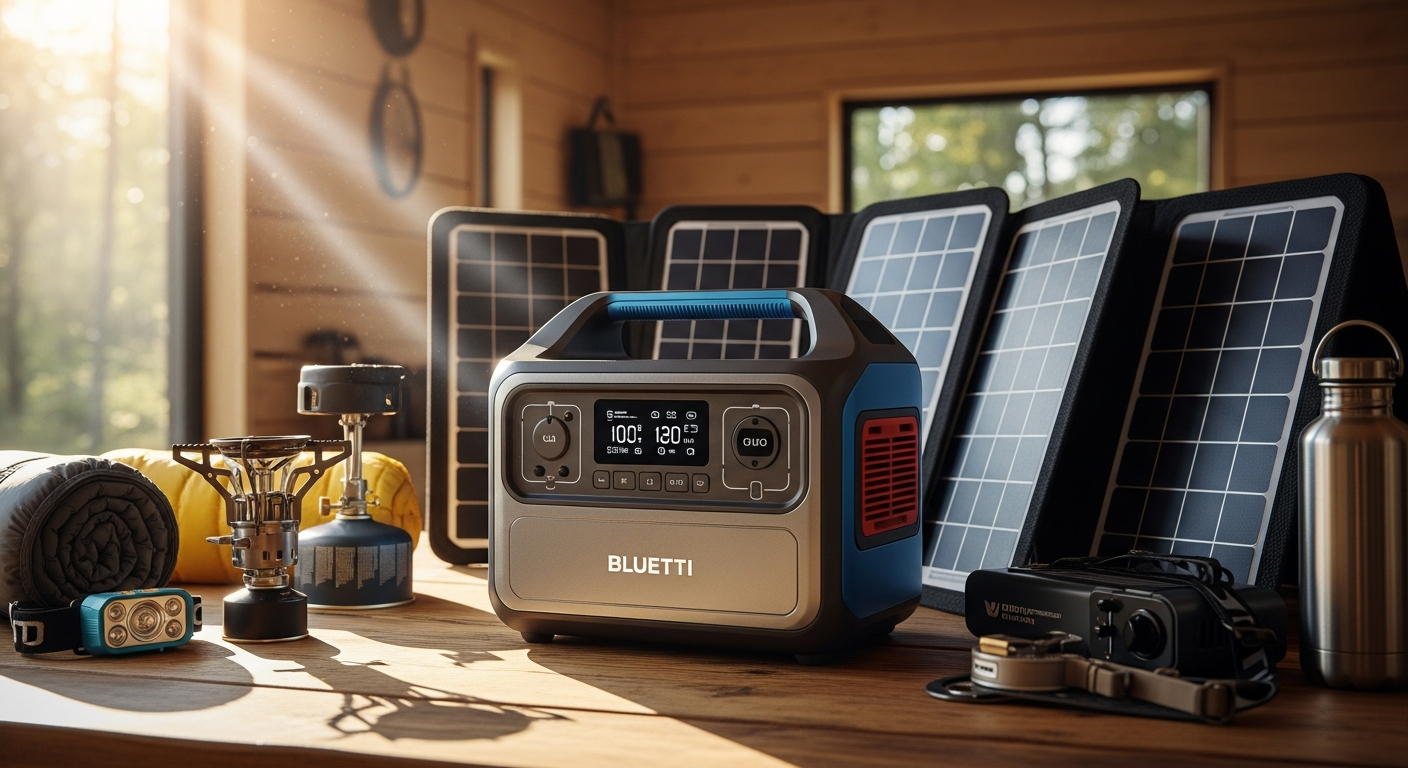
Over 60% of homesteaders and off-grid enthusiasts cite power reliability as their biggest challenge. Most settle for solutions that drain their wallets or force uncomfortable compromises—undersized systems that can’t handle simultaneous appliances, batteries that degrade rapidly, or backup options that simply don’t scale to real-world demands.
The BLUETTI Elite 200 V2 changes that narrative with its 2,073Wh LiFePO4 battery, 2,600W continuous output, and ability to accept 1,000W solar input. This isn’t a recreational gadget repurposed for serious work. This is infrastructure designed from the ground up for energy independence.
Explore the BLUETTI Elite 200 V2 and transform your off-grid power setup today.
Why Off-Grid Living Demands a Serious Power Solution
Off-grid homesteads don’t operate like weekend camping adventures. You’re not powering a phone and a camping light for two days. You’re running well pumps at unpredictable times, refrigerators that cycle continuously, power tools for projects, and potentially medical equipment or heating systems that can’t be interrupted. The power demands are constant, interconnected, and unforgiving.
The unique power demands of off-grid homesteads compared to traditional camping
A traditional camper might draw 300-500W during evening hours and accept power cuts. An off-grid homestead runs essential systems around the clock. Your well pump might demand 1,500W when it kicks on while your refrigerator is already drawing 200W, your water heater element pulls 4,000W (though you’ll manage this carefully), and you’re charging tools or running a wood saw. The power station isn’t a luxury—it’s what stands between normal life and crisis.
How inadequate power systems create cascading failures
Undersized battery systems force constant prioritization decisions. You stop running certain appliances because the battery can’t handle simultaneous loads. The system enters low-battery protection mode frequently, stressing the battery itself and shortening its lifespan dramatically. When you finally push the system to its limits, voltage sag damages sensitive equipment—your well pump controller fails, your refrigerator compressor burns out, or your electronics get fried by the voltage fluctuations.
Why portable power stations have evolved beyond recreational use into essential infrastructure
Early portable power stations were toys. Lithium battery costs were prohibitive. Output was weak. Reliability was questionable. Modern LiFePO4 systems changed everything. The technology matured, prices dropped closer to reality, and manufacturers began designing for genuine off-grid households rather than glampers. Today’s systems are fundamentally different animals.
The difference between getting by and thriving with reliable backup power
Getting by means constant anxiety about power. You monitor your battery percentage obsessively. You delay projects because you’re unsure if the system has enough capacity. You run your generator more than you wanted because the solar panels couldn’t recharge fully. Thriving means confidence. You know your system handles your actual power consumption. You can run multiple appliances without second-guessing. You sleep well knowing your critical systems won’t fail.
How the Elite 200 V2 addresses the specific pain points of off-grid residents
The Elite 200 V2 delivers 2,600W of continuous power—enough to run high-draw appliances without constant switching. Its 2,073Wh capacity handles typical homestead load cycles without constant recharge desperation. The 1,000W solar input means you can actually refill the battery meaningfully on clear days rather than trickle-charging for hours. The 6,000-cycle LiFePO4 battery means you’re investing in a system that will still perform 10-15 years from now, not something you’ll replace in five years.
LiFePO4 Battery Technology and Long-Term Reliability
Battery chemistry matters far more than most people realize. It’s the difference between a system that gets stronger and more trustworthy over time and one that becomes increasingly unreliable as it ages.
Understanding LiFePO4 chemistry versus traditional lithium-ion batteries
Lithium-ion batteries (the older standard) use cobalt-based chemistry. They’re cheap to manufacture and deliver reasonable performance initially, but they degrade noticeably with each charge cycle. They’re also vulnerable to thermal runaway—basically, they can catch fire if anything goes wrong. They’re fine for phones you replace every few years, but terrible for critical infrastructure you’re betting your life on.
LiFePO4 chemistry—lithium iron phosphate—swaps cobalt for iron. This change is profound. LiFePO4 batteries are thermally stable (they resist catching fire even under stress), chemically stable (they maintain capacity through thousands of cycles), and genuinely safer for residential use. The downside? They cost more upfront. The upside? They last decades and never compromise your safety.
Why the 6,000-cycle lifespan translates to 15+ years of practical use for homesteaders
A 6,000-cycle lifespan sounds technical. Here’s what it means in practice: if you fully discharge and recharge the Elite 200 V2 once daily, it will retain approximately 80% of its original capacity after 6,000 days—roughly 16 years. Most homesteaders don’t fully cycle their battery daily. They use partial cycles, which actually extends the real-world lifespan. Many users report their LiFePO4 systems still delivering strong performance after 10+ years of daily use.
That 6,000-cycle rating isn’t marketing hype—it’s conservative engineering. Real-world performance often exceeds these projections.
Safety advantages of LiFePO4 in residential applications (thermal stability, reduced fire risk)
Off-grid systems often run unattended. Your battery system sits in a garage, shed, or basement while you work or sleep. You need absolute confidence that a malfunction won’t create a fire hazard. LiFePO4 batteries are intrinsically safer. They resist thermal runaway. Even if something fails electronically, the battery won’t spontaneously combust. This matters more than manufacturers typically emphasize, especially when you’re storing several thousand watt-hours of energy in a confined space.
How battery degradation affects off-grid power systems over time
As traditional lithium-ion batteries age, their capacity shrinks. A battery that delivered 2,000Wh new might deliver only 1,600Wh after 3-4 years of regular use. This means your system becomes less reliable precisely when you need it most. In an off-grid scenario, this degradation forces difficult decisions: replace the battery (expensive), reduce your appliance usage, or add more solar panels (also expensive).
LiFePO4 batteries degrade far more slowly. After 6,000 cycles, you’re typically at 80% capacity—and that degradation stalls. You don’t drop from 80% to 60% in the next few years like you would with older chemistry. Your system remains dependable for decades.
The cost-per-cycle advantage when calculated over the Elite 200 V2’s lifetime
The Elite 200 V2 costs around $749 on sale. Over 6,000 cycles, that’s roughly $0.125 per cycle. Compare that to cheaper power stations rated for 500-1,000 cycles, which costs $0.50-$1.00 per cycle. The Elite 200 V2 actually becomes cheaper to operate over its lifetime, even with a higher upfront price.
Maintenance requirements and real-world longevity expectations
LiFePO4 systems require virtually no maintenance. No fluid checks, no terminal cleaning, no seasonal preparation. Charge it, use it, repeat. The Elite 200 V2’s built-in management system handles everything—balancing cells, managing temperature, protecting against overcharge or over-discharge. Real-world reports from multi-year users consistently report zero maintenance surprises and steady performance across seasons.
Real-World Power Output for Homestead Appliances
Numbers matter, but real-world performance matters more. The 2,600W specification is impressive, but what does it actually run on your homestead?
Breaking down the 2,600W continuous output and what it actually powers
2,600W continuous means the system supplies 2,600 watts indefinitely without reducing output. That’s a critical specification because many competitors claim high peak watts but much lower continuous watts. Here’s what 2,600W actually powers: a 1,500W well pump running full-speed, a 900W refrigerator, 150W of LED lighting, and a 100W water heater element—simultaneously. Most homesteaders never need all at once, but the point is capability.
Simultaneous appliance scenarios: mini-fridge, power tools, lighting, and water pump
A realistic evening scenario: your well pump needs to refill the pressure tank (1,500W for 15 minutes), your mini-fridge is running (150W continuous), you’re charging power tools with a 400W charger, and you have 100W of lighting. Total: about 2,150W. The Elite 200 V2 handles this effortlessly. A smaller system (1,500W output) would force you to stop charging tools or turn off lights. A larger system would cost significantly more.
Peak versus sustained power demands in typical homestead routines
Peak power happens when things start up: a well pump might spike to 1,500W for a moment, then stabilize at 1,200W. A refrigerator compressor draws 900W briefly, then settles at 150W. Most of your actual usage is sustained loads far below the 2,600W limit. This is why the Elite 200 V2’s continuous output rating matters—you’re not living on the edge of capacity. You have comfortable overhead.
Appliances that work seamlessly (and those requiring strategic timing)
The Elite 200 V2 runs mini-fridges, refrigerators, lighting, water pumps, television, computers, and most power tools without compromise. Where you exercise caution: simultaneous high-draw elements. You won’t run an electric water heater element, an oven, and a space heater all at once. Not because the system can’t handle them individually, but because homesteads rarely need them simultaneously. You learn which appliances run together naturally and which require spacing.
How the four AC outlets enable practical workflow management
Four AC outlets might sound limited until you use them. One outlet feeds your refrigerator (always on). One powers your well pump system. One charges tools and supplies the workshop. One covers household loads—television, fans, water heater. This isn’t constraint; it’s clarity. You know which circuit feeds which systems, and you can manage them consciously.
Powering essential systems during grid outages (well pumps, HVAC, medical equipment)
If you have a medical device that requires continuous power, the Elite 200 V2 and a quality solar panel setup mean you’re protected. Well pumps—the single most critical homestead system—run reliably. Even modest HVAC systems (newer, efficient units) can run for hours. The security of knowing your essential systems won’t fail during an outage is the true value proposition.
Maximizing Solar Charging for Year-Round Energy Independence
The 2,073Wh capacity is half the equation. How you refill it matters just as much.
The advantage of 1,000W solar input capacity in off-grid contexts
1,000W solar input means you can connect substantial solar panel arrays directly to the Elite 200 V2. On a clear day, four 250W panels deliver roughly 1,000W into the battery. That’s a full recharge (from empty) in roughly 2-3 hours of direct sunlight. Competitors with lower solar input capacity require multiple days or constant cloud cover that makes the solar setup effectively pointless.
Calculating realistic recharge times based on seasonal sunlight availability
Winter in northern climates might deliver only 3-4 peak sun hours daily. A 1,000W solar input means you’re pulling in roughly 3,000-4,000Wh per day—almost one full charge cycle. Summer delivers 6-8 peak sun hours, meaning two complete recharge cycles daily. The seasons balance out; you’re not adding a backup generator unless you’re in exceptionally cloudy climates.
Optimal solar panel configurations paired with the Elite 200 V2
Most homesteaders pair the Elite 200 V2 with 1,000-2,000W of solar panels (four to eight 250W panels). This creates redundancy; if panels are partially shaded or weather is poor, you still gather meaningful power. It also allows for future expansion—adding more capacity without overwhelming your existing system.
The 50-minute wall-charge option as a practical backup for cloudy periods
0-80% in 50 minutes from a standard 120V outlet is genuinely fast. If you’re in an extended cloudy period and your solar panels are underperforming, you can plug into house power for an hour and gain substantial capacity. For grid-dependent homes using the Elite 200 V2 as emergency backup, this is freedom from generator dependence.
Hybrid charging strategies (solar, car charging, wall outlet) for flexibility
Real off-grid living uses multiple charging sources strategically. Solar charges during the day. Car charging (through the 12V port) adds capacity during commutes. Wall charging handles extended cloudy periods or emergency top-offs. The Elite 200 V2 supports all three simultaneously, meaning you’re never forced to choose one option.
Seasonal power planning and battery management across different climates
In winter, you run loads more conservatively while accepting lower solar production. In summer, you can afford to run higher-draw appliances freely. You learn your climate’s rhythm and adjust accordingly. The Elite 200 V2’s capacity is large enough that seasonal variation doesn’t create constant stress—unlike smaller systems that struggle every winter.
Connectivity and Device Integration Across Your Homestead
Power is only useful if you can actually use it effectively.
Four AC outlets for major appliances and equipment
Four standard 120V AC outlets handle most homestead needs. You run refrigeration, water systems, tools, and household loads without adapters or workarounds. The outlets accept standard plugs—no proprietary connectors that fail or require replacements.
USB-C and USB-A ports for phones, tablets, and small electronics
Two USB-C ports and two USB-A ports mean your phones, tablets, headphones, and small devices charge simultaneously without dedicated wall adapters. In an off-grid scenario, this is invaluable. You charge critical communication devices and tools efficiently.
Powering multiple systems simultaneously without bottlenecks
The limiting factor isn’t the outlets; it’s the 2,600W output ceiling. If you stay below that, everything charges simultaneously without performance loss. Modern systems are efficient enough that you rarely hit that limit.
Integration with smart home systems and monitoring capabilities
The Elite 200 V2 supports monitoring through BLUETTI’s app (via optional hub), allowing you to track power consumption, adjust settings, and monitor battery health remotely. For off-grid homesteaders with multiple systems, this visibility is genuinely useful.
Charging hierarchy: which devices get priority during extended off-grid periods
In a true off-grid scenario with extended cloudy weather, you manage priorities consciously. Medical devices and communication get priority. Comfort devices (heating, cooling) get second priority. Non-essentials wait. The Elite 200 V2’s capacity is large enough that this prioritization rarely becomes emergency-level decision-making.
Investment Analysis: Is the $749 Price Point Worth It?
The sticker price can seem steep until you understand what you’re actually buying.
Comparing the Elite 200 V2 to alternative backup power solutions
A comparably-sized traditional lead-acid battery system costs $600-800 but lasts only 3-5 years and requires regular maintenance. A smaller LiFePO4 system (1,000-1,500Wh) costs $400-600 but forces constant compromises on power demands. Larger systems (3,000Wh+) exceed $1,500. The Elite 200 V2 sits at the efficiency sweet spot—enough capacity for real homesteads, powerful enough for simultaneous appliances, priced reasonably for the capability.
Cost-per-watt-hour analysis versus smaller or larger competitors
The Elite 200 V2 delivers 2,073Wh for $749—roughly $0.36 per watt-hour. Smaller competitors charge $0.50-0.70 per watt-hour. Larger competitors also command $0.40-0.50 per watt-hour. The Elite 200 V2 offers genuine value by that metric.
Long-term value calculation over the 6,000-cycle lifespan
Over 15 years of daily use, $749 becomes $0.137 per day in system cost. Add typical maintenance and replacement costs for inferior systems, and the Elite 200 V2 becomes substantially cheaper over its lifetime. You’re not buying an expensive gadget; you’re investing in a decade-plus of reliable power.
Hidden costs of inadequate power systems (appliance replacement, stress on batteries)
A cheaper, undersized system creates hidden costs. You replace damaged refrigerators ($500-1,000). You buy a backup generator to supplement weak solar ($1,000+). You replace the inadequate battery when it fails prematurely ($400-600). The total cost of false economy often exceeds the cost of getting the right system initially.
Financing options and seasonal sales patterns
The $749 price is a promotional figure; standard pricing hovers around $1,070. BLUETTI frequently runs sales during spring (pre-summer off-grid season) and fall (pre-winter emergency prep). Many retailers offer financing options, making the system accessible even at full price.
ROI timeline for off-grid homesteaders and emergency preparedness advocates
For someone living off-grid full-time, payback happens within 3-4 years through eliminated generator fuel costs and avoided premature battery replacement. For emergency preparedness advocates using it as backup, payback is intangible but real—it’s the peace of mind of knowing you won’t lose power to appliance damage or grid failures.
Practical Setup Strategies for Different Off-Grid Scenarios
The Elite 200 V2 adapts to different situations. Your setup depends on your actual use case.
Permanent homestead installation (mounting, weatherproofing, solar integration)
For a permanent homestead setup, mount the Elite 200 V2 in a shed or garage protected from extreme weather but accessible for maintenance. Ensure proper ventilation; the system generates minimal heat but benefits from air circulation. Connect your solar array via a quality charge controller (the system has MPPT built-in, but many prefer external controllers for monitoring). Run AC outlets from a weatherproof sub-panel inside to avoid outdoor extension cords.
Seasonal cabin power management
Seasonal cabins require a different approach. Install the system to prioritize essential circuits—well pump, refrigeration, lighting. During off-season, store the unit indoors in temperature-controlled space. Autumn is the ideal setup time; summer peak isn’t the time to test new infrastructure.
RV and mobile off-grid living configurations
The Elite 200 V2’s weight (around 62 pounds) is manageable but not truly portable for constant moving. For RV use, secure it to a shelf or cabinet to prevent shifting during travel. Mount solar panels on the RV roof. Use the AC outlets as your primary power source and keep your coach battery system as secondary. This hybrid approach extends both systems’ effectiveness.
Emergency backup positioning for grid-dependent homes
Position the unit near your main electrical panel or critical outlets (refrigerator, medical equipment). Keep solar panels accessible on the roof or in a garage. Test the system quarterly—run a load test to ensure everything activates correctly. Store it somewhere dry and temperature-controlled, though the Elite 200 V2 tolerates moderate temperature swings better than many competitors.
Expansion possibilities (stacking multiple units, adding external batteries)
The Elite 200 V2 supports linking with external battery modules (BLUETTI’s B300S) to expand capacity without duplicating the inverter and controls. For most homesteads, one unit is sufficient; two units provide substantial redundancy and capacity. You can daisy-chain them for increased watt-hour availability without overwhelming the electrical infrastructure.
Cable management and safety considerations for continuous operation
Run AC cables away from water sources and through conduit where they cross open areas. Use circuit breakers on the output side to protect against short circuits. For solar input, use appropriate gauge wire (typically 10 AWG for 1,000W input) and include disconnect switches for maintenance. Label everything. Future you will appreciate clarity.
The Reliability Factor That Changes Everything
Numbers don’t capture everything. Reliability is where the Elite 200 V2 separates itself from cheaper alternatives.
Build quality and durability testing in demanding environments
BLUETTI subjects the Elite 200 V2 to rigorous durability testing—thermal cycling, vibration testing, drop testing, and continuous load operation. The results show up in user reports: systems reliably operate across temperature extremes (the system functions from -4°F to 104°F, though optimal operation is warmer), through seasonal weather changes, and across years of daily use.
Real-world user testimonials from off-grid communities
Off-grid forums and homesteading communities consistently report the Elite 200 V2 as dependable infrastructure. Users describe systems running for 2-3+ years without failures, continuing to perform reliably even after thousands of charge cycles, and maintaining consistent output across seasons. When homesteaders—people whose survival depends on equipment reliability—choose a system repeatedly, that’s the highest endorsement possible.
Warranty coverage and customer support responsiveness
BLUETTI offers a 3-year standard warranty covering manufacturing defects. Their customer support is notably responsive; users report issues resolved quickly, often with replacements shipped before defective units are returned. For infrastructure you depend on, responsive support matters.
Common failure points in competing models (and why the Elite 200 V2 avoids them)
Cheaper systems fail at connection points (corroded terminals, loose internal connections), have inadequate thermal management (batteries overheat under sustained loads), or use battery chemistry that degrades rapidly. The Elite 200 V2 uses industrial-grade connections, active thermal management, and LiFePO4 chemistry designed for long-term reliability. These design decisions cost more upfront but prevent failures downstream.
Performance consistency across temperature extremes
Battery performance degrades in extreme cold; this is physics, not a design flaw. However, the Elite 200 V2 performs better in cold than competitors. The internal thermal management and robust build quality mean you can run the system in winter climates reliably, unlike cheaper systems that struggle below 40°F.
Why best overall designation translates to peace of mind
The Elite 200 V2 is frequently designated “Best Overall” by reviewers because it doesn’t sacrifice reliability for cost or cost for performance. It’s the balanced option that actually performs its claimed role. That designation reflects real-world testing by independent reviewers with no marketing relationship to BLUETTI.
Navigating the Limitations and Planning Accordingly
No system is perfect. Understanding what the Elite 200 V2 can’t do prevents false expectations.
Weight and portability trade-offs for a 2,073Wh system
At 62 pounds, the Elite 200 V2 isn’t backpacking gear. It’s designed for permanent or semi-permanent placement. You can move it between locations (pickup truck bed, garage, RV), but daily portability isn’t the design priority. This trade-off is intentional; adding 62 pounds of capacity and power is worth sacrificing lightweight portability.
Scenarios where the Elite 200 V2 reaches capacity (and how to plan for them)
Extended high-load usage—running a space heater, charging multiple power tools simultaneously while refrigerator and well pump operate, or running air conditioning—can deplete capacity faster than solar replenishes it. These scenarios aren’t failures; they’re reminders to either use solar panels strategically or adjust usage patterns. Most homesteaders rarely hit these limits during normal operation.
Charging speed constraints during extended cloudy periods
Three days of heavy clouds with minimal solar input can challenge even the Elite 200 V2’s capacity, especially in winter. A backup plan—generator, grid connection, or intentional load reduction—becomes necessary. This isn’t a design flaw; it’s reality. Off-grid living requires acknowledging seasons and weather patterns.
Simultaneous high-draw appliances and load management
You cannot run an electric oven, tankless water heater, and space heater simultaneously. You plan usage intentionally. This is off-grid living reality, not a system failure. Homesteaders who’ve adapted to this mindset rarely find it limiting.
When stacking multiple units becomes necessary
For compound operations—homestead plus rental cabin, larger families with multiple refrigerators, or those running energy-intensive equipment—two Elite 200 V2 units provide comfortable capacity. They can operate in parallel, distributing loads and providing redundancy.
Realistic expectations for year-round off-grid sustainability
Year-round off-grid sustainability with an Elite 200 V2 requires realistic assessment of your climate, appliances, and seasonality. In sunny climates with modest loads, one unit with robust solar panels is genuinely sustainable indefinitely. In cloudy climates or with high loads, you need backup planning—a second unit, generator access, or intentional load reduction during poor-solar seasons.
Your Path to Energy Independence Starts Here
The BLUETTI Elite 200 V2 isn’t flashy, and it won’t promise unlimited power. What it delivers instead is something far more valuable: a system you can genuinely depend on. The 2,073Wh capacity, 2,600W output, and LiFePO4 longevity create a foundation for real energy independence—not the fantasy version, but the practical, sustainable kind where you make conscious choices and trust your infrastructure.
If you’re serious about off-grid living, emergency preparedness, or simply refusing to be vulnerable to power outages, the Elite 200 V2 demands your attention. The $749 sale price represents genuine value when you factor in the 6,000-cycle lifespan and the appliances it protects. Your strategy starts with an honest assessment of your actual power needs—not fantasies, but real consumption patterns across seasons. Pair that assessment with quality solar panels (1,000-1,500W minimum), establish a charging strategy that uses solar and backup charging sources, and build from there.
The infrastructure you build today determines your resilience for the next decade. The Elite 200 V2 is the intelligent foundation for that independence.
Leave a Reply