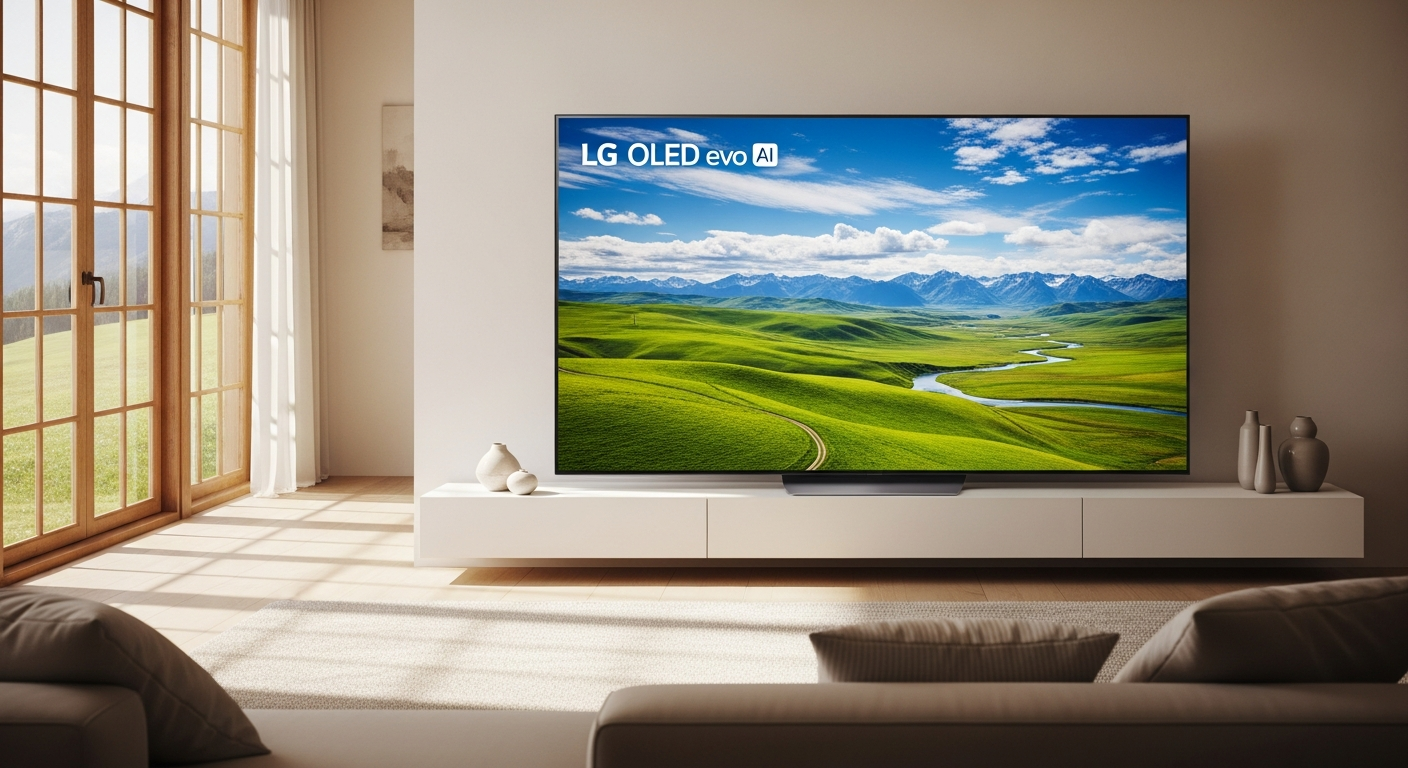
Over 3,800 units of the LG OLED evo AI Television C5 series sell monthly on Amazon alone—and that's just one screen size. The reason is straightforward: LG's revolutionary AI-driven picture processing has fundamentally changed what consumers expect from their televisions. These aren't merely premium displays; they're intelligent systems that learn and adapt to every frame.
The LG OLED evo AI Television represents a watershed moment in home entertainment. Powered by the α9 Gen8 4K AI Processor, these televisions combine LG's commanding 51% market share in North American OLED sales with cutting-edge machine learning capabilities that optimize content in real time. Whether you're streaming compressed video or watching native 4K, the AI engine works behind the scenes to enhance resolution, color accuracy, and contrast automatically.
This article examines exactly how AI Super Upscaling 4K technology transforms standard streaming into near-native quality. You'll understand the specific advantages of the α9 Gen8 processor, discover why tech enthusiasts and high-income households are gravitating toward these models, and determine whether the premium pricing aligns with actual performance gains in your living room.
Explore the LG OLED evo AI Television lineup today
How AI Super Upscaling 4K Transforms Everyday Streaming into Premium Viewing
Understanding AI Super Upscaling 4K Technology
AI Super Upscaling 4K represents a fundamental departure from traditional scaling algorithms. Rather than applying generic enlargement rules to lower-resolution content, the technology analyzes pixel patterns, textures, and contextual information within each frame to intelligently reconstruct missing data. The system examines surrounding pixels, recognizes objects within the scene, and applies learned patterns to fill gaps that standard upscaling would leave blurry or pixelated.
Real-World Streaming Service Performance
Netflix, Disney+, and HBO Max compress their streaming content to manage bandwidth requirements. A 1080p Netflix stream, for instance, undergoes significant compression to maintain smooth playback over standard internet connections. When displayed on a 75-inch or larger screen without enhancement, this compression becomes painfully visible—jagged edges, color banding, and soft details that look nothing like the original source material.
The α9 Gen8 processor identifies these compression artifacts and reconstructs lost detail by analyzing the content's inherent structure. A scene in a nature documentary suddenly reveals texture clarity in tree bark and foliage that appeared flat on the compressed stream. Action sequences in superhero films display sharper edges and smoother motion without the characteristic pixelation that plagues standard upscaling.
Standard Upscaling Versus AI-Driven Enhancement
Traditional upscaling uses mathematical formulas to interpolate pixels—essentially making educated guesses about what should exist between existing pixels. This approach works adequately for modest screen sizes but fails catastrophically on 75-inch and larger displays where pixel density becomes visibly inadequate.
AI-driven upscaling, by contrast, learns from millions of high-resolution images during training. The processor recognizes patterns—how skin texture typically appears, how fabric weave behaves under lighting, how natural edges transition between objects. When encountering compressed 1080p content on a 75-inch screen, the AI engine applies these learned patterns to reconstruct detail with remarkable accuracy, resulting in images that approach native 4K quality despite originating from lower-resolution sources.
The α9 Gen8 Processor's Role in Detail Enhancement
The α9 Gen8 4K AI Processor dedicates substantial computational resources to frame-by-frame analysis. As content plays, the processor examines each frame independently, identifying fine details that compression has obscured. Edges that appear soft in the original stream get sharpened through learned pattern recognition. Colors that suffered during compression get restored based on contextual analysis of surrounding pixels and established color relationships.
The processor simultaneously tracks temporal consistency—ensuring that frame-to-frame transitions maintain coherence and preventing the artificial artifacts that weaker upscaling systems introduce.
Machine Learning Adaptation Across Content Types
Different content types require different enhancement strategies. Sports broadcasts benefit from motion smoothing and judder reduction that preserves fast action without introducing blur. Cinematic content demands color and contrast enhancements that respect the director's creative intent. Documentaries with detailed natural scenery require texture clarity that reveals fine details without looking artificially sharpened.
The AI engine within the α9 Gen8 processor detects content type automatically and adjusts its upscaling parameters accordingly. A football game receives motion optimization while a nature documentary receives texture enhancement—all without user intervention or manual settings adjustment.
Visible Performance Improvements
The improvements viewers experience are concrete and immediate. Edges appear sharper and more defined. Pixelation that characterized lower-resolution content on large screens becomes virtually imperceptible. Textures—from fabric patterns to skin tone detail—display remarkable clarity. Color gradations smooth out, eliminating the banding artifacts that compressed content typically exhibits.
Watching a standard-definition streaming service on a traditional OLED TV reveals obvious quality limitations. The same content on an LG OLED evo AI Television appears substantially closer to native 4K quality, with detail and clarity that seems disproportionate to the source material's actual resolution.
Discover how AI upscaling transforms your streaming experience
The α9 Gen8 4K AI Processor Explained: What Sets It Apart
Core Specifications and Processing Architecture
The α9 Gen8 represents LG's eighth-generation AI processor specifically engineered for television picture optimization. The chip incorporates dedicated neural network processing cores designed for real-time frame analysis, separate from the standard video processing pipeline. This architecture allows simultaneous upscaling, color enhancement, and motion processing without computational bottlenecks.
The processor operates at speeds sufficient to analyze and optimize every frame as it renders, delivering frame-by-frame enhancement at the television's native refresh rate. This real-time capability distinguishes AI picture processing from post-production enhancement, where processing occurs offline and applies uniformly across content.
Generational Improvements from Previous Processors
The α9 Gen7 and earlier generations handled upscaling primarily through algorithmic methods with limited machine learning capability. These processors could enhance edge sharpness and apply broad color adjustments, but lacked the sophisticated pattern recognition that characterizes current AI systems.
The α9 Gen8 introduces substantially more powerful neural processing cores, allowing deeper machine learning model deployment. The processor can now analyze contextual information at multiple scales simultaneously—examining individual pixels, local regions, and entire objects within frames. This multi-scale analysis enables enhancement quality that previous generations couldn't achieve, particularly noticeable on content with fine detail or complex textures.
Real-Time Frame Analysis and Optimization
The processor analyzes each incoming frame before display, identifying compression artifacts, contrast limitations, and color inaccuracies introduced during source material creation and streaming compression. Rather than applying generic enhancement to every frame identically, the AI engine tailors adjustments based on frame-specific content characteristics.
A frame containing primarily faces receives different optimization than a frame dominated by landscape scenery. The processor recognizes these distinctions and adjusts enhancement parameters accordingly, preventing the over-processing that can create artificial or unnatural-looking results.
AI-Powered Color Mapping and Dynamic Contrast
Color accuracy represents a critical component of picture quality, yet streaming compression frequently degrades color fidelity. The α9 Gen8 processor applies machine learning-based color mapping that analyzes color relationships within scenes and reconstructs nuanced color variations that compression has flattened.
Dynamic contrast enhancement works in concert with color mapping, analyzing local brightness variations and adjusting contrast curves to emphasize detail while maintaining overall picture balance. The AI system prevents blooming—excessive brightness that degrades black levels and contrast—by analyzing each region's brightness requirements independently.
Integration with webOS Smart TV Platform
The α9 Gen8 processor operates seamlessly within LG's webOS ecosystem, accessing system information about content source, resolution, frame rate, and streaming protocol. This integration allows the processor to apply source-appropriate optimization automatically. Content from Netflix receives different processing than broadcast television, which receives different optimization than gaming consoles or Blu-ray players connected via HDMI.
The webOS platform also enables firmware updates that enhance processor capabilities over time, allowing LG to improve AI performance through software updates long after television purchase.
OLED Display Technology Meets Artificial Intelligence
Perfect Blacks and Infinite Contrast as Enhancement Foundation
OLED displays achieve perfect blacks by deactivating individual pixels completely—producing zero light output rather than the faint gray that LCD backlighting creates. This capability establishes an infinite contrast ratio theoretically, creating the ideal foundation for AI enhancement.
When the α9 Gen8 processor enhances contrast through AI analysis, it operates with absolute confidence that shadow areas can achieve complete darkness. This certainty enables aggressive contrast expansion without the risk of crushing shadow detail or creating artificial artifacts in low-light scenes. The result is contrast-enhanced imagery that appears film-like and three-dimensional, with depth that standard displays struggle to achieve.
AI Optimization Specifically for OLED Panels
OLED displays respond differently to image processing than LCD alternatives due to their pixel-by-pixel light generation. Each OLED pixel operates independently, allowing localized brightness and color adjustments that LCD displays cannot match. The α9 Gen8 processor exploits this capability through enhancement algorithms specifically architected for OLED panel characteristics.
The processor applies locally-adaptive enhancement, adjusting brightness and color in specific image regions without affecting adjacent areas. This capability enables contrast enhancement that preserves shadow detail while maximizing highlight brightness—a balance that broader, display-wide adjustments cannot achieve on LCD panels with backlighting constraints.
Brightness Optimization Preventing Blooming
Blooming—the excessive brightness around bright objects that degrades adjacent dark areas—represents a constant challenge in OLED displays, particularly during high-contrast scenes. The α9 Gen8 processor analyzes brightness distribution across frames and applies pixel-level optimization that maximizes brightness in appropriate regions while preventing blooming in critical areas.
The system learns from millions of high-quality reference images how brightness should distribute in typical scenes. When processing high-contrast content, the AI engine applies these learned patterns to determine optimal brightness levels that achieve impact without degradation.
AI-Driven Motion Smoothing and Judder Reduction
Sports broadcasts and action-heavy content exhibit motion characteristics that challenge standard displays. Frame interpolation—generating intermediate frames to create smoother motion—risks introducing unnatural judder or soap-opera effects when implemented incorrectly.
The α9 Gen8 processor uses AI-driven motion analysis to detect actual motion within content and generate intermediate frames intelligently. The system recognizes when motion interpolation appears natural versus artificial, applying enhancement selectively to maintain authenticity while eliminating actual judder and stutter.
Machine Learning Color Calibration
Color accuracy depends on precise tone mapping that translates the original creator's intent to the display's color capabilities. The α9 Gen8 processor employs machine learning models trained on professional color grading reference materials to calibrate colors automatically.
The system learns how professional colorists typically balance colors in various content genres, then applies these learned principles to optimize color reproduction in real time. The result is color accuracy that approaches professional reference monitors, delivering color that appears intentional and well-balanced rather than oversaturated or artificial.
HDR Processing Enhanced Through AI Analysis
High Dynamic Range content contains brightness and color information beyond standard display capabilities, requiring tone mapping that translates this extended information to display-compatible ranges without losing detail or impact. The α9 Gen8 processor analyzes HDR content structure and applies intelligent tone mapping that preserves both highlight detail and shadow information while maximizing the visual impact that HDR is designed to deliver.
Market Dominance and Consumer Demand: Why These Numbers Matter
Market Share Leadership in Premium OLED Segment
LG commands a 57.5% market share in 75-inch and larger OLED televisions, a remarkable concentration of sales in the segment where AI picture processing delivers maximum impact. This dominance reflects both LG's technology leadership and consumer recognition that larger OLED displays benefit most significantly from AI enhancement.
The 75-inch and larger segment represents the premium tier where buyers prioritize picture quality above price considerations, making this market segment the truest indicator of technology leadership. LG's overwhelming dominance in this tier validates that consumers recognize the α9 Gen8 processor and OLED technology combination as superior.
North American Market Penetration
North American OLED TV sales demonstrate LG's complete market dominance in the region, with 51% market share as of Q1 2025. This percentage represents more than double the share of any single competitor, positioning LG as the default choice for consumers seeking premium OLED televisions in the world's largest television market by revenue.
The consistency of this market share across quarters indicates established consumer preference rather than temporary promotional advantage, suggesting that buyers actively choose LG OLED evo AI televisions based on performance recognition.
Monthly Unit Sales for C5 Series
The 65-inch C5 model alone exceeds 3,800 monthly unit sales on Amazon. Considering that Amazon represents approximately 35-40% of online electronics retail volume and perhaps 25-30% of total television sales, these figures suggest monthly unit sales exceeding 12,000-15,000 units for this single model across all retail channels.
Annualized, the 65-inch C5 represents potential sales of 150,000+ units annually from one model in one size, highlighting the extraordinary demand for LG's AI-enhanced OLED televisions among mainstream consumers, not exclusively high-income early adopters.
Competitive Comparison and Leadership Positioning
Competitors including Samsung, Sony, and Hisense manufacture OLED televisions with competitive picture quality, yet none have achieved comparable market share or sales volume. Samsung's quantum-dot OLED technology offers specific advantages in brightness and color volume, yet LG's combination of OLED technology reliability, AI processing sophistication, and brand trust has created a competitive moat difficult for rivals to penetrate.
The market share advantage reflects both objective performance superiority and consumer perception that LG represents the safest, most capable choice for premium television purchases.
Target Demographic Characteristics
Tech enthusiasts who prioritize picture quality and appreciate innovation drive significant purchase volume. These buyers understand AI picture processing and actively seek the latest technology. They're willing to pay premium prices for capabilities like AI Super Upscaling 4K and advanced color processing.
High-income households represent the primary demographic, with median household incomes of $150,000+ representing typical LG OLED evo AI Television buyers. These consumers view television as a central entertainment investment and budget accordingly for premium products.
Premium Pricing Versus Real-World Performance: Is It Justified?
Price Structure and Positioning
LG OLED evo AI Television C5 and G5 series models command premium pricing reflecting their advanced technology and market position. While specific current pricing varies by retailer and model, the C5 series typically ranges from $1,500 for mid-sized models to $3,500+ for 85-inch variants. The G5 series, featuring additional refinements and premium builds, commands higher pricing in the $2,000-$4,500+ range across comparable sizes.
This pricing positions these televisions in the premium tier, accessible primarily to consumers for whom picture quality justifies substantial investment.
Promotional Discount Accessibility
LG frequently offers promotional discounts reaching $700 on best-selling OLED models, effectively reducing entry prices to more accessible levels. These promotions typically occur during major shopping events—Black Friday, post-holiday clearance, and seasonal sales periods—creating opportunities for price-conscious buyers to access premium technology at reduced cost.
The consistent availability of significant discounts suggests that LG uses promotional pricing strategically to reach broader audiences without devaluing the technology through permanent price reduction.
Premium Feature Cost Justification
The α9 Gen8 4K AI Processor represents substantial development investment, with the chip's manufacturing cost, R&D amortization, and technology licensing totaling several hundred dollars per television. OLED panel manufacturing costs exceed LCD alternatives by comparable margins. The webOS platform development and ongoing updates require dedicated software engineering resources.
These genuine technological advantages justify premium pricing relative to standard OLED or LCD alternatives. A consumer paying $2,000 for a 65-inch C5 versus $800-1,000 for a comparable non-OLED alternative is investing approximately $1,000-1,200 in OLED technology benefits and $500-700 in AI processing capabilities. The differentiation is substantial and justifiable for consumers who prioritize picture quality.
Long-Term Value Proposition
OLED technology reliability has improved dramatically over the past five years, with current-generation panels demonstrating lifespans comparable to LCD displays under normal viewing conditions. LG's reputation for service and warranty support further enhances long-term value.
AI processing capabilities through software updates improve over product lifespans, meaning televisions purchased today become progressively more capable as LG releases firmware enhancements. A C5 series television purchased in 2025 will benefit from processor optimization improvements for years, unlike traditional televisions whose capabilities remain static.
ROI Considerations by Viewer Type
For tech enthusiasts who watch premium streaming content daily, gaming regularly, and prioritize picture quality, the AI upscaling and OLED technology deliver noticeable, continuous benefits that justify premium pricing. These consumers will recognize improvement immediately and appreciate it throughout ownership.
Casual viewers who watch broadcast television or compressed streaming services several hours weekly may experience less dramatic differences. For these consumers, the premium investment may not deliver proportional value, making standard OLED or high-quality LCD alternatives more rational choices.
Price-to-Performance Across Screen Sizes
The economics of AI picture processing favor larger screen sizes. On 55-inch displays, AI upscaling improvements appear less dramatic because standard upscaling already addresses the pixel density limitations. On 75-inch and larger displays, where pixel density becomes clearly inadequate for standard upscaling, AI enhancement delivers visually dramatic improvements.
The 65-inch C5 model, where monthly sales exceed 3,800 units, represents the optimal balance point where AI enhancement delivers unmistakable improvements while remaining accessible to a broader buyer demographic than 85-inch models.
The Verdict: AI Processing That Justifies Premium OLED Investment
The LG OLED evo AI Television isn't simply a display upgrade—it's a fundamental shift in how televisions process and optimize visual content. The α9 Gen8 4K AI Processor transforms compressed streaming into near-native quality, while the OLED panel delivers the perfect blacks and infinite contrast that make AI enhancements truly shine. With 51% market share in North American OLED sales and monthly unit sales exceeding 3,800 for the C5 series alone, these televisions have earned their premium positioning through tangible performance gains.
The investment makes the most sense for tech enthusiasts, 4K content lovers, and households where television viewing is a central entertainment focus. Streaming constantly, gaming regularly, or tired of pixelated lower-resolution content on large screens? The AI upscaling capabilities deliver noticeable improvements that justify the higher price point—especially when LG's frequent promotions reduce costs by up to $700. The future of television has arrived, and these systems are learning how to make your content look better than ever before.
Visit LG to explore the complete OLED evo AI Television lineup
Leave a Reply