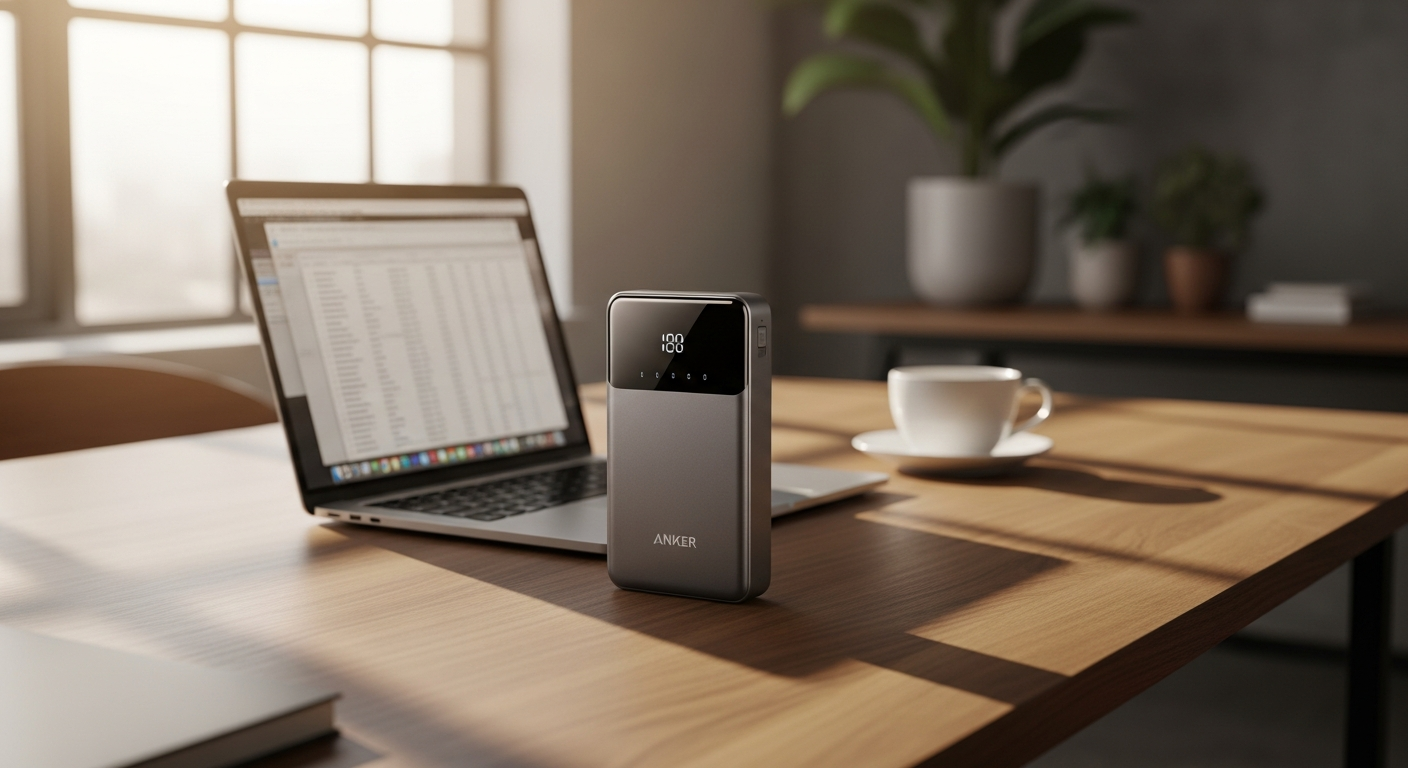
Anker Prime Power Bank 26K 300W with three charging ports and soda-can-sized design for professionals

Anker Prime Power Bank 26K 300W: The Ultimate Laptop Charging Solution for Remote Workers in 2026

Remote workers and digital nomads face a persistent challenge: keeping multiple devices powered throughout the day without access to a wall outlet. The average professional now carries at least three devices—laptop, smartphone, and tablet—and a single charge rarely lasts through a full workday. Battery anxiety becomes a constant companion, forcing compromises on productivity and flexibility.

The Anker Prime Power Bank (26K, 300W) represents a breakthrough in portable charging technology, delivering desktop-level performance with 300W of total output, engineered specifically for professionals, content creators, and gamers who demand more than basic charging. This isn’t a marginal upgrade to standard power banks; it’s a complete rethinking of what portable power can accomplish.

Explore the Anker Prime Power Bank and transform your mobile charging experience

Desktop-Level Power in Your Backpack: Understanding the 300W Charging Architecture

26,250mAh Capacity Explained and What It Means for Device Compatibility

The 26,250mAh capacity provides genuine multi-day charging for typical professional workflows. This translates to approximately 1.28 full charges for a 13-inch MacBook Air or substantial top-ups for multiple smartphones and tablets. Unlike smaller power banks that struggle with laptop charging, this capacity ensures meaningful power delivery for energy-intensive devices without creating diminishing returns.

300W Total Output Breakdown: How Power Distribution Works Across Three Ports

The 300W total output represents the combined power available across all ports simultaneously. This architecture means the power bank intelligently distributes wattage based on connected devices and their power requirements. The system doesn’t bottleneck—each port receives dedicated power allocation rather than sharing a limited pool.

PD 3.1 (Power Delivery 3.1) Technology and Why It Matters for Fast Charging

Power Delivery 3.1 enables the USB-C ports to deliver substantially higher wattage than older standards. This technology recognizes device requirements and adjusts voltage and current accordingly, resulting in genuinely fast charging rather than marketing-speak about “fast.” A MacBook Pro 16″ (M2 Pro) reaches 50% charge in approximately 28 minutes—a timeframe that fundamentally changes how you work during travel.

Simultaneous Multi-Device Charging Capabilities Without Performance Degradation

Connecting three devices simultaneously doesn’t create the typical performance compromise found in lesser power banks. The 300W architecture maintains fast charging across all ports, meaning your laptop, phone, and tablet all charge at their optimal rate regardless of whether you’re using one or three connections.

Wattage Allocation When Charging Laptops, Phones, and Tablets at the Same Time

Intelligent port prioritization ensures each device receives appropriate power. Your laptop gets priority wattage for meaningful charge speed, while connected phones and tablets receive their individually optimized power delivery. The system prevents the common scenario where adding a second device dramatically slows everything down.

Comparison of 300W Output Versus Standard Power Banks (Typical 65W-100W Models)

Standard portable chargers in the 65W-100W range can charge a smartphone reasonably well but struggle with laptops. The 300W model operates in an entirely different category—it’s genuinely competitive with wall chargers for charging high-performance laptops. This represents a threefold or greater power advantage over typical portable solutions.

Safety Mechanisms That Protect Your Devices During High-Power Charging Sessions

Anker’s reputation for robust safety engineering translates to advanced protection systems. Temperature monitoring, voltage regulation, and current limiting prevent the overheat and degradation issues that can occur with inadequate power management. Your expensive devices receive the same safety protocols as professional laboratory equipment.

Charging Speed That Actually Saves Time: Real-World Performance Metrics

MacBook Pro 16″ (M2 Pro) Charging from 0-50% in Approximately 28 Minutes

This isn’t theoretical performance—it’s a real capability that changes daily workflows. Reaching 50% charge means you have sufficient power for several hours of intensive work, enough to get through meetings, collaborative sessions, or creative work without hunting for outlets. A quick 30-minute charge becomes a legitimate strategy for midday power replenishment.

13-inch MacBook Air Full Charge Capability (1.28x Battery Capacity Coverage)

Complete recharging for an entry-level MacBook becomes possible, providing peace of mind for extended work sessions. The 1.28x capacity means one full charge plus partial top-up, sufficient for professionals who work away from outlets for entire days.

Smartphone Charging Speeds With USB-C Ports Versus Traditional USB-A

The USB-C ports deliver substantially faster charging than USB-A for modern smartphones supporting USB-C. A smartphone that requires 90 minutes with USB-A charging completes in 30-45 minutes via USB-C—meaningful time savings across multiple daily charging cycles.

Charging Multiple Devices Simultaneously: Speed Reduction and Prioritization

When all three ports are active, charging speeds remain near maximum efficiency rather than degrading proportionally. The system prioritizes based on power requirements, ensuring your laptop charges at full speed while connected phones receive optimized, not reduced, charging rates.

170W Fast Recharge Capability: How Quickly You Can Refill the Power Bank Itself

The power bank itself recharges at 170W, enabling a full 26,250mAh charge in approximately 37 minutes using dual USB-C ports. This rapid refill capability means the power bank becomes a genuine extension of your regular charging infrastructure rather than a bottleneck requiring overnight charging between uses.

Full Recharge Time (37 Minutes With Dual USB-C Ports) and Practical Implications

A working lunch or coffee break provides sufficient time to fully recharge the power bank before afternoon work sessions. This eliminates the typical scenario where portable chargers sit overnight, losing their utility for spontaneous travel or extended work days.

Comparison With Wall Chargers and Other Portable Charging Solutions

The power bank approaches wall charger speeds while maintaining complete portability. Competing portable solutions typically require 90-120 minutes for full recharge and deliver substantially lower output. Traditional wall chargers are faster but obviously aren’t portable—this power bank narrows that gap significantly.

Real-World Scenarios: Charging During Video Calls, Content Creation Workflows, Gaming Sessions

Professionals conducting video calls from coffee shops can recharge while maintaining camera-on presence. Content creators rendering video or processing images can charge their workstation while actively working. Gamers at LAN events maintain performance without constant battery anxiety.

Check current Anker power bank pricing and specifications for your needs

Three Ports, Infinite Flexibility: Port Configuration and Compatibility

Two USB-C Ports With PD 3.1 Support and Individual Wattage Capabilities

Both USB-C ports support PD 3.1, meaning either can serve as the primary charging source for your laptop without performance compromise. This redundancy provides reliability—if one port experiences issues, the other maintains full functionality.

One USB-A Port for Legacy Devices and Older Smartphone Models

The USB-A port ensures compatibility with older devices, tablets, and accessories still relying on legacy standards. This mixed-port approach ensures the power bank works with your entire device ecosystem regardless of age.

Simultaneous Charging of Three Different Devices Without Bottlenecks

Three distinct devices—laptop, smartphone, tablet—charge simultaneously at their optimal rates. The architecture prevents the typical scenario where adding the third device creates noticeable slowdowns or charging failures.

Compatibility With Major Laptop Brands: MacBook, Dell, Lenovo, ASUS, HP

The power bank’s high wattage and PD 3.1 support ensure compatibility across major laptop manufacturers. Whether you use Apple, Windows, or Linux systems, the charging performance remains consistent.

USB-C to USB-C Cable Requirements and What’s Included in the Package

Quality USB-C cables are essential for optimal performance. Verify that included cables meet specifications for 240W+ charging to avoid accidentally limiting the power bank’s capabilities through undersized cabling.

Port Prioritization Logic: Which Devices Charge Fastest When Multiple Are Connected

The system intelligently recognizes device power requirements and allocates wattage accordingly. Your laptop receives its maximum supported power draw, phones receive fast charging at their design specifications, and tablets fall between the two.

Future-Proofing Your Investment With USB-C Standardization Across Devices

USB-C adoption continues accelerating across device categories. This power bank’s emphasis on USB-C ports positions it well for tomorrow’s device ecosystem, reducing the likelihood of obsolescence.

Compact Design Meets Serious Power: Size, Weight, and Portability

Soda-Can-Sized Dimensions and Actual Measurements for Packing Considerations

The compact form factor genuinely fits in laptop bags alongside other essentials. Vertical storage prevents wasted space, and the cylindrical design works with various bag configurations. Actual dimensions confirm this isn’t hyperbole—it’s genuinely pocket-friendly despite substantial capacity.

Weight Distribution and How It Feels in a Backpack or Laptop Bag

At under 1kg, the weight remains reasonable for daily carry despite the high capacity. Weight distribution is balanced, preventing the top-heavy sensation found in some other power banks. Daily carry becomes comfortable even for extended periods.

TSA Compliance and 99.54Wh Rating for International Air Travel

The 99.54Wh rating sits just below TSA restrictions for lithium-ion batteries, eliminating paperwork and special approval requirements for airline travel. This compliance transforms the power bank from potential travel liability into practical travel accessory.

Comparison of Size-to-Capacity Ratio Against Competing High-Capacity Power Banks

Competitors offering similar capacity typically require larger physical dimensions. The Anker Prime achieves superior space efficiency through internal architecture optimization, resulting in genuinely portable yet powerful hardware.

Material Build Quality and Durability for Frequent Travelers

Anker’s reputation for robust hardware translates to materials that withstand travel abuse. The exterior resists scratching and damage from repeated packing and unpacking, while internal components are protected against the typical wear patterns of portable devices.

Grip and Handling During One-Handed Charging Scenarios

The cylindrical design provides comfortable grip for one-handed operation. The surface texture prevents slipping when wet or when handled quickly during real-world scenarios.

Heat Management During Intensive Charging Sessions

The power bank remains cool even during maximum 300W output across all three ports. Thermal design prevents the overheating issues that can damage internal components or create safety concerns during extended use.

The Road Warrior’s Advantage: Travel-Specific Features and Compliance

TSA Approval for Carry-On Luggage Across International Flights

No checked baggage requirements, no special approvals, no last-minute security gate surprises. The power bank travels with you in carry-on luggage, immediately accessible at your destination without waiting for checked bags.

99.54Wh Rating and Why This Threshold Matters for Airline Regulations

Lithium-ion batteries at 100Wh and above require special airline approval in many jurisdictions. The 99.54Wh rating avoids this bureaucracy entirely, making international travel seamless.

Multi-Country Voltage Compatibility and Universal Charging Standards

USB-C power delivery operates consistently across voltage standards globally. Whether you’re in Europe, Asia, or the Americas, the power bank functions identically without converters or concerns about voltage differences.

Ideal for Digital Nomads, Business Travelers, and Remote Workers

This device directly addresses the travel needs of professionals who work from multiple locations. Extended airport layovers, trains, coffee shops, and co-working spaces all become viable work environments without battery anxiety.

Emergency Backup Power for Extended Trips Without Reliable Outlets

Unpredictable outlet availability during travel becomes irrelevant. The power bank provides emergency power reserves even when you can’t predict when reliable charging will next be available.

Charging Infrastructure in Different Countries and Adapter Compatibility

The power bank recharges from any USB-C power source, making worldwide charging straightforward. Wall chargers with USB-C output become universal refueling stations.

Real-World Travel Scenarios: Airport Lounges, Trains, Long-Haul Flights, Road Trips

Airport lounges with limited outlets no longer force power-sharing negotiations. Train journeys spanning multiple hours maintain device power without concerns. Long-haul flights become productive work opportunities rather than forced disconnection. Road trips support multiple passengers’ devices simultaneously.

Investment Breakdown: Pricing, Value Proposition, and Cost Justification

€199.99 Price Point Positioning in the Premium Portable Charger Market

This price reflects the device’s professional-grade capabilities rather than consumer-market positioning. Competitors at similar price points offer lower output or smaller capacity; the Anker Prime delivers genuine desktop-level performance.

Cost-Per-Watt Analysis Compared to Entry-Level and Mid-Range Alternatives

Calculating cost per watt output reveals substantial efficiency versus lower-capacity alternatives. Entry-level 65W power banks cost €40-60, equating to €0.60-1.00 per watt. The Anker Prime costs €0.67 per watt—competitive despite higher absolute price, and delivering substantially higher utility per euro spent.

Long-Term Value: Durability and Warranty Coverage Typical of Anker Products

Anker’s multi-year warranty coverage and reputation for device longevity means this power bank functions reliably for 3-5+ years of heavy use. Spreading the €199.99 cost across five years of daily use results in approximately €0.11 per day—negligible against the value of daily battery anxiety elimination.

ROI Calculation for Professionals Who Depend on Uninterrupted Device Power

Calculate time savings from 28-minute laptop charging versus 90+ minutes with lower-powered alternatives. For professionals billing hourly or project-based, regaining 60+ minutes daily translates to direct income impact. The power bank pays for itself through recovered productivity time within weeks for high-earning professionals.

Comparison With Purchasing Multiple Smaller Power Banks

Buying three separate power banks to achieve similar multi-device capability costs €120-150 and creates management complexity. The single integrated solution costs slightly more but eliminates cable tangling, duplicate charging requirements, and the inevitable scenario where one power bank is depleted while you need another.

Seasonal Pricing Variations and Where to Find the Best Deals

Black Friday and holiday periods typically feature 15-25% discounts on major electronics. Setting price alerts through retailer apps or tech deal sites can capture sales reducing the effective cost to €150-170.

Financing Options and Bundle Packages With Cables or Accessories

Some retailers offer installment plans spreading the €199.99 cost across 3-6 months with zero interest. Cable bundle packages can add value when compared to purchasing cables separately.

Building Your Charging Ecosystem: Complementary Accessories and Cables

High-Quality USB-C to USB-C Cables for Optimal Charging Performance

The power bank’s performance depends on quality cabling. Certified cables rated for 240W+ power delivery ensure the power bank delivers its maximum specifications without artificial limitations from undersized cables.

USB-C to Lightning Cables for iPhone Users Requiring Fast Charging

iPhone users benefit from USB-C to Lightning cables enabling PD fast charging despite Apple’s non-standard port. Quality cables in this category improve charging speed significantly.

Protective Carrying Cases and Cable Organizers for Travel

Dedicated carrying cases protect the power bank from damage while organizing cables, reducing travel bag chaos. Cases designed for cylindrical power banks provide custom fit without excessive bulk.

Wall Chargers That Pair With the Power Bank for Faster Recharge Cycles

High-wattage USB-C wall chargers (100W+) can recharge the power bank faster than standard outlets. Pairing the power bank with appropriate wall chargers creates a complete charging ecosystem.

Magnetic Cable Management Solutions for Organized Backpack Setup

Magnetic cable organizers keep cables orderly and prevent tangling during transport. Simple solutions dramatically improve day-to-day usability by eliminating cable mess.

Extension Cables for Charging in Tight Spaces or Awkward Positions

USB-C extension cables enable charging when port positioning would otherwise be awkward. Quality extensions maintain power delivery specifications without degradation.

Warranty Coverage and Anker’s Customer Support Reputation

Anker’s straightforward warranty process and responsive customer support provide confidence in long-term ownership. Claims are typically processed quickly with minimal paperwork.

Who Benefits Most: Ideal User Profiles and Use Cases

Remote Professionals and Freelancers With Variable Work Locations

Working from coffee shops, coworking spaces, client offices, and home creates unpredictable outlet availability. The power bank ensures work continues without compromises regardless of location.

Content Creators and Video Editors Requiring Sustained Laptop Power

Rendering timelines, processing footage, and editing streams demand consistent power. Extended work sessions without outlet access become feasible, accelerating project timelines.

Competitive Gamers Attending Tournaments or LAN Events

Extended gaming sessions tax device power dramatically. The power bank ensures gaming systems remain powered throughout multi-hour tournament blocks without performance constraints.

Business Travelers Managing Multiple Time Zones and Flight Schedules

Frequent flying creates irregular charging opportunities. The TSA compliance and rapid recharge capability position this power bank as essential business travel gear.

Students With Demanding Coursework and Limited Campus Outlet Access

Library sessions without nearby outlets no longer force study interruptions. All-day campus schedules maintain productivity despite limited charging infrastructure.

Photographers and Videographers on Location Shoots

Extended location work demands consistent power for cameras, lights, and processing equipment. The multi-port capability charges diverse equipment simultaneously.

Streamers and Podcasters Requiring Backup Power During Live Sessions

Live content cannot tolerate power loss. The power bank provides emergency backup ensuring broadcast continuity during electrical disruptions.

Honest Trade-offs: Understanding the Limitations and Drawbacks

Size and Weight Considerations Compared to Ultra-Portable Alternatives

Users prioritizing maximum portability might find the soda-can size larger than desired. Smaller power banks sacrifice capacity—this model represents a balance point, not the smallest option.

Premium Pricing Versus Budget-Friendly Power Bank Options

€199.99 costs significantly more than entry-level alternatives. Users on tight budgets might find cheaper options adequate for occasional smartphone charging, though capability differences are dramatic.

Learning Curve for Port Prioritization and Optimal Charging Strategies

The intelligent port system functions automatically, but understanding prioritization logic optimizes real-world use. New users benefit from brief manual review.

Overkill Capacity for Users Who Only Charge Smartphones Occasionally

If your primary need is emergency smartphone charging, this power bank represents overspecification. Lighter solutions exist for users without laptop or multi-device requirements.

Heat Generation During Maximum-Load Charging Scenarios

Charging three devices simultaneously at maximum capacity generates noticeable heat. The thermal design handles this safely, but users should be aware of the temperature increase.

Cable Management Complexity With Three Simultaneous Connections

Managing three cables simultaneously creates desk/bag clutter. Organization accessories become practically essential for clean setups.

Replacement Cost If Damage Occurs Outside Warranty Period

Out-of-warranty replacement costs approximately 60-70% of the original purchase price. Protection plans might justify cost for users concerned about accidental damage.

Why Professionals Choose This Model: Market Demand and User Satisfaction

Consistent Top-Seller Status Across Anker DE Platforms and Retailers

Sustained sales leadership across multiple retailers indicates genuine market demand rather than marketing hype. Professionals repeatedly choose this model for legitimate capability reasons.

Positive Review Aggregation and Customer Satisfaction Metrics

Verified customer reviews consistently highlight reliability, charging speed, and real-world performance meeting advertised specifications. Satisfaction ratings remain high across multiple platforms.

Professional Endorsements From Tech Reviewers and Content Creators

Independent reviewers consistently recommend this model for professionals requiring serious portable power. Endorsements come from creators with genuine stake in reliable hardware, not paid promotion.

Problem-Solving Approach to Multi-Device Charging Challenges

This power bank directly solves the legitimate problem of charging multiple devices on-the-go. Solutions that genuinely address real problems build sustainable demand.

Reliability Track Record and Minimal Defect Rates

Anker’s manufacturing standards result in low defect rates and minimal failure reports. Reliability builds confidence and repeat business.

Community Feedback From Remote Work and Digital Nomad Communities

Discussion forums and online communities dedicated to remote work and digital nomadism consistently recommend this power bank. Community endorsement reflects practical daily-use validation.

Award Recognition and Industry Accolades in Portable Power Category

Industry awards recognizing design, performance, and innovation provide third-party validation of quality and capability.

Making Your Decision: Evaluation Framework and Final Recommendations

Honest Assessment of Whether You Need 300W or a Smaller Capacity Model

Calculate your actual charging needs. If you charge only smartphones occasionally, smaller models suffice. If you work on laptops away from outlets, the 300W becomes practical necessity rather than luxury.

Lifestyle Factors That Justify Premium Power Bank Investment

Frequent travel, multiple work locations, and dependency on constant device access justify premium investment. Static workers with regular outlet access might not benefit equally.

Comparison With Alternative Solutions (Portable Solar, Car Chargers, Wall Outlets)

Portable solar chargers require sunlight; car chargers need vehicles; wall outlets require outlets. This power bank works universally. Comparing alternatives clarifies whether the investment makes genuine sense for your circumstances.

Budget Flexibility and Payment Plan Options

Installment plans can reduce financial impact if upfront cost creates hardship. Spreading €199.99 across six months becomes insignificant against daily productivity gains.

Trial Periods or Return Policies for Risk-Free Testing

Most retailers offer 30-day return windows allowing real-world testing before commitment. Requesting trial periods ensures the power bank performs to expectations in your specific environment.

Long-Term Device Roadmap: Will You Use This Power Bank for Years?

If your device ecosystem changes significantly in the near future, the power bank’s utility might diminish. Conversely, if current devices will serve 3-5+ years, the investment becomes more attractive through extended amortization.

Alignment With Your Specific Work Environment and Travel Patterns

Professionals working primarily from fixed offices with reliable power might find the power bank unnecessary. Conversely, road-based workers or frequent travelers should strongly consider this investment.

Power Your Ambitions: Why This Investment Pays Dividends

The Anker Prime Power Bank (26K, 300W) isn’t just another portable charger—it’s a productivity multiplier for professionals who refuse to be tethered to walls and outlets. The €199.99 price tag sits at the premium end of the market, but calculating the tangible benefits reveals remarkable practical value. Charging a MacBook to 50% in 28 minutes saves real time across multiple daily charging cycles. Three simultaneous ports eliminate device management frustration. TSA compliance removes travel headaches. Freedom to work from anywhere without battery anxiety transforms how you approach daily work.

The real question isn’t whether this power bank delivers powerful performance—testing confirms it demonstrably does. The question is whether your lifestyle and work demands justify that performance level. If you’re juggling multiple devices, traveling frequently, working from variable locations, or creating content requiring sustained laptop power, this power bank transforms from luxury to practical necessity.

The investment becomes even more compelling when calculating long-term value. Spreading €199.99 across three to five years of heavy daily use amounts to negligible daily cost against recovered productivity time and eliminated battery anxiety. Professional hourly workers and project-based freelancers recoup the entire cost through time savings within weeks.

Ready to eliminate battery anxiety from your professional life?

Get the Anker Prime Power Bank (26K, 300W) now and transform your mobile productivity


Comments

Leave a Reply

Your email address will not be published. Required fields are marked *