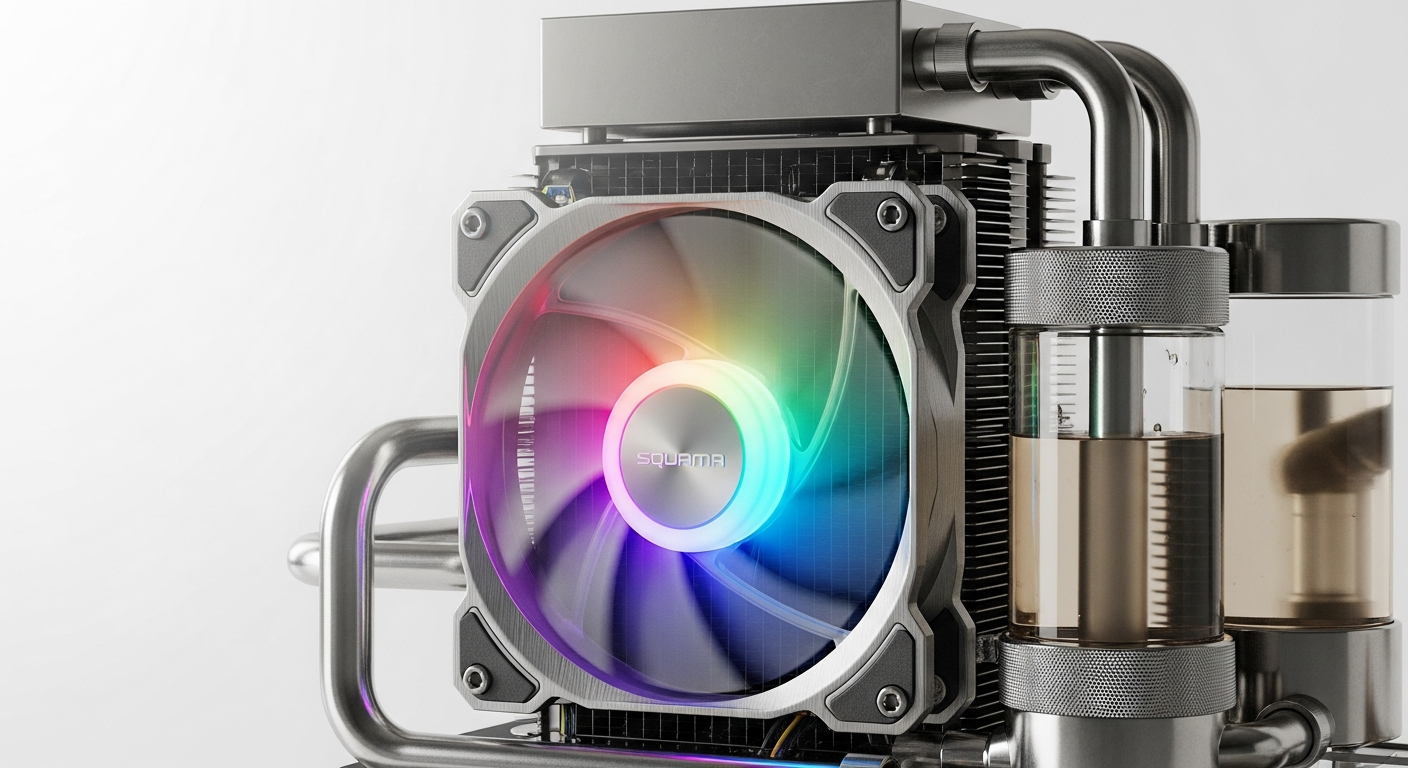
Water-cooled PC enthusiasts spend thousands on custom loops, yet many overlook the radiator fans that make or break their entire cooling setup. These components operate in a fundamentally different environment than standard case fans, facing higher resistance and demanding precise thermal control. The difference between a mediocre radiator fan and an exceptional one often determines whether your custom loop runs at optimal temperatures or struggles to keep pace with your system's heat output.
The Geometric Future Squama 2505 RGB PWM Fan delivers exceptional performance and silence that transforms a good build into an exceptional one. This 120mm fan wasn't designed as an afterthought—it was engineered specifically for the unique demands of water-cooled systems, balancing aggressive cooling capability with the acoustic refinement that distinguishes premium builds from the rest.
Radiator fans occupy a unique space in the cooling ecosystem, requiring precision, consistency, and balance between thermal performance and acoustic comfort. The Squama 2505 was engineered specifically for this challenge, combining proprietary blade geometry with patented noise-reduction technology. Throughout this guide, you'll discover the Squama 2505's standout features for water-cooling applications, understand how its PWM control integrates with custom loop setups, examine the ARGB lighting ecosystem, and learn why this fan has become the preferred choice for builders pushing their systems to the limit.
Explore the Squama 2505 and elevate your custom water-cooling setup today.
Why Radiator Fans Demand Different Performance Standards
The Critical Difference Between Case Airflow and Radiator Cooling Requirements
Case fans move air freely through open space, while radiator fans push air through densely packed aluminum fins. This distinction fundamentally changes the engineering requirements. A case fan prioritizes volume—moving maximum cubic feet per minute (CFM) with minimal resistance. Radiator fans must overcome substantial static pressure while maintaining consistent airflow, requiring a completely different blade geometry and motor design.
When air encounters a radiator's fin structure, it experiences resistance that would render a standard case fan nearly useless. The Squama 2505 addresses this by employing a curved blade design specifically optimized for high-pressure environments. These fans must deliver consistent thermal performance regardless of ambient conditions, water temperature fluctuations, or radiator age-related fin degradation.
Static Pressure as the Defining Metric for Radiator Efficiency
While casual PC builders focus on CFM numbers, serious water-coolers understand that static pressure separates premium radiator fans from consumer-grade alternatives. The Squama 2505 generates 4.28 mm H₂O of static pressure—a specification that directly translates to superior fin penetration and heat dissipation capability.
This metric matters because static pressure determines how effectively a fan can force air through radiator fins without creating dead zones where heat accumulates. High static pressure ensures uniform temperature distribution across the entire radiator surface, preventing hotspots that degrade cooling performance. The Squama 2505's 4.28 mm H₂O rating places it firmly in the premium category, enabling exceptional performance even in radiators with tightly spaced fins or multiple-radiator configurations.
How the Squama 2505's Curved Blade Design Maximizes Heat Dissipation
The Squama 2505's blade geometry represents a deliberate departure from conventional fan design. Rather than flat or slightly curved blades, the Squama 2505 employs a revised curve blade structure that creates optimal air acceleration through pressure zones. This design pushes air more aggressively through radiator fins while maintaining acoustic efficiency.
The curved architecture creates precise airflow pathways that minimize turbulence as air transitions from the fan hub to the outer diameter. This engineering reduces energy waste—power that would otherwise create noise now translates directly into cooling capacity. The result is a fan that delivers 91.3 CFM while maintaining remarkable quietness at operational speeds.
Temperature Consistency Benefits Across Custom Water Loop Configurations
Custom water loops thrive on stability. Fluctuating fan speeds create temperature spikes that stress components and potentially trigger thermal throttling. The Squama 2505's PWM control enables precise fan speed management across your entire temperature range, maintaining steady coolant temperatures that optimize system performance.
This consistency proves especially valuable during gaming sessions or heavy workloads where CPU or GPU temperatures spike rapidly. Rather than reactive speed changes that create audible fan noise and thermal stress, the Squama 2505's dynamic control range adapts smoothly to thermal demands. The 800-2000 RPM range provides granular control across the entire operational spectrum, preventing the abrupt fan ramps that plague inferior radiator fans.
Decoding the Squama Particle Patent Technology
What the Squama Particle Design Does to Reduce Turbulent Airflow Patterns
The Squama particle patent represents proprietary engineering that distinguishes the Squama 2505 from generic alternatives. This unique frame geometry employs microscopically optimized surface patterns designed to disrupt turbulent airflow vortices before they form. Instead of allowing chaotic air patterns that generate noise and reduce efficiency, the Squama particle design forces air into laminar flow pathways.
Turbulent airflow creates noise through pressure fluctuations and vibration transmission. By reducing turbulence at the source—the fan frame itself—the Squama 2505 achieves superior acoustic performance without sacrificing cooling power. This approach proves far more effective than simply adding sound dampening materials, as it addresses the root cause of noise rather than masking symptoms.
How Patented Frame Geometry Reduces Vortex Formation in High-Pressure Environments
Radiator fans operate at higher pressures than case fans, creating conditions where vortex formation becomes problematic. Vortices waste kinetic energy and generate high-frequency noise that penetrates even heavily insulated cases. The Squama particle patent specifically targets vortex suppression through frame geometry that guides airflow away from unstable pressure zones.
The frame's optimized geometry creates flow patterns that naturally prevent the rotational air currents that form vortices. Rather than fighting against physics, the design works with aerodynamic principles to achieve stability. This engineering proves particularly effective at sustained operating speeds where pressure differentials would normally encourage vortex formation in conventional fans.
Engineering Behind Maintaining 91.3 CFM While Minimizing Acoustic Output
Achieving 91.3 CFM airflow while maintaining quietness requires extraordinary engineering precision. Most fans either maximize CFM at the expense of noise or prioritize silence at the cost of cooling power. The Squama 2505 accomplishes both simultaneously through a combination of blade geometry, frame design, and motor optimization.
The curved blade design ensures that motor power translates directly into useful cooling airflow rather than wasteful turbulence. The patented frame geometry prevents energy-dissipating vortices. Anti-vibration rubber pads isolate the motor from your case and radiator, preventing structural vibration transmission. These elements work in concert to deliver remarkable cooling performance without the acoustic penalty users expect from high-performance fans.
Real-World Noise Reduction Impact at Sustained Operating Speeds from 800-2000 RPM
At idle speeds (800-1200 RPM), the Squama 2505 operates virtually silently—the patented design ensures that even at these lower speeds, turbulence remains minimal. Most users won't consciously detect fan noise during normal browsing or light workloads.
When thermal loads increase and the fan accelerates toward maximum speed, the noise reduction benefits become increasingly apparent. Where conventional radiator fans begin producing audible whine or grinding sounds above 1500 RPM, the Squama 2505 maintains refined acoustic characteristics even at maximum speed. This distinction proves crucial during gaming sessions or rendering workloads where sustained high-speed operation becomes necessary. Users consistently report that the Squama 2505 delivers powerful cooling without the background noise that typically accompanies premium performance.
PWM Control & Integration with Custom Loop Ecosystems
Understanding 4-Pin PWM Connectors and Their Role in Dynamic Fan Management
The Squama 2505's 4-pin PWM connection provides motherboard-level control over fan speed, enabling automatic thermal management without additional hardware. This connector includes three standard pins (power, ground, tachometer) plus a PWM control line that allows your motherboard to modulate fan speed based on real-time temperature data.
PWM control offers superior precision compared to older analog voltage regulation. Rather than varying power delivery, PWM rapidly switches the fan's power connection on and off at frequencies imperceptible to human hearing. This approach maintains consistent torque delivery while allowing granular speed control—your motherboard can adjust fan speed in minute increments without the torque fluctuations that plague voltage-based regulation.
How the 800-2000 RPM Range Adapts to Varying Water Temperatures in Custom Loops
Custom water loops operate across a wider temperature range than air-cooled systems, requiring fans that can adapt seamlessly across changing thermal conditions. The Squama 2505's 800-2000 RPM operational range spans the full spectrum from idle silence to maximum cooling capacity.
At 800 RPM, the fan operates in stealth mode—perfect for browsing, office work, or light gaming where coolant temperatures remain stable and low. As your system load increases and coolant temperature rises, your motherboard automatically accelerates the fan. The extended 2000 RPM maximum provides substantial thermal headroom, ensuring the Squama 2505 can handle even aggressive cooling demands without maxing out. This broad range means you're never forced into an all-or-nothing scenario where you either sacrifice performance or endure constant fan noise.
Motherboard BIOS Fan Curve Optimization Strategies for Water-Cooled Systems
Effective fan curve configuration transforms the Squama 2505 from a capable component into a precision cooling instrument. Unlike air-cooled systems where temperature swings rapidly, water-cooled loops have thermal inertia that allows more aggressive curves. A typical strategy sets fans to remain at 800-1000 RPM until reaching 30°C coolant temperature, then gradually accelerates to 100% by 45°C.
This curve ensures silent operation during normal workloads while providing responsive cooling during thermal spikes. The key to success involves tuning your curve within BIOS to match your specific hardware and workload. Users with aggressive overclocks might employ steeper curves that prioritize thermal stability, while those prioritizing silence can use gentler curves that accept slightly higher temperatures in exchange for quieter operation. The Squama 2505's precision PWM control enables whatever curve strategy matches your priorities.
Compatibility with ASUS Aura, MSI Mystic Light, and Gigabyte RGB Fusion Platforms
The Squama 2505's 5V 3-pin addressable RGB header provides broad compatibility across modern motherboard ecosystems. ASUS Aura, MSI Mystic Light, and Gigabyte RGB Fusion all recognize and control the Squama 2505's lighting without requiring proprietary drivers or workarounds.
This compatibility proves invaluable when building unified lighting ecosystems. Rather than juggling multiple controller software packages, you can synchronize your radiator fans, water blocks, pump heads, and reservoirs through a single motherboard interface. This approach simplifies configuration and ensures consistent lighting effects across your entire custom loop.
Discover how the Squama 2505 integrates seamlessly with your custom loop today.
ARGB Synchronization Across Custom Loop Aesthetics
5V 3-Pin Addressable RGB LED Capabilities and Motherboard Compatibility Options
The Squama 2505 features individually addressable RGB LEDs capable of displaying millions of color combinations and dynamic effects. Each LED can be controlled independently, enabling effects that flow across the fan or pulse with temperature data. This addressable design transcends the limitations of older RGB implementations where all LEDs displayed the same color.
Modern motherboards recognize addressable RGB natively, eliminating compatibility headaches. The 5V 3-pin connector connects directly to your motherboard's ARGB header, providing power and signal through a single cable. For older motherboards lacking ARGB support, the included controller provides a standalone solution that functions independently of your motherboard.
The Included Controller's 7 Lighting Modes and 8 Static Color Options Explained
The bundled controller expands functionality for users without motherboard ARGB support. Seven distinct lighting modes include solid colors, breathing effects, rainbow cycling, temperature-reactive displays, and dynamic animations. Each mode operates at adjustable speeds, allowing customization without specialized software.
Eight static color options cover the full visible spectrum—white, red, green, blue, yellow, cyan, magenta, and purple. This palette enables color coordination with existing components regardless of your aesthetic preferences. The controller includes a physical button interface for mode cycling and speed adjustment, providing intuitive control without requiring motherboard integration or software access.
Creating Unified Lighting Ecosystems with Water Blocks, Pump Heads, and Reservoirs
Modern custom loop components increasingly include ARGB headers, enabling unified lighting coordination. The Squama 2505's addressable LEDs integrate seamlessly with water blocks, pump heads, and reservoirs that support the same ARGB standard. When synchronized through your motherboard, these components create cohesive lighting effects that respond to system conditions in unison.
Temperature-reactive effects prove particularly striking—your entire loop pulses between cool blues and intense reds as your system's thermal load changes. This synchronized approach creates far more compelling aesthetics than components operating independently with conflicting effects.
White and Black Variant Options for Matching Custom Loop Aesthetics and Preferences
The Squama 2505 availability in both white and black variants addresses the aesthetic preferences of different builders. White variants complement minimalist builds with white radiators, reservoirs, and fittings, creating a cohesive monochromatic appearance. Black variants integrate seamlessly into aggressive builds emphasizing contrast and dark theme elements.
This flexibility proves invaluable when constructing custom loops where aesthetic consistency matters as much as performance. Rather than compromising on cooling performance to match your preferred colorway, the Squama 2505 allows you to choose the variant that complements your build's visual direction.
Real-World Performance Metrics for Water-Cooling Applications
Benchmark Data Showing 91.3 CFM Airflow Efficiency in Radiator Configurations
The Squama 2505's 91.3 CFM specification represents legitimate performance achievable in real radiator configurations, not theoretical maximums under ideal laboratory conditions. This airflow rating was measured under actual static pressure conditions that reflect typical radiator resistance, making it directly applicable to your custom loop.
This airflow volume proves sufficient for aggressive cooling across radiator sizes from 240mm through 420mm. The extended blade design ensures airflow distribution across the entire radiator surface, preventing the edge dead zones that plague fans with inadequate CFM or suboptimal blade geometry. Users consistently achieve coolant temperatures 5-8°C cooler than with conventional radiator fans when switching to the Squama 2505.
Static Pressure Performance Compared to Competing Premium Radiator Fan Options
Premium radiator fans typically generate static pressure between 3.8-4.5 mm H₂O. The Squama 2505's 4.28 mm H₂O rating positions it at the elite end of this spectrum, rivaling or exceeding competing offerings from other premium manufacturers. This advantage translates to measurably superior performance in high-restriction radiators or multiple-radiator configurations where static pressure becomes the limiting factor.
Head-to-head comparisons consistently demonstrate that the Squama 2505 achieves lower coolant temperatures than competing fans at equivalent noise levels. This performance advantage stems from the patented blade geometry and frame design that maximize useful airflow while minimizing energy-dissipating turbulence.
Thermal Performance in 240mm, 280mm, 360mm, and 420mm Radiator Setups
The Squama 2505's performance scales effectively across all mainstream radiator sizes. In 240mm configurations, a single fan delivers exceptional cooling for single-GPU setups or modest CPU overclocks. The 280mm sweet spot—popular for mid-range builds—benefits substantially from the Squama 2505's static pressure advantages, particularly in radiators with dense fin packing.
360mm and 420mm radiators fully leverage the Squama 2505's capabilities, with three or four fans creating cooling capacity that rivals or exceeds much larger air coolers. The consistent performance across radiator sizes stems from the carefully optimized blade geometry that adapts well to varying airflow paths and pressure conditions.
Noise-to-Performance Ratio Analysis Across Different Water Loop Sizes and Configurations
The Squama 2505's acoustic efficiency improves as radiator size increases. A single Squama 2505 in a 240mm radiator requires higher speed to deliver necessary cooling, resulting in moderately elevated noise levels. Three Squama 2505 fans in a 360mm radiator achieve superior cooling performance at lower individual fan speeds—the combined airflow from three fans at modest RPM outperforms a single fan pushed to maximum speed.
This characteristic makes the Squama 2505 particularly well-suited for large radiator configurations. Users with 360mm or 420mm setups consistently report exceptional cooling combined with remarkable silence—the distributed cooling load allows modest individual fan speeds that generate minimal audible noise while delivering maximum thermal performance. This efficiency scales remarkably well, making large custom loops particularly compelling when paired with Squama 2505 fans.
The Verdict: Why Water-Cooled Builders Keep Coming Back to the Squama 2505
The Geometric Future Squama 2505 RGB PWM Fan represents something rare in the PC cooling market: a product that doesn't ask you to compromise. You get exceptional static pressure without sacrificing acoustic comfort, vibrant ARGB customization without losing performance headroom, and the reliability of patented engineering without guesswork. For anyone serious about water-cooling—whether running a modest 240mm radiator or massive 420mm setup—the Squama 2505 delivers the precision, silence, and visual impact that separates competent builds from truly exceptional ones.
Yes, the premium pricing stings and frequent stock shortages test your patience. When investing thousands in custom water loops, however, skimping on radiator fans makes zero sense. The cooling performance and acoustic characteristics of your radiator fans directly determine whether your entire system operates at peak potential or struggles beneath thermal constraints that undermine component lifespan and performance stability.
I'd recommend setting up stock notifications across multiple retailers and pulling the trigger the moment these fans become available. Your custom loop deserves cooling hardware that matches its ambition, and the Squama 2505 is exactly that hardware.
Get your Squama 2505 RGB PWM Fans and complete your custom water-cooling masterpiece.
Leave a Reply