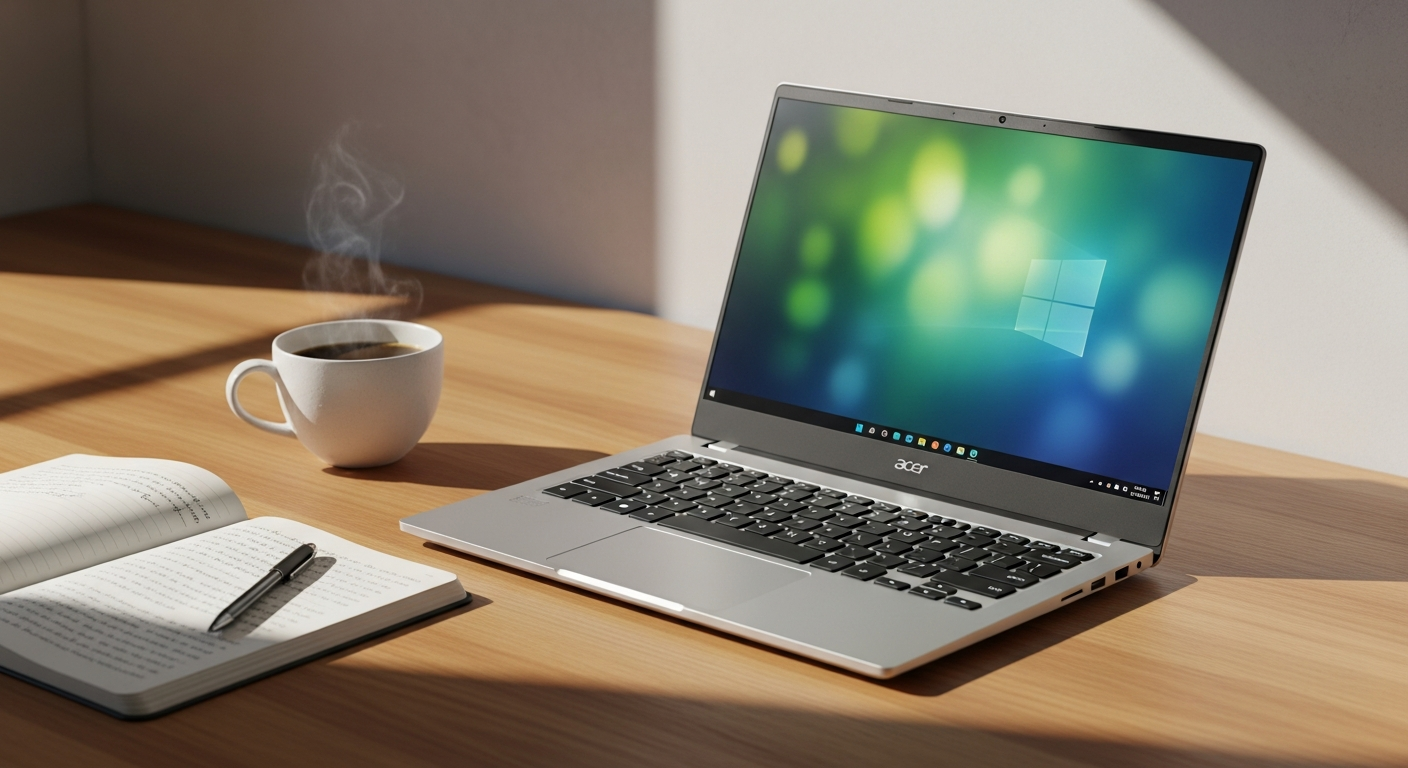
Over 60% of remote workers cite portability and battery life as their top laptop priorities—yet most ultraportables demand a premium price tag. The Acer Swift 3 shatters that expectation. I've watched countless professionals and students struggle with the weight of traditional laptops, the drain on their wallets, and the compromise between power and portability. What if you could have all three without breaking the bank?
The Acer Swift 3 has earned its reputation as one of the market's best-selling ultraportable laptops for good reason. Its all-aluminum chassis delivers that premium feel you'd expect from laptops costing significantly more. Whether you're working from coffee shops, libraries, or constantly traveling between client sites, this machine was engineered with your lifestyle in mind—combining genuine performance with a weight that won't weigh down your shoulders.
Check the latest Acer Swift 3 configurations on the official Acer store.
The Ultraportable Design That Actually Feels Premium
All-aluminum chassis construction and what it means for durability and aesthetics
The Swift 3's construction philosophy separates it from the plastic-heavy competition. The all-aluminum chassis isn't just a marketing feature—it's a practical choice that affects how this laptop feels and performs. Metal construction provides rigidity without excessive weight, meaning your display won't flex when you adjust the screen, and the frame won't develop creaks after six months of daily use. Aesthetically, aluminum gives the Swift 3 that premium appearance that typically commands significantly higher price tags on competitor machines.
Exact weight and thickness specifications compared to competitor ultraportables
The Swift 3 typically weighs between 2.6 to 2.9 pounds depending on the specific model, with thickness hovering around 0.63 inches. These numbers place it squarely in the ultraportable category—light enough that you won't notice it during a full day of traveling between locations, yet substantial enough to feel stable when typing. Compared to the Dell XPS 13 (which starts around 2.8 pounds) and the HP Pavilion (usually 2.9 to 3.1 pounds), the Swift 3 holds its own in the weight department without sacrificing build quality.
How the compact 14-inch form factor balances screen real estate with portability
The 14-inch display strikes an intelligent balance. It's large enough that you won't feel cramped when working with spreadsheets or writing documents for hours, yet small enough that the overall footprint remains manageable in backpacks and on airplane tray tables. The bezels are reasonably thin on recent models, maximizing screen space without bloating the chassis. For most users, this size represents the sweet spot between productivity and portability.
Build quality assessment and long-term durability expectations
The Swift 3's construction can handle the rigors of daily ultraportable life. The hinge mechanism is reinforced, and the chassis maintains structural integrity even when opened on uneven surfaces. The keyboard deck doesn't flex excessively when typing, and the bottom panel resists warping. Long-term durability depends on how you treat the machine, but the aluminum construction and quality assembly suggest you'll get several years of reliable service without cosmetic degradation becoming a concern.
Color options and finish choices available across different models
The Swift 3 comes in elegant finishes like Silver, Gold, and Blue across various configurations. The color options vary depending on the specific model year and region, but the finishes maintain that premium appearance throughout the chassis. The matte finishes resist fingerprints better than glossy alternatives, keeping your laptop looking fresh without constant cleaning.
Hinge mechanism reliability and opening/closing experience
The hinge feels satisfying—it opens smoothly without excessive wobbling and maintains consistent tension throughout its range. The display stays in position when adjusted, whether you're working at a shallow angle for presentations or opening it fully for intensive work. Users report reliable hinge performance across multiple years of ownership, suggesting the engineering holds up to repeated opening and closing cycles.
Thermal design considerations for a thin-profile machine
Keeping a thin ultraportable cool presents engineering challenges. The Swift 3 addresses this through careful internal layout and efficient thermal pathways. Under moderate workloads, the machine remains quiet with minimal fan noise. During more demanding tasks, the fans spin up noticeably but rarely reach levels that disturb work sessions. The aluminum chassis actually helps with heat dissipation, channeling warmth away from internal components effectively.
Display Performance: From Full HD to OLED Clarity
14-inch Full HD (1920×1080) IPS panel specifications and everyday usability
The entry-level Swift 3 configurations feature a 14-inch Full HD IPS display with 1920×1080 resolution. This specification sounds modest, but pixel density remains comfortable for everyday work—text appears sharp at normal viewing distances, and the IPS panel provides wide viewing angles so you won't experience color shift when adjusting your seating position. Full HD is sufficient for email, document editing, web browsing, and video streaming without the battery drain that higher resolutions demand.
Newer 2K (2256×1504) and 2.8K OLED panel upgrades and visual improvements
Stepping up to newer configurations unlocks more impressive display technology. The 2K panels offer noticeably sharper text and crisper image detail compared to Full HD. The 2.8K OLED options represent the premium tier—these panels deliver exceptional contrast with true blacks (since OLED pixels emit their own light), vibrant colors, and the kind of visual clarity you'll notice immediately when comparing side-by-side with lower-tier models. OLED panels consume more power, so battery life takes a modest hit, but many users consider the display quality worth the tradeoff.
Color accuracy and vibrancy for content creators versus general users
The IPS panels provide decent color accuracy suitable for general users and light creative work. If you're occasionally editing photos or creating presentations, the display won't betray you. However, if color-critical work is your primary function, the OLED upgrades offer superior gamut coverage and more reliable color reproduction. Professional designers and photographers might find standard panels insufficient, but for the majority of users (students, remote workers, casual creators), the included panels handle color adequately.
Screen brightness levels and performance in bright environments
Brightness varies by model and panel type. Full HD IPS panels typically reach around 300 nits, which proves adequate for indoor work but can struggle in bright sunlight or near windows during peak hours. OLED panels often deliver 400+ nits peak brightness, providing better outdoor usability. If you frequently work outdoors or in very bright environments, the brightness specifications deserve serious consideration when choosing your configuration.
Viewing angles and anti-glare considerations
The IPS technology provides wide horizontal and vertical viewing angles—colors remain accurate even when viewing from extreme angles. Anti-glare coatings on the panel reduce reflections, though glossy surfaces still appear on some configurations. The anti-glare treatment works reasonably well, though it does introduce a slight matte appearance that some users find slightly reduces perceived color vibrancy compared to glossy alternatives.
Refresh rate capabilities and impact on scrolling and video playback
Most Swift 3 configurations feature standard 60Hz refresh rates, which is perfectly adequate for productivity work and video streaming. The display updates smoothly during normal scrolling and video playback. If you're accustomed to 144Hz gaming monitors, the 60Hz refresh rate might feel slightly less fluid, but for typical ultraportable use cases, this specification is not a limitation.
Panel options across different price tiers and configurations
Entry-level models ($479-$599) feature Full HD IPS panels. Mid-range configurations ($599-$749) often include Full HD or 2K options. Premium models ($900-$999) typically showcase 2K or OLED displays. The progression makes sense from a value perspective—each tier gets you a tangibly better visual experience as you move upward.
Processing Power for Real-World Productivity
Intel Core i3, i5, and i7 processor options and their practical performance differences
The Swift 3 offers processor choices spanning from Intel Core i3 to i7 (or AMD Ryzen equivalents). The i3 handles everyday computing capably—web browsing, email, document editing, and streaming video present no challenges. The i5 adds meaningful headroom for multitasking and running multiple applications simultaneously. The i7 represents the performance ceiling, delivering noticeably faster compilation times for developers and quicker rendering for creative professionals, though the real-world difference for typical productivity tasks remains subtle.
AMD Ryzen CPU alternatives and competitive advantages
AMD Ryzen configurations offer compelling value, particularly in mid-range models. Ryzen processors deliver strong multithreaded performance and often include more cores than Intel equivalents at similar price points. For users running multiple applications simultaneously or working with tasks that leverage multiple processor cores, Ryzen versions of the Swift 3 can outperform Intel counterparts. The choice between Intel and AMD often comes down to software compatibility and personal preference, as both perform admirably for everyday work.
Multitasking capabilities with 8GB versus 16GB RAM configurations
Eight gigabytes of RAM handles typical workloads—you can keep 15-20 browser tabs open, run office applications, and stream music simultaneously without noticeable stuttering. However, power users who keep dozens of tabs open, run virtual machines, or work with memory-intensive applications benefit from the 16GB option. For students and remote professionals with typical workflows, 8GB represents the practical minimum, while 16GB provides comfortable breathing room for heavy multitaskers.
PCIe NVMe SSD speed benefits for boot times and application loading
The Swift 3 equips all configurations with fast PCIe NVMe SSDs rather than slower SATA drives. This translates to rapid boot times (typically under 10 seconds to a usable desktop) and snappy application loading. Switching between programs feels instantaneous, and file transfers happen quickly. The 256GB base configuration provides ample space for operating system, applications, and documents, while 512GB configurations offer comfortable headroom for larger media libraries or project files.
Performance benchmarks for everyday tasks: web browsing, office applications, video streaming
Real-world performance is where the Swift 3 excels. Web browsing with 15+ tabs remains smooth and responsive. Editing documents in Microsoft Office or Google Workspace happens without lag. Video streaming on Netflix or YouTube plays flawlessly at maximum quality without stuttering. These are the tasks occupying most users' time, and the Swift 3 handles them effortlessly regardless of processor configuration.
Thermal management during sustained workloads
The thin chassis design requires careful thermal engineering. Under sustained loads (like video encoding or heavy multitasking), the fans activate and maintain audible but not intrusive noise levels. The machine stays comfortably cool to the touch—the keyboard and palmrest never become uncomfortably warm. Thermal performance suggests Acer prioritized user comfort over absolute silence, a practical tradeoff for an ultraportable laptop.
Processor generation comparisons and performance-per-dollar value
Newer processor generations offer modest performance improvements over previous years. The difference between an i5 from two years ago and a current-generation i5 is noticeable but not dramatic for everyday work. Acer typically prices recent-generation processors competitively, so you'll receive good value purchasing a current or recent-generation Swift 3 rather than overpaying for the absolute latest silicon.
Connectivity That Keeps You Productive
USB-C port functionality and Thunderbolt support capabilities
Most Swift 3 configurations include at least one USB-C port with Thunderbolt support, enabling high-speed data transfer, fast external storage access, and simultaneous video and power delivery. Thunderbolt opens possibilities like connecting to external GPUs or high-speed external storage arrays. For typical users, the USB-C connectivity provides future-proofing and flexibility that the older USB-A standard cannot match.
Multiple USB-A ports for legacy device compatibility
The Swift 3 includes two USB-A ports, acknowledging that USB-A peripherals (printers, external mice, old external drives) aren't going anywhere soon. This practical approach spares you from needing USB-C adapters for your existing hardware. The port placement positions them on the sides of the chassis, keeping cables away from your working area.
HDMI output for external monitor and projector connections
A full-size HDMI port allows straightforward connection to external displays, projectors, and televisions without adapters or dongles. This proves invaluable for presentations, video calling with proper external monitors, or extending your workspace for productivity work. Many ultraportables omit HDMI entirely, making its inclusion on the Swift 3 a practical advantage.
Audio jack availability and headphone quality considerations
The 3.5mm headphone jack remains present on the Swift 3, supporting wired headphones without requiring adapters. The audio quality through the jack is clean, with adequate volume and minimal noise. This traditional connection point persists on the Swift 3 despite the ultraportable trend toward wireless-only audio.
Wi-Fi 6 or newer wireless standards and real-world speed benefits
Recent Swift 3 models include Wi-Fi 6 (802.11ax) connectivity, delivering faster wireless speeds and better performance in congested network environments. Real-world benefits include faster downloads, more responsive web browsing in crowded locations, and smoother video calls on bandwidth-limited networks. Wi-Fi 6 represents a meaningful upgrade over earlier standards, particularly in busy environments like coffee shops and co-working spaces.
Bluetooth connectivity for wireless peripherals
Bluetooth 5.0 or newer enables reliable wireless connections to headphones, mice, keyboards, and mobile devices. The range is solid, maintaining connection throughout typical rooms without dropouts. Connection pairing is straightforward, and the Bluetooth stack prioritizes reliability over range extremes.
Port placement and accessibility while using the trackpad
The port layout positions USB-A ports on the sides at moderate height, allowing you to connect peripherals without cables interfering with trackpad usage. The USB-C port placement is similarly considerate. This thoughtful hardware design reflects the ultraportable use case where compact spacing matters.
Explore different Swift 3 connectivity options and configurations now.
Battery Life and Power Management
Typical battery endurance for a full workday of productivity
The Swift 3 typically sustains 8-10 hours of mixed usage (web browsing, document editing, video streaming) on a single charge, with lighter workflows pushing toward the upper range. A full workday of productivity work—from morning email reviews through afternoon document editing and video calls—is entirely feasible without accessing an outlet. This performance makes the Swift 3 genuinely portable rather than merely compact.
Real-world usage scenarios and battery drain patterns
Battery consumption depends heavily on usage patterns. Video streaming drains the battery faster than text editing or web browsing. Screen brightness affects consumption significantly—maximum brightness reduces battery life noticeably. Working on battery power versus plugged-in operation shows minor performance differences on the Swift 3, though running demanding tasks like video encoding drains battery quickly. Typical office work yields reliable all-day performance.
Charging speed and power adapter specifications
The power adapter is compact and surprisingly light—the charging system emphasizes portability alignment with the laptop itself. Charging from empty to full typically requires 90-120 minutes, meaning you can grab a quick charge during lunch breaks and return to full capacity. Fast charging capabilities on some models allow reaching 50% charge in roughly 45 minutes.
Battery health longevity and degradation expectations
The lithium battery degrades gradually over time, as all laptop batteries do. After 2-3 years of daily use, you might notice battery capacity declining by 10-15% from original specifications. The aluminum chassis provides reasonable thermal management around the battery, potentially slowing degradation. Users report reliable battery performance across multiple years of ownership without premature failure.
Power management settings and optimization tips
Windows power settings allow significant battery life optimization. Reducing screen brightness to comfortable-but-not-maximum levels extends battery life notably. Using Battery Saver mode during unplugged work reduces background application activity. Disabling Wi-Fi and Bluetooth when not needed helps marginally. These settings are straightforward to configure and provide meaningful battery extension for power-conscious users.
Performance impact when running on battery versus plugged in
The Swift 3 maintains strong performance whether plugged in or on battery. Windows power settings throttle the processor slightly on battery to extend endurance, but the impact is rarely noticeable during typical work. Heavy workloads (like video encoding) show more noticeable performance differences, but productivity applications perform identically between plugged and battery operation.
Comparison to competitor ultraportables in battery category
The Swift 3's battery performance places it competitively among ultraportables. The Dell XPS 13 typically achieves similar or slightly better endurance depending on configuration. HP Pavilion models vary more widely in battery performance depending on specific model. Overall, the Swift 3 delivers reliable all-day performance that meets expectations for the category.
Security Features Built In
Fingerprint reader integration and Windows Hello authentication
The integrated fingerprint reader provides convenient authentication that's faster and more secure than passwords alone. Windows Hello recognition is nearly instantaneous—place your finger and the laptop unlocks immediately. This biometric security proves particularly valuable in shared workspaces or public environments where you need confidence that unattended moments don't compromise security.
Facial recognition capabilities on select models
Some Swift 3 configurations include infrared cameras enabling Windows Hello facial recognition. This provides another convenient authentication option, particularly useful when your hands are full or wearing gloves. The infrared approach works reliably in various lighting conditions without relying on ambient light like standard cameras.
Encryption and data protection features
Windows includes built-in encryption options (BitLocker) available on most Swift 3 configurations. Enabling encryption protects your data should the laptop be lost or stolen. The encryption process is transparent—once enabled, you won't notice performance impact during normal operation, but your data remains protected.
BIOS security updates and firmware considerations
Acer provides firmware updates addressing security vulnerabilities and improving hardware performance. The BIOS update process is relatively straightforward, though typically requires restarting the machine. Regular BIOS updates ensure your laptop remains protected against newly discovered vulnerabilities and receives any necessary security patches.
Privacy features for remote work and sensitive information handling
The physical camera and microphone provide privacy controls through Windows settings and Acer's software. You can disable camera and microphone access on a per-application basis, preventing applications from accessing these inputs without permission. For remote work involving sensitive information, these granular controls provide peace of mind.
Physical security considerations for ultraportables
The aluminum chassis resists casual tampering—you cannot easily open the bottom panel without tools. The lack of easily accessible component bays (unlike some laptops with user-serviceable components) actually increases security by preventing unauthorized access to internal components. The compact size does make theft risk higher than larger machines, necessitating physical security measures like cable locks when in public spaces.
Keyboard, Trackpad, and Input Experience
Keyboard travel depth and typing comfort for extended work sessions
The Swift 3's keyboard features shallow to moderate key travel—typically 1.2-1.5mm depending on the generation. This shallow travel is characteristic of thin ultraportables and takes adjustment if you're accustomed to traditional laptops with deeper key switches. After brief acclimation, typing remains comfortable for extended sessions. The key response is crisp without excessive mushiness, making the typing experience reasonable rather than exceptional.
Key layout consistency and any unusual positioning quirks
The QWERTY layout follows standard conventions in most configurations. However, some user reports mention unusual key positioning in certain regional variants—specifically function keys or special character placements that differ from typical expectations. If you're particular about keyboard layout, checking the physical configuration before purchase proves wise, though most users adapt quickly regardless.
Trackpad size, responsiveness, and gesture support
The trackpad offers adequate size for everyday cursor control and navigation. Responsiveness is quick, with minimal lag between finger movement and cursor response. Multi-touch gestures (two-finger scroll, pinch-to-zoom, three-finger swipe) work reliably. The trackpad surface feels smooth, enabling comfortable gliding without excessive friction. For ultraportable standards, the trackpad implementation is solid without being extraordinary.
Typing noise levels and impact on shared workspaces
The shallow key travel produces minimal noise compared to traditional laptops. Typing in quiet environments like libraries or shared workspaces won't disturb others significantly. The acoustic signature is professional-appropriate for open office environments or remote calls where background noise matters.
Keyboard durability and long-term reliability
The keyboard withstands typical daily use well. Keys maintain consistent response after years of use, and the mechanism doesn't develop the mushiness that plagues some ultraportables over time. Accidental spills are a concern with any laptop keyboard, though the Swift 3 doesn't include special spill-resistance features that some competitors offer.
Backlighting options and visibility in low-light environments
Most configurations include single-level or multi-level keyboard backlighting. The backlighting illuminates keys adequately for working in dim environments without being overbright. The lighting is uniform across the keyboard, and brightness adjusts through function key combinations. For users frequently working in low-light situations, backlighting proves practical and appreciated.
Comparison to MacBook and premium Windows laptop keyboards
The Swift 3 keyboard isn't quite at MacBook level—Apple's keyboards offer superior key feel and more refined typing experience. However, compared to budget Windows laptops, the Swift 3 keyboard is more pleasant. Compared to other ultraportables in its price range, the keyboard is competitive without being a standout differentiator. If premium keyboard feel is your primary concern, higher-end ultraportables or MacBooks might warrant consideration.
Audio and Webcam Reality Check
Speaker quality and volume output for video calls and media
The stereo speakers produce adequate volume for personal listening—you can comfortably hear video calls or streaming audio without external speakers in typical environments. However, audio quality reflects budget optimization. The speakers lack bass response and sound somewhat tinny compared to dedicated external speakers. For critical audio listening or professional audio work, external speakers are essentially required.
Microphone clarity for remote meetings and voice recording
The microphone captures voice clearly enough for video calls and voice recording. Background noise rejection works reasonably well, so fans and keyboard noise don't overwhelm your voice. For professional voice recording or podcasting, external microphones would provide noticeably better quality, but for typical remote work video calls, the built-in microphone is functional and acceptable.
Webcam resolution and performance in various lighting conditions
The webcam typically features 1080p resolution and performs adequately in well-lit environments. Video calls display your image clearly without excessive pixelation. In dimly lit environments, image quality degrades noticeably with increased noise and reduced clarity. The camera's field of view is wide enough to capture reasonable composition for typical video calling situations.
Audio jack quality if external speakers are needed
The 3.5mm headphone jack provides clean audio output for external speakers or headphones. Signal quality is noise-free, and volume output is adequate. Connecting quality external speakers dramatically improves audio quality compared to the built-in speakers, making this a practical solution for users prioritizing audio quality.
Software enhancements for audio and video communication
Acer's software doesn't add significant audio or video enhancements beyond Windows defaults. The built-in functionality is straightforward, which some users appreciate as simpler and less resource-intensive. Third-party applications (like voice call software) can implement their own enhancements, but you're not receiving proprietary Acer improvements in this category.
Recommendations for external peripherals to enhance communication
For remote workers who spend significant time on video calls, a USB external microphone provides noticeable quality improvement. Many options exist in the $30-75 range offering substantially better clarity than built-in microphones. External webcams are less critical unless lighting in your workspace is consistently poor. Headphones or external speakers improve your audio experience dramatically and are worth prioritizing if audio quality matters.
Pricing Strategy and Configuration Options
Entry-level Core i3 models starting at $479.99 and their use cases
The entry-level Swift 3 with Intel Core i3, 8GB RAM, and 256GB SSD at $479.99 targets budget-conscious buyers and students. These configurations handle email, web browsing, document editing, and casual media consumption without struggle. The all-aluminum chassis and premium feel remain present despite the lower cost. For students or budget-limited professionals, this configuration delivers genuine value.
Mid-range Core i5 configurations ($599-$749) and sweet spot value
Mid-range configurations featuring Core i5 processors, 8GB or 16GB RAM, and 256GB or 512GB storage represent the best value across the lineup. These specifications handle multitasking comfortably, offer enough storage for most workflows, and provide noticeable performance improvement over entry-level options without excessive cost premium. For most users, these configurations offer the optimal balance between capability and price.
High-end Core i7 with OLED display options ($900-$999) for demanding users
Premium configurations with Core i7 processors, 16GB RAM, and OLED displays represent the performance ceiling. These options appeal to professionals requiring maximum processor performance and users who spend significant time viewing the display (content creators, photographers). The OLED upgrade transforms the visual experience noticeably, though the processor upgrade provides more subtle real-world benefits for typical workflows.
Storage upgrade paths and cost-benefit analysis
Moving from 256GB to 512GB storage typically adds $50-100 to the purchase price. The upgrade makes sense if you maintain large media libraries or frequently keep multiple project files locally. For cloud-focused workflows where most files live in OneDrive or Google Drive, 256GB suffices comfortably. Budget users might compromise with 256GB and rely on cloud storage to extend effective capacity.
RAM configuration choices and future upgrade considerations
Most Swift 3 configurations don't allow post-purchase RAM upgrades—memory is soldered to the motherboard. This makes the initial RAM choice important. Eight gigabytes is the practical minimum; 16GB provides comfortable headroom for multitaskers. Consider your typical workflow when deciding. Budget users should still prioritize 8GB as the minimum to avoid frustrating performance limitations.
Seasonal sales patterns and best times to purchase
Pricing fluctuates throughout the year, with significant discounts often appearing during Black Friday, holiday sales, and back-to-school seasons. Student discounts are frequently available if you have .edu email addresses. Online retailers often compete on pricing, making it worth checking multiple sources. Buying during major sales events can save $50-200 depending on configuration.
Warranty and extended protection options
Acer provides standard one-year warranty covering manufacturing defects. Extended warranty plans extending to 2-3 years are available for additional cost, typically $30-100 depending on duration. Accidental damage protection is available separately. For budget-conscious buyers, standard warranty suffices; those wanting comprehensive coverage should evaluate extended protection costs.
Real-World Performance Across Different Workflows
Student workloads: research, writing, online classes, and collaborative projects
Students represent a core Swift 3 demographic, and the laptop delivers admirably for academic work. Research with multiple browser tabs open alongside Google Docs or Microsoft Word poses no problems. Video lectures stream smoothly. Collaborative projects in Google Suite or Microsoft 365 work flawlessly. The portability means carrying it between dorm, library, and campus locations feels effortless. Battery life covers a full day of classes without charging.
Remote professional tasks: video conferencing, email, cloud applications, and document editing
Remote professionals find the Swift 3 handling their workflows competently. Video conferencing on Zoom, Teams, or Google Meet runs smoothly without stuttering or lag. Email and cloud applications (Salesforce, HubSpot, Jira) perform responsively. Document editing in Google Workspace or Microsoft 365 is snappy. The machine never feels like a bottleneck for typical remote work—you're limited by your internet connection, not the hardware.
Content consumption: streaming, browsing, and entertainment usage
The Swift 3 handles Netflix, YouTube, and web browsing without compromise. Video streams at maximum quality without stuttering. Web browsing with numerous tabs open remains responsive. Audio quality through headphones is decent. The display's color reproduction is sufficient for casual content consumption. It's a perfectly competent entertainment device for casual viewing.
Light creative work: photo viewing, basic editing, and presentations
The integrated graphics handle light creative tasks. Photo viewing and organization work smoothly. Basic photo editing in applications like Photoshop Elements or Lightroom processes without significant lag. Creating presentations in PowerPoint or Google Slides is entirely comfortable. The display quality is adequate, though professional photographers would prefer better color accuracy. The processor handles video playback and basic encoding without struggle.
Gaming limitations and why this isn't a gaming laptop
The integrated Intel or AMD graphics lack dedicated memory and aren't designed for gaming. Modern AAA games won't run at playable framerates. Older or less demanding games (like Minecraft at reduced settings) can run, but the Swift 3 isn't a gaming machine. If gaming is your primary interest, you need a dedicated graphics GPU. This limitation is expected and honestly represented by Acer—the Swift 3 targets productivity, not gaming.
Professional design work constraints and integrated graphics limitations
Professional designers, architects, or CAD professionals should consider configurations with dedicated GPUs. The integrated graphics struggle with complex 3D renderings or heavy design applications. Lightweight design work (Canva, basic photo editing) is manageable, but demanding professional work reveals hardware constraints. This isn't a limitation specific to the Swift 3—it's inherent to all ultraportables in this price range.
Thermal performance under sustained workloads
During sustained work (extended video encoding, heavy multitasking), the thermal system engages audibly but keeps the machine at comfortable temperatures. The keyboard deck and palmrest never become uncomfortably warm. The aluminum chassis effectively channels heat. Sustained workload performance doesn't throttle significantly—you maintain strong performance without thermal limitations impacting productivity.
Comparing the Swift 3 to Ultraportable Competitors
Head-to-head specifications with Dell XPS 13, HP Pavilion, and ASUS VivoBook
The Swift 3 competes directly with machines like the Dell XPS 13, HP Pavilion 14, and ASUS VivoBook 14. Specifications align closely—all feature aluminum construction, 14-inch displays, Intel or AMD processors, and similar port selections. The Swift 3 typically prices $100-200 lower than the XPS 13 while offering comparable specifications. The HP Pavilion and ASUS VivoBook are closer price competitors, though the Swift 3 edges ahead in design refinement.
Price-to-performance positioning in the ultraportable market
The Swift 3 positions itself as the value leader in the ultraportable category. It delivers 90% of the performance and quality of more expensive competitors while costing noticeably less. This positioning isn't a weakness—it's the defining strength. If you're budget-conscious, the Swift 3 represents better value than paying premium prices for incremental improvements.
Design and build quality differentiation
The all-aluminum construction matches competitors, though some ultraportables use magnesium alloys for marginal weight savings. The Swift 3's design is clean and modern without flashiness. Compared to the Dell XPS 13's more distinctive aesthetic, the Swift 3 is more conservative. Both approaches have merit—the Swift 3's straightforward design appeals to professionals preferring subtle appearance.
Display quality comparisons across competitor models
The Dell XPS 13 offers marginally superior display options and higher brightness levels on comparable models. The Swift 3's OLED options compete favorably with XPS 13 OLED variants. For Full HD configurations, display quality differences are minimal. Overall, the Swift 3 holds its own in display performance without overshadowing competitors.
Keyboard and trackpad experiences relative to alternatives
The Swift 3's keyboard is competitive but not exceptional. The Dell XPS 13 keyboard is slightly more refined. The HP Pavilion keyboards vary more widely depending on specific model. From a trackpad perspective, the Swift 3 is perfectly adequate and comparable to competitors—no clear winner emerges across the category.
Brand reputation and customer support considerations
Acer's brand reputation in the ultraportable category is solid. Customer support is generally reliable, though some users report variations in support quality by region. Dell and HP have established broader support networks, which matters if you require local service options. Online warranty support is straightforward across all three brands.
Resale value and long-term ownership costs
The Swift 3 typically holds its resale value reasonably well, though premium brands like Dell command slightly higher second-hand prices. Battery replacement costs are comparable across ultraportables (around $80-120), as are other service options. Long-term ownership costs don't significantly favor one competitor over another.
Who Should (and Shouldn't) Buy the Acer Swift 3
Ideal candidates: students, remote workers, and frequent travelers
Students face demanding portability requirements and limited budgets—the Swift 3 checks both boxes. Remote professionals need reliable machines they can carry between locations—the Swift 3 delivers. Frequent travelers value lightweight machines that don't add to luggage weight—the Swift 3 obliges. These user groups represent the ideal customer base where the Swift 3 truly shines.
Professionals who benefit most from this configuration
Consultants who work on-site with clients appreciate the portability and professional appearance. Freelancers who work from coffee shops value battery life and lightweight design. Writers, journalists, and content creators benefit from the reliable performance and all-day endurance. Sales professionals who present from customer locations appreciate the compact form factor and HDMI connectivity.
Use cases where the Swift 3 excels and delivers genuine value
Web-based work (email, cloud applications, video conferencing) is where the Swift 3 truly excels. General productivity (documents, spreadsheets, presentations) poses no challenges. Media consumption and research work smoothly. Email-heavy workloads are handled comfortably. These everyday tasks occupy most users' time, and the Swift 3 handles them effortlessly.
Situations where you might need a different laptop instead
Heavy gaming requires dedicated GPU—the Swift 3 isn't equipped. Professional CAD, 3D rendering, or video editing benefits from more powerful GPUs and processors. Developers working with intensive compilation tasks might want more processing power. If your primary need falls outside productivity and web-based work, investigate specialized machines first.
Budget-conscious buyers seeking premium-feeling devices
The Swift 3's value proposition appeals directly to budget shoppers refusing to compromise on feel and build quality. You get aluminum construction and premium
Leave a Reply