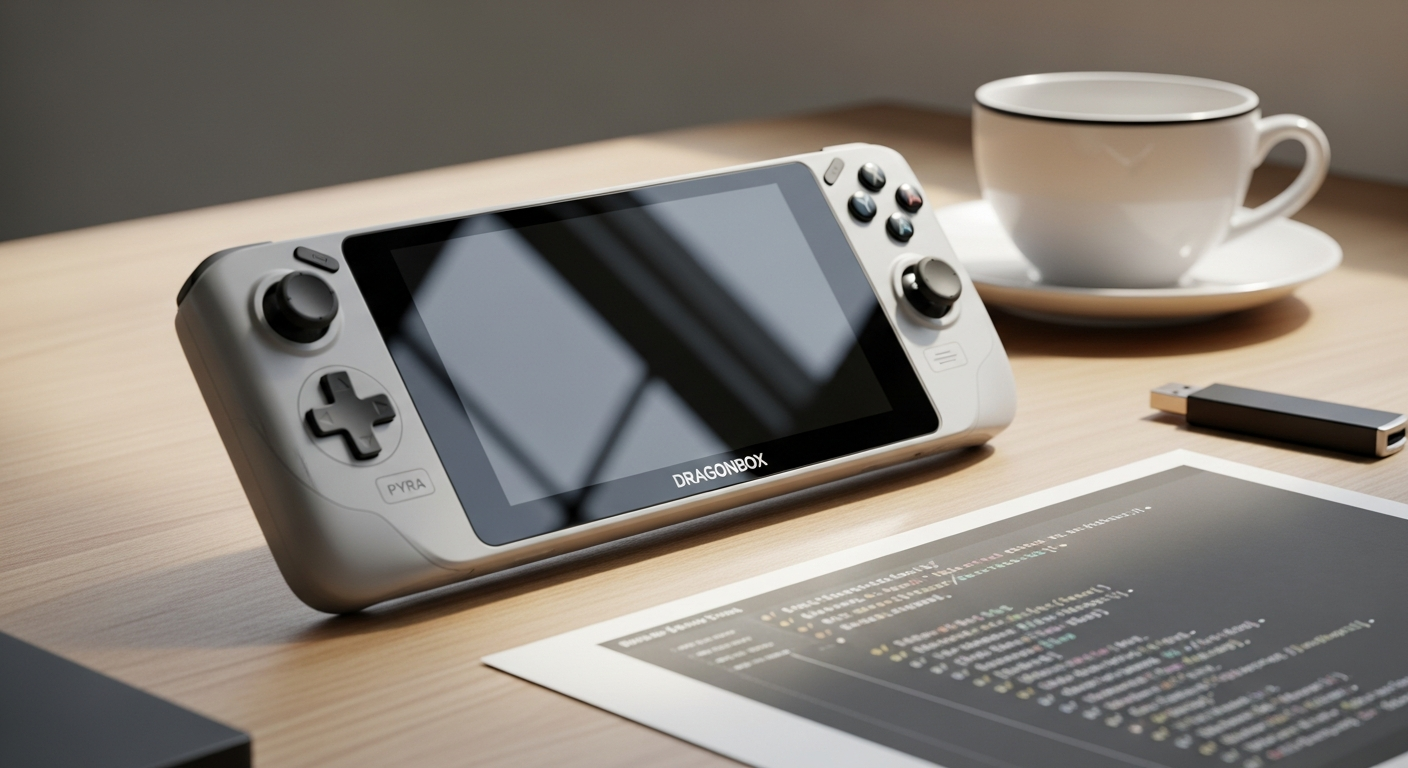
The DragonBox Pyra Handheld Gaming PC takes a very different approach from mainstream portable gaming systems.
Instead of focusing on high-end Windows games and desktop-class processors, the Pyra combines a compact Linux computer, physical keyboard, gaming controls, replaceable battery, and modular internal hardware in a pocket-sized clamshell design.
Developed as the successor to the OpenPandora handheld, the DragonBox Pyra targets Linux users, retro gamers, developers, hardware tinkerers, and people who want direct control over their portable computer.
Get your Dragonbox Pyra now and join the community of users reclaiming control over their devices.
What Is the DragonBox Pyra?
The DragonBox Pyra is a small ARM-based computer running Debian GNU/Linux.
Its design combines features normally associated with several device categories: a handheld game console, miniature laptop, development computer, and retro-gaming system.
The official Pyra documentation describes the device as a combination of a gaming handheld and mini-laptop.
It can run standard Debian software and connect to external peripherals such as a keyboard, mouse, and monitor.
Unlike closed gaming consoles, the Pyra was developed around user control. Owners can install Linux applications, access the operating system directly, use command-line tools, program on the device, and configure the hardware for specialized tasks.
DragonBox Pyra Specifications
The Pyra uses hardware that reflects its long development history rather than the architecture found inside current Windows gaming handhelds.
Key specifications include:
- Processor: Texas Instruments OMAP5432
- CPU: Dual-core ARM Cortex-A15
- Additional processors: Dual ARM Cortex-M4 cores
- GPU: PowerVR SGX544-MP2
- RAM: 2GB or 4GB DDR3, depending on configuration
- Display: 5-inch 1280 × 720 LCD
- Touchscreen: Resistive touchscreen
- Operating system: Debian GNU/Linux
- Battery: Removable 6000mAh battery
- Controls: D-pad, gaming buttons, shoulder buttons, and dual gaming control inputs
- Keyboard: Integrated physical keyboard
- Storage expansion: SD card support
- Desktop functionality: External monitor, keyboard, and mouse support
The official Pyra Wiki confirms the 5-inch 720p display, 6000mAh battery, Debian-based operating system, and interchangeable CPU-board architecture.
The OMAP5432 platform includes two Cortex-A15 CPU cores alongside PowerVR SGX544 graphics hardware.
A Handheld PC With a Physical Keyboard
One of the most recognizable DragonBox Pyra features is its built-in keyboard.
Many gaming handhelds depend heavily on touchscreens or external keyboards for desktop tasks.
The Pyra places a physical keyboard directly beneath the display alongside dedicated gaming controls.
That layout makes the device suitable for tasks such as:
- Terminal commands
- Linux configuration
- Programming
- Messaging
- Document editing
- File management
- Remote server access
- Classic PC gaming
For users who frequently work inside Linux terminals, having physical keys available on the device can be especially practical.
Gaming Controls Built Into the Device
The DragonBox Pyra was designed with gaming in mind from the beginning.
Its controls include a directional pad, face buttons, shoulder controls, and two primary gaming control inputs.
The layout allows games and emulators to run without requiring a separate USB or Bluetooth controller.
Official and independent hardware documentation lists a D-pad, six face buttons, four shoulder buttons, and dual control inputs with push-button functionality.
The keyboard also gives players access to keys required by older PC titles, Linux games, emulators, and software that cannot be operated entirely through a traditional gamepad.
DragonBox Pyra and Retro Gaming
Retro gaming is one of the most natural uses for the Pyra.
Its Linux operating system can support emulation software and native ports of older games. The physical gaming controls and 720p display fit classic console titles particularly well.
Potential emulation targets depend heavily on emulator development, software configuration, and individual games.
Older console generations generally place far lighter demands on the Pyra than modern 3D systems.
The device should therefore be viewed primarily as a Linux retro-gaming and portable-computing platform, rather than a direct rival to recent high-performance handheld gaming PCs.
Debian Linux Gives Users Full PC Control
A major difference between the DragonBox Pyra and traditional handheld consoles is its operating system.
The Pyra runs Debian GNU/Linux instead of a locked console interface.
Software can be installed through normal Debian repositories using package-management tools such as APT, alongside software distributed through the Pyra community repository.
That gives users access to many familiar Linux capabilities, including:
- Desktop applications
- Terminal tools
- Programming environments
- Networking software
- Media applications
- Emulators
- Open-source games
- System utilities
- Development packages
For experienced Linux users, this level of access is one of the strongest reasons to own a Pyra.
Modular and Upgradeable Hardware
The DragonBox Pyra has another unusual feature: a replaceable CPU board.
Instead of placing every major component permanently onto a single mainboard, the system separates key hardware into several boards.
The CPU board contains major processing components and was designed so it could potentially be replaced by another compatible board.
The hardware architecture includes separate CPU, main, and display boards.
This design can simplify repairs and gives the platform the possibility of hardware upgrades without replacing the complete handheld.
Actual upgrade availability depends on compatible boards being produced, so buyers should not assume that a newer processor upgrade is automatically available.
Removable 6000mAh Battery
The 6000mAh removable battery is another practical feature of the DragonBox Pyra.
A replaceable battery has several advantages for long-term ownership. A worn battery can potentially be exchanged without replacing the complete computer, and users can carry another compatible battery for extended use.
That philosophy matches the Pyra’s broader focus on repairability and owner access.
Explore the Dragonbox Pyra’s complete hardware specifications and order today.
5-Inch 720p Display
The DragonBox Pyra uses a 5-inch display with a 1280 × 720 resolution.
On a screen of this size, 720p provides enough workspace for games, Linux desktop applications, terminals, file managers, and web interfaces while keeping graphics demands lower than higher-resolution panels.
The clamshell format protects the display when the device is closed and allows the keyboard and gaming controls to occupy the lower section.
Can the DragonBox Pyra Work as a Desktop PC?
Yes. The Pyra can function as a small desktop Linux computer when connected to external equipment.
The official project page states that users can connect a monitor, mouse, and keyboard and operate the Pyra as a desktop computer.
That means a single device can serve several roles:
portable gaming system, Linux terminal, development machine, lightweight workstation, media device, or compact desktop computer.
Performance expectations still need to match the ARM hardware. Modern desktop workloads designed for powerful x86 processors may exceed what the Pyra can comfortably handle.
DragonBox Pyra vs Modern Gaming Handheld PCs
Calling the Pyra a handheld gaming PC can create misleading expectations if it is compared directly with current devices built around AMD or Intel x86 processors.
Systems designed for modern PC gaming focus heavily on GPU performance and compatibility with current Windows games.
The Pyra follows another philosophy.
Its priorities include:
- Debian Linux
- Physical keyboard access
- Retro gaming
- Open hardware
- Repairability
- Replaceable components
- Software experimentation
- Developer access
- Compact computing
- Community-driven development
Raw gaming performance is therefore only one part of the device.
Anyone primarily interested in recent AAA games will find newer x86 handheld PCs far better suited to that task.
People interested in Linux experimentation, portable computing, classic games, hardware access, and unusual computer designs may find the Pyra far more compelling.
Who Is the DragonBox Pyra For?
The DragonBox Pyra makes the most sense for a fairly specific audience.
Linux Users
Debian users can work with a familiar package-management system and standard Linux software rather than a heavily restricted console operating system.
Retro Gamers
Physical controls, expandable storage, Linux emulators, and a compact screen make the Pyra well suited to classic gaming.
Developers
A built-in keyboard and full Linux environment make programming and command-line work possible directly from the handheld.
Hardware Tinkerers
The modular board architecture and accessible hardware design give technically inclined owners considerably greater control than typical consumer handhelds.
Open-Source Supporters
The Pyra project has long emphasized an open Linux environment and user access instead of locking owners into a tightly controlled software ecosystem.
DragonBox Pyra Advantages
The Pyra has several characteristics rarely found together in one handheld computer:
- Full Debian Linux operating system
- Physical keyboard
- Dedicated gaming controls
- Replaceable 6000mAh battery
- Expandable storage
- Modular processor board
- Desktop peripheral support
- Retro-gaming capabilities
- Strong user control
- Compact clamshell construction
For its intended audience, these features can matter far beyond benchmark results.
DragonBox Pyra Limitations
Potential buyers also need realistic expectations.
The OMAP5432 processor comes from an older generation of ARM hardware, so the Pyra cannot compete with current high-performance gaming handhelds in raw CPU or GPU speed.
Software compatibility can also require extra attention because the system uses ARM Linux rather than the x86 architecture used by most Windows PC games.
Other factors include its specialist-community status, limited production history, and potentially difficult availability compared with mass-market handheld consoles.
As of recent listings and community discussions, units remain uncommon on the second-hand market, reinforcing the Pyra’s status as a specialist device rather than a mainstream retail handheld.
Is the DragonBox Pyra Still Worth Buying?
The answer depends heavily on what you expect from a handheld computer. If your priority is high frame rates in current PC releases, the DragonBox Pyra is not designed for that role.
If your priorities include Debian Linux, retro games, physical controls, a built-in keyboard, removable hardware, programming, and experimentation, the Pyra remains an unusual alternative to conventional handheld systems.
Its biggest strength comes from the amount of control placed in the owner’s hands.
Frequently Asked Questions
What operating system does the DragonBox Pyra use?
The DragonBox Pyra runs Debian GNU/Linux by default. Users can install software through standard Debian repositories and Pyra-specific packages.
What processor does the DragonBox Pyra have?
The standard Pyra CPU board uses a Texas Instruments OMAP5432 with two ARM Cortex-A15 CPU cores and PowerVR SGX544 graphics.
How large is the DragonBox Pyra screen?
The Pyra has a 5-inch LCD with a resolution of 1280 × 720 pixels.
Does the DragonBox Pyra have a replaceable battery?
Yes. It uses a removable 6000mAh battery.
Can the DragonBox Pyra run emulators?
Yes. Its Debian Linux environment can run compatible emulation software. Performance varies according to the emulator, console being emulated, software build, settings, and individual game.
Can the DragonBox Pyra replace a laptop?
For lightweight Linux tasks, terminal work, coding, retro gaming, and portable computing, it can perform many laptop-like functions.
Its small display, keyboard, and older ARM processor make it less suitable for demanding desktop workloads.
Can the DragonBox Pyra connect to a monitor?
Yes. The official project documentation describes using the device with an external monitor, mouse, and keyboard as a desktop computer.
The DragonBox Pyra as a Linux Gaming Handheld
The DragonBox Pyra Handheld Gaming PC represents a rare type of portable computer. It combines Debian Linux, a physical keyboard, integrated gaming controls, expandable storage, a removable battery, and modular hardware inside a compact clamshell system.
Its aging ARM processor prevents it from competing with today’s high-performance gaming handhelds, yet outright speed was never the only goal of the project.
The Pyra focuses heavily on owner control, Linux software, repairability, experimentation, and classic gaming.
For users seeking a small Linux computer that can function as a gaming device, development machine, terminal, emulator platform, and miniature desktop system, the DragonBox Pyra remains one of the most distinctive handheld PCs created.
Discover the Dragonbox Pyra and take control of your handheld computing experience.
Leave a Reply