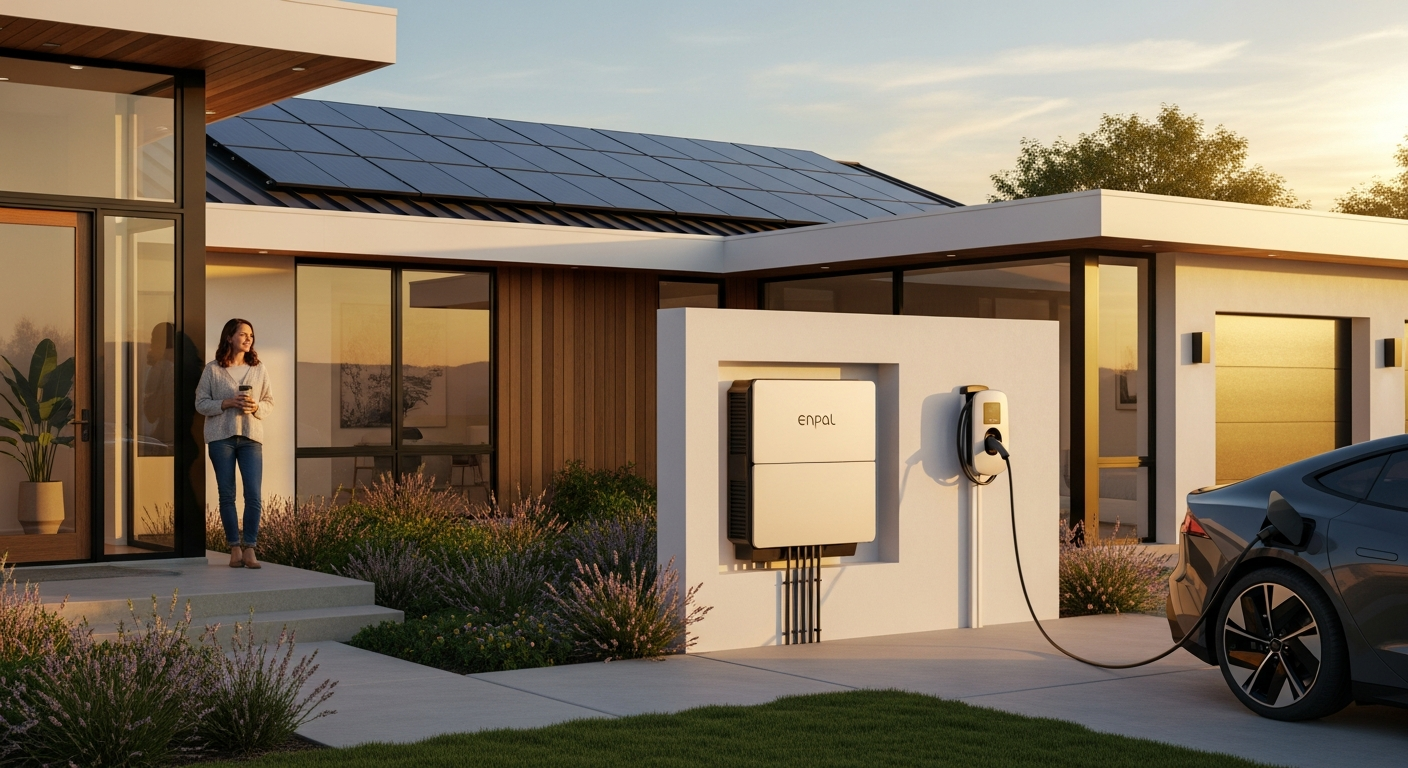
Enpal All-in-One Home Energy System with solar panels, battery storage, and EV charging wallbox integrated together

How Electric Vehicle Owners Can Maximize Home Charging With the Enpal All-in-One Home Energy System

More than 1 million electric vehicles now operate on German roads, yet most EV owners still rely on expensive grid electricity to charge their cars at home. The average household spends €600–€900 annually powering an electric vehicle through conventional charging—a number that climbs higher each year as energy prices surge. That financial reality shapes every decision an EV owner makes about where and how to charge.

What if you could generate your own clean electricity, charge your EV for free, and pocket money by selling excess power back to the grid? The Enpal All-in-One Home Energy System represents a fundamentally different approach for EV owners seeking energy independence. Rather than cobbling together separate solar panels, batteries, and charging solutions, Enpal bundles everything into one integrated ecosystem that actually talks to itself.

Discover how the Enpal All-in-One Home Energy System can transform your EV charging costs.

Why EV Owners Need More Than Just a Wallbox

Standard home charging solutions tell only half the story. Install a wallbox without solar generation, and you're simply moving your grid dependency from the fuel pump to your electrical panel. You'll charge your vehicle cheaper than at public stations, but you're still vulnerable to peak demand pricing, rising electricity rates, and the invisible carbon footprint of grid power.

Grid-dependent charging hits hardest during peak demand hours, typically between 6 p.m. and 9 p.m. when most households return home and plug in their vehicles simultaneously. Utilities respond to this surge by raising rates dramatically. An EV owner charging during these hours pays premium prices for the privilege of charging at home—often barely cheaper than a public charging network.

The real advantage emerges when you pair EV charging with onsite solar production. Morning and afternoon sunshine directly powers your vehicle instead of flowing to the grid. Your electricity costs drop from €0.35–€0.45 per kWh to essentially zero. This isn't theoretical savings—it's tangible money staying in your household account every single day.

Battery storage matters more than many EV owners realize. Without it, excess solar energy simply feeds back to the grid at rates utilities offer (typically far below retail prices). With intelligent battery storage, you capture that surplus power and deploy it strategically—charging your vehicle during evening hours when the sun isn't shining, maximizing self-consumption, and minimizing grid purchases.

Real-world charging patterns vary significantly. Daily commuters driving 40–80 kilometers need consistent, reliable charging that solar alone might struggle to provide on winter days. Weekend drivers with smaller commutes benefit more immediately from solar charging, often covering their entire weekly driving needs through stored solar energy. The Enpal system scales to match your actual usage patterns, not an idealized scenario that rarely matches real life.

Integrated systems fundamentally reduce reliance on public charging infrastructure. Instead of planning routes around charging networks or waiting for available stations, you charge at home from self-generated power. This convenience compounds over months and years, making EV ownership genuinely practical rather than constantly negotiated around charging logistics.

Breaking Down the Enpal All-in-One System for EV Households

The foundation rests on Full-Black 450 Wp solar modules that deliver efficiency and consistent output across Germany's variable climate. These panels generate approximately 450 watts each under standard test conditions, translating to real-world annual yields of 1,000–1,200 kWh per kilowatt installed depending on your location and roof orientation. For an EV owner driving 15,000 kilometers annually (typical usage), a 5–7 kW system typically generates sufficient solar energy to cover most charging needs, especially when paired with battery storage.

The integrated battery storage system maximizes self-consumption rates by holding excess daytime power for evening and night usage. Rather than exporting solar generation at unfavorable rates, you retain control of that energy and deploy it when you actually need it—primarily for EV charging after work or during evening hours. Self-consumption rates typically reach 60–75% with intelligent battery management, compared to 25–35% for systems without storage.

The wallbox component represents the bridge between your solar system and your vehicle. Enpal's wallbox supports charging speeds up to 11 kW (three-phase) or 7.4 kW (single-phase) depending on your home's electrical capacity. Smart features enable the wallbox to communicate directly with your battery storage and solar array, prioritizing vehicle charging when solar production peaks and deferring charging to battery reserves during low-production periods. Compatibility extends across virtually all modern EV models, from compact city cars to larger SUVs.

Heat pump integration transforms the system from EV-focused to comprehensive home energy management. Space heating and hot water production account for 60–70% of residential energy consumption in German homes. By replacing conventional gas or oil heating with an efficient heat pump powered by your solar array, total household energy independence becomes achievable. The system manages competing demands intelligently—prioritizing EV charging during peak solar hours while reserving power for heating needs.

The Enpal.One+ app serves as your command center for real-time monitoring and control. Track solar generation minute-by-minute, monitor battery charge levels, schedule EV charging for optimal times, and view consumption analytics that reveal exactly where your household energy goes. The app learns your patterns and suggests optimizations automatically, making energy management intuitive rather than technically demanding.

System scalability ensures your investment matches your actual needs. A small EV with 40 kWh battery and modest daily driving requires different specifications than a large SUV with 80 kWh capacity and high mileage. During consultation, Enpal's specialists assess your vehicle, driving patterns, household consumption, and roof characteristics to design a system sized precisely for your situation rather than oversized for theoretical capacity.

Get a custom system design tailored to your specific EV charging requirements.

The Zero-Down Payment Model: Accessibility Meets Affordability

The €0 down payment rental structure addresses the primary barrier preventing EV owners from adopting solar technology. Traditional solar installations require €8,000–€15,000 upfront investment, a financial commitment that reasonable homeowners hesitate to make. This capital requirement effectively locked solar energy behind a wealth barrier, making renewable generation a luxury rather than a practical option.

Enpal's rental model eliminates this barrier entirely. You begin using a complete home energy system immediately without accumulating savings first or accessing large loans. Monthly rental payments replace the upfront capital requirement, spreading costs across years and matching payments to actual energy savings. For many households, monthly payments decline below previous grid electricity expenses within the first year.

The initial six-month period provides a trial window to evaluate system performance, assess actual savings, and confirm the technology meets your expectations. After this period, you can continue renting, purchase the system outright, or explore alternative arrangements. This flexibility acknowledges that energy needs evolve and circumstances change.

Fixed-price rental agreements provide cost predictability and protection against rising electricity rates. While grid electricity prices fluctuate based on global energy markets and utility decisions, your monthly rental payment remains stable throughout the contract period. This stability transforms energy costs from an unpredictable variable into a planned, budgeted expense. Over a 20-year period when grid electricity might increase 30–50%, your fixed rental cost preserves purchasing power and locks in savings.

Financing flexibility accommodates EV owners with varying household budgets. Payment plans can be structured for different terms—shorter periods if you prefer ownership sooner, longer periods if you need lower monthly payments. Some households combine rental with subsidies or financing programs, further reducing their financial commitment.

Enpal's all-inclusive service package covers installation, grid connection, and ongoing maintenance. This comprehensive approach means no surprise costs or fragmented vendor relationships. The company handles permits, inspections, technical compliance, and system monitoring. If components require service or replacement, Enpal manages it without additional invoices. This bundled responsibility eliminates the frustration of coordinating multiple contractors and bearing unexpected costs.

Smart Energy Management for EV Charging Optimization

The Enpal.One+ app prioritizes EV charging precisely during peak solar production hours. Rather than charging passively whenever your vehicle sits at home, the system actively monitors solar generation forecasts and schedules charging windows to capture maximum self-generated power. On a sunny day with 6 kW solar production and 3 kW charging demand, the system runs the wallbox continuously during afternoon hours when generation exceeds household consumption, then relies on battery reserves in the evening.

Intelligent load management balances competing home consumption and vehicle charging demands. A household simultaneously running laundry, heating, cooking, and charging an EV creates peak loads that might exceed available solar generation and battery power. The system prioritizes by rules you define—perhaps charging the vehicle gets priority, with heating deferred to later hours, or vice versa. This granular control prevents overload conditions while maximizing energy utilization.

Demand response features adapt to your actual driving schedule. Commuters with predictable patterns benefit from automatic optimization that learns when the vehicle typically returns home and pre-positions the battery to charge the car efficiently. Weekend drivers with irregular schedules gain manual control and forecasting tools that suggest optimal charging windows based on upcoming solar generation and your stated travel plans.

The earning potential from selling excess solar energy back to the grid transforms excess generation from wasted capacity into revenue. On low-consumption days when solar production exceeds household needs and battery storage reaches capacity, your system exports power to the grid at regulated feed-in rates. While these rates won't make you wealthy, they meaningfully offset monthly energy costs, contributing €50–€200 annually on average depending on system size and local grid conditions.

Battery optimization algorithms extend storage system lifespan by managing charge cycles intelligently. Batteries degrade faster with frequent full discharge-recharge cycles. The system instead maintains batteries within optimal charge ranges, completing more partial cycles rather than deep discharges. Over 10–15 years, this algorithmic management preserves battery capacity and delays expensive replacement requirements.

Real-time energy tracking and consumption analytics reveal precisely where household energy flows. You'll see that EV charging typically consumes 40–60% of total household energy, heating claims another 30–40%, with remaining consumption distributed across lighting, appliances, and other devices. These insights enable informed decisions about where additional efficiency gains are possible and how to further optimize system operation.

Calculating Actual Savings for Electric Vehicle Owners

Annual electricity cost comparisons reveal the dramatic difference between grid charging and solar-powered charging. An EV owner currently paying €0.40 per kWh from the grid and charging 10,000 kWh annually spends €4,000 yearly on vehicle electricity. That same household charging from solar generation supplemented by battery storage reduces electricity costs to €200–€500 annually, depending on season and generation variability. Over 10 years, that difference accumulates to €35,000–€40,000 in direct savings.

Protection against rising energy prices constitutes an underestimated benefit. Energy costs in Germany have risen consistently for 20 years, with accelerating increases following geopolitical disruptions. While predicting future rates is impossible, historical trends suggest grid electricity will cost 50–100% more in 10 years than today. Households with solar systems maintain constant energy costs regardless of external market pressures, protecting themselves from inflation that grid-dependent households absorb fully.

Long-term ROI analysis for EV households over 10–15 years reveals positive returns for most German homeowners. Assuming average solar generation, battery costs, installation expenses, and current electricity prices, systems typically break even in 7–9 years through electricity savings alone. Years 10–25 generate pure economic benefit as capital costs are recouped. This analysis improves significantly for high-consumption households, southern German locations with superior solar resources, and properties already requiring electrical system upgrades.

Tax incentives and government subsidies available in Germany enhance financial returns. Federal and state programs offer grants covering 25–40% of installation costs for systems meeting efficiency standards. These subsidies reduce effective capital requirements and accelerate break-even timelines. Additional incentives apply in some states for battery storage and heat pump integration. Enpal specialists identify programs applicable to your specific situation, maximizing available financial support.

Reduced maintenance costs compared to conventional grid-dependent setups emerge over time. Solar systems contain no moving parts and require only periodic cleaning. Battery systems operate without consumables or fluid replacement. The wallbox needs no service beyond occasional software updates. Contrast this with gas furnaces requiring annual service, heating oil tank replacement, and conventional electrical system maintenance. Total cost of ownership heavily favors integrated renewable systems.

Additional revenue streams from excess energy sales, though modest individually, accumulate meaningfully. Monthly feed-in payments for exported power, combined with electricity cost reductions, create financial returns that exceed what traditional investments generate on comparable capital.

Installation, Setup, and Getting Started With Your System

The end-to-end consultation process begins with understanding your specific situation. Enpal specialists discuss your EV model and annual mileage, current electricity costs, household energy consumption patterns, home construction and roof characteristics, and financial preferences regarding rental or purchase. This conversation typically consumes 1–2 hours and establishes the foundation for system design tailored to your actual needs.

Site assessment and custom system design follow initial consultation. Specialists visit your home to evaluate roof orientation, shading from trees or buildings, available space for solar panels and battery storage, electrical panel capacity, and existing wiring infrastructure. They then design a system specification—exact number of panels, battery capacity, wallbox positioning, and installation approach—that optimizes performance for your specific property.

Professional installation timeline typically spans 3–5 days for a complete system. Workers conduct excavation and wiring for battery equipment, mount solar panels on roof systems, install the wallbox with appropriate electrical upgrades, and connect all components through the central management system. While installation happens, your home experiences minimal disruption—work concentrates on specific areas, and the installation team coordinates timing to minimize inconvenience.

Grid connection procedures and regulatory compliance in Germany involve submitting technical documentation to your local utility and obtaining approval before the system feeds power to the grid. Enpal manages these administrative steps entirely, handling inspections, documentation, and utility communication. This process typically requires 2–6 weeks depending on utility responsiveness but happens in the background without your direct involvement.

Integration with existing home electrical systems and EV chargers ensures new components work seamlessly with current infrastructure. If your current wallbox is incompatible or your electrical panel lacks capacity for new equipment, Enpal upgrades necessary components as part of the installation. This comprehensive approach prevents surprise incompatibilities or incomplete installations that leave you without functional systems.

Activation and first-use setup of the Enpal.One+ management platform transforms the physical system into a usable tool. Specialists walk through app configuration, demonstrate monitoring features, explain control options, and establish your personal preferences. Within hours of installation completion, you're generating solar power, charging your vehicle, and managing your home energy independently.

Potential Limitations and Realistic Expectations

Long-term contractual commitments typically span 15–25 years depending on your rental agreement. This duration aligns with battery system lifespans and ensures Enpal can sustainably maintain the system and support customers. However, it represents a significant long-term obligation. Early termination options exist but typically involve financial penalties that reduce attractiveness of abandoning the system before contract completion.

Geographic constraints affect system performance across different German regions. Northern states like Schleswig-Holstein and Lower Saxony receive 20–25% less solar radiation annually than Bavaria or Baden-Württemberg. While solar generation still proves economically viable throughout Germany, northern properties require larger systems to achieve equivalent output. Some rural locations with significant shading from forests or mountainous terrain may be unsuitable regardless of region.

Weather-dependent generation creates seasonal charging variability. December produces one-third the solar energy of June. Winter months require greater reliance on grid electricity or extremely large battery systems that compromise economics. Most households accept modest seasonal variation, charging heavily from solar in summer and gradually using grid power more in winter—total annual costs remain dramatically lower than full grid dependence.

Pricing transparency requires direct contact with Enpal for accurate quotes. The company prices custom designs based on your specific system specifications rather than offering fixed retail prices. While this approach ensures precision, it prevents quick online cost comparisons. Obtaining quotes requires providing detailed information about your property and energy situation.

Space requirements for solar panel installation and battery storage occupy physical assets. Roof space must accommodate panels (typically 20–30 square meters for residential systems), and battery equipment requires 1–2 square meters of indoor space, usually in a basement or utility room. Properties with extremely limited roof space or no suitable interior location may be problematic for system installation.

Compatibility considerations with different EV models and charging standards exist but are rarely problematic. Enpal's wallbox supports Type 2 connectors used by virtually all European EVs. Older or exotic vehicles might require adapters, but compatibility stretches across practical market realities. The system works with any standard-equipped modern electric vehicle.

Making the Decision: Is Enpal Right for Your EV Lifestyle?

Assessment questions help determine whether integrated solar charging fits your specific needs. Do you drive an electric vehicle and plan to own it for at least five more years? Does your home have roof space with reasonable southern exposure and minimal shading? Are you comfortable with a 15–20 year contractual commitment? Do rising energy prices concern you and motivate long-term cost reduction? Do you value environmental sustainability alongside financial benefits? If you answered yes to most questions, Enpal deserves serious consideration.

Comparing Enpal against traditional solar installations and public charging networks reveals distinct advantages and trade-offs. Traditional solar systems offer ownership immediately but require substantial upfront capital, leaving EV owners responsible for maintenance and replacement costs. Public charging networks provide flexibility but incur per-minute fees and time investments in locating available chargers. Enpal's integrated approach balances accessible costs, predictable expenses, and comprehensive support against long-term contractual commitment.

Evaluating your household's energy consumption patterns informs whether a system sized primarily for EV charging makes sense. If your household consumes 3,000 kWh annually and your EV adds 2,000 kWh yearly, the total 5,000 kWh target guides system design. High-consumption households benefit more from integrated systems that address total energy needs, not just vehicle charging.

Long-term commitment evaluation examines whether you're likely to remain in your home for the contract duration. Selling a property with an active Enpal system requires transferring the contract to new owners or negotiating early termination. While possible, this complexity discourages homeowners uncertain about their long-term residence plans.

Next steps involve requesting a personalized consultation and system quote from Enpal. The company's specialists can answer specific questions about your property, provide preliminary cost estimates, and explore whether their solutions align with your circumstances.

Timeline expectations from initial contact to active charging typically span 8–12 weeks. Consultation and design require 2–3 weeks, grid approval and permitting span 4–6 weeks, and installation consumes 1–2 weeks. After system activation, you're charging your EV from self-generated solar power immediately.

The Bigger Picture—Energy Independence for Modern EV Owners

Integrated home energy systems support Germany's renewable energy transition by distributing generation capacity across millions of households rather than concentrating it in utility-scale facilities. When EV owners install solar systems with battery storage, they participate directly in Energiewende—the energy transition redefining Germany's power infrastructure. Distributed residential generation creates resilience, reduces transmission losses, and accelerates renewable adoption.

Environmental impact of reducing your household's carbon footprint through solar EV charging extends far beyond your individual vehicle. A household transitioning from grid-charged electric vehicles to solar-powered charging eliminates approximately 1.5–2 tons of CO2 emissions annually (accounting for typical charging needs and Germany's grid carbon intensity). Across a system lifetime, that translates to 25–30 tons of prevented emissions—equivalent to planting and growing approximately 200 trees to maturity.

Future-proofing your home as EV adoption accelerates positions your household ahead of infrastructure development. While public charging networks expand, home charging remains the primary charging location for most EV owners. Systems installed today will serve enhanced EV fleets and multi-vehicle households that emerge over the next decade.

Integration possibilities with emerging smart home technologies enable sophisticated energy management. Future systems might coordinate vehicle charging with heating schedules, appliance operation timing, and even neighborhood-level grid services. Enpal's app architecture supports these expansions, ensuring today's investment remains relevant as technology evolves.

Community benefits of distributed solar generation and grid stability contribute to energy security beyond your household. When thousands of homes simultaneously generate solar power during peak production hours, utilities reduce fossil fuel generation and stabilize grid voltage. This collective contribution improves reliability and reduces system costs for all electricity consumers.

Your role in Germany's Energiewende movement positions you among early adopters driving the energy transition. Decisions made by EV owners considering solar systems influence neighbors' perceptions, municipal policy development, and political support for renewable energy programs. By adopting integrated solar systems, you're not merely reducing personal electricity costs—you're advancing the energy future that Germany committed to achieve.

Your Path to Free EV Charging Starts Here

The Enpal All-in-One Home Energy System fundamentally changes the economics of EV ownership for German homeowners. Rather than accepting the burden of expensive grid electricity, you gain the power to generate, store, and manage your own clean energy. That shift transforms monthly charging costs into long-term savings and genuine environmental impact.

The €0 down payment model erases the traditional barrier that prevented many EV owners from adopting solar. While the integrated wallbox, battery storage, and intelligent app create a seamless charging experience that adapts naturally to your driving habits and household patterns.

What genuinely distinguishes this approach is the comprehensive nature of the solution. You're not juggling separate vendors, incompatible systems, or fragmented support channels. Enpal handles everything—from initial design and installation through grid connection and ongoing maintenance. The Enpal.One+ app puts real-time energy management directly in your hands, letting you monitor, optimize, and monetize system performance.

The decision ultimately hinges on your commitment to energy independence and long-term cost savings. If you drive an electric vehicle in Germany and want to eliminate grid electricity costs while contributing to the renewable energy transition, Enpal's integrated system deserves serious consideration. The financial case strengthens further when you factor in rising energy prices, government incentives, and the peace of mind that comes from powering your car with sunshine rather than fossil fuels.

Begin your journey toward affordable, sustainable driving with a personalized Enpal consultation today.


Comments

Leave a Reply

Your email address will not be published. Required fields are marked *