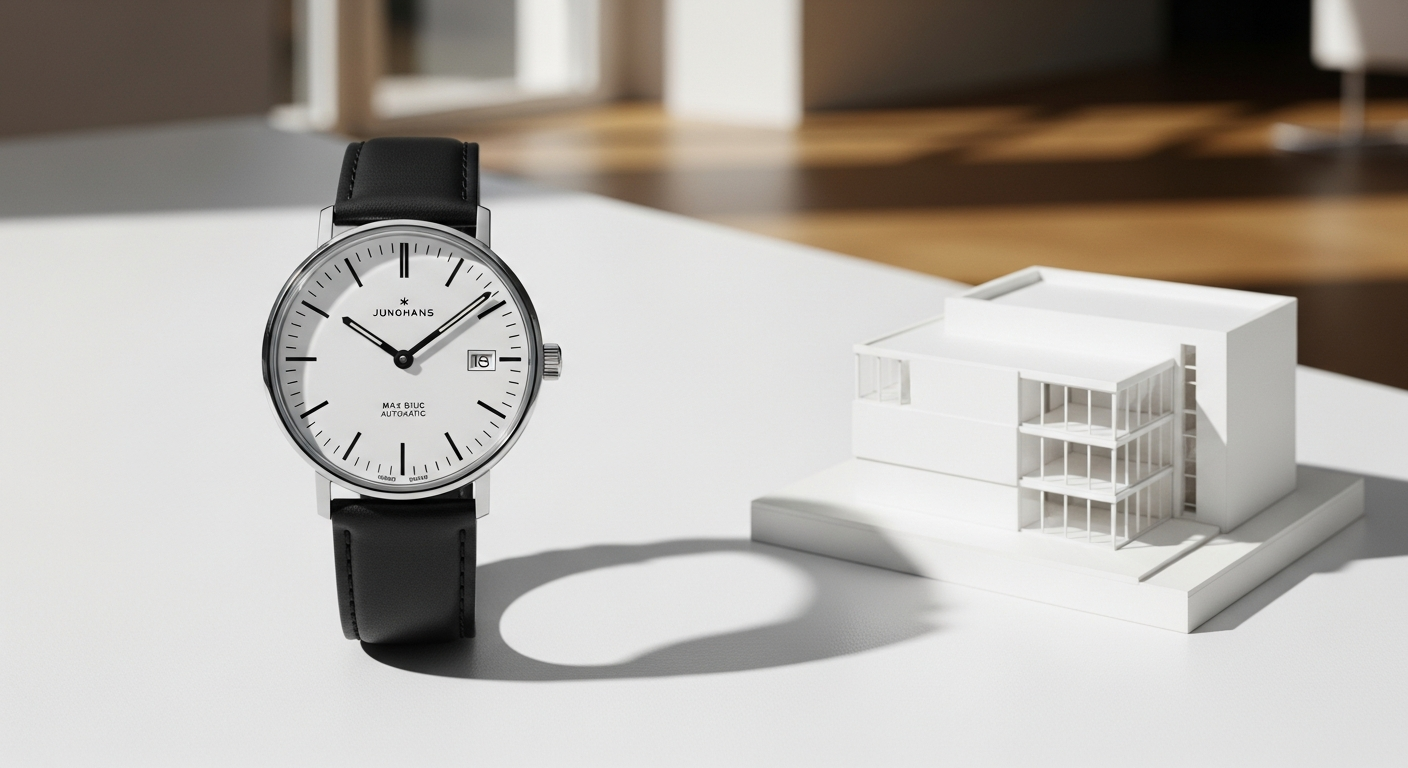
Over 75% of luxury watch collectors prioritize design heritage over flashy complications—yet most brands still chase trend-driven aesthetics. The Junghans Max Bill Automatic Bauhaus Watch represents a radical departure from this approach. It's a timepiece that refuses to age, not because of marketing hype, but because it was designed by a Bauhaus visionary to transcend the very concept of obsolescence.
Max Bill, the Swiss artist and architect who studied at the legendary Bauhaus school, created more than just a watch—he engineered a philosophy into metal and crystal. This timepiece embodies the Bauhaus principle that form must serve function, with zero tolerance for unnecessary ornamentation. The watch's power lies not in what it does, but in how ruthlessly it eliminates everything extraneous to its core purpose.
Explore the Junghans Max Bill collection at Bauhaus today.
The Bauhaus Philosophy Embedded in Every Detail
How Max Bill's training at the Bauhaus school shaped his design methodology
Max Bill's education at the Bauhaus wasn't merely instruction in aesthetics—it was indoctrination into a design philosophy that treated function as the foundation of all beauty. The school's founding principle, articulated by Walter Gropius, demanded that designers dissolve the artificial boundary between fine art and applied craft. Bill absorbed this ethos completely, carrying it forward throughout his career as an artist, architect, and industrial designer. When he later turned his attention to watchmaking, he brought with him a fundamental conviction: every element must earn its presence through necessity.
The principle of form follows function applied to watch design
In watchmaking, form follows function means something specific and unforgiving. A watch must be readable at a glance, mechanically reliable over years of wear, and proportioned to sit naturally on the human wrist. Bill accepted these constraints as opportunities, not limitations. Where other designers might have added decorative indices or ornamental complications to justify a watch's existence, Bill stripped away every superfluous detail. The dial contains only what the eye needs: numerals, hands, a date window on certain models (or a ghost date position), and nothing more.
Why minimalism in watchmaking requires more, not less, design expertise
The misconception that minimalism equates to simplicity persists across design disciplines, but watchmaking exposes this fallacy immediately. Creating a dial that looks uncluttered while maintaining optimal legibility requires obsessive attention to proportion, typography, and spatial hierarchy. Max Bill spent considerable time refining the relationships between numeral size, hand length, dial spacing, and the domed crystal that magnifies the dial surface. Each decision cascaded into the next. A larger numeral required different hand proportions; different hand proportions demanded adjustments to the dial layout. Minimalism in this context represents mastery, not laziness.
The relationship between clarity and complexity in dial architecture
The Max Bill dial achieves its clarity through a layered approach to visual hierarchy. Numerals occupy the perimeter, positioned to guide the eye around the dial's circumference. The hands—precisely shaped to follow the dial's curvature—dominate the center, moving across a clean background with no competing elements. This architecture creates what designers call "visual rest," a quality largely absent from modern watches cluttered with subdials, date windows, and decorative complications. The dial invites the eye to settle, to read the time without effort or distraction.
Dial Design & Typography That Demand Closer Inspection
The custom typography Max Bill created specifically for this watch
Max Bill didn't adopt an existing typeface for the Max Bill watch. Instead, he designed bespoke numerals specifically for this project, a level of commitment that underscores the watch's intentionality. These numerals are neither purely modernist sans-serif nor traditional serif forms; they occupy a middle ground that balances geometric precision with human warmth. The rounded forms echo the soft edges of the case and the curves of the hands, creating visual cohesion across every component.
Understanding the hooked 4 numeral and its functional elegance
The "hooked 4" has become iconic among watch enthusiasts—a small detail that somehow captures the entire philosophy of the watch. This numeral features a distinctive hook or serif at the top, a departure from the numeral's typical geometric form. The hook serves a functional purpose: it prevents the 4 from appearing as a 9 when viewed at certain angles or under certain lighting conditions. This solution demonstrates Max Bill's design methodology perfectly. He identified a potential legibility issue and addressed it with a minimal intervention that became aesthetically distinctive rather than merely corrective.
Rounded numerals and their role in legibility hierarchy
The rounded quality of all numerals on the Max Bill dial creates visual softness without sacrificing legibility. This roundness establishes a clear hierarchy: the hour numerals command attention through their size and positioning, while the minute markers—simple lines—recede into supporting roles. This hierarchy allows the wearer to quickly distinguish hours from minutes, a seemingly simple distinction that many watches fail to articulate clearly.
How hand shapes follow dial curvature for optical perfection
The hands aren't merely functional pointers; they're sculptural elements designed to reinforce the dial's architecture. The hour and minute hands sweep across the dial following a subtle curvature that mirrors the dial surface's gentle dome. This curvature creates an optical illusion where the hands appear to float above the dial, enhanced by the Hesalite crystal's light-diffusing properties. The result is a three-dimensional quality that photographs poorly but becomes immediately apparent when the watch catches light on the wrist.
Technical Specifications That Justify the Investment
Junghans Caliber J800.1 movement: reliability and heritage
The heart of the Max Bill Automatic is the Junghans Caliber J800.1, an automatic movement that represents decades of refinement. Junghans, one of Germany's oldest watchmakers, developed this caliber as a response to the quartz crisis and the Japanese onslaught of the 1970s. The movement synthesizes German engineering discipline with proven Swiss mechanics, a combination that produces exceptional reliability metrics.
ETA 2824-2 base movement and its proven track record
The J800.1 builds upon the ETA 2824-2, one of the most prolific movements in modern watchmaking. This Swiss caliber has powered thousands of watches across multiple brands and price points, generating a vast historical record of longevity and durability. By licensing and modifying this proven base, Junghans secured a movement with inherent reliability, then applied their own engineering expertise to enhance it. The result is a movement with virtually zero learning curve for service technicians worldwide.
Power reserve of 38-42 hours and what it means for daily wear
A 38-to-42-hour power reserve sits comfortably in the middle zone for automatic watches. It's sufficient for daily wear without requiring a watch winder—missing a day or two won't result in a stopped watch—yet it's modest enough to encourage regular wearing rather than safe-keeping. This specification reflects Max Bill's practical mindset: the power reserve should serve the wearer's actual needs, no more.
Case dimensions (38mm diameter, 10mm thickness) and wrist compatibility
The 38mm diameter may seem modest in an era of oversized sports watches, but this size was intentional. Max Bill understood that proportional balance matters more than absolute dimensions. A 38mm case with 10mm thickness creates a watch that sits naturally on the wrist without dominating it. The lug-to-lug distance—the measurement from one strap attachment point to the opposite—remains compact enough for wearers with smaller wrists while remaining substantial enough for larger frames. The downward-sweeping lugs enhance this versatility, angling slightly downward to improve comfort and visual proportion.
Visit Bauhaus to view the complete Max Bill watch specifications.
Strap & Bracelet Pairings That Complete the Package
Premium calf leather strap options and aging characteristics
The Max Bill typically arrives on a high-quality calf leather strap, selected for its supple texture and aging characteristics. Calf leather develops patina over time—the surface becomes darker and more textured through exposure to light, moisture, and constant wear. This patina isn't deterioration; it's evidence of use and connection. A Max Bill wearer often finds themselves drawn to the strap's evolution, watching it transform from a fresh tan to a rich caramel brown over months and years.
Milanese-style steel bracelet versatility and durability
Certain Max Bill variants arrive on a Milanese-style steel bracelet, a woven construction that offers durability without weight. This bracelet style drapes on the wrist rather than relying on individual links, creating a seamless, comfortable fit across varying wrist sizes. The steel variant transforms the watch's character—it shifts from formal-evening appropriate to versatile all-arounder, suitable for office and casual settings with equal conviction.
How strap choice affects the watch's formal-to-casual transition
The leather strap establishes a more formal aesthetic, pairing naturally with dress wear and business contexts. The steel bracelet tips the watch toward casual versatility, suggesting durability and everyday reliability. Many Max Bill owners ultimately own both, switching based on context. This flexibility—the ability to adapt the watch's presentation through strap changes—mirrors Max Bill's design philosophy of efficient multifunctionality.
Leather patina development and what it signals about ownership
A Max Bill on a calf leather strap with developed patina tells a story of genuine use and ownership. The watch has been worn regularly, exposed to natural light and weather, maintained rather than preserved. This visible evidence of wear contradicts the artificial newness that defines much of the luxury watch market. For collectors who view watches as objects to be lived with rather than insured and stored, this patina represents success.
Design Heritage & Cultural Significance
Max Bill's contributions to modern design beyond watchmaking
Max Bill's influence extends far beyond horology. His work as an architect shaped Swiss modernism; his graphic designs established visual languages adopted across industries; his sculptures occupy museum collections worldwide. The Museum of Modern Art in New York permanently houses his kitchen clock, a design that shares DNA with the Max Bill watch—the same commitment to clarity, proportion, and purposeful restraint. This clock, designed decades before the watch, demonstrates that Max Bill's design philosophy wasn't a novelty but a consistent worldview applied across all media.
Connection to the Museum of Modern Art's permanent collection
Owning a Max Bill watch establishes a tangible connection to design history recorded by the institution that defines modern art's cultural significance. The watch sits in a lineage of objects deemed worthy of preservation and study. This institutional recognition carries weight that marketing cannot manufacture. When collectors reference the Max Bill watch's cultural legitimacy, they're pointing to actual museum validation, not advertising claims.
Bauhaus movement principles and their lasting impact on industrial design
The Bauhaus school, operating for only 14 years before the Nazi regime closed it in 1933, fundamentally restructured how the world thinks about design. The school's insistence that function and beauty are inseparable, that craft and industry can coexist, and that design serves human needs rather than ego—these principles permeate contemporary design practice. The Max Bill watch represents the Bauhaus philosophy functioning in the real world, proving that these principles create objects that remain vital and relevant decades after their creation.
Why owning a Max Bill watch connects you to design history
Purchasing a Max Bill watch isn't merely acquiring a timepiece; it's consciously aligning yourself with a design tradition that challenges the contemporary emphasis on novelty and accumulation. The watch makes a statement about what you value, what you consider timeless, and how you approach the objects in your life. For collectors and design enthusiasts, this connection to documented design history carries profound meaning.
Price-to-Value Analysis in the Luxury Watch Market
New model pricing range ($1,000-$1,450 USD) and what drives variation
The Junghans Max Bill Automatic positions itself in the accessible luxury segment, with pricing that reflects its target audience: educated collectors rather than investment speculators. New models range from approximately $1,000 to $1,450 USD, with variations driven by several factors. Case material (stainless steel versus PVD-coated variants), crystal composition (Hesalite versus sapphire), and strap configuration all influence final pricing. Some limited editions or special finishes can push toward $1,940 USD. This pricing acknowledges the watch's quality without demanding the premium associated with Swiss heritage brands or haute horlogerie complications.
Pre-owned market opportunities and where to source them responsibly
Pre-owned Max Bill watches frequently appear on the secondary market at reduced prices, typically ranging from $600 to $1,000 depending on condition and configuration. Reputable dealers and auction houses dedicated to horology offer provenance and authentication guarantees. Purchasing pre-owned provides an opportunity to enter the watch at a reduced price point while supporting the circular economy. A well-maintained Max Bill resists obsolescence, aging gracefully rather than becoming dated.
Why German craftsmanship plus Swiss movement justifies the price point
The pricing reflects a genuinely balanced equation. German manufacturing expertise applied to case finishing, assembly, and quality control combines with Swiss movement heritage and proven reliability. This isn't a German watch wearing a Swiss movement as decoration; it's a deliberate engineering synthesis that justifies premium pricing against mass-produced alternatives. The price acknowledges design heritage, manufacturing quality, and cultural significance without inflating toward speculation bubbles.
Resale value retention and investment potential over 5-10 years
The Max Bill demonstrates strong resale value retention compared to trend-driven luxury watches. A watch purchased at $1,200 typically retains $700-$900 of its value over five years, a performance that compares favorably to Swiss heritage brands. This retention stems from the watch's design consistency—there's no obsolescence, no sense that next year's model will render this year's irrelevant. Collectors seeking vintage Max Bills actively seek examples from decades past, suggesting the watch's timelessness extends to its investment characteristics.
Collector Psychology & Why Enthusiasts Choose It
The appeal of owning a piece of design history
Certain objects transcend their functional purpose and become cultural artifacts. The Max Bill watch occupies this territory. Owning one means possessing a physical manifestation of Bauhaus philosophy, a direct connection to a design movement that reshaped the twentieth century. This isn't intellectual—collectors who wear a Max Bill experience their design values materialized on their wrist, a daily reminder of the principles they admire.
Bauhaus aesthetics and their alignment with minimalist lifestyle philosophies
Contemporary minimalism—the lifestyle philosophy emphasizing intentionality, reduction of excess, and deliberate consumption—finds perfect expression in Bauhaus-designed objects. The Max Bill watch appeals to those who've consciously moved away from accumulation and toward quality, purposefulness, and longevity. For minimalists, owning fewer, better-designed objects makes philosophical sense. A Max Bill watch represents this ideal: one excellent watch rather than a collection of mediocre ones.
How design-focused collectors differ from specification-obsessed watch nerds
Two distinct tribes inhabit the watch enthusiast community. The specification-obsessed focus on movement complications, water resistance ratings, and feature comparisons. Design-focused collectors ask different questions: How does the dial organize visual information? Why does this proportion feel right? What does the watch communicate about the designer's philosophy? The Max Bill appeals overwhelmingly to the latter group, who value understanding the "why" behind design decisions over checking specification checkboxes.
The satisfaction of understanding the why behind every design decision
Wearing a Max Bill watch provides intellectual satisfaction beyond timekeeping. Each element invites contemplation: Why that numeral size? Why that hand shape? Why that specific shade of dial? These questions have documented answers rooted in design philosophy and functional necessity. This transparency—the ability to understand and appreciate the reasoning behind every millimeter—creates a deeper engagement with the object than most watches facilitate.
Making Your Decision: Is This the Right Watch for You?
Assessing your design philosophy and aesthetic preferences
Before committing to the Max Bill, examine your actual design preferences rather than aspirational ones. Do you find yourself drawn to clean, uncluttered spaces? Do you appreciate objects with visible heritage and documented history? Do you value restraint over ornamentation? If questions about why a design decision was made interest you more than accumulating features, the Max Bill aligns with your worldview.
Evaluating your lifestyle needs against the watch's capabilities
The Max Bill isn't a sports watch or a diving instrument. Its 30-50 meter water resistance handles daily moisture—washing hands, light rain—but excludes swimming or diving. The Hesalite crystal scratches more easily than sapphire, though it can be polished. If your lifestyle demands a robust all-purpose instrument, the Max Bill makes compromises. If you're seeking a refined daily wearer for professional and casual contexts, these limitations transform into benefits—the watch remains light, elegant, and unpretentious rather than overbuilt.
Determining whether you value heritage and design over specifications
Many watches offer superior specifications—longer power reserves, higher water resistance, more complications—at similar price points. The Max Bill doesn't compete on these terms. Its value proposition centers on design heritage, intellectual coherence, and cultural significance. Determine whether these factors matter to you more than maximizing specifications. If they do, the Max Bill becomes obvious. If not, consider alternatives with more ambitious technical capabilities.
Testing the watch in person and what to look for during inspection
The Max Bill must be experienced in person. Visit an authorized dealer and wear it for at least fifteen minutes. Notice how the dial's legibility feels at various angles and lighting conditions. Observe the domed crystal and how the hands appear to float above the surface. Check the case's proportions against your wrist size and bone structure. Examine the strap's quality and comfort. Look for manufacturing defects or finishing irregularities that might indicate quality control issues. Allow the watch's coherence to register sensorially before making a final decision.
The Enduring Relevance of Purposeful Design
The Junghans Max Bill Automatic Bauhaus Watch occupies a rare position in horology—it's simultaneously a technical instrument, a design artifact, and a cultural statement. It refuses to compete on the terms that dominate modern watch marketing: it has no chronograph, no GMT function, no flashy complications. Instead, it competes on something far more valuable: intellectual honesty. Every millimeter of this watch exists because Max Bill determined it necessary, nothing more, nothing less.
What makes this timepiece genuinely compelling is that its minimalism demands more from the wearer. You're not distracted by unnecessary features; you're confronted with pure design. The clarity that Max Bill engineered into every element requires active engagement. You appreciate the watch not passively but through understanding—recognizing the proportional relationships, the typographic refinement, the architectural coherence that lesser designs merely pretend to possess.
For those who appreciate the Bauhaus principle that function and beauty are inseparable, this watch becomes indispensable. It proves that restraint, when executed with absolute commitment, achieves more than excess ever could. The watch resists fashion and obsolescence not through nostalgia but through purposefulness. It will look precisely as intentional in ten years as it does today.
If you've found yourself drawn to watches that prioritize clarity over complexity, heritage over hype, and purposeful restraint over feature bloat, the Junghans Max Bill Automatic Bauhaus Watch deserves serious consideration. Start by handling one in person and let the dial's legibility and the case's proportions speak for themselves.
Leave a Reply