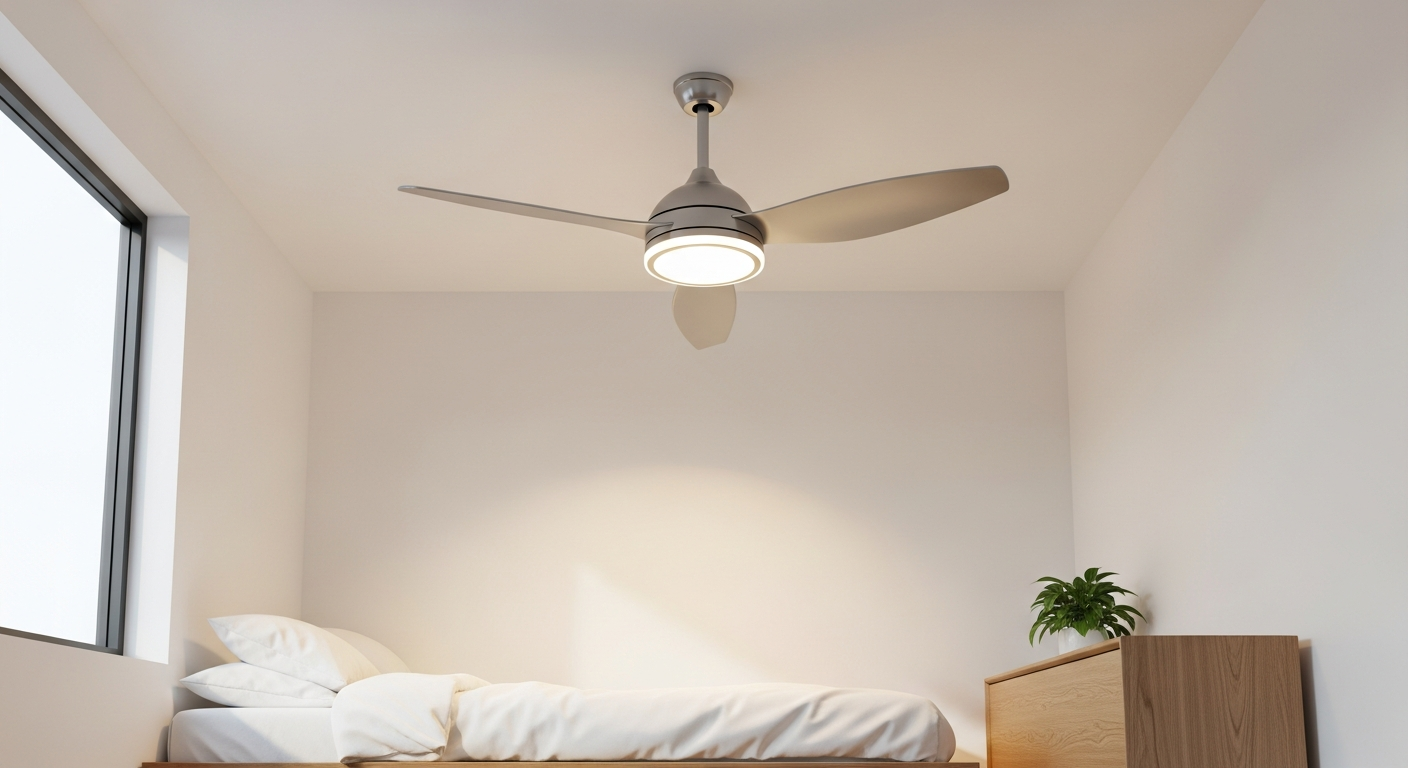
Choosing ceiling fan light fixtures can help you handle two room needs with one installation: airflow and overhead lighting.
Yet models vary widely in fan diameter, light output, mounting height, controls, motor design, and overall appearance.
Checking these details before buying can help you choose a fixture that fits your room instead of relying on looks alone.
Many ceiling fans with lights now include integrated LEDs, remote controls, reversible motors, and several speed settings.
The best option for your space depends on room size, ceiling height, desired brightness, and how frequently you plan to run the fan.
Ceiling Fan Light Fixtures: What Should You Check First?
Start with the room itself. Measure its dimensions and ceiling height, then check the specifications of each fixture you are comparing.
A fan that is too small may provide limited airflow across a large room, while an oversized model can feel visually heavy in a compact area.
Pay attention to these buying factors:
- Fan diameter and recommended room coverage
- Ceiling height and mounting method
- Light output and color temperature
- Motor type and speed settings
- Reversible airflow settings
- Remote, wall, or app controls
- Bulb replacement requirements
- Damp- or wet-location ratings when needed
- Installation requirements
- Warranty coverage
These specifications give you a better basis for comparing products than appearance alone.
Choose the Right Fan Size for Your Room
Fan diameter is one of the first specifications worth checking. Manufacturers commonly provide recommended room dimensions or square-foot coverage for individual models.
A ceiling fan size guide can give you a starting point, though manufacturer recommendations should take priority.
Measure the length and width of your room, calculate its square footage, and compare that figure with the listed coverage for the fan.
Bedrooms and home offices may work well with smaller fan diameters. Living rooms, family rooms, and open-plan areas can require larger models or several fixtures to distribute air effectively.
Blade span is only part of the equation. Motor performance, blade pitch, fan speed, and installation height can affect actual airflow.
Check Your Ceiling Height and Mounting Options
Mounting style matters because the fan needs enough clearance to operate safely while providing useful airflow.
A flush mount ceiling fan can suit rooms with lower ceilings because its housing sits close to the ceiling. Rooms with taller ceilings may use a downrod to position the fan at a practical height.
Before buying, check:
- Overall installed height
- Downrod length
- Manufacturer clearance requirements
- Ceiling slope compatibility
- Electrical box requirements
For angled ceilings, verify that the selected model supports sloped installation and check its maximum permitted angle.
Compare Integrated LEDs and Replaceable Bulbs
Lighting design deserves as much attention as fan performance. Some fixtures use integrated LED modules, while others accept replaceable bulbs.
An LED ceiling fan can provide efficient overhead lighting without requiring separate bulbs. Integrated LEDs can also allow manufacturers to create thinner light housings.
However, check whether the LED module can be replaced separately. If the lighting component eventually fails, service options can vary by manufacturer.
Fixtures using standard replaceable bulbs give you greater control over bulb brightness and color temperature. They can also make future bulb replacement straightforward.
How Bright Should the Light Be?
Do not judge brightness by wattage alone. For LED lighting, lumens provide a better indication of visible light output.
Think about how the room is used. A bedroom may need softer ambient lighting, while a kitchen, office, or multipurpose room may benefit from stronger illumination.
Also check color temperature, commonly measured in kelvins. Lower color temperatures generally produce warmer-looking light, while higher temperatures create a cooler appearance.
Dimmable lighting can be useful if the room serves several purposes. Before purchasing, confirm that dimming is supported by the fan, light module, remote, or compatible wall control.
Look at Motor Type and Energy Use
If you expect to run your fan for several hours each day, motor efficiency deserves attention.
An energy efficient ceiling fan may use a DC motor. DC motors are commonly associated with lower electricity consumption, quieter operation, and several speed settings compared with many traditional AC fan motors.
Still, compare actual manufacturer specifications rather than assuming every DC model performs identically.
Look for:
- Airflow ratings
- Power consumption
- Number of fan speeds
- Reversible operation
- Noise-related product information
- Energy efficiency certifications when applicable
A reversible motor can be especially useful in climates where you use heating during part of the year because changing blade direction can help redistribute room air.
Match the Fixture to Your Interior
Performance comes first, yet appearance still matters for a fixture installed in a prominent location.
A modern ceiling fan may feature simple blades, compact motor housing, integrated lighting, and finishes such as matte black, white, brushed metal, or wood-look materials.
Try to coordinate the fixture with nearby lighting, hardware, furniture, and ceiling color. A visually oversized fixture can dominate a small room even when its technical specifications are suitable.
Blade color can affect how noticeable the fan appears. Blades close to your ceiling color tend to create a quieter visual effect, while contrasting blades draw greater attention.
Check the Controls Before Buying
Fan controls vary significantly between products. Basic models may use pull chains or wall switches, while other fixtures include handheld remotes or smartphone controls.
Remote controls are convenient in bedrooms and living rooms because you can adjust fan speed or lighting without reaching a wall switch.
Smart models may support scheduling, voice assistants, or mobile apps. If those functions matter to you, verify compatibility with your preferred platform before purchasing.
Also check what happens after a power interruption. Some models remember previous fan and light settings, while others return to default settings.
Can You Install a Ceiling Fan Where a Light Fixture Was?
Sometimes, but you need the correct electrical support.
A ceiling fan creates movement and vibration that a standard light fixture does not. The electrical box and mounting hardware must therefore be rated to support a ceiling fan.
Replacing an existing light does not automatically mean its electrical box is suitable for a fan. Check the box rating before installation.
If you are uncertain about wiring, mounting support, or local electrical requirements, using a qualified electrician is the safer option.
What Should You Check for Bathrooms and Outdoor Areas?
Location ratings matter in spaces exposed to moisture.
A dry-rated fixture is generally intended for indoor areas without significant moisture exposure.
Damp-rated fans can handle moisture and humidity under appropriate covered conditions. Wet-rated fans are designed for greater exposure to water.
Check the manufacturer’s location rating rather than choosing based on appearance. This is especially important for covered patios, porches, bathrooms, and similar areas.
Questions to Ask Before Purchasing
Do you need a fan with an integrated light?
Choose one if you need both overhead lighting and air circulation from the same ceiling location. If the room already has sufficient lighting, a fan without a light may make sense.
Are integrated LEDs worth buying?
They can provide efficient lighting and a clean fixture design. Check lumen output, color temperature, dimming support, expected LED lifespan, and replacement options before deciding.
Should you choose remote or wall controls?
A remote can be convenient for bedrooms and living spaces. Wall controls can be easier to keep track of in busy shared rooms. Some models support both.
Does blade count determine airflow?
Not by itself. Motor performance, blade dimensions, pitch, speed, and overall fan design all affect airflow.
Can one fixture light an entire room?
That depends on the fixture’s lumen output, room dimensions, wall colors, layout, and lighting needs. Larger rooms may still need lamps, recessed lights, or other task lighting.
How to Compare Ceiling Fan Light Fixtures with Confidence
A good purchase starts with measurements rather than style. Check your room dimensions, ceiling height, mounting requirements, and existing electrical box before comparing designs.
Then look at airflow, light output, motor type, controls, location rating, warranty, and replacement parts. Compare specifications across several models rather than choosing solely by price or appearance.
The right ceiling fan and light combination should fit the physical space, provide suitable airflow, and give you enough light for everyday activities.
Spending a little time checking specifications before buying can prevent installation problems and help you choose a fixture suited to your room.
Leave a Reply