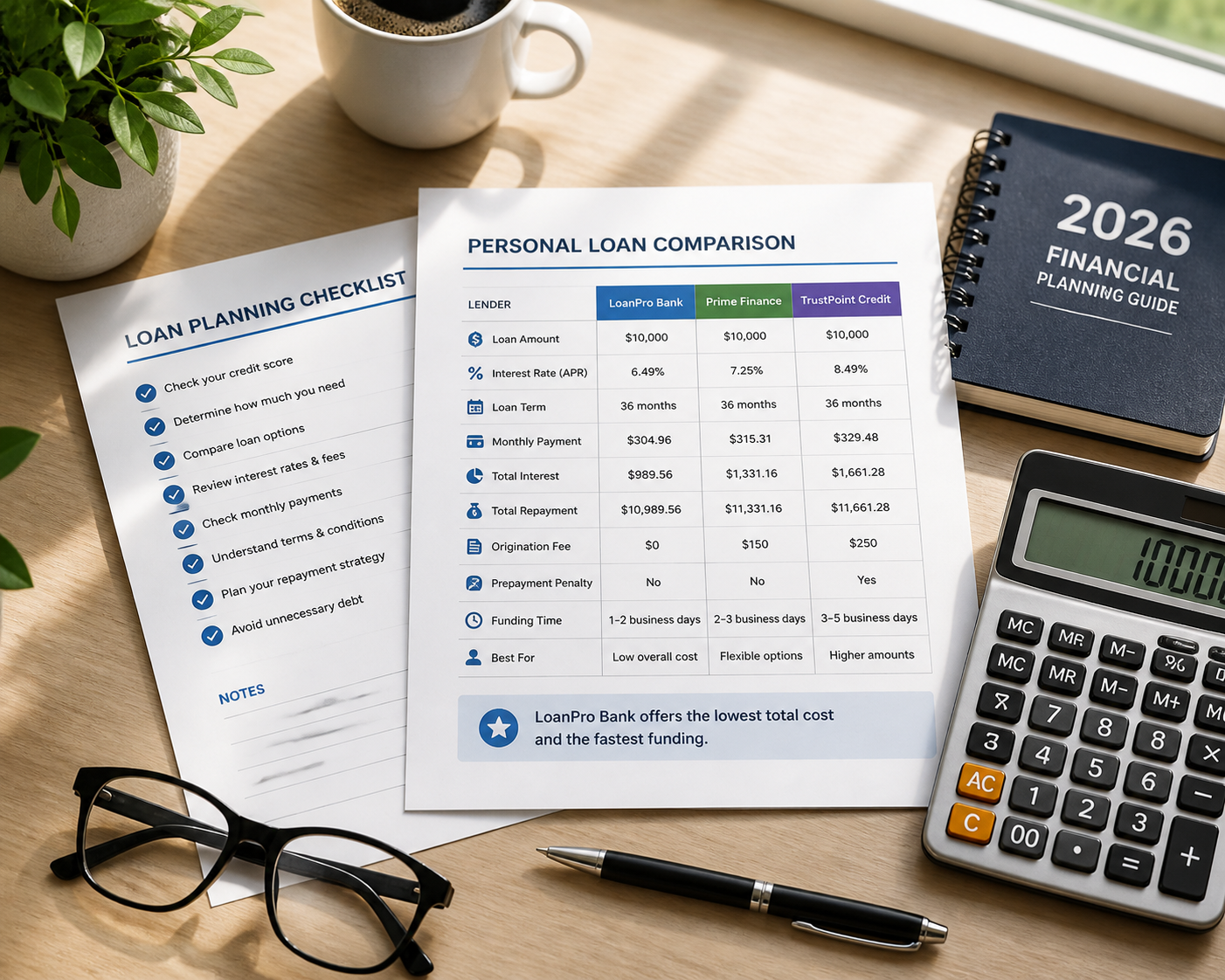
When it comes to personal loans, one statistic stands out: over 60% of UK borrowers never shop around. They accept the first offer presented to them and move on. That single decision often costs thousands of pounds in unnecessary interest over the loan term—money that could have stayed in your pocket with just a bit of research.
The good news is that comparison shopping has become remarkably simple. loan.co.uk exists specifically to solve this problem by letting you compare multiple personal loan offers in one place without triggering hard credit checks that damage your credit score. The platform aggregates lenders and third-party partners, giving you visibility into realistic rates based on your actual credit profile rather than the glossy advertised figures that apply to very few people.
This guide walks you through how the platform works, what rates you can realistically expect, and how to use the comparison tool strategically to maximize your approval chances at the lowest possible cost. Start comparing personal loans on loan.co.uk to see your options in minutes.
What Makes loan.co.uk's Comparison Model Different
How the soft-search eligibility check protects your credit score during the comparison phase
The soft-search is the foundation of loan.co.uk's approach. When you enter your details and loan requirements, the platform runs a soft credit check—one that lenders can see but that doesn't appear on your credit file or affect your credit score. This means you can explore multiple lender options without the damage that comes from traditional hard inquiries. Each hard search typically reduces your score by a small amount, but multiple inquiries in short succession can signal desperation to future lenders and significantly harm your score. Soft searches bypass this problem entirely.
Why seeing multiple lender offers upfront saves time compared to traditional bank applications
Traditionally, borrowers contact individual banks, fill out separate application forms for each one, and wait days for responses. With loan.co.uk, you enter your details once and see multiple offers side-by-side within minutes. This eliminates the repetitive paperwork and allows you to compare key metrics—monthly payments, total interest, APR, and repayment terms—all on one screen. You can then decide which lenders genuinely match your needs before proceeding to formal applications.
The range of loan amounts available (from small emergency loans to larger multi-thousand-pound borrowing)
loan.co.uk supports a broad spectrum of borrowing needs. Whether you need £500 for an urgent expense or £25,000 for a major project, the platform accommodates both. Repayment periods typically range from 1 to 7 years depending on the lender and loan size. This flexibility means you can find a loan structure that fits your specific situation rather than forcing yourself into a generic product.
How the platform aggregates lenders and third-party partners to expand your options
The comparison model works by connecting to numerous lenders and third-party lending partners across the UK market. This aggregation approach means you're not limited to a single bank's offerings. Instead, you access a wider range of products and interest rates than you'd find by visiting individual lenders. Some lenders exclusively advertise through comparison platforms, so you'd miss their offers entirely by applying directly to banks.
Why representative APR displays matter more than advertised rates for realistic expectations
You've likely seen loans advertised at incredibly low rates—4.9% APR or similar figures. These are representative APRs, meaning only a portion of approved customers qualify for that rate (typically 51% or more). The vast majority pay higher rates based on their credit profile. loan.co.uk displays these representative APRs alongside your likely rate range based on your credit history, giving you realistic expectations rather than aspirational marketing speak.
The transparency advantage: reviewing estimated monthly repayments before you commit
Before submitting a formal application, loan.co.uk shows you estimated monthly repayment amounts and total interest costs for each lender. This transparency lets you do the math: Can you afford £250 per month for 48 months, or would £180 per month over 60 months work better for your budget? This step prevents impulsive decisions and ensures you understand the true cost of borrowing.
Understanding APR Ranges and How Your Credit Profile Affects Your Rate
What credit score ranges typically qualify for low single-digit APR loans
Excellent credit—typically a score of 750 or above—positions you for the most competitive rates, often in the 4–7% APR range depending on loan amount and term. Good credit (700–749) might see rates in the 7–12% range, while fair credit (650–699) typically falls into the 12–20% bracket. Poor credit or no credit history can result in rates substantially higher, sometimes exceeding 25% APR. These are approximations; actual rates depend on multiple factors beyond the score itself.
How loan amount and repayment term influence the interest rate you'll be offered
Larger loans often attract lower APRs because they're less risky for lenders—the fixed costs of servicing a £10,000 loan versus a £1,000 loan are proportionally lower. Similarly, longer repayment terms (5–7 years) often come with higher overall interest costs, but lower monthly payments, while shorter terms (1–3 years) mean higher monthly payments but less total interest paid. The lender balances risk and reward by adjusting rates based on these variables.
Why actual rates often differ from advertised ones (and what factors cause the gap)
The gap between advertised representative APRs and actual approval rates exists because lenders assess individual risk. They review your credit history, income stability, existing debts, employment status, and other factors. Someone with a perfect payment record and high income qualifies for better rates than someone with missed payments or high existing debt obligations. loan.co.uk helps narrow this uncertainty by showing you a likely rate range, but only the formal application reveals your actual approved rate.
The relationship between credit history strength and approval likelihood
A strong credit history—on-time payments, low credit utilization, diverse credit types—signals reliability to lenders. This strength directly influences both approval likelihood and the rate you receive. If your credit history shows recent missed payments or defaults, you're a higher-risk borrower, and lenders either decline your application or offer rates that reflect that risk. Building credit history is therefore a long-term strategy for better borrowing costs.
How to interpret representative APR when comparing lenders
When loan.co.uk displays a representative APR alongside your likely rate range, focus on your range rather than the representative figure. If the platform indicates a lender's representative APR is 5.9% but your likely range is 15–19%, that's the more accurate expectation for your situation. Use representative APRs primarily for comparing similar lenders in similar tiers—not as an absolute benchmark for what you'll receive.
Why pre-approval estimates are estimates, not guarantees
The figures loan.co.uk provides are based on the information you've entered and the soft-search results. During the formal application, lenders verify income (through payslips or tax returns), confirm employment, review bank statements, and sometimes conduct additional checks. Any discrepancies or new information discovered during this verification can change your approved rate or result in a declined application. The estimate remains valuable for comparison purposes, but it's not a guarantee.
Common rate brackets: excellent credit vs. fair credit vs. poor credit scenarios
Excellent credit (750+): 4–8% APR, highest approval likelihood, shortest terms possible without penalty.
Good credit (700–749): 7–13% APR, good approval likelihood, standard terms (3–5 years).
Fair credit (650–699): 12–20% APR, moderate approval likelihood, may require shorter terms or guarantors.
Poor credit or no history (<650): 20%+ APR, lower approval likelihood, possibly limited lender options or requirement for secured borrowing.
Loan Purposes That Benefit Most From Comparison Shopping
Debt consolidation: combining multiple debts into a single loan with potentially lower interest
Debt consolidation is one of loan.co.uk's strongest use cases. If you're juggling three credit cards, an overdraft, and a store card, each charging different interest rates (often 15–30% APR), consolidating into a single personal loan at 10–15% APR can save hundreds monthly. Comparison shopping is crucial here because even a 2% rate difference on a £15,000 consolidation loan translates to significant savings over a 5-year term.
Home improvement financing: comparing rates for renovation and upgrade projects
Home improvements—kitchens, bathrooms, roofing, extensions—are significant expenses. Personal loans offer a faster alternative to remortgaging. Comparing lenders ensures you find the best rate for the specific amount and timeframe of your project. Some lenders specialize in this category, so comparison platforms often reveal better terms than your bank's standard rates.
Car purchase loans: finding competitive rates for vehicle financing
Whether buying new or used, car finance through personal loans provides flexibility. Comparison shopping lets you secure a rate before negotiating with the dealership, giving you leverage. Some lenders offer better rates for car purchases specifically, making the comparison process worthwhile.
Emergency expenses: accessing quick funds for unexpected costs
Boiler breakdowns, medical emergencies, or urgent car repairs can't wait for the perfect rate. Comparison shopping still matters here because speed and cost both matter. Knowing you can access £5,000 at 12% APR within 24 hours beats panic-borrowing at 25% from a payday lender.
Wedding and holiday loans: comparing terms for planned major expenses
For planned expenses with longer timeframes, comparison shopping is especially valuable. Weddings and holidays often cost £5,000–£15,000 or more, so a 3–4% rate difference multiplied over a 3–5 year term yields substantial savings. You have time to shop carefully rather than rushing.
Business-related personal borrowing: using personal loans for self-employed needs
Self-employed individuals often find business loans difficult to secure due to variable income. Personal loans provide an alternative, though the amount available may be limited compared to business lending products. Comparison shopping helps identify lenders most willing to work with self-employed borrowers and those offering competitive rates in this category.
Why comparing is especially valuable for larger loan amounts (where rate differences multiply)
A 3% rate difference on a £5,000 loan matters, but it matters far more on a £20,000 loan. Over a 5-year term, that 3% difference could mean £3,000+ in additional interest. As loan amounts grow, the value of shopping around increases exponentially. This is precisely why comparison platforms exist—to capture those savings at scale. Compare your loan options now and see exactly how much you could save.
Step-by-Step: How to Navigate the loan.co.uk Comparison Process
Entering your desired loan amount and repayment term preferences
Start by determining how much you actually need to borrow. Borrowing more than necessary means paying extra interest; borrowing too little leaves you short. Next, consider repayment timelines. A 3-year term means higher monthly payments but lower total interest. A 7-year term spreads costs across more payments but accumulates more interest overall. Enter realistic figures based on your budget and financial goals.
Understanding how the soft-search works and why it doesn't harm your credit score
After entering your loan details, the platform conducts a soft-search using your personal information. This check is visible only to you and the lenders you've specifically allowed to review your details through loan.co.uk. It doesn't appear on your credit file and doesn't affect your score. You can run multiple comparisons over days or weeks without cumulative damage—a major advantage over traditional applications.
Reviewing lender comparison results and key metrics side-by-side
loan.co.uk displays results in a comparison table showing each lender's representative APR, your likely rate range, monthly payment estimates, total interest, and lender information. Sort by APR, monthly payment, or total interest depending on what matters most to your situation. This side-by-side view eliminates the need to visit individual websites.
Interpreting monthly repayment estimates and total interest costs
The monthly payment tells you whether the loan fits your budget; total interest reveals the true cost. A £15,000 loan at 10% APR over 60 months means £318 monthly payments and approximately £3,081 in total interest. At 12% APR, it's £333 monthly and £3,975 in interest—that's £900 extra. Use these figures to identify which combinations of rate and term genuinely serve your situation.
Identifying which lenders match your credit profile and approval likelihood
loan.co.uk indicates approval likelihood for each lender based on your credit profile and their typical approval criteria. A lender showing "likely" approval is a safer bet than one showing "possible." While no guarantee exists, these indicators help prioritize which lenders to approach first, increasing your likelihood of approval.
The application flow: moving from comparison to formal application with your chosen lender
Once you've identified your preferred lenders (typically top 2–3 options), you can click to apply. This takes you through to that lender's formal application process. Here, you'll provide verified information: employment details, income confirmation, bank statements, and so on. The lender conducts a hard credit search at this stage, so choose your applications carefully—apply to too many lenders simultaneously and multiple hard searches can damage your score.
What happens after you submit an application (approval timelines and next steps)
After submitting a formal application, most lenders provide initial decisions within 24–48 hours. Some approve immediately; others require additional verification. If approved, you'll receive a loan agreement detailing the exact rate, monthly payment, and terms. Review this carefully before accepting. Once accepted, funds typically arrive within 1–5 working days. During this window, you can back out if circumstances change, though backing out after formally accepting may carry penalties.
Advantages of Using a Comparison Platform vs. Direct Lender Applications
Time savings: comparing dozens of lenders without contacting each individually
Visiting each lender's website, filling out separate forms, and waiting for individual responses takes hours or days. loan.co.uk condenses this into minutes. You see multiple offers simultaneously, eliminating the need to repeat information and chase responses from individual lenders.
Reduced credit score impact: soft searches versus multiple hard inquiries
A single hard inquiry reduces your score by approximately 5–10 points; multiple inquiries in short succession can reduce it by 30–50 points or more. Soft searches through loan.co.uk avoid this damage entirely, allowing you to explore options freely.
Simplified decision-making: standardized information across all lenders
Each lender's website presents information differently, making direct comparison tedious. loan.co.uk standardizes everything—APR, monthly payment, term options—so you're comparing apples to apples rather than deciphering different marketing presentations.
Access to exclusive rates: some lenders only advertise through comparison platforms
Certain lenders don't maintain their own retail presence; they exclusively partner with comparison platforms. By using loan.co.uk, you access these lenders' offers, which you'd miss entirely by contacting banks directly.
Convenience: completing the entire process from home on your schedule
No branch visits, no phone calls, no appointments. Everything happens online at your pace, any time of day or night.
Competitive pressure: lenders on comparison sites often offer better rates to attract customers
Lenders know they're being directly compared on comparison platforms, so they're incentivized to offer competitive rates to win your business. You benefit from this competitive pressure as a customer.
No obligation: reviewing options without committing to any application
Browsing loan.co.uk and reviewing estimates carries no obligation. You can explore options, run multiple comparisons, and decide to apply later—or not at all. There's no pressure to commit immediately.
Potential Drawbacks and What You Should Know Before Applying
Actual approval rates and terms may differ significantly from advertised rates
The rates shown during comparison are estimates. The actual approved rate depends on additional verification. It's entirely possible to see a 10% estimated rate but receive approval only at 14% when the lender reviews your full financial picture. Some customers are declined entirely despite positive soft-search results.
Some users get redirected to third-party lenders with different approval criteria
loan.co.uk partners with various lenders and lending networks. Some of these third-party lenders operate with different standards or approval procedures. You might find yourself redirected to a lender you weren't expecting, with approval criteria that don't match your situation. Always review which lender you're being directed to before proceeding.
Variable fees and charges that aren't always immediately obvious in the comparison
While APR should theoretically capture all costs, some lenders charge origination fees, early repayment penalties, or other charges that may not be fully transparent in the comparison view. Read the full terms carefully before accepting any loan offer.
The possibility of being declined after applying, even with a soft-search pre-qualification
A soft search doesn't guarantee approval. If your circumstances change between comparison and formal application, or if the lender's fuller investigation reveals issues, you can be declined. This is especially true if any information you provided proves inaccurate.
Limited lender options compared to the entire UK lending market
While loan.co.uk aggregates many lenders, it doesn't include every lender operating in the UK. Some smaller or specialist lenders may not be represented. For most borrowers, the selection is comprehensive, but it's not exhaustive.
How data usage and privacy policies work across comparison platforms
When you use loan.co.uk, you're sharing personal financial information with the platform and the lenders you allow to view it. Review the privacy policy to understand how your data is used and stored. Generally, loan.co.uk uses data to match you with appropriate lenders and doesn't sell data to third parties, but reading their specific policy ensures you're comfortable with their practices.
Why some lenders require additional documentation or verification during the formal application
If you're borrowing a large amount, have self-employed income, or have complex financial circumstances, lenders may request payslips, tax returns, bank statements, or proof of employment. This verification step takes additional time but is standard practice for protecting both borrower and lender.
Maximizing Your Approval Chances and Securing the Best Rate
Preparing your financial information before starting the comparison
Before logging into loan.co.uk, gather your details: current income, employment status, existing debts (credit cards, overdrafts, other loans), and housing costs. Having this information ready speeds up the comparison process and ensures accuracy. Inaccurate information leads to inaccurate rate estimates and eventual declined applications.
Choosing a realistic loan amount based on your income and existing commitments
Lenders assess your debt-to-income ratio—how much of your monthly income goes toward debt repayment. If you're already paying £800 monthly in debt and earn £2,500 gross, adding a £300 monthly loan payment strains your finances. Choose a loan amount where the monthly payment represents a manageable portion of your income (typically 10–15% at most).
Selecting repayment terms strategically (shorter terms = lower interest, but higher monthly payments)
A 3-year term on a £10,000 loan costs more in total interest than a 5-year term, but you're debt-free faster and build equity in your financial health sooner. A 7-year term minimizes monthly payments but means paying interest for seven years. Consider your financial goals: Is minimizing monthly outgoings more important, or is paying off debt quickly?
Understanding which lenders are most likely to approve your credit profile
loan.co.uk indicates approval likelihood for each lender. Focus primarily on lenders showing "likely" or "very likely" approval. These are lenders whose typical approval criteria match your profile. Applying to multiple lenders showing only "possible" approval wastes credit checks and increases decline likelihood.
Timing your application: why applying during certain periods can affect availability
Month-end or quarter-end is often when lenders are actively competing for new business, making rates slightly more competitive. Applying when funds are available also matters—if a lender has depleted its lending budget for the month, your application may face delays or rejection regardless of your profile. While you can't always control timing, being aware of it helps.
Bundling strategies: how some lenders offer better rates for existing customers
If you're an existing customer of a bank or lender, they often offer better rates on personal loans. Before comparing on loan.co.uk, check whether your current bank has a competitive offer. Some customers qualify for rates 1–3% lower simply by borrowing from an institution where they already hold accounts.
The importance of accurate information: why false details lead to declined applications
Lenders verify everything during formal application. False or exaggerated income claims, undisclosed debts, or inaccurate employment details result in declined applications and damage to your credit score. Honesty is not just ethical—it's practical. Lenders want to approve loans they believe you can repay. Accuracy actually increases approval likelihood.
Beyond the Comparison: Managing Your New Loan Successfully
What to expect after approval and loan disbursement
Once you've accepted a loan offer, the lender arranges funds transfer. Most deposits funds within 1–5 working days into the account you specified. You'll receive a loan agreement detailing the exact terms, payment schedule, and any conditions. Store this document securely; you'll need it for reference.
Setting up repayment schedules and payment reminders
As soon as funds arrive, set up automatic payments from your bank account to ensure you never miss a due date. Missing payments damages your credit score and can trigger late fees. Most lenders allow you to set up automatic payments through their online portal or via your bank's bill payment system. Consider setting reminders for a few days before each payment date to verify funds are available.
Early repayment options and whether breaking your loan early makes financial sense
Many lenders allow early repayment without penalty, saving you substantial interest if you can afford to pay faster. If you receive a bonus, inheritance, or windfall, paying down your loan early is often a better use of funds than keeping it in savings earning minimal interest. Confirm your lender's early repayment policy before committing—some charge penalties.
How making on-time payments builds credit for your future borrowing
Every on-time payment strengthens your credit history. After 6–12 months of perfect payments, your credit score noticeably improves. This matters for future borrowing: refinancing your current loan at a better rate, or accessing better rates on future applications. Treat your loan payments as an investment in your financial future.
Refinancing opportunities: when to consider switching to a better rate later
If interest rates drop significantly or your credit score improves, refinancing—taking out a new loan to pay off the original one—might save you money. Run the numbers: Does the new rate justify the fees and hassle? Only refinance if savings are substantial and you're financially stable to handle another application and new terms.
Avoiding common pitfalls that lead to missed payments or financial stress
Budget carefully to ensure your monthly loan payment fits comfortably alongside other expenses. Avoid taking on additional large debts during your loan term—this overstretches finances and increases missed payment risk. If circumstances change (job loss, income reduction), contact your lender immediately to discuss options rather than simply missing payments.
Using loan.co.uk for future borrowing needs as your credit profile improves
As your credit history strengthens, loan.co.uk becomes an even more valuable tool. Future loans will show significantly better rates available to you. When you need to borrow again—whether for another consolidation, home improvement, or unexpected need—the platform remains your fastest route to comparing multiple offers. Your improved credit profile means access to competitive rates that weren't available initially.
Making Your Comparison Count: Next Steps and Final Takeaways
Using loan.co.uk's personal loan comparison tool isn't just about finding the lowest rate—it's about taking control of your borrowing costs and avoiding expensive mistakes. The platform strips away the complexity of shopping multiple lenders, giving you clear visibility into your options without damaging your credit score. Over 60% of UK borrowers never shop around, and that passive approach costs them thousands in unnecessary interest. You're in the position to do better.
Start by identifying your loan purpose and the amount you genuinely need. Be realistic about what you can afford to repay monthly. Use loan.co.uk's soft-search feature to explore your options without risk, then compare the top 3–5 lenders that match your credit profile. Take time to review the monthly repayment estimates and total interest costs—that's where you'll spot the real savings opportunity. The difference between the best rate and a middling rate on a £15,000 loan could easily be £2,000–£3,000 over the loan term.
Prepare your financial information before you start. Gather payslips, employment details, and information about existing debts. Apply to lenders showing good approval likelihood for your profile. After approval, set up automatic payments and treat your loan repayment as a priority—on-time payments strengthen your credit history for future borrowing.
Head to loan.co.uk today, run your comparison, and see how much you could save by shopping around.
Leave a Reply