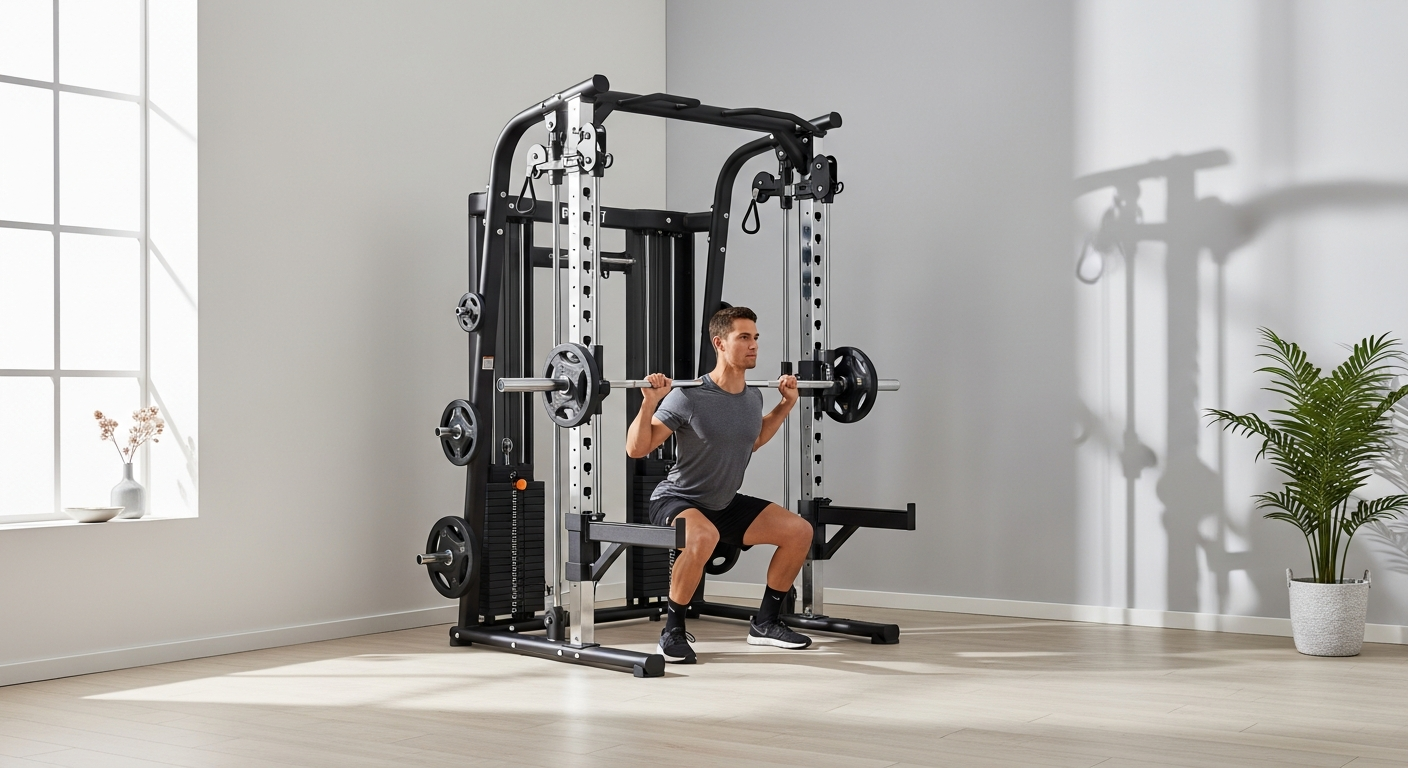
Over 73% of fitness enthusiasts abandon their gym memberships within the first year—but home gym owners stick with their routines. The difference isn’t motivation; it’s friction. Traveling to a commercial gym, waiting for equipment, and paying monthly fees create barriers that compound over time. Home gym ownership removes those obstacles entirely.
If you’re tired of paying monthly fees for equipment you barely use, or you’re cramped for space in a basement or garage, the struggle is real. The RitFit M1 Multi-Functional Smith Machine 2.0 has become a go-to choice for people building home gyms on realistic budgets.
Check out the RitFit M1 2.0 today and start your home gym journey.
Unlike commercial-grade systems that demand thousands of dollars and a dedicated room, this all-in-one unit combines a Smith machine, functional trainer, power rack, and pull-up bar into one compact footprint. I’m walking you through everything you need to know before investing, including what this machine actually delivers, which features justify the price tag, real-world weight capacities versus marketing claims, and whether it genuinely works for solo lifters. By the end, you’ll have the clarity to decide if the M1 2.0 belongs in your space.
All-in-one consolidation
The M1 2.0 consolidates Smith machine, functional trainer, power rack, and pull-up bar into a single unit—eliminating the need to purchase five separate pieces of equipment. This consolidation doesn’t mean compromise; each component functions as a standalone station would in a commercial gym.
Space efficiency
Compact footprint engineered specifically for basements, garages, and rooms with standard ceiling heights. You’re not building around the equipment; the equipment fits your actual home environment.
Safety-first design
Integrated Smith machine rails and spotter arms allow solo training without a workout partner. This feature matters more than marketing materials suggest—solo lifters represent the vast majority of home gym users.
Smooth cable system
Upgraded aluminum pulleys reduce friction and wear compared to standard plastic pulley systems. Smoother operation translates directly to better muscle engagement and exercise consistency.
Attachment versatility
Multiple D-handles and landmine attachment expand exercise options beyond basic barbell movements. You’re not limited to compound lifts; isolation work becomes accessible on the same machine.
Breaking Down the Core Components and Real Specifications
Smith machine section
The Smith machine delivers 500 lbs weight capacity with smooth vertical travel—sufficient for squats, bench presses, and deadlifts across a wide range of lifter experience levels. The 500 lb specification appears in user manuals rather than marketing materials, so you’re working with actual tested capacity rather than theoretical maximum.
Dual pulley cable system
Functional trainer with adjustable height for rows, chest presses, and lat pulldowns. The cable system operates independently from the Smith machine, allowing simultaneous use if training with a partner or enabling quick transitions between exercises.
Power rack integration
J-cups and safety spotter arms enable traditional barbell exercises and heavy compound lifts. This integration means you can load a barbell, perform a set of squats, then switch to cable rows without repositioning yourself or relocating equipment.
Multi-grip pull-up bar
Accommodates neutral, wide, and standard grip positions for back and arm development. Multiple grip options prevent repetitive strain injuries common with single-grip pull-up bars.
Assembly, Setup, and Space Considerations for Your Home Gym
Assembly timeline
Expect 4–6 hours with two people; detailed instructions and video guides come standard. The assembly process requires no specialized skills—basic mechanical aptitude and organization matter more than experience.
Tool requirements
Standard wrench and socket set; no specialized equipment needed. Most home gym builders already own these tools, eliminating additional purchase requirements.
Space footprint
Compact design fits rooms as small as 10×12 feet without restricting movement. You need clearance around the machine, but the footprint itself doesn’t consume excessive floor space.
Ceiling height compatibility
Engineered for standard 8-foot basement or garage ceilings. If your space has lower ceilings, verify specific dimensions before purchasing—this represents a dealbreaker for some potential buyers.
Real-World Performance: What Users Actually Experience
Smith machine smoothness
Aluminum rails deliver consistent glide without binding or sticking. The difference between aluminum and inferior rail systems becomes immediately apparent during heavy pressing movements.
Cable system responsiveness
Upgraded pulleys eliminate lag during rapid exercises like cable flyes. Responsiveness matters for exercise effectiveness; delayed cable return creates awkward stopping points.
Stability during heavy lifts
Sturdy construction holds firm during maximal effort squats and presses. The machine doesn’t shift or wobble when handling serious weight—a critical safety factor for solo training.
Solo training safety
Spotter arms and Smith machine rails provide confidence for unassisted heavy lifts. Many home gym beginners hesitate to lift heavy without a partner; the integrated safety features remove this barrier.
Explore the RitFit M1 2.0’s complete feature set to see if it matches your home gym vision.
Honest Pros That Justify the Investment
Unmatched versatility
Full-body training capability without purchasing multiple machines. You can perform 35+ different exercises across all major muscle groups without changing locations.
True affordability
Delivers commercial-quality features at a fraction of boutique gym equipment costs. Comparable standalone equipment from premium brands costs $3,500–$4,500; the M1 2.0 undercuts this pricing substantially.
Space-saving design
Replaces 4–5 separate machines in a single, organized footprint. This benefit compounds in smaller homes where dedicated gym rooms aren’t feasible.
Beginner-friendly safety
Smith machine rails eliminate fear of dropping heavy weight for new lifters. Psychological barriers disappear when lifters know the bar won’t fall on their chest if they fail a rep.
Realistic Limitations You Should Know Before Buying
Weight capacity discrepancies
Advertised limits sometimes exceed actual manual specifications by 100+ lbs. Verify specifications in the user manual rather than marketing materials—this represents responsible equipment selection.
Premium feel trade-offs
Materials feel functional rather than luxury compared to $5,000+ commercial systems. The equipment works as intended, but it doesn’t feel like equipment designed for commercial gym environments.
Non-standard attachment sizing
2×2 inch uprights with 1-inch holes prevent compatibility with standard 3×3 inch accessories. If you plan to expand your home gym with third-party attachments later, research compatibility beforehand.
Pull-up bar design
Some models lack a straight bar option; only neutral-grip available on certain versions. Verify which grip options your specific model includes before committing to purchase.
Who Should (and Shouldn’t) Buy the RitFit M1 2.0
Ideal for
Budget-conscious fitness enthusiasts building a first home gym. Apartment dwellers with limited square footage. Solo lifters prioritizing safety. Beginners seeking a complete workout solution. Intermediate lifters wanting strength training without gym fees.
Not ideal for
Advanced powerlifters requiring competition-standard equipment. Athletes exclusively focused on Olympic lifting. Users with non-standard ceiling heights below 7.5 feet. Those needing extensive third-party attachment compatibility.
Comparing Value: RitFit M1 2.0 Versus Buying Equipment Separately
Cost comparison
$1,500 M1 2.0 versus $3,500–$4,500 for equivalent separate machines (Smith + functional trainer + power rack). The price difference reflects genuine savings rather than corner-cutting.
Space efficiency
One footprint versus three separate equipment zones. Your home gym occupies less total space with the integrated system.
Setup simplicity
Single assembly versus coordinating delivery and setup for multiple machines. You manage one delivery window, one assembly process, and one placement decision.
Exercise continuity
Seamless transitions between exercises without repositioning. Training flow improves substantially when equipment transitions don’t require walking across the room.
The Bottom Line: Is the RitFit M1 2.0 Worth Your Money?
The RitFit M1 Multi-Functional Smith Machine 2.0 delivers genuine value for home gym builders operating on realistic budgets. You’re getting commercial-quality features—smooth Smith rails, aluminum pulleys, integrated storage—at a price point that doesn’t require financing. The machine genuinely works for beginners through intermediate lifters, and the safety features eliminate the solo training anxiety that stops many people from lifting at home.
For the price, you’re getting a machine that handles squats, bench presses, cable rows, pull-ups, and 35+ other exercises without requiring a second mortgage or a dedicated 20×20 space. If you’re choosing between this and a commercial gym membership, the math is clear. If you’re choosing between this and buying five separate machines, the space and cost savings are obvious. For everyone else building a serious home gym in 2026, the M1 2.0 earns its place.
Get your RitFit M1 2.0 now and transform your space into a functional, complete home gym.
Leave a Reply