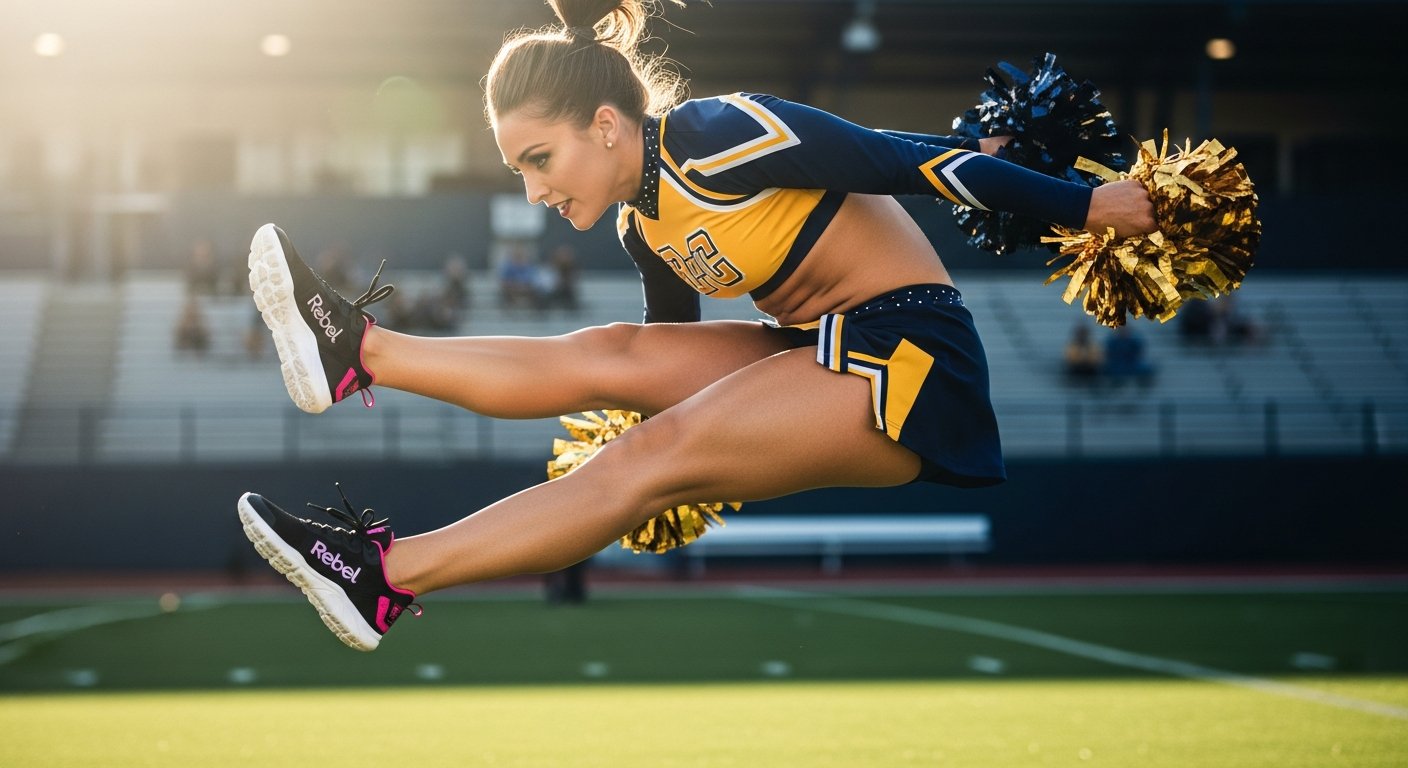
Cheerleading stunts operate on razor-thin margins. When a base catches a flyer’s foot, the pressure distributes across a shoe’s sole in ways that everyday athletic footwear simply doesn’t accommodate. The weight of multiple athletes transfers through contact points measured in inches. A flyer’s balance depends on ankle proprioception—the body’s ability to sense its position in space. A tumbler’s power generation starts from the ground up, requiring shoes that respond instantly to directional changes and weight shifts. Standard running or cross-training shoes were designed for forward motion, not the multidirectional chaos of competitive cheerleading.
How Standard Athletic Shoes Fail to Address Cheer-Specific Movement Patterns
Generic athletic footwear treats all sports as variations on the same theme. A basketball shoe optimizes for lateral cuts on a hardwood court. A soccer cleat prioritizes ball control and forward acceleration. Neither addresses the unique biomechanical demands cheerleaders face. Flyers need shoes that stabilize their ankles while remaining lightweight enough to maintain elevation. Bases require footwear that anchors their position without limiting their ability to shift weight rapidly. Tumblers demand flexibility for rotation paired with enough structure to protect joints during high-impact landings. When you’re executing a basket toss or holding a liberty, you’re not just moving—you’re managing forces that would immediately destabilize feet in shoes built for different sports.
The Role of Grip, Ankle Support, and Lateral Stability in Successful Stunt Execution
Three factors determine whether a stunt succeeds or fails. Grip prevents the base’s feet from sliding during the loading phase and the catch. Ankle support keeps the flyer upright when landing and protects the base when absorbing weight. Lateral stability prevents the rotational forces of the stunt from rolling ankles inward or outward. These three elements must work together without compromise. A shoe with exceptional grip but minimal ankle support creates a false sense of security—you’ll stick to the mat but twist your ankle when weight distribution shifts unexpectedly. A shoe with maximum ankle support but poor grip becomes a liability, as bases can’t generate the friction needed to control the stunt. The engineering challenge is creating shoes where all three elements enhance each other rather than competing for shoe real estate.
Why Position-Specific Athletes Need Shoes That Adapt to Their Unique Demands
Bases and flyers perform almost entirely different functions within the same stunt. A base plants their feet and generates upward force through their legs and core. They need maximum stability, weight-bearing capacity, and ankle protection. A flyer relies on precise balance and minimal extra weight that could drag them down. They need shoes that feel like an extension of their foot, offering proprioceptive feedback without bulk. A tumbler spends half their time inverted, absorbing impact from dismounts and generating explosive power for passes. Tumblers need shoes that flex during rotation but stiffen during landing. One-size-fits-all athletic shoes ignore these distinctions, forcing athletes to compromise. Purpose-built cheer shoes adapt to the role you play in your team’s stunts.
The Connection Between Proper Footwear and Injury Prevention During Advanced Stunts
Ankle injuries remain the leading cause of lost practice and competition time in cheerleading. Most ankle injuries stem from inadequate lateral support when feet contact the mat at non-vertical angles—exactly what happens during stunts. A shoe designed specifically for cheer reduces injury risk through architecture that anticipates these movement patterns. The exo-skeleton technology, strategic heel cushioning, and mid-top construction work together to prevent the ankle rolls and sprains that sideline athletes. This isn’t theoretical—it’s biomechanics applied to real impact forces. When your footwear actively protects your joints rather than merely covering your feet, you can train harder, compete with confidence, and stay healthy throughout the season.
Stunt Grooves™ and Grip Technology: The Foundation of Control
What Stunt Grooves™ Are and How They Differ from Standard Sole Patterns
Stunt Grooves™ represent a fundamental rethinking of cheer shoe sole design. Standard shoe treads feature patterns optimized for forward-and-back traction or multi-directional walking. Stunt Grooves™ specifically address the grip requirements of stunting—they’re strategically positioned to maximize contact between the sole and mat during the precise moments when grip matters most. The groove placement prevents slipping during base-flyer weight transfers, heel stretches, and the explosive loading phase of tosses. Unlike tread patterns designed for general traction, Stunt Grooves™ concentrate grip where cheerleaders actually place pressure during stunts.
The Ruthless Sole Foundation and Its Proven Track Record in Competitive Cheer
The Rebel Revolution builds upon the Ruthless sole, which has earned its reputation through seasons of competitive use across thousands of cheerleaders. This isn’t a new experimental technology—it’s a proven foundation enhanced with Stunt Grooves™ specifically engineered for performance. The Ruthless sole’s track record means the base platform delivers reliability, and the added Stunt Grooves™ layer provides additional grip specifically calibrated for cheer-specific movements. Coaches and athletes trust the Ruthless sole because it’s performed in nationals competitions, high school championships, and grueling training camps.
How Proprietary Grip Technology Prevents Slipping During Base-Flyer Transitions
The moment when a flyer’s weight transfers from the load phase to the stunt’s peak represents the grip system’s most critical test. The base’s feet are bearing maximum stress while the flyer adjusts their position. If the base’s shoe sole slips even a quarter-inch, the entire structure destabilizes. Stunt Grooves™ create micro-contact points that prevent this slippage even when mat conditions vary or sweat affects sole moisture. The proprietary technology ensures consistent grip across different mat types—spring floors in some gyms, mats with different fabric textures, competition surfaces that vary between venues.
Testing Grip Performance on Different Mat Surfaces and Conditions
Real-world cheer happens under variable conditions. One weekend you’re training on a worn gym mat; the next you’re competing on equipment specifically manufactured for nationals. Some facilities have rubberized mats; others have woven surfaces. Humidity and sweat change grip characteristics throughout the day. Shoes tested only in controlled lab conditions fail when conditions shift. The Rebel Revolution’s grip technology performs across these variables because it’s been tested in the environments where cheerleaders actually practice and compete.
Real-World Scenarios Where Enhanced Grip Makes the Difference
Picture a basket toss. The bases dip, load, and explode upward while their feet remain locked in position. Any slippage translates directly to reduced height and stability. The flyer experiences a jerky, unreliable toss instead of the smooth acceleration that allows confidence during the stunt. Enhanced grip eliminates this variable, giving the flyer consistent launching conditions. During a heel stretch, the bases adjust their positioning constantly as the flyer extends their leg. The bases need grip sufficient to prevent foot movement while maintaining the agility to micro-adjust their stance. A liberty hold requires the base to maintain absolute foot position while the flyer balances on their hand with only the base’s stability anchoring them. Stunt Grooves™ mean the base’s feet stay exactly where they planted them.
The Rebel Spin Pad: Precision Rotation for Competitive Routines
Understanding the Rebel Spin Pad’s Strategic Placement and Function
The Rebel Spin Pad occupies a specific position within the shoe’s sole, engineered to facilitate rotational movement without interfering with other functions. Its placement optimizes the pivot point for turns and spins—the exact location where cheerleaders apply pressure during rotational movements. Unlike a generic heel pad, the Rebel Spin Pad is calibrated to the biomechanics of cheerleading rotations. It reduces friction in the precise way that allows smooth, controlled spins while maintaining the grip necessary for other stunt components.
How Optimized Rotational Control Elevates Turn Quality and Consistency
Inconsistent rotations undermine routine scores. Judges evaluate the sharpness, speed, and control of every spin. When a shoe’s sole creates unpredictable friction during rotation, the turn falters. Foot catches unexpectedly, the spin slows, the athlete loses balance. These millisecond-long disruptions cascade through the performance. The Rebel Spin Pad eliminates this variability by providing consistent rotational mechanics. Athletes can train at the level of spin quality they’ll execute in competition, rather than managing the chaos of shoes that provide inconsistent rotational feedback.
The Biomechanics of Spins: Weight Transfer and Foot Positioning
Executing a tight, controlled spin involves transferring your body weight onto the ball of your foot while your heel maintains contact with the mat. This weight distribution creates a pivot point. Your muscles adjust pressure distribution across that pivot point to control rotation speed and stability. A shoe that provides unpredictable friction at this pivot point forces your proprioceptive system to constantly recalibrate. A shoe optimized for spins allows your body to execute the same muscular adjustments repeatedly, building muscle memory. The Rebel Spin Pad reduces the neuromuscular compensation your body must manage, allowing refined execution.
Comparing Spin Performance with Standard Cheer Shoe Designs
Standard athletic shoes have heel pads designed for walking and running, not spinning. Their rotational characteristics emerge as an afterthought rather than an engineered feature. Athletes adapting to these shoes either alter their technique to work within the shoe’s limitations or struggle with inconsistent results. The Rebel Spin Pad represents the difference between accommodating the shoe’s characteristics and having shoe characteristics accommodate your athletic technique. Flyers and bases who switch to the Rebel Revolution frequently report immediate improvements in spin consistency and speed.
Training Drills to Maximize the Rebel Spin Pad’s Potential in Your Routine
Developing spin consistency requires training that forces proprioceptive awareness of weight distribution and foot positioning. Spotting drills where athletes maintain focus on a fixed point while spinning train the vestibular system to manage balance independently of foot feedback. Performing these drills in shoes optimized for rotation allows athletes to build muscle memory around ideal foot positioning. Progressive speed increases during training—starting with controlled, slow spins and gradually increasing tempo—allow the neuromuscular system to adapt to the Rebel Spin Pad’s characteristics. By competition day, spins feel natural rather than technically demanding.
Ankle Support Architecture: The Exo-Skeleton Advantage
The Stabilizing Exo-Skeleton Design and Its Anti-Roll Technology
The exo-skeleton wraps around the ankle’s sides and back, creating a structural cage that prevents the inward rotation characteristic of ankle rolls. This isn’t ankle wrapping or elastic support that compresses the ankle joint—it’s structural reinforcement that physically limits problematic movement ranges. The exo-skeleton design allows normal ankle motion necessary for cheer movements while preventing the specific angles that cause injury. This targeted approach protects joints without creating the feeling of constraint that makes some athletes feel restricted in their movements.
Inner Heel Cushioning Systems and Their Role in Impact Absorption
The heel absorbs impact forces with every landing, toss catch, and jump dismount. Inadequate heel cushioning concentrates impact stress on bones and joints, increasing injury risk and creating foot fatigue. Strategic inner heel cushioning absorbs these forces without dampening feedback from the ground. Cheerleaders need to sense ground contact clearly enough to maintain balance during stunts—the cushioning must protect joints while preserving proprioceptive input. The Rebel Revolution’s inner heel system accomplishes both.
How Mid-Top Construction Provides Security Without Restricting Movement
Mid-top shoes cover the ankle and lower shin, providing structural support above the ankle joint while leaving the foot and lower leg mobile. This construction bridges the gap between low-top shoes that offer minimal ankle protection and high-tops that restrict ankle motion and increase swelling risk. The mid-top design of the Rebel Revolution protects the ankle’s vulnerable lateral and medial aspects while allowing the dorsi and plantar flexion (up-and-down ankle movement) that cheerleaders need. Athletes can move freely while their ankles receive substantial protection.
Preventing Common Cheer Injuries: Ankle Sprains, Rolls, and Twists
Lateral ankle sprains—the most common cheerleading injury—occur when the foot inverts (turns inward) beyond normal range. The exo-skeleton’s structural design physically prevents this excessive inversion. Ankle rolls result from inadequate lateral stability; the exo-skeleton provides that stability. Ankle twists during rotational movements threaten the ankle’s integrity; the structured support manages rotational forces. These aren’t theoretical protections. The shoe’s construction directly addresses the exact movements that cause the injuries most frequently sideling cheerleaders.
The Balance Between Support and Flexibility for Dynamic Stunt Work
Maximum ankle support without flexibility creates a stiff, clunky shoe that impedes athletic performance. Maximum flexibility without support leaves the ankle vulnerable. The Rebel Revolution’s exo-skeleton architecture maintains supportive structure while allowing the ankle mobility that stunting requires. Bases need flexibility to adjust their stance micro-adjustments during stunts. Flyers need enough ankle mobility to maintain balance across different body positions. Tumblers need flexibility for rotational movement. The shoe’s engineering balances protection and performance rather than sacrificing one for the other.
Comfort and Fit Across All Cheer Positions
Knit Construction and the Sock-Like Fit for All-Day Wear Comfort
The knit material feels like an extension of the foot rather than a restrictive shoe. This sock-like quality eliminates the pressure points and blisters that traditional shoe uppers can create during extended wear. Cheerleaders often spend 6+ hours at competitions, moving between warm-ups, practices, and competition rounds. A shoe that maintains comfort across these hours reduces fatigue and maintains performance. The knit construction conforms to individual foot shapes, eliminating the generic fit of traditional shoes. Your foot’s unique contours are accommodated rather than forced into a mold.
How the Shoe Conforms to Individual Foot Shapes During Intense Routines
Knit material stretches slightly to match your foot’s specific geometry. Someone with a high arch experiences different support characteristics than an athlete with a flatter arch. The knit construction adapts to these differences, providing customized fit without requiring multiple shoe models. This adaptive fit becomes especially important during intense routines when swelling and pressure changes occur. The knit material accommodates these shifts rather than creating areas of pinching or looseness.
Bubble Laces and Thread Lock/Lace Channel Lock Systems for Secure Positioning
Standard laces loosen during activity, requiring periodic re-tightening. Bubble Laces feature enlarged sections that prevent them from slipping through eyelets, maintaining consistent tension throughout your routine. The Thread Lock/Lace Channel Lock system creates an additional security layer, channeling laces through a dedicated path that prevents slippage. Combined, these technologies ensure your foot stays locked in position without requiring active lace management during practice or competition.
Addressing the Knit Material Stretch Issue with Proper Lacing Techniques
Knit material’s advantage—its adaptive fit—becomes a disadvantage if material stretches excessively over time. Proper lacing techniques prevent this stretch. Tightening the laces firmly from the toe toward the ankle creates compression that locks the knit material in place. Using the Bubble Laces and lace channel lock systems correctly prevents the loosening that leads to excessive stretching. Regular re-tightening during practice and maintaining proper tension extends the shoe’s lifespan while maintaining the snug fit that supports performance.
Fit Considerations for Bases, Flyers, and Tumblers
Bases prioritize stability and support, benefiting from the shoe’s structural features and firm lacing. The knit material conforming to their foot provides customized fit while the exo-skeleton and heel cushioning deliver the support required for weight-bearing. Flyers emphasize lightweight comfort and proprioceptive feedback. The Rebel Revolution’s relatively light weight and responsive sole give flyers the ground feel they need for balance adjustments. The conforming knit material doesn’t add bulk, keeping the shoe lightweight. Tumblers need flexibility paired with support. The knit material’s stretch accommodates their foot’s motion during rotations, while the shoe’s structural elements provide protection during impact. Every position benefits from the shoe’s design, though athletes in each position might emphasize different aspects.
Lightweight Design and Endurance: Reducing Fatigue During Competition
The Performance Advantage of Reduced Shoe Weight During Multi-Stunt Routines
Every ounce of shoe weight multiplies across an entire routine. A flyer performs 8-12 stunts during competition. If each stunt involves multiple tosses and catches, that shoe weight is propelled upward dozens of times. The accumulated energy cost of lifting heavier shoes compounds throughout the routine. Lighter shoes preserve energy for the athletic movements that matter—the powerful base loading, the flyer’s body control during flight, the tumbler’s rotational momentum. The Rebel Revolution’s lightweight construction ensures shoes don’t become an energy drain.
How Lightweight Construction Impacts Agility and Quick Directional Changes
Agility requires rapid acceleration and deceleration. Heavier shoes increase inertia, requiring more force and time to change direction. During stunts that require quick repositioning—a base adjusting their stance mid-stunt or a tumbler switching from forward to backward motion—lighter shoes respond faster. The neuromuscular system can execute quicker movements with less physical effort. Over the course of a competition season, this increased agility compounds into measurably better performance.
Fatigue Reduction During Extended Practice Sessions and Back-to-Back Competitions
A practice session might include 3-4 hours of drilling stunts with minimal rest. Back-to-back competition rounds span 6-8 hours with only brief breaks. During these extended periods, every ounce of equipment weight accelerates fatigue. Lighter shoes mean muscles expend less energy managing shoe weight, leaving greater capacity for the actual athletic movements. This fatigue reduction becomes crucial during the final round of competition when athletes are already depleted—lighter shoes help maintain form and precision when exhaustion would otherwise degrade performance.
The Relationship Between Shoe Weight and Explosive Power in Stunting
The base’s power generation starts from the ground and transfers upward through the legs. Heavier shoes absorb some of this power, reducing the force transmitted to the flyer. Lighter shoes create a more efficient power transfer pathway. The flyer’s explosiveness in their body position during flight depends partly on not carrying unnecessary weight. During tumbling, the explosive power required for passes and dismounts benefits from footwear that doesn’t dissipate energy through unnecessary weight.
Breathability Features That Keep Feet Cool and Maintain Performance Throughout the Day
The ventilation air holes strategically placed throughout the shoe increase airflow around the foot, dissipating heat generated by intense activity. During competition, feet sweat. Moisture accumulation reduces grip and creates blister conditions. Airflow prevents this moisture accumulation, maintaining both grip and comfort. A cool foot is a comfortable foot, reducing the distraction of discomfort that can degrade focus and precision during critical stunts. The combination of lightweight construction and breathability creates shoes that feel like extensions of your body rather than equipment you’re wearing.
Durability and Rebel Level™ Quality for Rigorous Training
Construction Standards and Materials That Withstand Repetitive Stunt Work
Every materials choice in the Rebel Revolution reflects durability under cheerleading-specific stress. The knit material selected resists tearing from the twisting and flexing that happens during stunts. The exo-skeleton components use materials proven to maintain structural integrity through countless weight transfers and impacts. The sole compounds are chosen to resist the wear patterns specific to cheer movements. This isn’t generic athletic shoe construction adapted for cheer—it’s materials selection optimized for the exact wear patterns your feet create.
How Rebel Level™ Quality Ensures Longevity Through Competitive Seasons
Rebel Level™ represents a commitment to construction and quality control that extends shoe lifespan. Shoes manufactured to Rebel Level™ standards maintain their performance characteristics longer, delivering consistent support and grip throughout the season. An athlete wearing Rebel Revolution shoes in August will experience the same response from their shoes in February. Shoes that degrade throughout the season require mid-season replacement, disrupting your training and performance consistency. Rebel Level™ quality ensures your shoes remain reliable throughout the competitive season.
Maintenance Tips to Extend Shoe Lifespan and Maintain Performance Features
Regular cleaning removes salt and mineral deposits from sweat that can degrade materials. Allowing shoes to fully dry between uses prevents moisture accumulation that accelerates degradation. Rotating between two pairs of shoes if possible allows each pair to fully dry and recover between uses. Checking lace condition and replacing worn laces maintains tension and prevents excessive material stretching. Storing shoes in a dry, cool environment slows material aging. These simple maintenance steps extend the lifespan and preserve the performance characteristics that make the Rebel Revolution worth the investment.
The Value Proposition: Premium Pricing Justified by Durability and Performance
The Rebel Revolution typically falls within the $97.95 to $102.99 range, positioning it as a premium cheer shoe. This pricing reflects the specialized engineering, proprietary technologies, and Rebel Level™ construction quality. Premium pricing is justified when shoes maintain their performance throughout a competitive season and beyond, when the grip and support characteristics that define the shoe’s performance remain consistent from first wear through nationals competition.
Comparing Replacement Costs and Performance Longevity with Budget Alternatives
Budget cheer shoes might cost $40-60, representing an apparent savings. However, if these shoes degrade within 4-6 months and require replacement mid-season, the cost of replacement shoes plus the performance disruption of switching shoes during competition actually exceeds the cost of investing in the Rebel Revolution. A premium shoe that maintains performance for 12+ months of competitive use delivers better value despite higher initial cost. The calculation should consider replacement frequency and performance degradation, not just the initial price tag.
Customization Options for Team Branding and Unity
Team Logo Integration and Customization Capabilities
The Rebel Revolution offers customization options allowing teams to integrate their logos into the shoe design. This transforms footwear from individual equipment into team identity markers. Athletes wearing customized shoes with their team logo display organizational identity with every movement. This visible commitment to team identity reinforces psychological connections to the program and the athletes around you.
Building Team Identity Through Coordinated Footwear
When every athlete on a team wears the same shoes with team branding, visual cohesion increases. The team appears unified and organized. This visible unity influences both performance psychology and audience perception. Athletes psychologically feel more connected to their program and teammates. The audience perceives the team as serious and professional rather than casual or under-resourced.
Minimum Order Requirements for Customization Programs
Customization programs require minimum order quantities, making this option most practical for programs with sufficient athletes to reach these minimums. Smaller programs might find customization economically unfeasible. Larger programs can negotiate customization for entire squads, leveraging their buying power to create unified team equipment.
Color Options: Classic Black and White with Contrasting Soles
The Rebel Revolution is available in classic black or white, often with contrasting colored soles. This color palette provides flexibility for team branding while maintaining the professional aesthetic appropriate for competitive cheer. Teams can select the base color matching their school colors, then customize the sole color to create visual impact while maintaining design coherence.
How Team-Wide Shoe Standardization Impacts Synchronization and Morale
Standardized footwear across the team serves practical and psychological functions. Practically, all athletes using the same shoes experience identical footwear characteristics, eliminating variables in how individual athletes’ shoes respond during stunts. Psychologically, team standardization reinforces collective identity and commitment to unified excellence. Athletes notice when their teammates all choose identical equipment—it signals a program culture of commitment and professionalism.
Transverse Flex Tunnel and Weight Transfer Mechanics
How the Transverse Flex Tunnel Optimizes Shoe Flexibility
The Transverse Flex Tunnel creates a specific flex pattern across the shoe’s width, allowing controlled bending and flexing rather than random deformation. This directed flexibility maintains shoe structure while accommodating foot motion. Standard shoes flex in unpredictable patterns; the Transverse Flex Tunnel creates intentional flex patterns aligned with natural foot biomechanics during cheerleading movements.
The Science of Efficient Weight Transfer During Stunts and Tumbling
Successful stunts require smooth, efficient weight transfer from base to flyer and back again. Inefficient weight transfer creates delays and instability that disrupt the stunt. The Transverse Flex Tunnel facilitates weight transfer by allowing the sole to flex in ways that permit efficient energy transmission from the foot through the shoe to the ground. When weight shifts rapidly from heel to ball of foot (as happens during loading), the tunnel flexes to accommodate this shift smoothly.
Flexibility Without Sacrificing Support: The Engineering Balance
Maximum rigidity prevents support; maximum flexibility provides no support. The Transverse Flex Tunnel represents an engineered balance where the sole flexes where flexibility benefits athletic performance while maintaining structural support where support prevents injury. The heel and midfoot maintain structure to protect during impact; the forefoot area flexes to accommodate the rolling motion of running and tumbling passes. This targeted approach delivers both protection and performance.
How This Feature Supports Explosive Movements and Quick Repositioning
Explosive movements require rapid power generation from the ground. A shoe that doesn’t flex efficiently dissipates some of this power through its structure rather than transmitting it to the athlete’s body. Quick repositioning—a base rapidly shifting stance during a stunt or a tumbler changing direction during a pass—depends on feet responding instantly to muscular commands. The Transverse Flex Tunnel enables this responsiveness by flexing intuitively with natural foot motion.
Training Techniques to Develop Proprioceptive Awareness with Optimized Flex
Proprioception—your body’s awareness of its position in space—develops through training that challenges balance and coordination. Single-leg stance drills that emphasize balance develop proprioceptive awareness of foot position and motion. Performed in shoes with optimized flex like the Rebel Revolution, these drills train your proprioceptive system to interpret feedback from shoes that respond predictably to your movements. Board work and balance training on unstable surfaces force proprioceptive engagement, developing the sensory integration between your feet and your central nervous system.
Ventilation and Heat Management During Intense Competition
Air Hole Placement and Its Impact on Foot Cooling During Routines
Strategically placed ventilation holes allow air circulation around the foot, dissipating metabolic heat generated by intense activity. The placement isn’t random—holes are positioned where feet generate the most heat and sweat accumulation would be most problematic. This targeted ventilation provides cooling benefits without creating pressure point weaknesses in the shoe structure.
Heat Dissipation Technology for Extended Wear Comfort
Beyond air holes, the knit material itself facilitates air circulation and moisture wicking compared to traditional synthetic uppers. The breathable material allows heat to escape rather than trapping it around the foot. Extended wear—6+ hours during competition—would create severe discomfort in shoes without effective heat dissipation. The Rebel Revolution’s ventilation keeps feet cool even during extended activity, maintaining comfort that allows focus on performance rather than foot discomfort.
Moisture Management in High-Intensity Training Environments
Sweat accumulation creates multiple problems: reduced grip, blister formation, fungal growth conditions, and general discomfort. Ventilation prevents sweat accumulation by allowing moisture to evaporate rather than collecting inside the shoe. During high-intensity training in warm gyms, this moisture management becomes critical. Shoes that trap sweat create conditions where athletes struggle with grip loss and discomfort that degrades performance and increases injury risk.
Breathability Benefits for Maintaining Grip and Foot Stability
Wet feet lose grip against mat surfaces. Sweat reduces friction between sole and mat, compromising the exact grip the Stunt Grooves™ are engineered to provide. Ventilation that keeps feet dry maintains the grip characteristics the shoe is designed to deliver. Additionally, moisture-related discomfort destabilizes proprioceptive feedback. A comfortable, dry foot provides clearer positional information to the central nervous system. Ventilation, therefore, supports both grip and balance through moisture management.
Preventing Blisters and Discomfort During Multi-Hour Competition Days
Blisters develop from friction combined with moisture accumulation. Ventilation reduces moisture accumulation. The conforming knit material reduces friction. Combined, these features prevent the blister-causing conditions. An athlete who can compete for 6-8 hours without developing blisters maintains performance throughout the day. An athlete experiencing blistering pain during the final competition rounds cannot perform optimally—pain demands attention and limits movement capacity. Ventilation and material selection prevent this degradation.
Price Point and Value Assessment for Serious Athletes
Competitive Pricing Within the Premium Cheer Shoe Market
The Rebel Revolution typically falls within the $97.95 to $102.99 range, positioning it within the premium segment of cheer shoe pricing. This pricing is competitive with other high-performance cheer shoes from established manufacturers. The price reflects the specialized engineering, proprietary technologies, and quality construction that differentiate premium cheer shoes from basic athletic footwear.
Return on Investment: Performance Gains Versus Cost
The question isn’t simply whether the shoe is expensive, but whether the performance gains justify the expense. An athlete who improves stunt consistency, reduces injury risk, and performs more confidently in the Rebel Revolution gains measurable return on their investment. If the shoe prevents even one ankle injury that would cost time away from training and competition, the investment pays for itself. If the shoe’s superior grip prevents a failed stunt that costs competition points, the investment gains direct value through competition results.
Comparing Value Across Rebel Athletic’s Product Line
Rebel Athletic manufactures multiple cheer shoes at various price points. The Rebel Revolution represents a high-end option within their product line. Athletes shopping for cheer shoes should evaluate where the Rebel Revolution fits within their budget constraints and performance needs. A casual recreational athlete might find lower-priced Rebel options adequate. A serious competitor training toward nationals benefits from the premium features and technologies the Rebel Revolution offers.
Budget Considerations for Individual Athletes Versus Team Purchases
Individual athletes purchasing shoes face the full retail cost. Teams purchasing multiple shoes sometimes negotiate bulk discounts. A program buying 20-30 pairs of shoes might access pricing better than individual retail. Coaches considering standardizing team footwear should explore bulk purchasing options. Individual athletes should consider whether their level of competition and training commitment justify the premium investment.
Long-Term Cost Analysis Including Durability and Replacement Frequency
True cost analysis requires considering how long shoes remain usable. A $60 shoe that requires replacement every 6 months costs $120 annually. A $100 shoe that remains usable for 12+ months costs less annually despite higher initial cost. Athletes who train year-round and compete seriously benefit from shoes that maintain performance throughout extended use. The Rebel Revolution’s durability through Rebel Level™ construction means the shoes remain reliable longer, reducing replacement frequency and total annual footwear cost.
Real-World Performance: Athlete Testimonials and Competitive Success
Stories from Flyers, Bases, and Tumblers Using the Rebel Revolution
Flyers report that the shoe’s lightweight design reduces the physical toll of multiple tosses per routine while the responsive sole provides the proprioceptive feedback necessary for balance adjustments. Bases appreciate the exo-skeleton’s ankle support and the grip that lets them plant their feet confidently during stunts. Tumblers praise the flexibility that accommodates rotational movements while the cushioning protects joints during impact landings. These testimonials from different positions confirm that the shoe performs across diverse athletic demands.
Competition Results and Confidence Improvements Reported by Athletes
Programs switching to the Rebel Revolution report improved competition scores as athletes execute stunts with greater consistency and confidence. Flyers land more securely. Bases adjust more quickly. Tumblers execute passes more cleanly. These improvements compound throughout the competitive season. Additionally, athletes report increased confidence in their abilities. Knowing their footwear won’t fail during critical stunts allows athletes to push their performance boundaries rather than holding back to compensate for equipment limitations. Confidence translates to performance improvements visible in competition results.
How the Shoe Performs Under Pressure in High-Stakes Routines
High-stakes routines—nationals competition, championship finals—demand equipment that performs reliably under maximum stress. Athletes report that the Rebel Revolution doesn’t betray them when it matters most. The grip remains consistent. The support holds up. The shoe responds as expected even when the routine’s outcome depends on flawless execution. This reliability under pressure differentiates premium cheer shoes from adequate general athletic footwear.
Feedback from Coaching Staff on Athlete Performance and Injury Reduction
Coaches observe performance improvements in athletes wearing optimized cheer footwear. They also notice reduced injury rates. Fewer ankle injuries mean consistent team composition through the season. Fewer training days missed to injury-related recovery means more practice time to refine routines. Coaches also report improved safety culture in programs where athletes wear shoes designed to protect their joints. When athletes feel confident in their footwear’s protective characteristics, they’re more willing to attempt difficult stunts, pushing their team’s competitive level.
Before-and-After Perspectives on Stunt Execution and Consistency
Athletes switching from generic athletic shoes to the Rebel Revolution frequently report immediate differences. Stunts feel more stable. Grip feels more reliable. Turns feel more controlled. Balance feels more precise. These immediate improvements motivate continued use. Over weeks and months, athletes report that they’ve developed greater consistency in stunt execution. Stunts that were previously “hit or miss” become reliably executed. This progression from immediate feel improvements to sustained performance gains validates the engineering behind the shoe.
Take Your Stunts to the Next Level
The Rebel Revolution Cheerleading Performance Shoe isn’t just another piece of equipment—it’s a strategic investment in your athletic performance and competitive success. From the grip-enhancing Stunt Grooves™ to the ankle-protecting exo-skeleton, every feature addresses the real demands you face when executing complex stunts, managing weight transfers, and maintaining precision under pressure. These elements work together in ways that separate this shoe from generic athletic footwear.
I’ve outlined how this shoe bridges the gap between comfort and performance, giving you the stability bases need, the lightness flyers crave, and the flexibility tumblers require. The proprietary Rebel Spin Pad and Transverse Flex Tunnel represent genuine innovations that compound throughout your competitive season. The lightweight design reduces fatigue during extended competitions. The breathability keeps you cool when intensity increases. The durability through Rebel Level™ construction means your shoes remain reliable from early season practice through nationals competition.
Whether you’re preparing for nationals, training year-round, or building a cohesive team identity through customization, the Rebel Revolution delivers
Leave a Reply