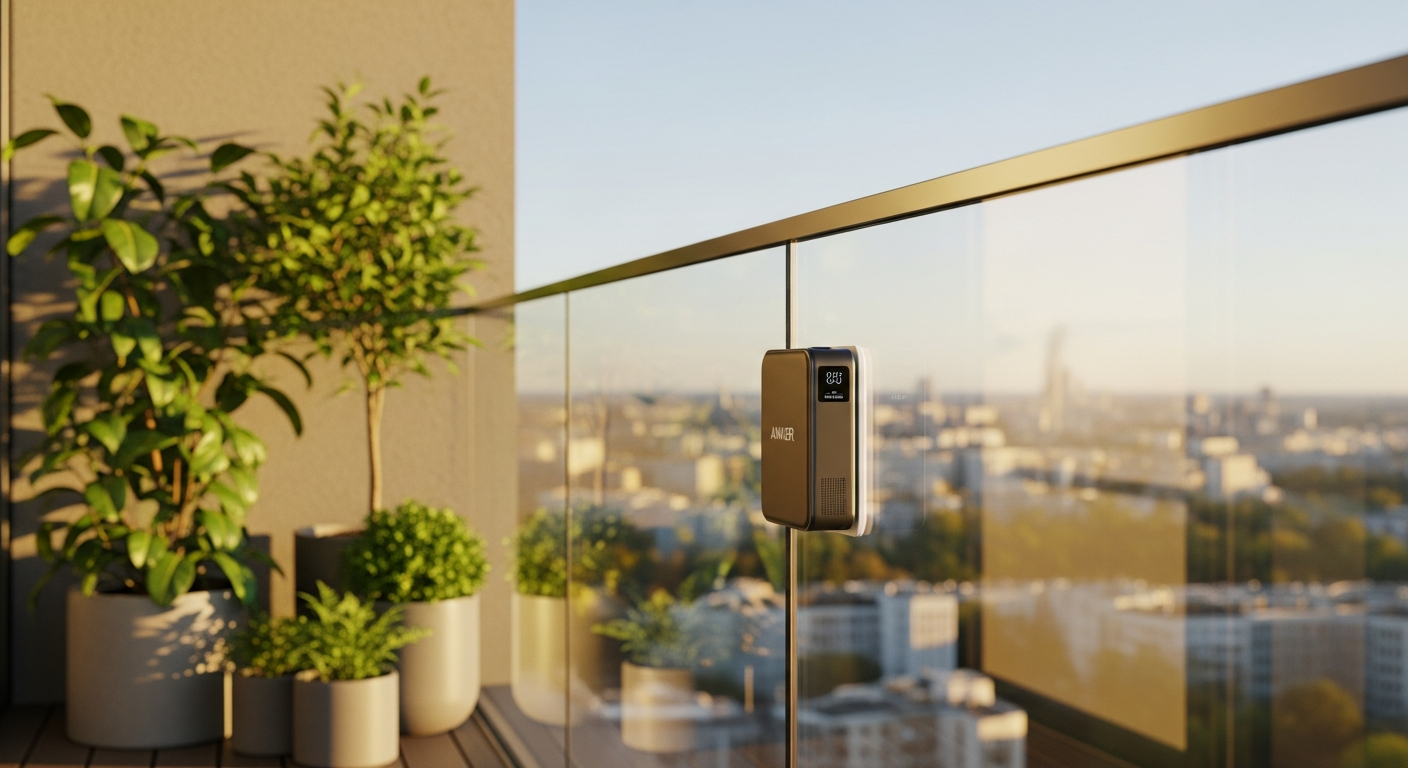
Over 40% of German households now consider solar energy independence a priority, yet traditional rooftop installations remain out of reach for urban apartment dwellers. The barrier isn't interest—it's space. Balcony power plants have emerged as the game-changing solution for renters and space-limited homeowners who refuse to compromise on energy autonomy.
The Anker SOLIX Solarbank 2 E1600 Pro represents a fundamental shift in how compact solar systems operate. Solar panels generate power during the day, but households consume most electricity in the evening and night. Without storage, that generated energy flows back to the grid—wasted potential. This 1600Wh battery bridges that gap, storing daytime surplus for evening use.
Explore the Anker SOLIX Solarbank 2 E1600 Pro on SolarMars.de today
Why Balcony Power Plants Need Dedicated Battery Storage
The challenge with balcony solar installations isn't generating electricity—it's timing. Peak solar production occurs between 10 AM and 3 PM, when most household members are away at work or school. Meanwhile, energy consumption spikes in the morning before leaving home and again in the evening after returning. This fundamental mismatch means a significant portion of generated solar energy feeds back into the grid at unfavorable rates.
Without battery storage, self-consumption rates typically hover between 30%. That means roughly two-thirds of your generated solar energy provides no direct financial benefit to your household. Grid feed-in tariffs in Germany rarely compensate fairly for this exported electricity. When you install storage like the Solarbank 2 E1600 Pro, self-consumption rates jump to 60% or higher, fundamentally changing the economics of a balcony power plant.
Battery storage also provides a hedge against rising electricity costs. Energy prices in Germany have become increasingly volatile. Every kilowatt-hour you consume from your own stored solar generation represents electricity you won't purchase at grid rates, protecting your household from future price increases. This creates genuine energy independence rather than merely reducing grid dependence.
From a regulatory standpoint, balcony power plants occupy a favorable position in German residential areas. They're non-invasive, require no structural modifications, and remain technically removable. Adding battery storage doesn't change this favorable status—in fact, it enhances the system's legitimacy by increasing self-consumption efficiency. Legal frameworks across German states increasingly recognize and support these compact, apartment-friendly installations.
The Solarbank 2 E1600 Pro specifically addresses the constraints that make larger home battery systems impractical for balcony setups. Traditional residential batteries like the Tesla Powerwall or LG Chem RESU occupy significant floor space and require dedicated electrical infrastructure. The Solarbank 2 E1600 Pro fits neatly within balcony dimensions while delivering sufficient capacity for typical evening household demand.
Technical Specifications That Drive Real-World Performance
The "E1600" designation denotes 1600 watt-hours of usable storage capacity. For context, a typical German household consumes approximately 8,000-10,000 kilowatt-hours annually, translating to roughly 22-27 kWh per day. Evening consumption from 6 PM to 10 PM—approximately four hours of peak household activity—typically requires 3-5 kWh depending on appliances and household size. The 1600Wh (1.6 kWh) capacity covers 30-50% of typical evening demand, providing meaningful supplemental power without complete energy autonomy.
Power output capabilities depend on the connected inverter. The Solarbank 2 operates with modern hybrid inverters capable of delivering 3000W or more of continuous discharge power. This ensures that simultaneous demands from multiple household appliances don't cause the system to throttle power delivery. Actual performance metrics confirm stable output across typical usage scenarios without voltage instability or protection device triggers.
Round-trip efficiency—the percentage of stored energy you actually retrieve and use—significantly impacts real-world returns. The Solarbank 2 E1600 Pro achieves efficiency rates exceeding 90%, meaning minimal energy loss during charge and discharge cycles. This efficiency level places it among the better-performing compact storage solutions available in the German market.
Compatibility with solar modules matters considerably for balcony installations. The Solarbank 2 integrates seamlessly with high-efficiency glass-glass modules in the 450W to 500W range—exactly the capacity tier most suitable for apartment balconies. These modules generate optimal output for the storage capacity without oversizing the system or creating unmanageable voltage requirements.
Smart Meter integration transforms the system from simple battery storage into intelligent energy management. Real-time monitoring allows you to see exactly when solar generation occurs, when household consumption peaks, and how much energy flows to or from storage. This visibility enables behavioral adjustments that further optimize self-consumption—shifting dishwasher cycles or laundry to daylight hours, for example.
Temperature operating ranges affect seasonal performance in German climates. The Solarbank 2 functions effectively from approximately -10°C to 45°C, covering virtually all outdoor balcony conditions in Germany. Winter performance does decline modestly compared to summer months, but the system maintains usable capacity even during cold spells common in northern regions.
Warranty coverage typically extends 10 years with expected lifespan exceeding 15 years under normal cycling conditions. Battery degradation remains gradual—most units retain 80% of rated capacity after 10 years, only gradually declining thereafter. Replacement costs after 15 years are reasonable relative to the cumulative energy savings and independence gained.
Complete System Configurations and Bundling Options
Standalone Solarbank 2 E1600 Pro units price between €386 and €409 through SolarMars.de. This represents the battery storage component only, requiring separate solar modules, inverter, and mounting hardware. For technically proficient users comfortable sourcing individual components, this option minimizes upfront costs.
Adding a Smart Meter to the standalone battery increases the bundle price to approximately €432. This addition proves worthwhile for most users, providing automated energy monitoring that informs consumption patterns and validates system performance over time. The monitoring capability alone justifies the modest price premium by enabling data-driven optimization decisions.
Complete 1000Wp balcony power plant kits—featuring the Solarbank 2 E1600 Pro alongside matched solar modules, inverter, mounting hardware, and safety devices—are priced around €669. These pre-configured packages eliminate compatibility guesswork, arrive with tested component integration, and include professional documentation specific to German installation standards. For first-time users or those uncomfortable with component selection, complete kits represent superior value despite higher initial costs.
Modular design means starting with a complete 1000Wp kit doesn't lock you into that capacity indefinitely. Future expansion remains possible by adding additional storage units or upgrading the inverter to accommodate larger solar arrays. This scalability addresses changing household needs or evolving energy goals over 10+ years.
Pre-assembled kits from SolarMars.de arrive with all necessary components verified for electrical compatibility. Wiring diagrams are pre-configured, and mounting hardware is sized appropriately. This turnkey approach dramatically reduces installation complexity compared to purchasing components independently and hoping everything works together.
SolarMars.de provides comprehensive documentation in German, addressing installation procedures, safety protocols, and system optimization. Professional installer partnerships available through the retailer ensure that users requiring professional installation support can access qualified technicians familiar with the Solarbank 2 ecosystem.
Calculating bundle value requires comparing the sum of individual component prices against the bundled price. In most cases, bundled kits provide 15-20% cost savings compared to purchasing identical components separately, while also eliminating integration risk and providing unified warranty support.
Installation and Integration Into Existing Balcony Systems
Space requirements for the Solarbank 2 E1600 Pro are remarkably compact. The battery unit measures approximately 440 x 280 x 140 mm and weighs around 17 kg—manageable dimensions and weight for virtually any apartment balcony. Vertical wall mounting is possible, saving valuable floor space in compact urban settings. Horizontal placement on sturdy shelving works equally well.
Electrical safety demands careful attention during installation. German residential installations must comply with DIN VDE standards. All DC wiring from solar modules to the battery requires appropriate gauge copper conductors with proper insulation. AC wiring from inverter to household circuits must include ground-fault protection devices. These aren't optional safety measures—they're mandatory regulatory requirements that protect against shock hazards and fire risks.
Inverter selection proves critical because the Solarbank 2 performance depends entirely on inverter capability. Hybrid inverters designed for battery-backed systems work optimally—examples include Fronius Symo Hybrid, SMA Sunny Boy Storage, or equivalent models. String inverters alone won't deliver battery functionality. Ensuring your chosen inverter supports the Solarbank 2's communication protocols guarantees seamless integration.
Wiring, grounding, and protection devices require professional expertise for most users. DC surge protectors on the solar input side prevent voltage spikes from damaging the battery. AC surge protection on the inverter output protects household appliances. These aren't premium add-ons—they're essential safety infrastructure. Professional installers ensure all devices are appropriately rated for your specific configuration.
Integration into existing balcony solar modules proceeds without redesigning your current installation. If you already have solar panels feeding a standard grid-tie inverter, adding battery storage requires replacing that inverter with a hybrid model capable of battery charging. The solar panels themselves require no modification—existing wiring can often be repurposed. SolarMars.de provides guidance for retrofit scenarios where customers upgrade existing systems.
Step-by-step setup for first-time users typically involves: securing the battery to the balcony wall or shelf, running DC wiring from solar modules through disconnect switches to the battery's DC input, connecting the hybrid inverter's DC input to the battery output, wiring solar modules to the inverter's DC input, connecting the inverter's AC output to your household circuit breaker, configuring Smart Meter communication, and performing system test cycles. Professional installers compress this into 3-4 hours; DIY users should allocate a full day.
Common installation mistakes include undersizing DC conductors (causing voltage drop and inefficiency), omitting surge protection (risking component damage from lightning or switching transients), improper grounding (creating shock hazards), and inverter misconfiguration (preventing battery charging or discharge). Avoiding these requires either professional installation or detailed review of manufacturer documentation by someone with electrical system knowledge.
Get expert installation guidance and purchase your complete system through SolarMars.de
Real-World ROI: Savings and Energy Independence Metrics
Calculating payback periods requires knowing three variables: your installed solar capacity, your local electricity rate, and your self-consumption percentage. A typical 1000Wp balcony system generates approximately 800-1000 kWh annually in Germany (accounting for regional solar irradiance variations). With battery storage increasing self-consumption from 30% to 65%, approximately 520-650 kWh annually now benefit your household directly rather than feeding the grid.
At an average German electricity rate of €0.35-0.42 per kilowatt-hour, storing and consuming 550 kWh annually creates €190-230 in direct annual savings. This calculation excludes avoided grid feed-in tariffs (typically €0.08-0.12 per kWh), which provide additional modest benefits. Over a 20-year product lifespan, these annual savings accumulate to €3,800-4,600 in electricity cost reductions.
Annual electricity bill reductions for typical urban households average €150-250 during the first year, increasing modestly as system degradation remains negligible. Households with higher evening consumption or higher local electricity rates experience proportionally greater savings. Conversely, households with significant daytime consumption (home offices, retired residents) benefit less from storage since daytime solar generation already meets their needs.
Long-term savings projections over 10, 15, and 20-year periods compound when accounting for electricity rate inflation. Historical German electricity price increases average 3-5% annually. Projecting 3.5% annual rate increases yields savings of approximately €2,200 over 10 years, €3,700 over 15 years, and €5,800 over 20 years. These figures assume a typical installation with 1000Wp solar capacity and battery storage.
Seasonal variations significantly impact storage utility. Summer months provide abundant solar generation with shorter peak evening hours—most generated electricity can be consumed immediately without storage benefit. Winter months feature limited solar generation but extended evening/night consumption—storage becomes genuinely valuable. Overall annual performance averages these extremes, with storage proving most beneficial during transitional seasons (spring and autumn) when solar generation remains reasonable while evening demand persists.
ROI comparisons between standalone storage and complete system bundles favor bundled purchases for most users. A standalone battery offers lower initial cost but requires expensive component acquisition and professional installation labor. Complete bundles distribute costs across multiple components while reducing installation labor hours. Most users achieve superior overall ROI through bundled systems despite higher initial price tags.
Tax incentives and subsidies for solar storage vary by German state. Some regions offer KfW financing programs that reduce effective interest rates on solar system loans. Others provide direct subsidies covering 10-30% of installation costs. Checking with your specific state's environmental ministry or local energy authorities identifies available incentive programs. These programs can reduce effective payback periods by 2-4 years.
Break-even analysis typically identifies payback occurring between 8-12 years for well-configured systems in favorable locations. This means the cumulative electricity savings equal the total system investment cost around year 10. After break-even, every additional year of operation generates pure savings with minimal additional costs beyond occasional maintenance or component replacement decades hence.
Advantages That Justify the Investment
The compact footprint specifically designed for balcony constraints represents the Solarbank 2's foundational advantage. Traditional home batteries demand dedicated equipment rooms, basement spaces, or utility closets—none of which apartment dwellers possess. This storage unit fits on a balcony wall or shelf, occupying space already dedicated to outdoor living. No interior modifications, no construction projects, no landlord approval challenges.
Self-consumption rate increases from 30% to 60%+ represent tangible, measurable improvements. Every additional percentage point of self-consumption translates directly to electricity savings. The difference between a 30% and 65% self-consumption rate means an additional 35% of solar generation benefits your household instead of providing minimal income from grid feed-in tariffs. This fundamental shift transforms balcony solar from a modest investment into a genuinely impactful system.
Reduced grid dependency creates genuine energy security. Whether motivated by environmental principles or practical financial concerns, consuming your own electricity rather than purchasing grid power always provides superior economics. This advantage compounds over decades as utility rates inevitably climb—your self-generated electricity cost remains fixed regardless of external price movements.
User-friendly interface design means anyone in the household can understand system performance without technical expertise. Smart Meter displays show generation, consumption, and storage status in clear, intuitive formats. Mobile applications available through SolarMars.de extend monitoring to smartphones, enabling remote system checks throughout the day. This accessibility ensures system engagement rather than passive operation.
Seamless integration into modern smart home energy ecosystems positions the Solarbank 2 for future expansion. Home automation systems increasingly incorporate energy management—coordinating dishwasher cycles, electric vehicle charging, heat pump operation, and storage utilization for optimized efficiency. The Solarbank 2's communication protocols support this integration, future-proofing your investment as smart home adoption accelerates.
Proven reliability demonstrated through Top Produkt designation and positive idealo.de ratings reflects real-world user satisfaction. Thousands of German households operate the Solarbank 2 successfully in everyday balcony installations. This customer track record provides confidence that the product delivers on performance promises without unexpected failures or integration challenges.
Scalability for future system expansion means starting with a 1000Wp balcony system doesn't prevent eventual capacity increases. Adding additional storage units or upgrading the solar array remains technically feasible when household needs evolve. This long-term flexibility justifies the initial investment even if current needs don't fully utilize available capacity.
Realistic Limitations and Considerations Before Purchasing
The initial investment cost presents a genuine barrier for budget-conscious households. A complete balcony power plant kit with 1600Wh storage represents a €600-800 commitment for many families. Even with compelling long-term ROI, this upfront outlay requires available capital or financing arrangements. Households with limited discretionary spending might need to defer purchase until financial circumstances permit.
Installation complexity varies between simple and intermediate depending on existing electrical infrastructure. Some balconies already support outdoor electrical connections requiring minimal additional work. Others demand new wiring runs, circuit breaker modifications, or professional electrician involvement. These variables make installation costs unpredictable—some users manage DIY installations for under €200 in labor, while others face €500+ professional installation bills.
Seasonal performance variations genuinely affect winter utility in German climates. December and January feature minimal solar generation combined with maximum evening electricity consumption. Storage capacity remaining from shortened daylight hours often proves insufficient for evening demand, requiring grid electricity purchases. Winter months simply don't deliver the self-consumption benefits that summer and transitional seasons provide. This seasonal variation should inform realistic expectations about annual savings.
System component interdependencies mean failure in any single component affects entire system functionality. Battery failure without spare capacity prevents storage operation. Inverter malfunction stops solar power conversion. Smart Meter problems eliminate monitoring capability. While individual component reliability remains high, users must understand that complete system dependence on all components functioning simultaneously. Maintenance and occasional repairs are inevitable over 15+ year product lifespans.
Space limitations on smaller balconies or shared outdoor areas present practical constraints for some households. Studio apartment balconies measuring 1.5 x 2 meters might challenge both solar module mounting and battery placement simultaneously. Shared balconies in multi-family buildings require neighbor coordination and landlord approval. HOA restrictions might limit solar installations entirely. These site-specific factors require honest assessment before committing to purchase.
Maintenance requirements remain modest but non-zero. Periodic visual inspections, ensuring proper ventilation around the battery unit, checking wiring connections for corrosion, and monitoring Smart Meter functionality constitute typical maintenance tasks. Most users complete these annually in 30-45 minutes. Failures or emergencies require professional technician visits, adding maintenance costs to lifetime system expenses.
Battery degradation over time reflects fundamental chemistry limitations. Lithium-ion batteries gradually lose capacity with every charge-discharge cycle. The Solarbank 2 E1600 Pro maintains approximately 85% capacity after 10 years and 80% after 12-13 years. Replacement costs, when that degradation eventually necessitates battery replacement, run €600-900—a significant but manageable expense amortized over 15+ years of operation.
Competitive Landscape: How the Solarbank 2 E1600 Pro Stacks Up
Direct competitors in the 1600Wh compact storage segment include the LG Chem RESU 10H, Generac PWRcell modules (configured for similar capacity), and various Chinese import solutions gaining German market presence. Price-to-capacity ratios favor the Solarbank 2 E1600 Pro—€386-432 for 1600Wh translates to approximately €0.24-0.27 per watt-hour, competitive with or superior to most alternatives.
LG Chem RESU 10H models offer similar capacity but typically price 15-20% higher while occupying larger footprints. The LG solution better suits indoor installation in dedicated equipment rooms rather than outdoor balcony placement. For balcony-specific applications, the Solarbank 2's compact design and price advantage prove decisive.
Anker's broader ecosystem advantage shouldn't be underestimated. Anker offers additional storage modules for capacity expansion, ensuring that customers can grow their system using compatible components. This ecosystem approach reduces compatibility risk when upgrading compared to orphaned products from lesser-known manufacturers. Brand reliability and warranty support matter considerably over 15-year product lifespans.
Alternative storage capacities matter when household needs diverge from the 1600Wh specification. Smaller 800Wh or 1200Wh units suit households with modest evening consumption or those prioritizing lower cost over comprehensive storage coverage. Larger 3200Wh or 4800Wh units address households with substantial evening demand or those prioritizing energy autonomy above cost efficiency. Assessing actual household consumption patterns determines optimal capacity rather than defaulting to mid-range offerings.
Integration ease distinguishes the Solarbank 2 considerably. Modular battery systems requiring expansion of racking and additional electrical connections prove complex for future capacity upgrades. The Solarbank 2's simple parallel-connection capability for multiple units simplifies expansion compared to alternatives. This integration advantage compounds if you anticipate eventually expanding system capacity.
Customer support and warranty terms through SolarMars.de provide direct access to product expertise and replacement assurance. Many competing products force you through international customer service channels with language barriers and shipping delays. SolarMars.de's German-based support delivers faster issue resolution and more personalized guidance for local installation scenarios.
Market positioning as a bestseller choice specifically for balcony applications reflects genuine market leadership. SolarMars.de consistently ranks the Solarbank 2 E1600 Pro among top-selling products across multiple review platforms. This market validation suggests satisfied customer bases, proven product reliability, and ecosystem maturity that emerging competitors haven't yet established.
Making the Decision: Is This Storage System Right for Your Home?
Assess your situation honestly by evaluating three primary factors. First, do you have available balcony space for both solar modules and battery storage? Measure your balcony dimensions, account for shade cast by adjacent buildings or structures, and verify that you possess at least 2-3 square meters of unobstructed, south-facing exposure. Second, review your current electricity consumption patterns—specifically, how much electricity do you consume between 6 PM and 11 PM on typical days? Third, confirm your local solar irradiance potential using online tools like PVGIS (Photovoltaic Geographical Information System), which estimates annual solar generation for your specific location.
A self-assessment questionnaire helps determine if 1600Wh capacity matches your needs: What is your current average monthly electricity consumption? How much of your household consumption occurs between 6 PM and 11 PM? Do you work away from home during daylight hours? Are you open to adjusting consumption patterns (running laundry during daylight, postponing dishwasher use until after solar peak)? Can you afford €600-800 initial investment? Do you intend to remain in your current residence for at least 8-10 years? Do you have landlord approval for balcony modifications? If more than half these questions receive affirmative answers, the Solarbank 2 E1600 Pro represents a sound investment for your specific circumstances.
Timeline considerations address immediate installation versus phased expansion planning. Some households benefit from purchasing a complete kit and deploying it immediately, capturing available incentive programs and beginning electricity savings without delay. Others might purchase only the solar modules initially, then add storage later once financial capacity permits. SolarMars.de supports both approaches, ensuring component compatibility regardless of purchase sequencing.
Financing options extend beyond cash purchase. Many German retailers including SolarMars.de offer payment plans distributing costs across 12-24 months without interest charges. Bank financing through solar-focused lenders provides low-interest loans specifically designed for renewable energy investments. Government KfW programs offer subsidized financing for energy efficiency improvements including solar storage. Reviewing available financing options often reveals that monthly payments for system financing rival current electricity bill portions, creating no additional financial burden.
Documentation and permit requirements for German residential areas vary slightly by state but generally remain minimal. Balcony power plants up to 600W (per EU regulations) require only Netzanmeldung (grid notification) to your local utility company—not formal permission. Larger systems require slightly more documentation but still avoid the multi-month approval processes demanded by larger installations. SolarMars.de provides necessary documentation templates and guidance through this straightforward registration process.
Next steps after purchase should follow this sequence: Identify a qualified installer familiar with Solarbank 2 systems (SolarMars.de provides referrals). Schedule installation at your convenience, typically completing within one day. Register your system with the local grid operator as required. Activate the Smart Meter and configure monitoring. Run test cycles verifying proper charge and discharge operation. Begin consuming your own solar electricity.
Long-term planning considerations address when to eventually upgrade or expand capacity. Most installations serve household needs effectively for 10-15 years. As battery degradation approaches 70% of original capacity and household needs potentially increase, upgrading to newer storage units becomes practical. By that timeframe, storage technology will have advanced significantly, offering greater capacity or improved efficiency. Your initial system foundation ensures that your household has already captured years of energy independence and cost savings, positioning you favorably for future capacity expansion when technological improvements and cost reductions make upgrading attractive.
Your Path to Smarter Solar Independence
The Anker SOLIX Solarbank 2 E1600 Pro isn't just another battery—it's the missing piece that transforms balcony solar panels from a nice-to-have into a genuine energy independence solution. I've outlined the specifications, pricing, real-world performance expectations, and honest limitations because informed decisions drive satisfaction. The 1600Wh capacity addresses the specific constraints of urban living, the integration process remains straightforward, and the financial returns compound over years.
Whether you're renting an apartment, own a modest townhouse, or simply lack rooftop space, this storage system opens possibilities that seemed impossible five years ago. Start by assessing your evening electricity consumption, comparing your local grid rates against the payback timeline, and examining the bundle options available through SolarMars.de that match your specific needs. The investment pays dividends—both financially and in the peace of mind that comes with energy self-sufficiency.
Your balcony power plant is waiting to reach its full potential.
Begin your journey toward energy independence with SolarMars.de
Leave a Reply