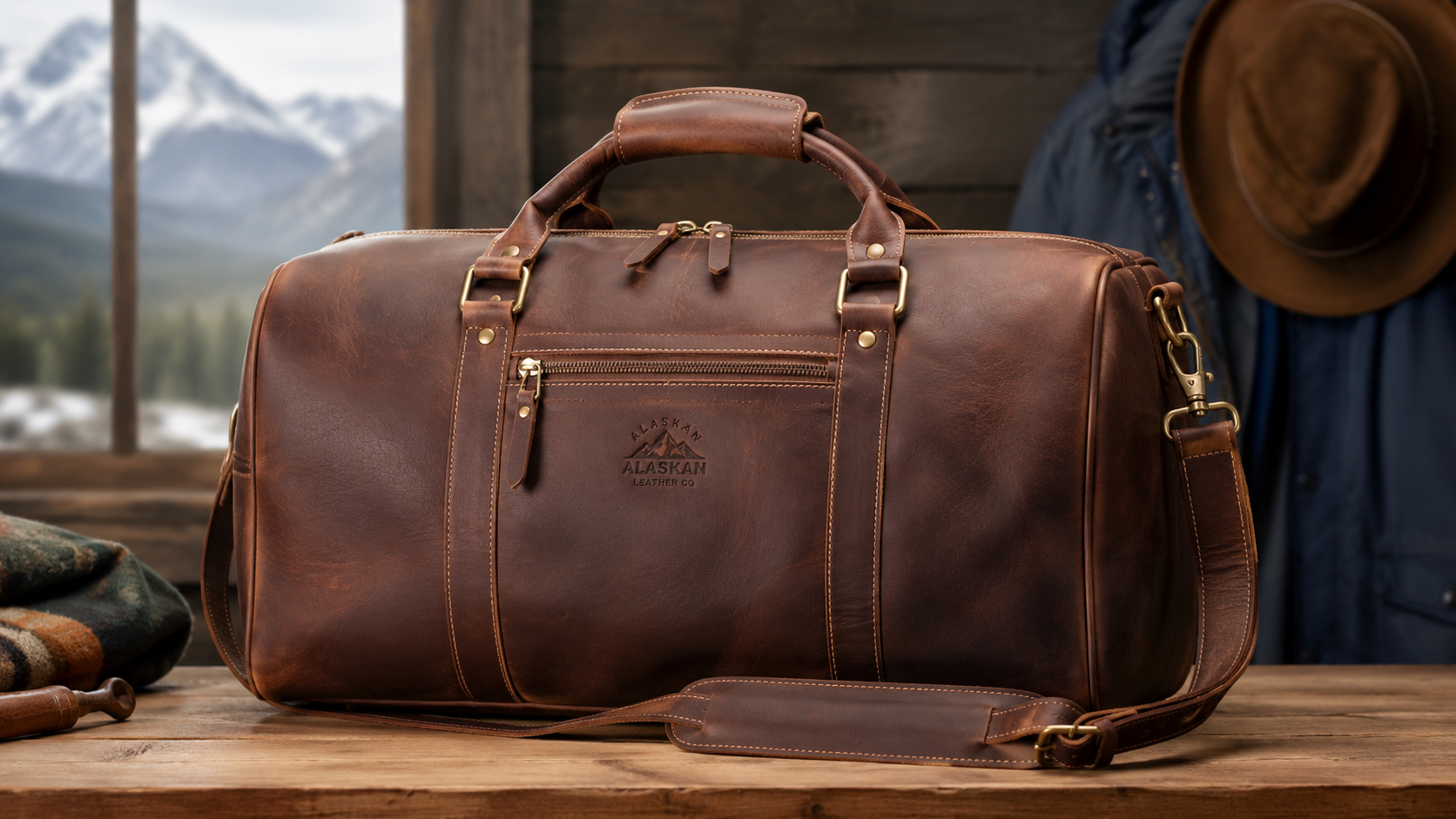
Most travelers waste hundreds of dollars on luggage that falls apart after a few trips, yet the Kingston Leather Travel Duffle Bag has earned its cult status by doing the opposite—it actually improves with age. Worn leather develops character where synthetic materials just show damage. The bag becomes more beautiful, more personal, and more dependable with each journey.
The Alaskan Leather Company created the Kingston Duffle Bag in response to a genuine problem: travelers wanted something that looked sophisticated enough for business trips, felt durable enough for adventure, and wouldn't require replacing every couple of years. The market was full of compromises—stylish bags that couldn't survive rough handling, or rugged bags that looked out of place in a conference room. The Kingston bridges that gap with intentional design choices.
Full-Grain Leather Construction: Why Material Quality Matters for Travel Bags
Premium full-grain leather sourcing and why it outperforms split or bonded leather alternatives
The Kingston uses solid full-grain leather, typically in a gorgeous tan brown, rather than the split or bonded alternatives that dominate budget luggage. Full-grain leather preserves the entire hide, including the natural grain and surface, which is why it develops such distinctive character over time. Split leather removes the top grain and uses only the underlying material—it's thinner, less durable, and doesn't age beautifully. Bonded leather particles are held together with adhesives, creating a material that flakes and deteriorates rather than strengthening.
Full-grain leather means you're getting the premium part of the hide, and that choice directly impacts how the bag performs across months and years of travel.
The tanning and treatment process that creates durability without synthetic coatings
The Kingston's leather undergoes tanning and treatment specifically designed to create a bag that lasts without relying on plastic coatings or synthetic finishes. This approach preserves the natural properties of the leather rather than masking them. The leather breathes, flexes naturally, and bonds with its environment instead of resisting it. When you touch a genuine full-grain leather bag, you're feeling authentic material that responds to handling and environmental conditions—not a plastic surface designed to remain unchanged.
This treatment philosophy means the bag won't peel, crack, or delaminate the way coated or synthetic materials eventually do. The durability comes from the material itself, not from a protective layer waiting to fail.
Patina development: how the bag's appearance evolves and improves over months and years
The Kingston develops a rich patina as months and years of travel unfold—a natural darkening and character development that makes each bag unique. New leather is lighter and more uniform in appearance. As the bag travels, the leather absorbs oils from handling, experiences varying light exposure, and adjusts to the shapes it contains. These interactions create subtle variations in color and texture that tell the story of the bag's journeys.
This patina transformation fascinates owners because it's not just aging—it's improvement. A two-year-old Kingston looks better than it did new, with a deeper color, richer tone, and visible character in the creases and worn areas. The bag becomes increasingly distinctive, developing a personality that no two bags share identically.
Storage Architecture: Unpacking the Kingston's Thoughtful Compartment System
Main zippered compartment capacity and ideal packing scenarios for weekend trips
The Kingston's main zippered compartment offers ample storage for travel essentials, with dimensions around 48.2 cm in length, 42.1 cm in height, and 24.1 cm in diameter. This size is elongated rather than boxy, striking a balance between capacity and handleability. Weekend trips fit comfortably—think two to four days of clothing plus toiletries and a change of shoes. The compartment zips securely, containing items without spillage during transit through airports or onto vehicle seats.
The elongated shape receives consistent praise from reviewers for its charm and ease of use. Rather than the warehouse-sized duffels that dominate luggage aisles, the Kingston maintains proportions that feel sophisticated and controlled.
Inner zipper pocket placement and security features for valuables, documents, and electronics
Inside the soft internal lining, an inner zipper pocket provides designated security for items you want isolated from the main compartment. Passports, credit cards, phone chargers, or other electronics fit here safely, separated from clothing and larger items. This placement prevents valuable items from getting lost among travel gear or damaged by pressure from heavier contents.
The soft internal lining protects these items further, and the inner pocket's strategic placement ensures you can access it without completely unpacking the bag.
Press-button side pockets: quick-access functionality for boarding passes and travel essentials
Two press-button open pockets on either side provide quick access to frequently needed items—boarding passes, travel documents, snacks, or a book for the flight. These don't require opening the main compartment, making them invaluable at security checkpoints or when you need something while standing in an airport corridor. The press-button closure is tactile and reliable, staying secure without slowing access.
Carrying Comfort and Versatility: From Airport to Boardroom
Removable leather shoulder strap: adjustability options and comfort for extended wear
The Kingston includes a removable leather shoulder strap, offering versatile carrying options that adapt to different situations and preferences. You can carry it as a traditional duffle using the handles, shift to the shoulder strap for hands-free transport through airports, or remove the strap entirely for storage. The leather strap material matches the bag itself, maintaining aesthetic coherence while providing comfort for extended wear across your shoulder.
This versatility matters because travel situations change constantly—sometimes you need both hands free for navigating crowds, sometimes you prefer using the handles while seated, and sometimes you're simply moving the bag short distances and want the option removed entirely.
Dual carry handles: grip design and reinforced stitching at attachment points
The dual carry handles feature grip design and reinforced stitching at attachment points where stress concentrates during use. This reinforcement prevents the bag from coming apart at the seams—a common failure point on luggage that gets dropped, yanked, and thrown into overhead bins. Reviewers consistently highlight the sturdy construction at these critical stress points, where cheaper bags typically show first signs of failure.
The handles themselves provide comfortable grip without digging into hands during extended carrying, and the reinforcement means they'll support the bag's weight reliably for years.
Versatility across casual, business, and formal settings
The Kingston complements casual outfits for weekend getaways, business attire for corporate travel, and even formal settings where luggage aesthetic matters. The classic tan brown leather with gold brass hardware creates a timeless look that adapts to different contexts. A leather duffle works for adventure travel in a way that matches your outdoor aesthetic, but it also sits convincingly beside you in a boardroom or luxury hotel lobby.
This versatility means you're not buying separate bags for different travel types—the Kingston performs across all scenarios.
Craftsmanship and Durability: What $200 Actually Buys You
Sturdy zipper construction: quality hardware that withstands repeated opening and closing
The Kingston features gold brass hardware and sturdy zippers engineered to withstand repeated opening and closing across hundreds of trips. Cheap bags fail at zippers—the slider gets stuck, the teeth separate, or the pull breaks off entirely. The Kingston's hardware resists these common failures through quality construction and proper stress distribution at connection points. The brass hardware not only looks beautiful but also ages gracefully, developing a warm patina that complements the leather's darkening.
When you open and close the Kingston's main compartment or access inner pockets, you feel the difference immediately—smooth, confident operation that won't leave you struggling with jammed zippers before the bag reaches two years old.
Reinforced stitching techniques at stress points and seams
Reinforced stitching at stress points and seams creates structural integrity that prevents the bag from separating at weak points. The attachment points for handles, the base seams where weight concentrates, and the pocket stitching all receive reinforcement that distributes stress evenly rather than allowing failure at individual threads. This technique means the bag maintains its shape and function even as it carries heavy loads repeatedly.
Reviewers consistently mention the flawless appearance and construction quality, noting that stitching shows no signs of fraying, separation, or weakness even on well-used bags.
Real-world durability reports from multi-year users
Real-world reports from multi-year users document the Kingston's reliability across extended use patterns. Travelers report their bags functioning perfectly after multiple years of regular use, with no zipper failures, no handle separation, and no structural compromise. The leather shows patina development and wear appropriate to age, but the bag's integrity remains intact. Some users report ownership spanning five, seven, or more years—timeframes that put most luggage in the landfill.
These multi-year reports matter because they prove durability isn't marketing language but measurable reality. People invest in the Kingston and reliably report satisfaction years later.
The Value Proposition: Is $200 Worth the Investment?
Cost-per-use analysis: amortizing the investment across years of travel
The Kingston's $200 price point seems substantial until you calculate cost-per-use across years of ownership. A traveler who takes quarterly trips (12 trips yearly) across five years uses the bag 60 times, bringing cost-per-use to approximately $3.33. That same traveler using synthetic luggage requiring replacement every 2-3 years pays multiple times across the same period—$150 for an initial bag, then $150 again after wear and failure, possibly twice more depending on replacement cycles. The synthetic luggage approach costs $300-450 over the same five-year period while the Kingston costs $200.
This analysis shifts the perspective from initial purchase cost to actual investment value.
Comparison to synthetic bags requiring replacement every 2-3 years
Synthetic bags in the $100-150 range typically require replacement every 2-3 years as zippers fail, handles separate, or materials crack and degrade. You're not replacing one synthetic bag with another identical bag—you're buying progressively different models as companies discontinue old designs, meaning you rarely find the same bag twice. Each replacement means learning new compartment systems and losing familiarity with your luggage.
The Kingston remains available consistently, meaning your next purchase (if ever needed) will likely be the same bag—no learning curve, no redesign adjustments, just the continuation of what you already know works.
Longevity ROI: how the Kingston pays for itself through durability
The longevity ROI considers not just cost-per-use but the accumulated expense of replacements, repair costs on synthetic bags (which are typically uneconomical to repair), and the value of reliability. Synthetic luggage failures often occur at inconvenient moments—mid-trip with no replacement available, requiring expensive emergency solutions or compromised travel. The Kingston's reliability means you travel with confidence, knowing the bag will perform when you need it most.
Over a decade of travel, the Kingston's ROI becomes obvious: one $200 investment versus multiple synthetic replacements, repair costs, and the stress of unreliable equipment.
Aging Beautifully: The Patina Story That Sets Leather Apart
Patina formation process: natural darkening and character development over time
The patina formation process begins immediately upon use—the leather starts absorbing oils from handling, responding to humidity and temperature variations, and developing subtle color variations where it experiences different levels of light and contact. Creases where the bag folds deepen in color. Handles where hands grip repeatedly develop rich, dark tones. Areas protected from light remain lighter, creating natural contrast patterns that develop uniquely on each bag.
This isn't decay or damage—it's the leather becoming more itself, developing the characteristics that make genuine leather desirable. Synthetic materials can't replicate this process because they're engineered to resist change rather than embrace it.
Visual transformation from new bag to well-traveled companion
A new Kingston appears pristine and uniform in color, with a lighter tan brown and minimal surface character. The brass hardware gleams with newness. By six months of regular travel, subtle darkening appears at stress points and heavily handled areas. By one year, the bag shows clear character development, with a deeper base color and distinct wear patterns that reflect its use. By two years, the transformation becomes striking—a bag that visibly tells the story of its travels through color variation, creasing patterns, and developed patina.
This visual transformation fascinates owners because the bag becomes increasingly beautiful rather than showing its age as deterioration. You're watching genuine material develop character, not watching synthetic coating fail.
Why patina is a feature, not a flaw, in genuine leather goods
Patina represents the difference between genuine leather goods and synthetic alternatives. Synthetic materials are designed to resist change—to remain uniform and unchanged indefinitely or until they fail completely. Genuine leather embraces change, developing character through interaction with its environment and user. This philosophy celebrates the material's authenticity rather than fighting against it.
Collectors and long-term users of leather goods explicitly seek patina development because it proves authenticity and creates sentimental connection. A ten-year-old leather bag tells your travel story visibly; a ten-year-old synthetic bag just looks old.
Your Next Travel Upgrade Awaits
The Kingston Leather Travel Duffle Bag represents something increasingly rare in modern consumer goods: a product that genuinely improves with time instead of deteriorating. The full-grain leather develops character, the brass hardware ages gracefully, and the organizational system adapts to whatever travel scenario you encounter. Whether you're a weekend warrior juggling short getaways, a business traveler navigating multiple cities weekly, or someone who simply refuses to compromise on quality, the Kingston delivers reliably across all these scenarios.
The decision point arrives when you recognize that buying cheap luggage repeatedly costs more than investing in something built to last. The Kingston has earned its cult status not through marketing but through consistent, measurable performance across thousands of users and multiple years of documented reliability. Your luggage either becomes your constant travel companion or becomes the thing you're constantly replacing—the Kingston shifts that equation entirely.
Make the Kingston Leather Travel Duffle Bag your most reliable travel investment today.
Leave a Reply