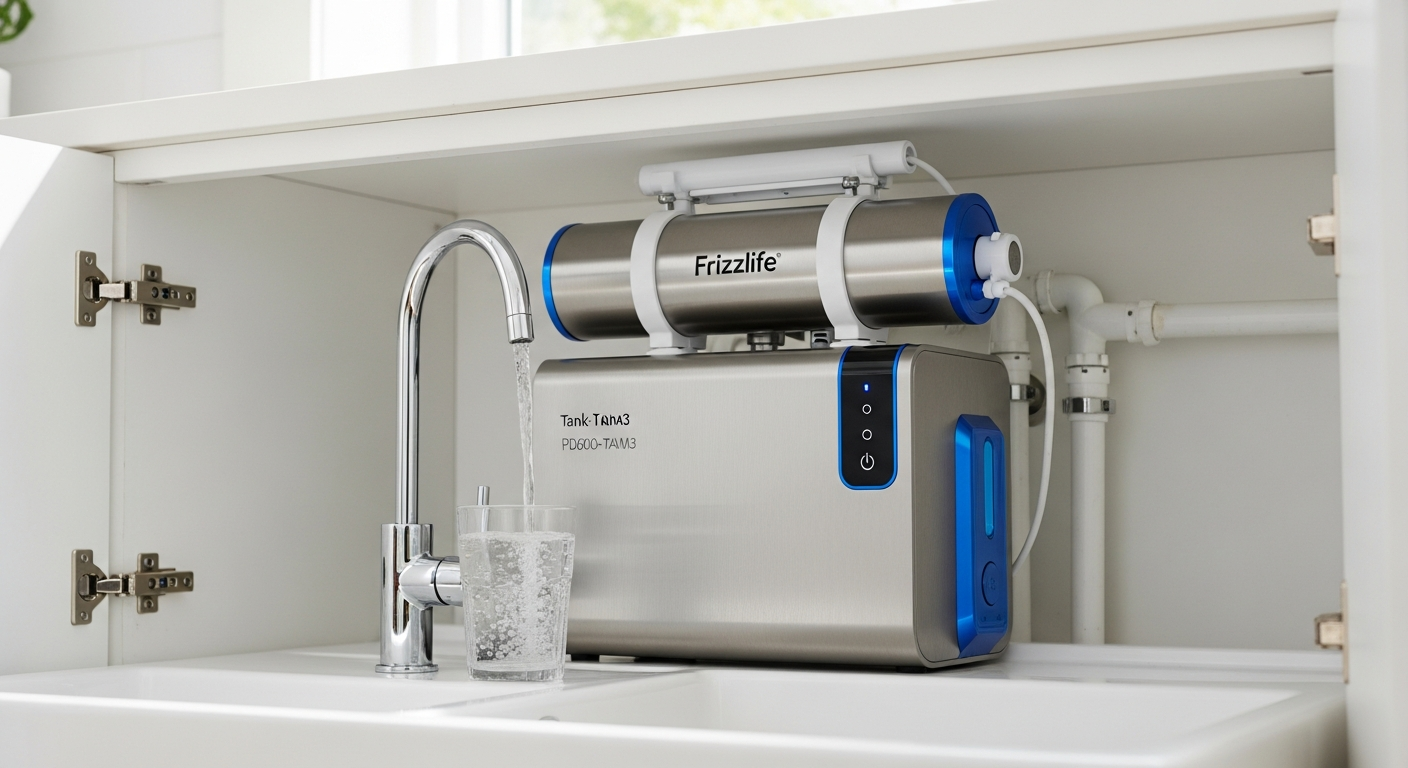
Frizzlife PD600-TAM3 Tankless RO System Review
If you’ve ever looked under your kitchen sink and wondered where a water filtration system would actually fit, you’re not alone. Traditional reverse osmosis systems demand significant real estate—cabinets designed for cleaning supplies suddenly become home to massive storage tanks that crowd out everything else. For renters, apartment dwellers, and anyone working with limited kitchen storage, this reality forces an uncomfortable compromise between water quality and functional cabinetry.
The Frizzlife PD600-TAM3 enters this conversation with a straightforward promise: deliver premium water purification without consuming your entire under-sink footprint. This tankless system combines a 7-stage deep filtration process, a respectable 600 GPD flow rate, and alkaline remineralization capabilities—all in a compact design that actually fits in constrained spaces. The question becomes whether this compact approach genuinely maintains the filtration excellence expected at the $376–$469 price point.
Explore the Frizzlife PD600-TAM3 now to see current pricing and available promotions.
How the 7-Stage Filtration System Actually Works
The PD600-TAM3’s effectiveness hinges on its multi-stage approach, each layer addressing specific contaminant categories rather than attempting one-size-fits-all purification.
Sediment Pre-Filtration
The journey starts with a pleated sediment filter that captures visible particles, sand, and suspended solids before water reaches more sophisticated filtration stages. This initial barrier protects downstream components from premature clogging and extends the lifespan of the reverse osmosis membrane.
Reverse Osmosis Membrane Technology
At the system’s core sits the RO membrane, responsible for eliminating up to 99% of total dissolved solids (TDS). This membrane blocks heavy metals, fluoride, and dissolved contaminants while allowing only pure water molecules through. The membrane’s semi-permeable nature makes it the most critical component for removing dissolved substances that basic filters cannot catch.
Dual Carbon Filtration Stages
ACF1 and ACF2 media work in tandem to target chlorine, pesticides, volatile organic compounds (VOCs), and odor-causing compounds. These activated carbon layers address chemical residues that escaped earlier stages while beginning the taste-improvement process that consumers consistently praise.
Carbon Block Filtration
An additional carbon block layer captures remaining chemical residues and further refines water taste. This redundancy ensures that volatile chemicals and off-flavors don’t make it to your glass, resulting in noticeably better-tasting water than single-stage carbon systems provide.
Alkaline Remineralization
Standard reverse osmosis strips water of minerals, leaving it flat and potentially demineralized. The PD600-TAM3’s remineralization stage reintroduces beneficial minerals—calcium, magnesium, potassium—that support hydration and electrolyte balance while improving taste and pH balance.
Weak Alkaline Filter
The final stage balances pH levels, creating mineral-rich drinking water that typically registers between 7.5 and 8.5 pH. This creates water that tastes noticeably better than acidic, demineralized RO water while maintaining the health benefits of mineral content.
NSF/ANSI Certification
The system meets rigorous performance standards: NSF/ANSI Standards 58 for reverse osmosis systems and NSF/ANSI Standards 372 for lead-free material compliance. These certifications provide independent verification that the system performs as claimed and meets safety requirements for residential water treatment.
Space-Saving Design vs. Traditional Tank Systems
The tankless architecture represents the PD600-TAM3’s most distinctive advantage. Conventional reverse osmosis systems require large storage tanks that sit beneath sinks, consuming 30-40% of available cabinet space and making installations problematic for anyone with tight kitchens.
The PD600-TAM3 eliminates this bulk entirely. Without a holding tank requiring pre-fill time, the system delivers water on demand at 600 gallons per day capacity—sufficient for typical households without requiring users to wait for a tank to replenish. This instantly-available water represents a quality-of-life improvement that tank-based systems simply cannot match.
Cabinet compatibility extends the system’s appeal significantly. Renters gain access to premium water filtration without permanent plumbing modifications. Apartment dwellers find a purification option that fits their constraints. Homeowners with modest under-sink space finally have a solution that doesn’t require architectural sacrifices.
Installation complexity decreases when fewer components need connection. The tankless design means simpler plumbing connections compared to systems requiring tank placement, inlet lines, outlet lines, and drain connections. Even DIY installers with basic plumbing knowledge report straightforward setup experiences.
The aesthetic advantage shouldn’t be overlooked. An under-sink cabinet with a compact filtration system looks cleaner and more professional than one dominated by a bulky storage tank. For kitchen renovations or simply maintaining visual appeal, the space savings matter beyond pure functionality.
Efficiency gains further distinguish this system. The 1.5:1 wastewater ratio means 1.5 gallons of pure water are produced for every 1 gallon of wastewater—substantially better than older tank-based systems that often waste significantly more water. Over time, this efficiency translates to lower water bills and reduced environmental impact.
Check current availability and delivery options for the PD600-TAM3 at this authorized retailer.
Flow Rate Performance and Water Pressure Reality
The 600 GPD capacity addresses a common frustration with older RO systems: waiting for water. At standard 60 psi municipal water pressure, the PD600-TAM3 delivers sufficient volume for typical household needs without noticeable delays. A family of 4-6 people can fill glasses, wash vegetables, and brew coffee without experiencing the tank-refill bottleneck that characterizes tank-based systems.
Pressure stability distinguishes the PD600-TAM3 from competitors. The system maintains consistent flow at standard 60 psi without dramatic pressure drops that plague some multi-stage systems. This stability means the alkaline remineralization stage doesn’t create the restrictive bottleneck issues seen in other advanced filtration systems.
Instant gratification becomes tangible. No waiting for a storage tank to replenish between uses. Water flows on demand, a seemingly minor advantage that noticeably improves daily user experience compared to tank systems where the final gallon trickles slowly as pressure drops.
Real-world usage scenarios highlight the system’s capability. Filling a pitcher while washing vegetables while someone pours a drinking glass—simultaneous demands that might strain tank systems don’t faze the PD600-TAM3’s direct-flow architecture. The system handles normal household usage patterns without compromise.
Pressure sensitivity remains a consideration. In municipal systems with low incoming water pressure (below 40 psi), performance may decline. Customers in areas with naturally lower water pressure should verify system suitability before purchasing. Most standard municipal systems provide adequate pressure, but older homes or rural properties sometimes operate at lower pressure thresholds.
The high-flow advantage extends to the remineralization process itself. Systems with inadequate flow often sacrifice water quality through remineralization stages—minerals remain in the water too briefly for proper absorption. The PD600-TAM3’s flow rate ensures minerals spend adequate time in the water before dispensing.
Installation, Maintenance, and Long-Term Upkeep
Most users report straightforward under-sink installation with basic plumbing knowledge. The compact tankless design reduces installation complexity compared to multi-component tank systems. Homeowners comfortable with basic DIY plumbing typically complete setup in 2-3 hours.
Professional installation remains an option. Plumbers complete full setup in 1-2 hours if you prefer expert handling. This typically costs $75-$150 depending on local rates and existing cabinet configuration. For renters or those uncomfortable with plumbing, professional installation removes uncertainty and guarantees proper connections.
Filter replacement timeline requires attention. Components last 1-3 years depending on water quality and usage volume. Hard water areas with high mineral content or chlorine concentration see faster filter degradation. Light-use households enjoy extended filter lifespans. Frizzlife recommends more frequent changes than minimum timelines for optimal performance and contaminant removal.
Replacement filter availability ensures long-term system viability. Cartridges are readily available from Frizzlife and authorized retailers, preventing situations where discontinued filters force system obsolescence. Ordering replacement sets typically costs $100-$200 annually depending on your water quality and replacement schedule.
Maintenance simplicity distinguishes the PD600-TAM3. Straightforward cartridge swaps require no complex disassembly or professional service. Users simply shut off water supply, unscrew old cartridges, install new ones, and flush the system—a 15-minute process any homeowner can manage.
Monitoring indicators help track maintenance needs. Some models include filter-life indicators that remind users when replacements are due, eliminating guesswork about replacement timing. Even without indicators, a 2-3 year replacement schedule based on installation date prevents performance degradation from expired filters.
Water Quality Results and Taste Improvement
Contaminant removal effectiveness spans multiple categories. The 7-stage system eliminates chlorine, heavy metals, pesticides, sediment, and dissolved solids—the primary contaminants affecting taste and safety in most municipal water supplies.
TDS reduction reaches up to 99%, meaning total dissolved solids that create mineral taste, cloudiness, and potential health concerns are effectively eliminated. For customers with high TDS readings in their tap water, this reduction creates a dramatic difference in what comes from the dispenser.
Taste transformation emerges as perhaps the most noticeable benefit. Users consistently report dramatically improved water flavor compared to untreated tap water. The combination of contaminant removal and alkaline remineralization produces water that tastes noticeably better—crisp, clean, and mineral-balanced rather than flat or chemical-tasting.
Odor elimination removes sulfur, chlorine, and other odor-causing compounds that plague water in certain regions. Coffee and tea brewed with PD600-TAM3 water develop superior flavor without chlorine undertones or other off-tastes.
Mineral balance represents the alkaline remineralization advantage. While basic RO systems produce demineralized water that tastes flat and lacks beneficial minerals, the PD600-TAM3 adds back calcium, magnesium, and potassium. This creates water that tastes fuller and supports better hydration and electrolyte balance.
pH optimization typically produces water between 7.5 and 8.5 pH—slightly alkaline rather than acidic. This range appeals to health-conscious consumers who believe alkaline water supports better wellness, though standard pH water (6.5-7.5) also remains acceptable for most users.
Health considerations influence purchasing decisions. Beneficial minerals like calcium and magnesium play roles in bone health, muscle function, and hydration. Users choosing alkaline remineralization systems often cite these minerals as important reasons to avoid complete demineralization.
Comparison to bottled water reveals the system’s value proposition. Comparable or superior quality to bottled water at a fraction of the cost—typically pennies per gallon versus dollars when purchasing bottled alternatives. This comparison alone justifies the investment for families currently spending $100+ monthly on bottled water.
Pricing, Value Proposition, and Cost-Benefit Analysis
The price range of $376–$469.99 positions the PD600-TAM3 in the mid-premium tankless RO market. Discount availability frequently reduces this through promotional pricing or bundle deals, making entry costs sometimes $50-$100 lower than standard retail pricing.
Cost per gallon calculations reveal significant savings. Over a system’s 5-10 year lifespan, purified water from the PD600-TAM3 costs pennies per gallon versus bottled water at $1-$3 per gallon. For families currently purchasing bottled water, this difference compounds dramatically.
ROI timeline typically spans 12-18 months for families replacing bottled water purchases with purified tap water. A family spending $150 monthly on bottled water recovers the system’s cost within a year, after which every gallon represents pure savings.
Filter replacement costs remain manageable. Annual maintenance runs $100-$200 depending on replacement frequency and water quality, still substantially cheaper than bottled water alternatives. Over time, total cost of ownership remains favorable compared to bottled water or even other filtration methods.
Warranty coverage varies by retailer and distributor. Review manufacturer warranty details for parts and labor protection before purchasing. Some Frizzlife systems include multi-year warranties on the RO membrane and components, reducing long-term ownership costs.
Financing options appear through some retailers for purchases over $300. Payment plans spread costs across 12-24 months, making the upfront investment more manageable for budget-conscious buyers. Check retailer websites for current financing availability.
Value versus competitors positions the PD600-TAM3 competitively. Comparable to other premium tankless systems at similar price points, though its 600 GPD flow rate and 7-stage filtration provide strong feature value in this price range.
Potential Drawbacks and When This System Might Not Be Ideal
Some users report operational noise during filtration cycles, though the PD600-TAM3 specifically earns praise for quieter operation compared to other Frizzlife models. Noise sensitivity varies individually—some barely notice filtration sounds while others find any mechanical noise bothersome.
Vibration sensitivity depends on mounting location. Proper installation minimizes vibration transfer to cabinetry and plumbing. Wall-mounted systems vibrate differently than cabinet-mounted installations. Poor mounting can amplify vibration, making location and installation quality factors in overall user experience.
Leakage risk increases with improper installation or loose connections. This risk is substantially mitigated by professional setup, which ensures all connections are properly sealed and secured. DIY installers should verify every connection point carefully to prevent drips that damage cabinetry.
Water pressure dependency affects performance in areas with low municipal water pressure below 40 psi. Customers in rural areas or older homes with marginal water pressure may experience reduced flow rates that diminish the system’s primary advantage. Pre-purchase water pressure verification prevents disappointing performance later.
Filter replacement discipline is required. The system demands consistent maintenance on a 1-3 year schedule. Users who neglect filter changes experience performance degradation and potential contaminant breakthrough. This ongoing responsibility isn’t suitable for users unwilling to commit to maintenance.
Initial investment represents a genuine barrier. Higher upfront cost than basic pitcher filters or faucet attachments means the system requires sufficient household commitment to justify the purchase. Budget-conscious buyers with minimal water quality concerns might find simpler filtration adequate.
Wastewater generation remains a consideration despite improved efficiency. The 1.5:1 ratio means water flows to drain for every gallon purified. While substantially more efficient than older systems producing 3:1 or 4:1 ratios, the PD600-TAM3 isn’t a zero-waste solution. Environmentally conscious users might note this limitation.
Plumbing modifications may be necessary depending on current under-sink setup. Existing pipes might require repositioning or adapters. Most installations are straightforward, but complex cabinet layouts occasionally require professional assessment to determine feasibility.
Who Should (and Shouldn’t) Choose the PD600-TAM3
Ideal candidates include families in apartments or homes with limited cabinet space seeking premium filtration. Anyone whose kitchen cabinets are crowded but water quality matters finds an excellent match with the compact tankless design.
High-contaminant areas see maximum benefit from the 7-stage filtration. Residents in regions with poor municipal water quality, visible sediment, or known chemical contamination justify the investment quickly through improved taste and safety.
Bottled water replacers—anyone currently spending $100+ monthly on bottled water—find strong ROI. The system pays for itself within a year while eliminating plastic waste and inconvenience of bottle storage and carrying.
Health-conscious households prioritizing mineral-rich, pH-balanced water over demineralized alternatives align perfectly with the system’s design philosophy. Those researching alkaline water benefits find a practical solution without expensive trendy alternatives.
Renters gain access to premium water solutions without permanent plumbing commitments. The compact, non-invasive design accommodates lease restrictions while delivering superior water quality.
The system isn’t recommended for areas with very low water pressure, minimal cabinet access, or those unwilling to commit to regular filter changes. Customers in these situations should explore alternative solutions better suited to their constraints.
Budget considerations matter. Those with tight budgets might prefer basic pitcher filters initially, upgrading to the PD600-TAM3 later when finances allow. The system’s value improves as household water consumption increases.
Water usage patterns affect suitability. Households consuming less than 50 gallons daily might find smaller, less expensive systems more economical. The PD600-TAM3 targets households generating sufficient water demand to justify its capabilities and features.
Comparing PD600-TAM3 to Competing Tankless RO Systems
Frizzlife’s market positioning emphasizes competitive pricing with strong feature sets in the mid-range tankless market. The brand balances premium capabilities with reasonable pricing, appealing to value-conscious consumers unwilling to choose between quality and cost.
Flow rate advantage distinguishes the system. The 600 GPD capacity outperforms many competitors in the same price bracket. Systems delivering 300-400 GPD feel noticeably slower during normal household use, making the PD600-TAM3’s throughput a meaningful differentiator.
Filtration stages match or exceed most competitors at similar price points. The 7-stage system with dedicated remineralization and pH balancing provides comprehensive purification that basic RO systems lacking these stages cannot match.
Alkaline remineralization represents a unique advantage over competing basic RO systems that demineralize water completely. This feature addresses a legitimate criticism of standard RO—the removal of beneficial minerals alongside contaminants.
NSF certification indicates rigorous testing that some budget competitors skip. Independent verification of performance and safety provides confidence that marketing claims reflect actual capabilities rather than theoretical specifications.
Efficiency ratio competitiveness matters for environmentally conscious buyers. The 1.5:1 wastewater ratio aligns with premium brands despite the mid-range price point, making the system environmentally responsible without premium pricing.
Installation reputation favors the PD600-TAM3. Compared to more complex systems requiring specialized expertise, straightforward setup makes the system accessible to broader consumer audiences.
Brand reliability supports the system’s popularity. Frizzlife’s track record of customer satisfaction and positive long-term reviews builds confidence that the PD600-TAM3’s popularity reflects actual product quality rather than marketing hype.
Real User Feedback and What Owners Actually Experience
Positive testimonials consistently praise water taste, space savings, and reliable performance. Real owners describe dramatic taste improvements and appreciation for under-sink systems that don’t monopolize cabinet space.
Installation experiences vary predictably. Most report straightforward DIY setup; others prefer professional installation for peace of mind. Successfully completed installations across both approaches suggest the system accommodates different user comfort levels.
Long-term satisfaction emerges across reviews. Owners consistently cite the system as a worthwhile investment after months or years of use, not just initial enthusiasm that fades with time. This sustained satisfaction indicates genuine product quality rather than initial excitement.
Filter replacement feedback highlights user-friendly maintenance. Owners appreciate straightforward cartridge swaps and ready availability of replacement filters. The maintenance process matches claimed simplicity, indicating accurate product positioning.
Pressure performance earns high marks for consistent flow without the tank-refill wait familiar to older system users. The advantages of instant-on water delivery emerge clearly from user descriptions of daily convenience.
Noise levels generate mixed reports. Some users barely notice operational sounds while others find them bothersome. The PD600-TAM3 receives specifically positive mentions for quieter operation compared to other Frizzlife models, suggesting meaningful improvements over previous iterations.
Maintenance burden attracts minimal complaints. Users report straightforward upkeep requirements without unexpected complications or demanding procedures. This positive feedback validates the system’s design for user-friendly maintenance.
Cost justification resonates strongly with families replacing bottled water. Satisfaction with savings compounds over time as cumulative costs diverge dramatically from continued bottled water expenditures.
Making Your Final Decision on the PD600-TAM3
The Frizzlife PD600-TAM3 delivers on its core promise: premium water filtration without consuming your entire under-sink cabinet. Its 7-stage system removes contaminants effectively while the alkaline remineralization stage adds back beneficial minerals that matter for taste and health. The 600 GPD flow rate eliminates the frustration of waiting for water, and the tankless design genuinely solves the space problem that keeps many people from upgrading their water quality.
For apartment dwellers, families tired of buying bottled water, and anyone who values both space efficiency and filtration performance, the PD600-TAM3 represents solid value in the $376–$469 range. The NSF certifications provide peace of mind, the user-friendly design appeals to both DIY installers and those hiring professionals, and the consistent positive feedback from actual owners suggests you’d be joining a satisfied customer base.
If your household generates enough water demand to justify the investment and you have the cabinet space to accommodate the compact system, this tankless reverse osmosis solution merits serious consideration. The combination of advanced filtration, space-saving design, instant-on water delivery, and reasonable pricing addresses the legitimate concerns that prevent many households from accessing premium water purification.
Leave a Reply