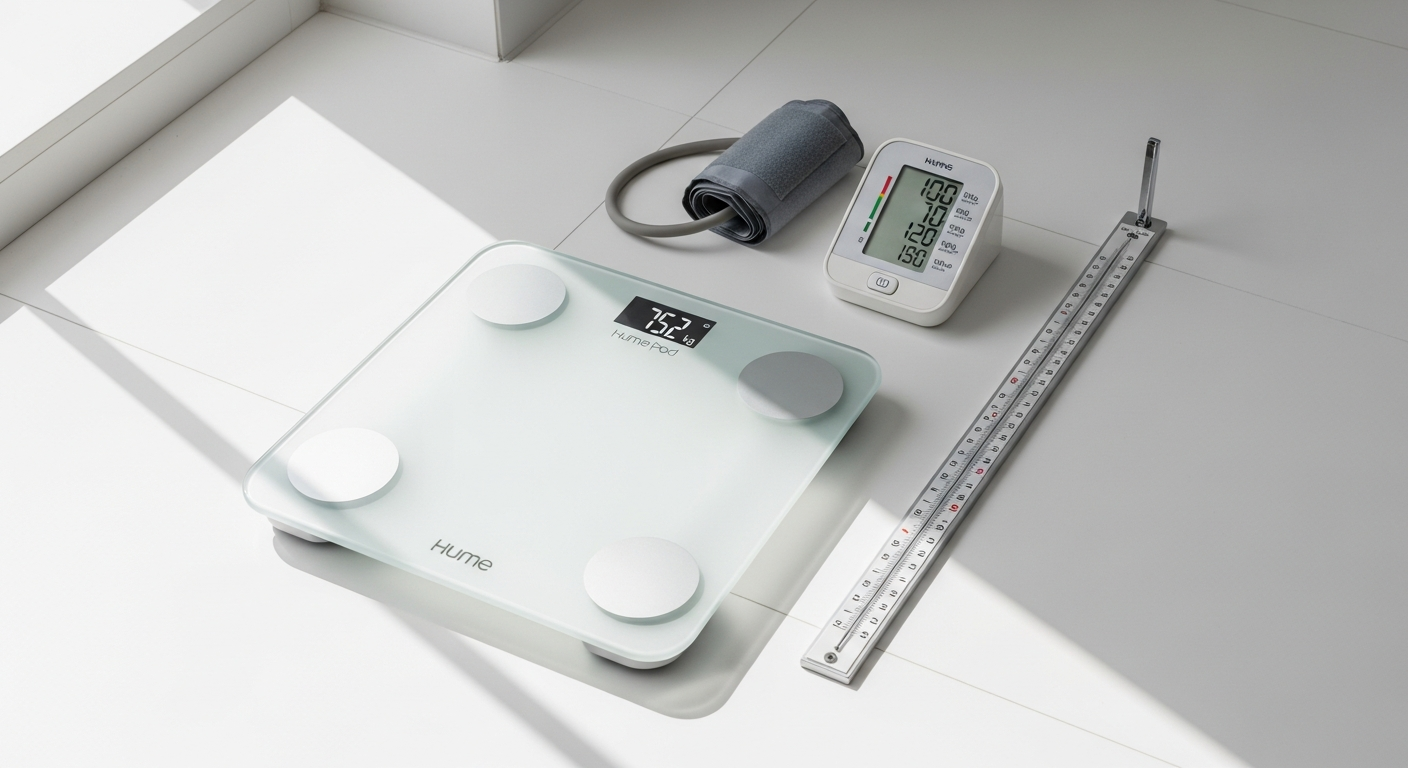
How the Hume Pod Redefines Body Composition Tracking
Most people step on a bathroom scale expecting one number—their weight—but that single metric tells you almost nothing about what’s actually happening inside your body. I’ve watched countless fitness enthusiasts and health-conscious individuals waste time chasing weight loss while their muscle mass plummets and their visceral fat remains dangerously high. The traditional scale is broken, and we all know it.
The Hume Pod Smart Body Composition Scale changes that equation entirely. This device brings the precision of clinical DEXA scans—technology that typically costs hundreds of dollars and requires a trip to a medical facility—directly into your home. What makes this particularly compelling is that it’s become Hume Health DE’s bestselling product, trusted by athletes, biohackers, and everyday people who refuse to settle for incomplete health data.
Discover how the Hume Pod delivers clinical-grade body composition analysis at home.
In this article, I’m breaking down exactly how the Hume Pod achieves its 98% clinical-grade accuracy, what those 45+ health metrics actually mean for your fitness journey, and whether the investment truly delivers compared to traditional body composition testing. You’ll also get honest insights into pricing, app functionality, and real user feedback to help you make an informed decision.
Beyond the Scale: Understanding Full-Body Composition Analysis
How traditional bathroom scales miss critical health data
Traditional bathroom scales operate on a fundamental limitation: they measure only total weight and sometimes estimate body fat percentage using crude algorithms that fail to account for individual variations. These devices cannot distinguish between muscle and fat, water weight and structural changes, or the dangerous visceral fat accumulating around your organs. A person can lose five pounds and believe they’re making progress while actually losing muscle mass and gaining fat—a metabolically damaging scenario that scales never reveal.
The difference between weight measurement and body composition analysis
Weight measurement is a one-dimensional snapshot. Body composition analysis, by contrast, breaks your body into meaningful categories: fat mass, lean muscle, bone density, water content, and protein levels. This distinction matters enormously. Two people at the same weight can have completely different body compositions, different health outcomes, and entirely different fitness trajectories. One might be muscular and metabolically healthy; the other might be carrying dangerous amounts of fat despite the same number on the scale.
Why segmental analysis matters more than lower-body-only readings
Most smart scales measure only through your feet, capturing data from your lower body while missing your torso and arms. The Hume Pod uses a segmental handle measurement system that directly analyzes your torso, arms, and legs separately. This approach matters because fat distribution varies dramatically across body regions. Someone might have healthy leg composition but excess visceral fat around their midsection—a pattern that lower-body-only measurement completely misses and that carries serious cardiovascular implications.
The role of the 8-frequency sensor system in capturing complete body metrics
The Hume Pod employs an 8-frequency sensor system, meaning it sends electrical signals at multiple frequencies through your body. Different frequencies penetrate tissues at different depths and interact with various cellular components. By analyzing responses across eight distinct frequencies, the device builds a multi-dimensional picture of your body composition rather than relying on a single measurement that oversimplifies reality. This technical sophistication is what enables the claimed 98% DEXA-level accuracy.
How 60-second full-body scans compare to manual measurement methods
Clinical body composition testing typically requires manual measurements, skinfold calipers, water displacement tanks, or DEXA imaging—all time-consuming and requiring professional administration. The Hume Pod accomplishes a comprehensive full-body analysis in 60 seconds with no expertise required. You step on the scale, grip the handles, and the device completes a segmental analysis of your entire body simultaneously. This speed doesn’t compromise accuracy; it simply eliminates the friction that prevents people from tracking consistently.
Real-world applications for athletes, fitness enthusiasts, and weight loss tracking
Athletes use body composition data to optimize training—they need to know if their weight gains come from muscle or fat. Fitness enthusiasts tracking progress beyond the scale discover that they’re building muscle while losing fat, a transformation that weight alone would never show. People in structured weight loss programs benefit enormously from seeing visceral fat decrease and muscle preserve, metrics that motivate them far more effectively than watching the scale plateau during muscle-building phases.
The 45 Metrics That Matter: Decoding Your Health Data
Core measurements: body weight, BMI, and body fat percentage
These foundational metrics provide context for everything else. Body weight is the total mass. BMI (body mass index) relates that weight to height. Body fat percentage reveals what portion of your total weight consists of fat tissue. While these alone are insufficient for a complete health picture, they serve as anchor points for understanding your other metrics.
Advanced metrics: visceral fat, subcutaneous fat, and bone density
Visceral fat—the dangerous fat surrounding your organs—correlates directly with metabolic disease risk. Subcutaneous fat lies beneath your skin and generally poses less health risk. Bone density matters profoundly as you age; tracking it helps you identify whether your current lifestyle preserves bone strength or leaves you vulnerable to osteoporosis. The Hume Pod separates these categories, giving you specificity that traditional scales cannot provide.
Muscle-specific tracking: skeletal muscle mass and fat-free body weight
Skeletal muscle mass tells you how much of your body consists of the muscle you can voluntarily move and train. Fat-free body weight includes muscle plus bone, organs, and other non-fat tissue. These metrics reveal whether your training program actually builds muscle or simply burns fat. Someone might lose total weight while gaining muscle and losing fat—something that only detailed metrics can illuminate.
Metabolic insights: basal metabolism, metabolic age, and body age
Your basal metabolic rate (BMR) represents the calories you burn at rest. Metabolic age compares your metabolism to others your chronological age. Body age estimates your physiological age based on health metrics. Together, these reveal whether your lifestyle choices are making you younger or older, metabolically speaking. They provide powerful motivation because improving metabolic age means improving your body’s fundamental functioning.
Water percentage and protein levels for comprehensive nutrition planning
Water percentage indicates hydration status and electrolyte balance. Protein levels reflect your body’s protein stores and serve as a proxy for lean tissue adequacy. These metrics help you understand whether your nutrition supports muscle preservation and recovery or leaves you protein-deficient and dehydrated—factors that dramatically influence fitness results.
Heart health indicators and what they reveal about cardiovascular fitness
The Hume Pod includes heart health metrics derived from your body composition data. Since cardiovascular fitness relates to body composition, metabolic health, and overall physical condition, these indicators provide additional insight into whether your current lifestyle supports or compromises heart health.
How AI-powered coaching interprets these metrics for actionable insights
Raw numbers mean little without interpretation. The Hume Pod’s app uses artificial intelligence to recognize patterns in your metrics, compare your trends over time, and generate personalized recommendations. If your visceral fat increases while skeletal muscle decreases, the app recognizes this pattern and suggests adjustments. If your metabolic age improves, it reinforces the behaviors driving that improvement. This coaching function transforms data collection into behavior change.
Explore the Hume Pod’s advanced metrics and AI-powered coaching features today.
Clinical-Grade Accuracy at Home: The Technology Behind the Numbers
DEXA-level accuracy explained: what 98% accuracy actually means
DEXA (Dual-Energy X-ray Absorptiometry) represents the gold standard for body composition measurement in clinical settings. It uses X-rays at two different energy levels to distinguish bone, fat, and muscle tissue with exceptional precision. When the Hume Pod claims 98% DEXA-level accuracy, it means independent testing found its measurements correlate with DEXA results at 98%—an extraordinarily high correlation that positions it alongside clinical imaging despite its home-use format.
The 8-point electrode system and dual-point contact technology
The Hume Pod uses eight electrodes positioned strategically on its surface. When you step on the scale and grip the handles, you complete eight different electrical circuits simultaneously. This multi-point contact approach, rather than relying on the two-point contact of basic bioimpedance scales, captures vastly more detailed information about tissue composition across your body. Dual-point contact technology specifically enhances precision by measuring from multiple angles and pathways.
How segmental handle measurement provides torso and arm analysis
By incorporating handles that you grip during measurement, the Hume Pod establishes electrical pathways through your upper body. This allows separate analysis of your torso and arms in addition to your legs. Most smart scales miss these regions entirely, making them fundamentally incomplete. The segmental handle system elevates the Hume Pod from a lower-body-only device to a true full-body analyzer.
Comparing Hume Pod precision to clinical body composition testing methods
Clinical methods include DEXA imaging, hydrostatic weighing, air displacement plethysmography, and manual skinfold measurement. DEXA costs $200-300 per session. The Hume Pod costs approximately $352 as a one-time investment, delivering equivalent accuracy and unlimited future measurements. No other at-home device matches the Hume Pod’s accuracy relative to these gold-standard methods.
Why sensor quality directly impacts the reliability of your health data
Cheap bioimpedance scales use basic sensors that misread tissue composition, especially in individuals with unusual body types, high athletic development, or metabolic conditions. The Hume Pod’s 8-frequency sensor system with precise electrode positioning and quality components delivers consistent, reliable readings across diverse body types. Sensor quality directly determines whether your data guides you toward better health or misleads you.
The importance of consistent measurement conditions for accurate tracking
The Hume Pod delivers maximum accuracy when you measure under consistent conditions: same time of day, similar hydration status, no recent exercise, and consistent electrode contact with the handles. The app guides users through optimal measurement protocols. Consistency matters more than absolute perfection because you’re tracking trends; if you measure the same way each time, trend data becomes extraordinarily valuable even if absolute values vary slightly.
Validation studies and third-party accuracy testing
The 98% DEXA-level accuracy claim rests on independent validation studies comparing Hume Pod measurements to clinical DEXA imaging. These studies represent third-party verification rather than manufacturer claims alone, lending credibility to the accuracy figures. The device has undergone rigorous testing to support its clinical-grade claims.
The Mobile App Experience: From Data Collection to Personalized Coaching
Real-time feedback and trend visualization across your health metrics
When you complete a measurement, the Hume Pod app immediately displays your results across all 45+ metrics. More valuably, it visualizes how each metric has trended over days, weeks, and months. You see your visceral fat declining even as your total weight increases—because you’re building muscle. You watch your metabolic age decrease month after month. This visual feedback transforms abstract numbers into a compelling narrative of improvement.
Integration with Apple Health and Google Health ecosystems
The Hume Pod syncs with Apple Health and Google Health, allowing your body composition data to flow into your broader health ecosystem. Other apps and devices you use can access this data, creating a comprehensive view of your health across fitness, nutrition, sleep, and more. This ecosystem integration means the Hume Pod becomes part of a larger health picture rather than remaining isolated.
AI-powered insights: how the app learns from your patterns
The app’s artificial intelligence analyzes your measurement history and identifies meaningful patterns. It notices which lifestyle factors correlate with improvements in specific metrics. Over time, the AI becomes increasingly personalized to your body and your patterns, offering insights increasingly tailored to your unique physiology and circumstances.
Data-driven coaching features and personalized recommendations
Beyond passive tracking, the app actively coaches you. It recommends specific actions based on your metrics and trends. If your protein levels decline, it suggests increasing protein intake. If your visceral fat rises, it recommends specific exercise and nutrition modifications. These recommendations emerge from your actual data rather than generic advice, making them more relevant and actionable.
Tracking progress beyond weight: motivation through comprehensive metrics
Traditional weight tracking produces plateaus that discourage people. The Hume Pod shows you that during a weight plateau, your body composition is transforming: fat decreases while muscle increases. You see your heart health improve, your metabolic age decrease, and your visceral fat decline. These non-weight metrics maintain motivation and accurately reflect actual progress when the scale stalls.
User interface design and ease of navigation
The app features an intuitive interface requiring minimal learning curve. Measurements display prominently, trends visualize clearly, and navigation between different metric categories feels natural. You don’t need extensive app proficiency to extract value from the Hume Pod; the interface supports both casual browsing and detailed analysis.
Mixed reviews on advanced features: what users report about app functionality
Some users report inconsistency with advanced app features. While the core measurement and tracking functionality receives consistent praise, some advanced coaching features or data export capabilities have received mixed feedback. This suggests the app excels at essential functions but occasionally stumbles with more specialized features. For most users, this limitation proves inconsequential; for power users, it warrants consideration.
Pricing, Durability, and Long-Term Value
Standard pricing at $352 versus flash sale pricing at $229
The Hume Pod typically retails at $352, making it one of the more affordable clinical-grade body composition devices available. Hume Health periodically runs flash sales dropping the price to $229, a roughly 35% discount. Waiting for these sales represents a viable strategy if budget constraints matter, though the standard pricing still delivers exceptional value relative to clinical alternatives.
Cost comparison: Hume Pod versus clinical body composition scans
A single DEXA scan costs $200-300. A comprehensive body composition analysis through a clinical setting might run $400-600 initially plus $100-200 for follow-up scans. The Hume Pod investment covers unlimited future measurements for life. After just one or two clinical scans, the Hume Pod pays for itself while providing vastly superior convenience and consistency.
Build quality: tempered glass construction and 400 lbs weight capacity
The Hume Pod features a tempered glass surface offering both durability and aesthetic appeal. The 400-pound weight capacity accommodates essentially all users. The construction quality suggests longevity; users report no durability concerns in available reviews, indicating the device holds up to regular use over years.
Battery life: one year of use on a single lithium-ion charge
The lithium-ion battery provides approximately one year of typical use before requiring a charge. This extended battery life means you’ll rarely think about charging; it simply works until you get a low-battery notification, then you charge it fully and return to months more of operation. This practical convenience eliminates the friction of constant charging that plagues many health devices.
Warranty coverage and the 45-day return policy
The 45-day return policy allows risk-free experimentation. If the Hume Pod doesn’t integrate into your routine successfully or fails to deliver value, you can return it within 45 days. This policy demonstrates manufacturer confidence in the product while protecting your purchase. Warranty coverage details deserve confirmation with the retailer, but the return policy provides substantial protection.
Long-term cost of ownership and replacement considerations
After your initial investment and an occasional battery charge, the Hume Pod incurs minimal ongoing costs. You never pay subscription fees for app access or coaching. You never pay per-measurement charges. It’s a true one-time investment with no hidden ongoing expenses, making the long-term cost of ownership extraordinarily low compared to repeated clinical testing or subscription-based fitness apps.
ROI analysis for different user segments
For someone currently spending $300 annually on personal training, nutrition coaching, and occasional clinical body composition testing, the Hume Pod delivers value within the first year through eliminated clinical testing and enhanced home training efficiency. For athletes currently spending thousands annually on performance optimization, the Hume Pod’s comprehensive metrics justify investment within weeks. For casual fitness enthusiasts, the ROI extends across years but still proves positive if the device sustains motivation and prevents wasted training cycles.
Strengths and Limitations: Honest User Feedback
Strengths: High accuracy, full-body analysis, ease of use, motivational value, free app, accessible price point
The Hume Pod excels across multiple dimensions. Its 98% DEXA-level accuracy matches clinical standards. Its full-body segmental analysis captures what partial-body scales miss. Measurements require no expertise—you step on, grip the handles, wait 60 seconds. The app presents data compellingly, sustaining motivation through comprehensive metrics beyond weight. The app costs nothing; pricing remains accessible. These strengths combine to create an exceptional home health device.
Limitations: Mixed app experiences, 3.9/5 Trustpilot rating, dropshipping concerns, metric interpretation learning curve, app stability issues, limited offline functionality
The Trustpilot rating of 3.9/5 indicates some users encountered problems. Some app experiences reportedly prove inconsistent, with occasional stability issues or advanced features underperforming. New users face a learning curve interpreting 45+ metrics; understanding what improvements mean requires education. Hume Health’s classification as a “Likely Dropshipper” by some sources raises supply chain and support concerns, though this doesn’t directly affect device functionality. These limitations suggest the Hume Pod isn’t universally perfect, though they don’t negate its core strengths.
Who Should Invest in the Hume Pod Smart Scale
Athletes and performance-focused fitness enthusiasts
Athletes benefit enormously from detailed body composition metrics. Knowing body fat percentage, visceral fat, and skeletal muscle mass guides training and nutrition decisions. An athlete can confirm that weight gains represent muscle rather than fat. Progressive tracking across seasons reveals whether training protocols successfully build lean mass. Performance athletes should strongly consider the Hume Pod.
Biohackers and quantified-self practitioners
Individuals committed to detailed self-tracking and optimization thrive with comprehensive metrics. The Hume Pod delivers the granular data that drives biohacking decisions. These users embrace multiple metrics and understand their physiological implications. If you’re already tracking sleep, HRV, glucose, and dozens of other metrics, the Hume Pod becomes an essential addition to your dashboard.
Individuals on structured weight loss programs
Weight loss seekers often experience discouragement when the scale stalls despite genuine progress. The Hume Pod reveals that fat decreases while muscle preserves or increases, showing real transformation where the scale shows nothing. This comprehensive feedback maintains motivation through plateaus that would otherwise trigger program abandonment.
People with metabolic health concerns
Those managing metabolic syndrome, prediabetes, or other metabolic conditions benefit from tracking visceral fat, metabolic age, and related metrics. The Hume Pod provides home-based monitoring that replaces frequent clinical visits while offering more granular trend data.
Fitness professionals and personal trainers
Trainers gain credibility and deliver better results when demonstrating client progress through comprehensive body composition metrics. A trainer showing a client that their weight increased while fat decreased and muscle increased proves training efficacy far more compellingly than a scale. Trainers can recommend the Hume Pod to clients, enhancing client outcomes and engagement.
Health-conscious individuals seeking preventive insights
People committed to long-term health benefit from metrics like visceral fat, bone density, and metabolic age. These measurements provide early warning of metabolic deterioration, allowing preventive intervention before disease develops. Regular measurement becomes part of proactive health management.
Those replacing expensive clinical testing appointments
Individuals currently paying for periodic clinical body composition testing immediately recoup their investment through the Hume Pod. Beyond cost savings, they gain the convenience of measuring at home whenever desired rather than scheduling appointments months in advance.
Users already invested in Apple Health or Google Health ecosystems
If you actively use Apple Health or Google Health for fitness and wellness tracking, the Hume Pod integrates seamlessly, consolidating your health data in your preferred platform. This ecosystem integration multiplies its value.
Setting Up and Maximizing Your Results
Initial setup and app connection process
Setup requires downloading the Hume Pod app, creating an account, and connecting via Bluetooth to the device. The process takes minutes. You select your profile information, calibrate the app to your body metrics, and you’re ready for your first measurement. No complex configuration exists; the app walks you through everything intuitively.
Optimal measurement conditions for consistent readings
Measure at the same time daily if possible, ideally morning before eating or exercising. Maintain consistent hydration—very dehydrated measurements differ from well-hydrated ones. Wear minimal clothing for consistent electrode contact. These protocols ensure your trend data reflects actual body composition changes rather than hydration fluctuations or inconsistent measurement conditions.
Frequency of weigh-ins for meaningful trend data
Daily or every-other-day measurement provides the most meaningful trend data. Measuring less frequently than weekly limits trend visibility. More frequently than daily adds no value and risks obsessive monitoring that undermines mental health. Most users find daily or every-other-day measurement optimal for motivation and trend analysis.
How to interpret metric changes and what they indicate
When body weight increases but body fat percentage decreases, you’re building muscle. When visceral fat increases despite weight stability, metabolic health deteriorates. When metabolic age decreases, your fundamental metabolic function improves. Understanding these interpretations prevents misguided conclusions based on single metrics. The app provides guidance, but understanding the logic behind metrics helps you use them intelligently.
Using coaching insights to inform nutrition and fitness decisions
When the app identifies that your protein intake appears insufficient, increase protein-rich foods. When it indicates excessive visceral fat, incorporate more cardiovascular training and reduce refined carbohydrates. When metabolic age increases, reassess sleep quality and stress management. The coaching transforms data into actionable modifications.
Integrating Hume Pod data with other health tracking tools
Connect the Hume Pod to Apple Health or Google Health, then sync with other apps like MyFitnessPal, Strava, or Whoop. This integration creates a comprehensive health dashboard where body composition data combines with nutrition, exercise, and recovery metrics. The unified view drives more informed decision-making than any single metric source.
Common mistakes that compromise measurement accuracy
Measuring immediately after exercise when you’re dehydrated produces artificially high readings. Measuring while severely sleep-deprived skews metabolic metrics. Inconsistent electrode contact with the handles (loose grip) reduces accuracy. Measuring at wildly different times daily makes trend analysis meaningless. Avoiding these mistakes maintains data reliability and maximizes the value you extract from the device.
The Bottom Line: Is the Hume Pod Worth Your Investment?
The Hume Pod Smart Body Composition Scale represents a genuine shift in how individuals access and understand their health data. You’re getting clinical-grade technology at a fraction of the cost of traditional body composition testing, paired with an intelligent app that transforms raw numbers into actionable insights. The 98% DEXA-level accuracy, full-body segmental analysis, and 45+ tracked metrics deliver the kind of comprehensive health picture that was previously reserved for expensive clinical settings.
That said, the mixed app reviews and 3.9/5 Trustpilot rating suggest this isn’t a perfect solution for everyone. If you’re someone who values deep data analysis, can navigate a learning curve with multiple metrics, and want to move beyond weight-based fitness tracking, the Hume Pod delivers exceptional value. For casual users seeking simple weight monitoring, traditional scales might still suffice.
The real power emerges when you commit to using the device consistently and engaging with the coaching insights. This scale works best for athletes, biohackers, weight loss enthusiasts, and health-conscious individuals who understand that true progress involves much more than a number on a scale. The durability, battery life, return policy, and pricing all support the investment. The minimal ongoing costs mean this device delivers value across years of use.
If that describes you—someone ready to move beyond weight-based fitness tracking toward genuine body composition understanding—the Hume Pod merits serious consideration. Watch for those flash sales dropping the price to $229 if budget constraints apply, but even at standard pricing, the value proposition remains compelling relative to clinical alternatives and inferior home scales.
Get the Hume Pod Smart Body Composition Scale and start tracking your real health metrics today.
Leave a Reply